How Insurers Analyze Police Reports In Texas


Every article on this site is researched by our internal team, reviewed for legal accuracy against current Texas law, and held to State Bar of Texas advertising standards before publication. We do not publish content that overstates outcomes or makes promises about results.
Learn more about our
editorial standards .
Key Takeaways
- Texas insurers treat the CR-3 as a fast-start investigation tool, focusing on the narrative, diagram, citations, and contributing factor codes to frame fault and settlement value.
- Officers have two weeks under Texas Transportation Code § 550.062 to file a crash report, and access rules under § 550.065 often let insurers see the full report before you do.
- If the CR-3 is wrong, order the report early, mark disputed fields precisely, and send the adjuster a written rebuttal with photos, video, witness statements, and medical records.
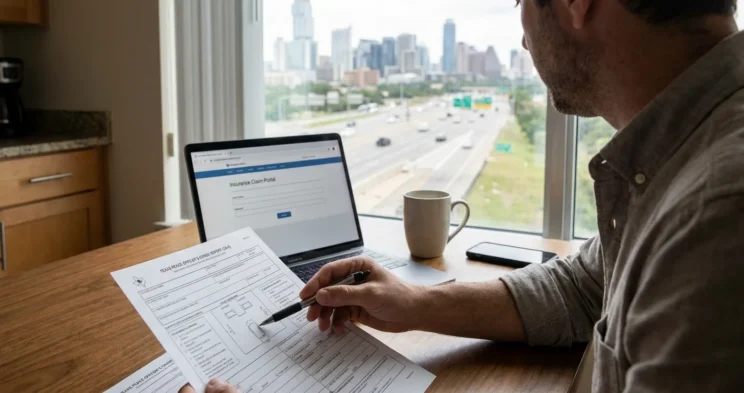
You were rear-ended on the I-35 near downtown Austin two days ago. The other driver’s insurance adjuster already called with a “preliminary” fault assessment, quoting something from the police report. You haven’t even seen the report yet, but the adjuster is talking about “shared fault” and a low offer.
That document is the Texas Peace Officer’s Crash Report, known as the CR-3. Insurers heavily rely on them as a source of evidence, sometimes too heavily.
What Is a CR-3?
A CR-3 is the standard crash report a Texas law enforcement officer completes after investigating a wreck. If you’ve never seen one, a blank PDF version of the official form is available online.
A completed CR-3 typically contains:
- The officer’s observations
- A diagram
- A narrative of events
- Citations
- Coded “contributing factors” pulled from a TxDOT code sheet
How to Get a Copy of a Texas CR-3 Crash Report Online
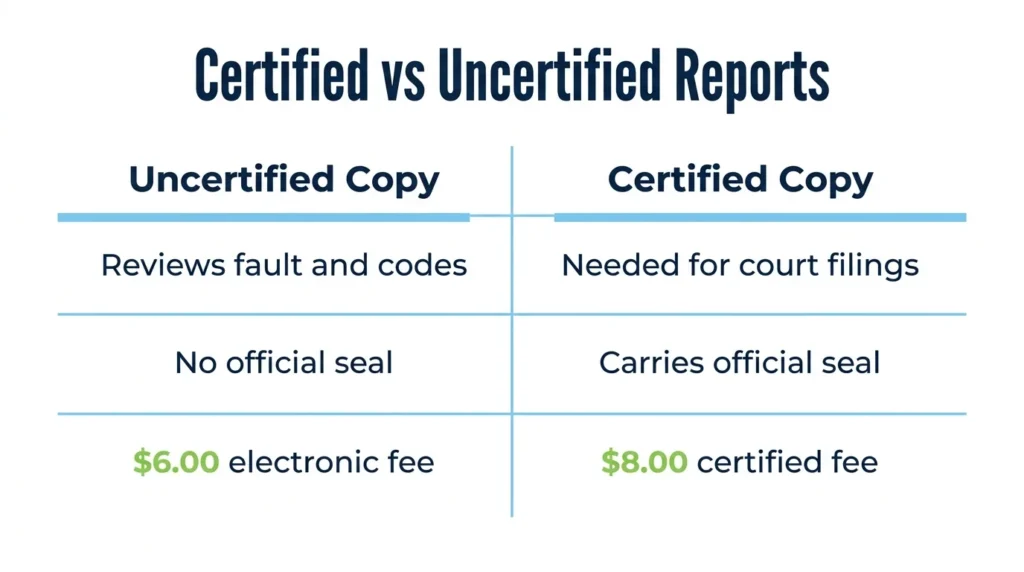
Most Texans involved in a car accident pull their CR-3 through TxDOT’s Crash Records Information System (CRIS). You can search by crash ID, name, location, or date through the TxDOT crash report online purchase system. Electronic reports carry a $6.00 fee, and certified paper copies cost $8.00.
Certified vs. Uncertified Copies
- Uncertified copies are usually enough to review fault, codes, and narrative.
- Certified copies carry an official seal and may matter for formal claims, court filings, or disputes.
Order early. The sooner you have the report, the sooner you can flag errors before the adjuster locks in a position.
When the Report Becomes Available
Texas Transportation Code § 550.062. The statute requires peace officers to submit CR-3 reports within 10 days of the crash. After filing, the report still needs time to appear in CRIS, so do not panic if it is not searchable on day one. It’s not uncommon for the report to take two weeks or more to become available.
Who Can Get the Full Report
Texas Transportation Code § 550.065 governs who receives a redacted version and who receives an unredacted copy. Insurers and parties to the crash typically qualify for the full version, which is one reason adjusters often have the report before you do.
Why the CR-3 Is Not Irrefutable
While a CR-3 is a good starting point for assessing an accident, it is not the final word.
Insurers love the CR-3 because it arrives quickly and looks official. Adjusters use it to set an initial fault theory, open a reserve amount, and frame their first settlement offer.
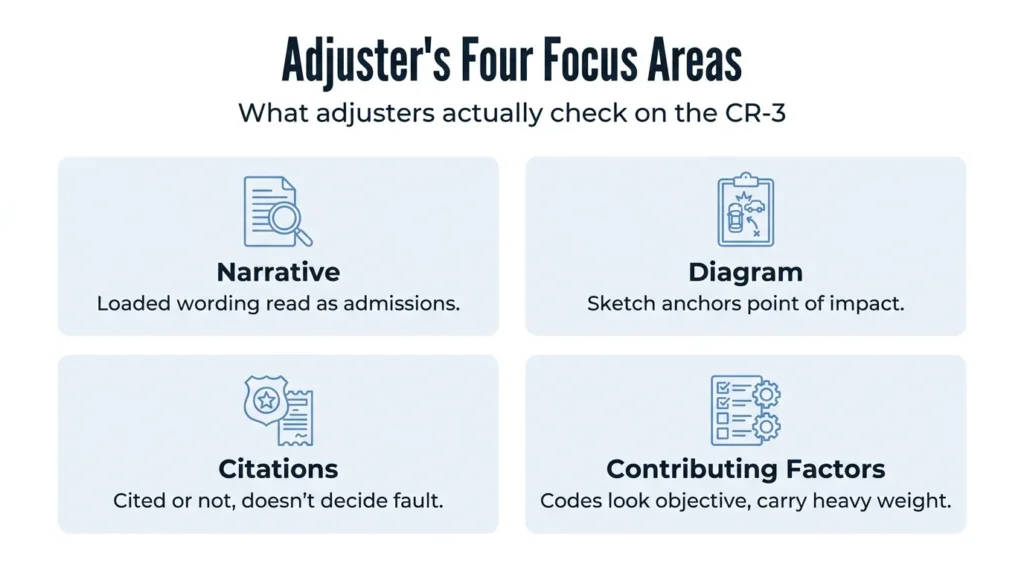
However, adjusters do not read every box. They focus on four areas that translate quickly into fault arguments: the narrative, the diagram, the citations, and the contributing factors.
Additionally, the CR-3’s facts may not be 100% accurate. Officers may arrive after vehicles are moved, hear conflicting statements, or rely on shorthand codes that flatten complex facts.
The numbered codes on the report look objective, which is exactly why they carry weight in negotiation letters. Decode them yourself using TxDOT’s official CR-3 code sheet so you can challenge the meaning, not just the conclusion.
The Narrative: Wording That Becomes “Admissions”
Officers write narratives quickly, often based on partial statements at the scene. Watch for loaded phrases like “failed to yield” or “unsafe speed,” which adjusters quote as if proven.
Look at what the officer personally observed versus what they inferred from a driver’s statement. Photos, dash cam footage, and witness statements can neutralize a narrative that leans on assumptions.
The Diagram: Locking in Point of Impact
The diagram fixes unit numbers, lane positions, travel directions, and impact points. A simplified sketch can become the insurer’s anchor for right-of-way arguments.
Common problems include incorrect lane counts, missing turn lanes, and unclear arrows. If the diagram is wrong, recreate the scene with photos and an annotated map of your own.
Contributing Factors: One Code Can Shift the Negotiation
Contributing factors are numeric entries pulled from the TxDOT code sheet. They look standardized and “scientific,” which makes them persuasive in claim notes.
Push back when a factor is unsupported by measurements, witnesses, or physical evidence. Ask the adjuster what specific evidence supports the code.
Citations: What They Do & Do Not Prove
A citation can influence negotiations, but it is not a complete liability ruling. Adjusters may overemphasize a citation issued to you, or the absence of one issued to the other driver.
Even without a citation, you can build fault arguments from witness statements, video, vehicle damage patterns, and medical timing. Our guide on how police reports impact your case walks through this in more detail.
For commercial vehicle wrecks, the investigation usually goes well beyond the CR-3, which is why our attorneys treat truck accidents reports as one piece of a much larger file.
How Texas Auto Insurers Use the CR-3 to Assign Fault & Value Damages
Insurance companies are businesses. Their goal is to resolve claims for the lowest reasonable payout, and the CR-3 gives them a quick framework to do that.
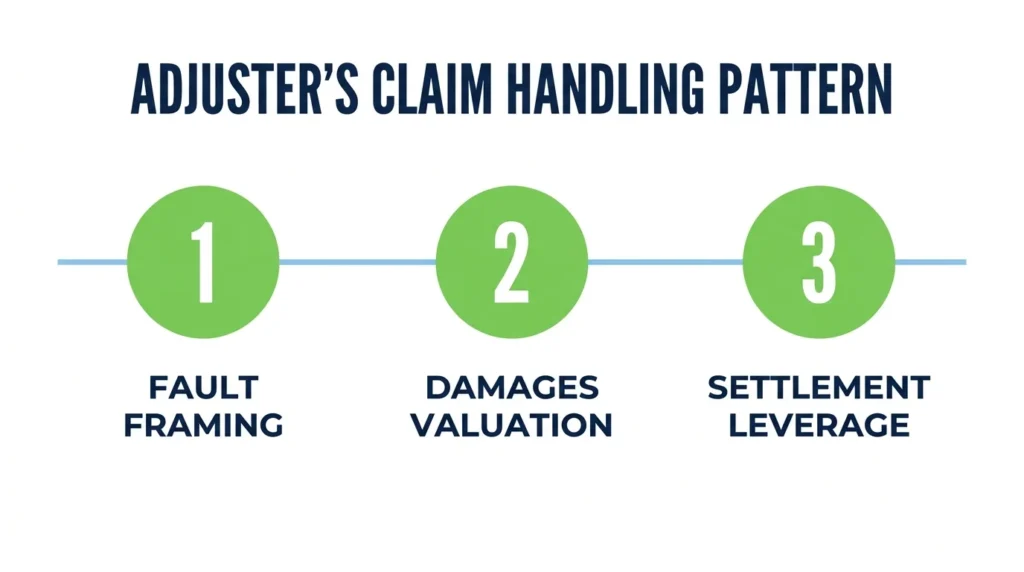
Here is the typical pattern adjusters follow:
- Fault framing. Convert the narrative, diagram, and codes into a one-sentence liability theory.
- Damages valuation. Use the CR-3 injury and damage boxes to set early reserves, even though those boxes rarely capture full medical reality.
- Settlement leverage. Exploit ambiguity (a vague narrative or a generic contributing factor) to argue shared fault and reduce the offer.
You can read more about this pattern in our overview of the insurance investigation process in Texas.
When an adjuster cites a code, ask for the underlying evidence. Measurements? A witness? Video? An admission? If the answer is “it is in the report,” that is a citation to a citation, not actual evidence.
What to Do if the Police Report Is Wrong
Mistakes on a CR-3 are common, especially after a chaotic scene. Accidents are emotionally charged, and officers, despite their training, are human and can make mistakes.
If your report has errors in it, the fix is twofold: try to correct the record, and build a parallel evidence file the insurer cannot ignore.
Correcting vs. Supplementing the Report
Start by contacting the reporting agency to ask about their correction or supplement process. Law enforcement departments will have procedures in place to amend or supplement a report on the official record if the mistake or oversight can be proven.
This means you’ll need to submit a request with hard evidence that verifies your claim beyond any doubt. This might sound difficult, but sometimes all it takes is a well-timed photo from your phone to set the record straight. Keep copies of every request you submit.
If the agency will not amend the report, build your own record. A clean timeline, labeled photos, and witness statements often carry as much weight as the original narrative when packaged properly.
When to Get Legal Help
Some red flags suggest the insurer is leaning on the CR-3 to undervalue your claim:
- A quick denial right after the report drops.
- A “shared fault” argument with no supporting evidence.
- Heavy reliance on one contributing factor code.
- Ignored video, photos, or witness statements.
If an incident involves serious injuries or contested liability, a lawyer can organize evidence, address misreads of the codes and narrative, bring in reconstruction specialists when needed, and handle negotiations directly with the carrier.
Talk to a Texas Car Accident Attorney Who Knows How Insurers Read the CR-3
A CR-3 should inform your claim, not define it. When an adjuster quotes codes and narrative back at you, the right response is evidence, not argument.
At Angel Reyes & Associates, we have over 30 years of experience helping Texas crash victims push back against insurer narratives. We work on a no fee unless we win basis, offer free consultations, and serve clients statewide from more than 20 office locations.
Schedule a free consultation to talk through your CR-3 and your options.
CR-3 Crash Report FAQs
Can a Texas crash report be used in court to prove who caused the wreck?
A CR-3 may be important evidence, but it usually is not treated as the final word on fault because it can include hearsay, shorthand, or an officer’s limited observations. Courts and insurers often look at the report alongside photos, witness testimony, medical records, and other evidence
What information do I need to order a Texas CR-3 report online?
The TxDOT system typically lets you search using details like the crash date, location, name involved, or the crash ID if you have it. Having more exact information usually makes it easier to find the right report and avoid delays.
Can I get a Texas crash report if I was a passenger, not a driver?
Often yes, but access can depend on your relationship to the crash under Texas law and whether you qualify for an unredacted copy. If you do not qualify for the full version, you may still be able to get a redacted report.
Does “no citation issued” mean the other driver was not at fault?
No. Police may decline to issue a ticket for many reasons, and insurance companies can still decide liability based on the full evidence.
What should I review first when my Texas crash report arrives?
Start with names, vehicle information, location, unit numbers, and insurance details, because basic identity or vehicle errors can create problems later in the claim. Then check whether the report matches your photos, medical timeline, and any witness information you have.
About the Authors

Angel Reyes
Writer
Angel L. Reyes, III is the Founder and Managing Partner of Angel Reyes & Associates. A nationally recognized trial attorney and business leader, Angel has helped over 70,000 injury victims recover more than $1 billion since founding the firm in 1993. Named to the Texas Super Lawyers list annually since 2008, Angel brings Wall Street experience, Ivy League education, and a deep commitment to client advocacy. He is a frequent legal commentator and published author with extensive contributions to legal scholarship, trial strategy, and consumer protection.

Kyle Nicolas
Editor
Kyle Nicolas is the Web Content & SEO Manager at Angel Reyes & Associates. He has more than 10 years of experience as a marketing co...

Angel Reyes
Reviewer
Angel L. Reyes, III is the Founder and Managing Partner of Angel Reyes & Associates. A nationally recognized trial attorney and business...