Filing a Claim After a Capital Metro (CapMetro) Bus Accident in Austin


Every article on this site is researched by our internal team, reviewed for legal accuracy against current Texas law, and held to State Bar of Texas advertising standards before publication. We do not publish content that overstates outcomes or makes promises about results.
Learn more about our
editorial standards .
Key Takeaways
- You must give CapMetro written notice of an injury claim within six months of the crash.
- CapMetro recovery is capped at $100,000 per person and $300,000 per single occurrence.
- A CapMetro claim is filed with the agency under government rules, not an outside insurer.
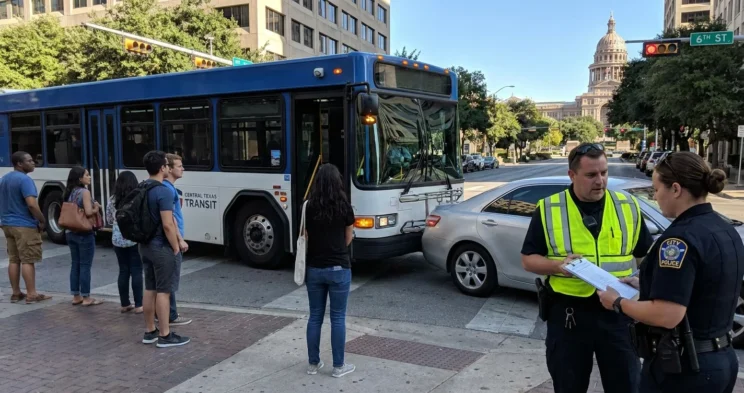
You were stopped at a light on Guadalupe near The Drag when a CapMetro bus changed lanes into your door. The pain set in by the time you got home, and so did the questions. Who do you even call when the bus belongs to the city’s transit agency?
A crash with a CapMetro bus does not follow the path of an ordinary car wreck. The rules are different, the deadline is shorter, and one early misstep can close your compensation door for good.
Why a CapMetro Claim Is Different
A CapMetro claim follows government rules, not the standard insurance process, because Capital Metro is a public agency rather than a private company. That single fact changes your deadline, limits your compensation, and decides who you file with.
CapMetro stands for the Capital Metropolitan Transportation Authority. It is a political subdivision of Texas, organized under Texas Transportation Code Chapter 451. In plain terms, it is a unit of government, and government bodies start with broad protection from lawsuits.
That protection is not absolute. Texas waives it in specific situations through the Texas Tort Claims Act.
The most important waiver for you involves vehicles. Under Texas Civil Practice and Remedies Code (CPRC) § 101.021, a government unit is liable when its employee causes injury while operating a motor vehicle. A CapMetro driver running a bus falls squarely within that rule.
This is why your claim can move forward. The bus driver’s negligence on the job opens the narrow door the law allows.
The rule covers more people than just riders. You can pursue a claim whether you were a passenger on the bus, a pedestrian in a crosswalk, or a driver in your own car when the bus hit you.
What the rule does not cover is just as important. A slip on a wet bus floor or a poorly maintained station may fall outside the motor vehicle waiver, and those claims can be more challenging. The clearest legal path runs through a crash caused by how the bus was driven.
The roads are busier than ever, which raises the odds of these crashes. CapMetro reports about 26.1 million boardings a year, with more than 83,000 weekday boardings as of May 2026. More riders and more buses mean more chances for a collision in heavy Austin traffic.
These crashes tend to happen where buses and other traffic mix closely. A bus pulling away from a stop on Lamar, a turn across a bike lane near campus, or a rear-end at a red light on Congress can all leave you hurt. The setting changes, but the legal path stays the same.
The Six-Month Notice Deadline
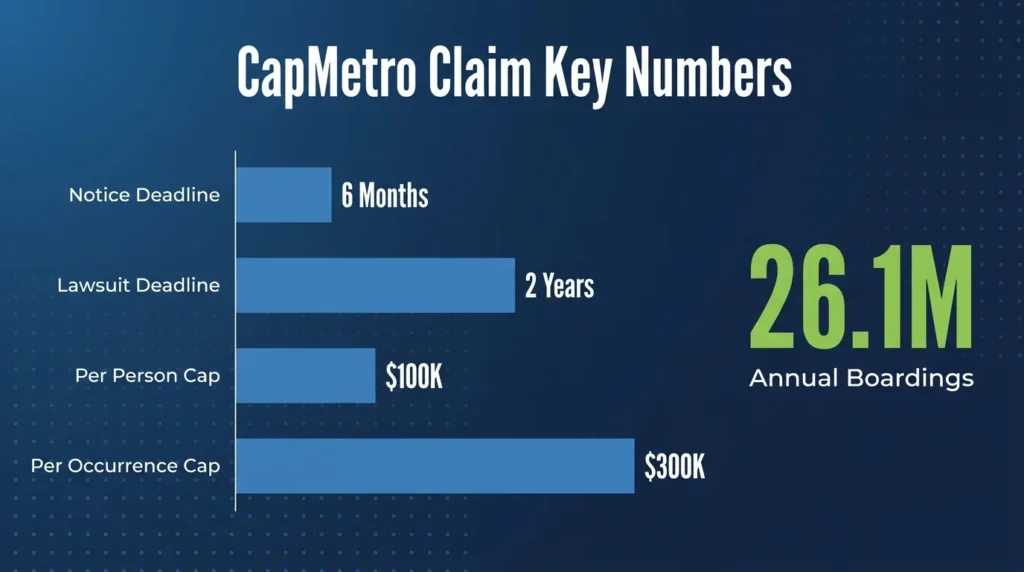
You must give CapMetro written notice of your claim within six months of the crash. This is the single most time-sensitive step, and missing it usually ends your claim before anyone looks at the facts.
The deadline comes from Texas Civil Practice and Remedies Code § 101.101. It applies to CapMetro as a transit authority, so the six-month clock is the window you work against.
A regular car accident gives you two years to sue. A government claim cuts your warning period to a fraction of that, and the clock starts the day of the crash.
The short window exists for the agency’s benefit, not yours. Early notice lets CapMetro investigate while the scene, the bus, and the records are still fresh. Courts enforce the rule strictly, so a strong injury will not save a claim filed even a day late.
Your notice cannot be a quick phone call. It must be in writing, and it has to describe three things:
- The injury or damage you suffered
- The time and place of the crash
- The incident itself and how it happened
Each piece serves a purpose. The agency needs enough detail to find the crash in its records and start its own review. A vague notice can be challenged as defective, so specifics protect you.
There is one narrow exception. If CapMetro already had actual knowledge of the crash and your injury, a court may excuse the formal notice. Relying on that exception is a gamble, because proving what the agency knew is harder than simply filing on time.
Getting the notice right matters as much as getting it in early. An attorney can prepare and serve it correctly.
How to File Your CapMetro Claim
You file your claim directly with CapMetro, not with an outside insurance company, because the agency handles its own liability. There is no third-party adjuster to call the way there would be after a private crash.
That changes who you are dealing with. The agency reviews and decides claims internally, and its goal is to protect public funds. You are negotiating with the same party you are holding responsible.
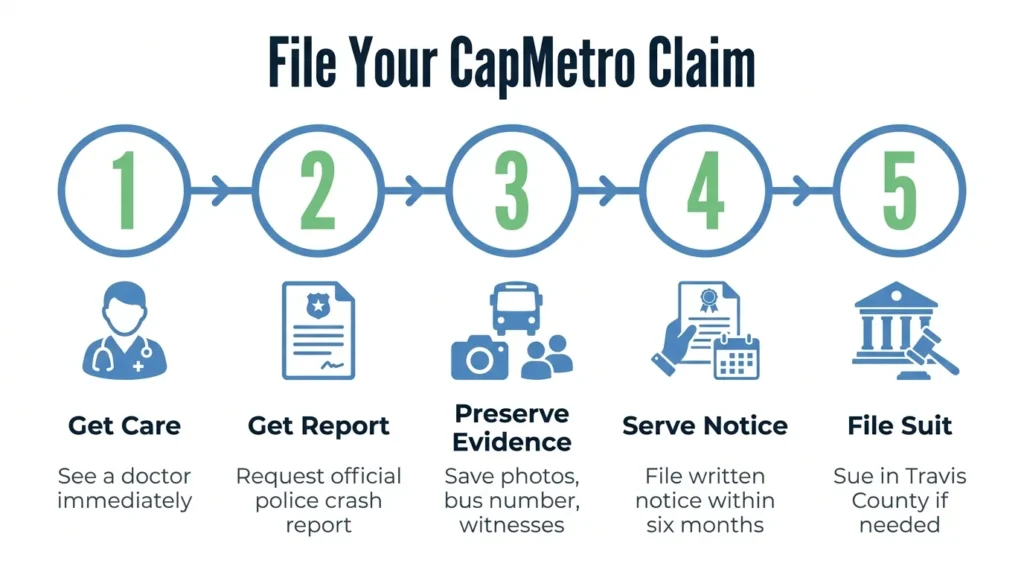
The steps below keep your claim on track from the first week forward.
- Step 1: Get medical care and keep every record. See a doctor right away, even if you feel only sore. Your medical records tie your injuries to the crash and form the backbone of your claim.
- Step 2: Request the official crash report. Austin police or the responding agency will document the collision. That report names the parties, the location, and the early view of fault.
- Step 3: Preserve your own evidence. Save photos of the scene and your injuries, the bus number or route, and the names of any witnesses. This information goes away fast, so collect it while it is fresh.
- Step 4: Serve written notice on CapMetro within six months. This is the legal step that protects your right to recover. The notice must meet the content rules described above.
- Step 5: File suit in Travis County if the claim does not resolve. Travis County district court has jurisdiction over a CapMetro case. Most claims settle before that point, but the option anchors your leverage.
Fault is rarely as simple as one driver. A bus crash can involve the CapMetro operator, the agency itself, and sometimes a third party who shares blame.
Once your notice is in, the claim usually moves into a review and settlement stage. CapMetro evaluates the facts, your medical bills, and its own exposure, then responds with a position on the accident. A documented file gives you far more leverage in those talks.
Expect the process to favor the agency at first. A low early offer is a common tactic, and accepting it ends your right to ask for more money later. Knowing what your injuries are actually worth keeps you from settling too soon.
Damage Caps on a CapMetro Claim
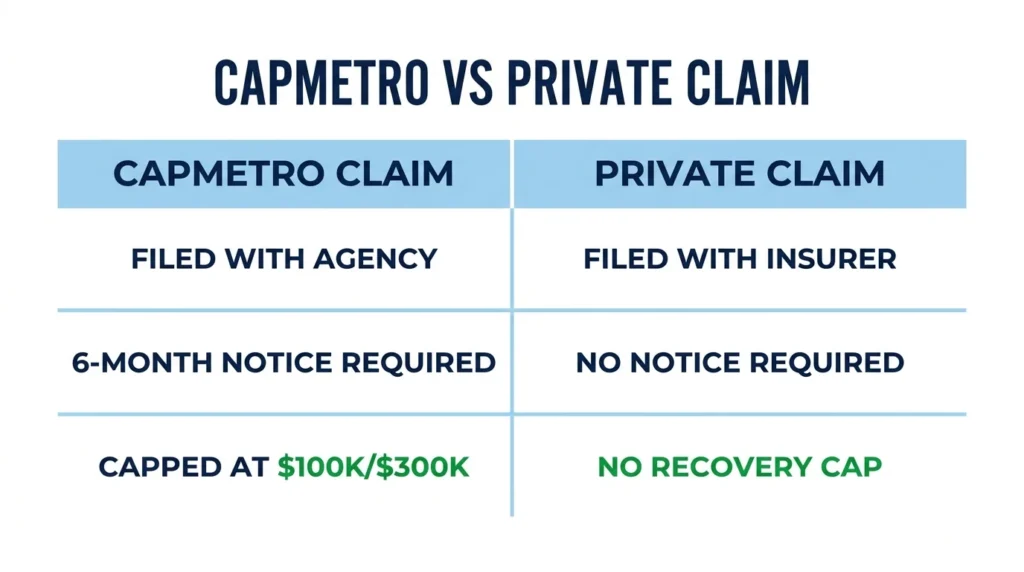
In most cases your recovery against CapMetro is capped at $100,000 per person and $300,000 per occurrence. These limits come from Texas Civil Practice and Remedies Code § 101.023, which sets the ceiling for a unit of local government.
The caps apply no matter how severe your injuries are. A jury could award more, but the law reduces the compensation to the statutory limit.
The two figures work together when several people are hurt. Each injured person can recover up to $100,000, but the total payout for a single crash cannot pass $300,000, no matter how many claimants there are.
Within those limits, you can still claim the same categories as any injury case. Medical bills, lost wages, and pain and suffering all count toward your total. The cap sets the limit, not the kinds of harm you can recover for.
A serious injury can blow past the cap quickly. A single hospital stay and a few months out of work can exceed $100,000 on its own, which is why the limit frustrates so many CapMetro claimants.
Understanding it early helps you plan around it instead of being surprised by it.
These limits look very different from a private claim. A crash with a private bus line or another driver carries no such government cap, which is why identifying the right defendant early shapes the whole case.
A third party can change the math. If a private company or another driver shares fault for the crash, you may be able to recover beyond the government cap against that party. Sorting out every responsible party is part of building a full Texas bus accident claim.
Say a delivery truck ran a stop sign and forced a CapMetro bus to slam into you. The truck company is private, and its insurance carries no government cap. Identifying that party early can be the difference between a capped recovery and full compensation.
Speak With an Attorney Today
A CapMetro claim runs on a short clock and strict rules, and you do not have to sort through them alone. Angel Reyes & Associates has spent over 30 years helping injured Texans hold the right parties accountable, including government bodies. We have even won a verdict against the City of Houston for an injured resident.
We work on contingency, so there is no fee unless we win, and your first consultation is free. We serve all of Texas, including Austin, we are available 24/7, and we have recovered more than $1 billion for clients. Reach out to us for a free consultation before your six-month window closes.
Past results do not guarantee future outcomes.
Filing a Claim After a CapMetro Bus Accident FAQs
Does the same six-month deadline apply if my child was hurt on a CapMetro bus?
Treat the six-month notice deadline as firm even for a minor, since the government notice rule is not tolled the way a child’s two-year lawsuit deadline can be. Serving timely written notice protects the claim regardless of the injured person’s age.
Do these rules also cover a CapMetro MetroRail train crash?
Yes. CapMetro operates the MetroRail Red Line as the same governmental authority, so a train injury follows the same Texas Tort Claims Act notice deadline, claim process, and damage caps.
Is the six-month notice the same as the deadline to file a lawsuit?
No. The six-month notice is an early warning step, while the lawsuit itself generally still must be filed within the two-year personal injury limit. Both deadlines must be met.
What happens if CapMetro denies my claim?
A denial does not end your options. You can still pursue the claim in Travis County district court within the lawsuit deadline, provided you gave proper notice on time.
Do I have to pay upfront to pursue a CapMetro claim?
Many personal injury attorneys work on contingency, meaning they are paid only if you recover. That arrangement lets you pursue a claim without paying legal fees out of pocket while you focus on healing.
About the Authors

Angel Reyes
Writer
Angel L. Reyes, III is the Founder and Managing Partner of Angel Reyes & Associates. A nationally recognized trial attorney and business leader, Angel has helped over 70,000 injury victims recover more than $1 billion since founding the firm in 1993. Named to the Texas Super Lawyers list annually since 2008, Angel brings Wall Street experience, Ivy League education, and a deep commitment to client advocacy. He is a frequent legal commentator and published author with extensive contributions to legal scholarship, trial strategy, and consumer protection.

Kyle Nicolas
Editor
Kyle Nicolas is the Web Content & SEO Manager at Angel Reyes & Associates. He has more than 10 years of experience as a marketing co...

Spencer Browne
Reviewer
Spencer Browne is a partner at Angel Reyes & Associates and a Board Certified personal injury trial lawyer with nearly 100 jury trials a...