How Medical Treatment Affects Your Motorcycle Accident Claim


Every article on this site is researched by our internal team, reviewed for legal accuracy against current Texas law, and held to State Bar of Texas advertising standards before publication. We do not publish content that overstates outcomes or makes promises about results.
Learn more about our
editorial standards .
Key Takeaways
- Unexplained treatment gaps give insurers grounds to argue your injuries were minor or unrelated to the crash.
- Skipping prescribed care can reduce your settlement under Texas proportionate responsibility law.
- Settling before reaching MMI risks leaving future medical costs permanently uncovered.

You were heading home on Mopac when a car cut across your lane and sent you down. You went to the ER that night, followed up with your doctor, and started recovering. Work got busy. You started feeling a little better. So you stopped going.
Now the insurance company is offering you less than you expected. You are wondering if that gap in your medical care has anything to do with it.
Your Medical Records Are Your Evidence
Your medical records document your health status and your case. Every diagnosis, every visit, every prescription creates a paper trail that connects the crash to your injuries and your injuries to the treatment you needed.
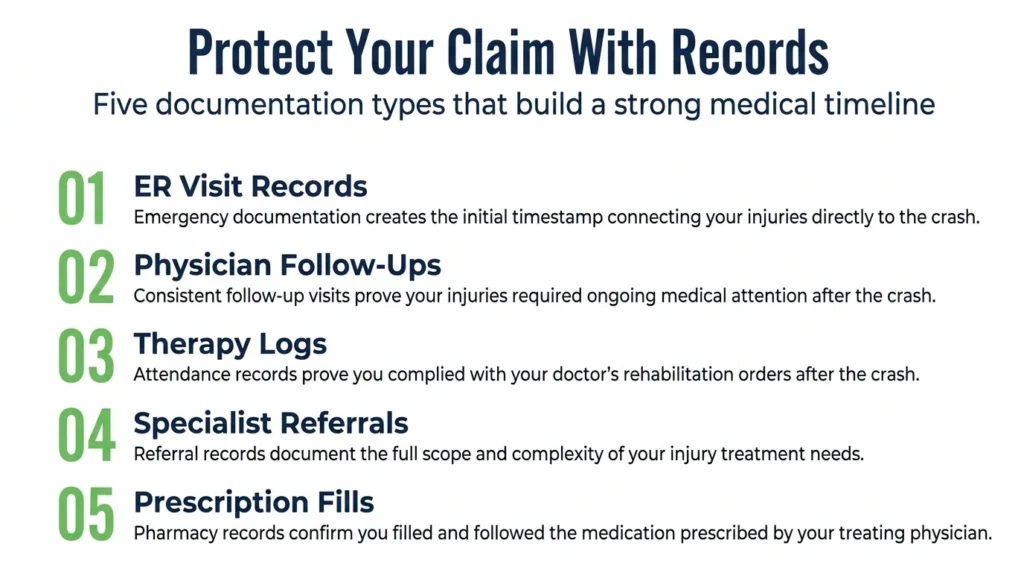
Insurers review that record before they make any offer. They are not reviewing it to help you. They are looking for breaks in care, unexplained gaps, and inconsistencies they can use to argue your injuries were minor or that your current symptoms have nothing to do with the accident.
A complete treatment record gives the insurer fewer opportunities to challenge your claim. Gaps in treatment give them ammunition. Medical treatment is one of the biggest factors that affects the value of a motorcycle accident settlement because it helps prove both the severity of your injuries and the care you needed afterward.
How Treatment Gaps Affect Your Settlement
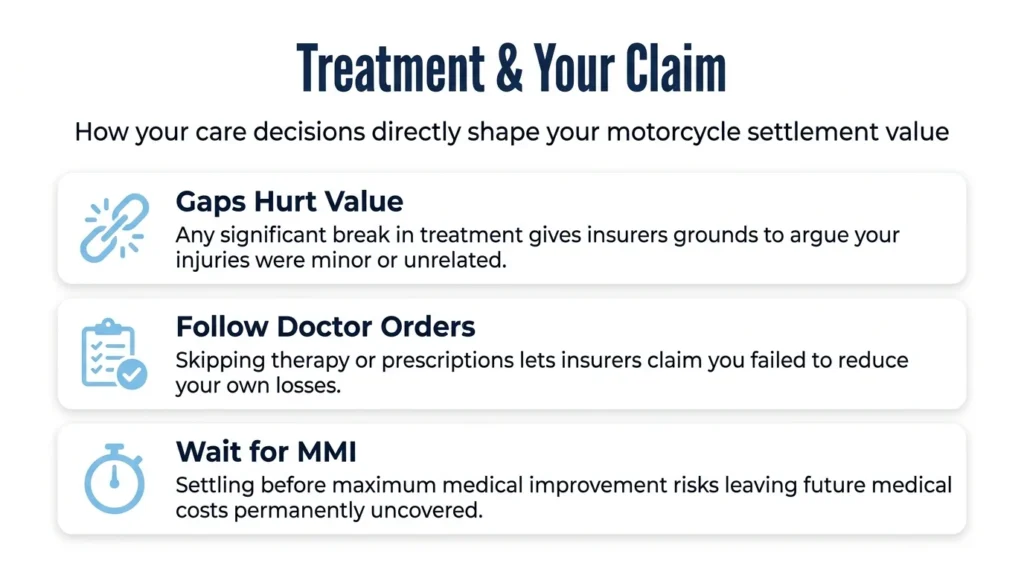
A treatment gap is any significant break between medical visits after the accident. Even a two-week pause can give the adjuster an argument.
Their argument is usually straightforward. If your injuries were severe, you would have continued seeking treatment. If you stopped, they may claim that your condition improved or that something other than the crash caused your ongoing symptoms. Insurers raise these arguments regularly because treatment history is one of the first things they review when evaluating a claim.
Work obligations, transportation issues, insurance problems, and difficulty scheduling appointments can all disrupt your care. If one of those situations applies to you, keep records that explain the delay. Appointment requests, referral paperwork, insurance correspondence, and physician notes can help show why the gap occurred.
Not every pause in treatment hurts your claim. Sometimes your doctor determines that you have reached maximum medical improvement (MMI), which means your condition has stabilized and further recovery is unlikely. At that point, a gap in treatment may reflect the natural end of your recovery rather than a problem with your claim.
Settling before you reach MMI can leave future medical costs uncovered because no one knows yet what permanent effects remain. Before you evaluate any settlement offer, your doctor’s assessment of whether you have reached MMI should be part of that conversation.
If you have received a first settlement offer after a motorcycle accident, checking it against your documented losses before responding can protect you from accepting less than your injuries are worth.
Following Physician Orders & the Duty to Mitigate
Texas law requires injured people to take reasonable steps to reduce their own losses. That common law duty, which insurers argue through Texas’s proportionate responsibility framework under Texas Civil Practice and Remedies Code Chapter 33, is how they claim you made your own injuries worse.
Missing physical therapy appointments, failing to fill a prescription, or skipping a specialist referral can all become part of that argument. The insurer can frame each of these as evidence that you failed to take reasonable steps to recover.
Following your physician’s orders creates documented compliance. Physical therapy attendance logs, pharmacy fill records, and specialist visit notes are all evidence that you did what the medical team told you to do. This is your evidence that any continuing pain or impairment is not the result of your own choices.
Consistent treatment helps connect your injuries to the motorcycle accident and makes it harder for insurers to argue that pre-existing injuries or unrelated medical conditions caused your symptoms.
How Insurers Investigate Your Treatment History
Adjusters do not just review records from after the crash. They pull your full medical history, looking for prior injuries and pre-existing conditions. Their goal is to argue that what you are experiencing now was already there before the accident.
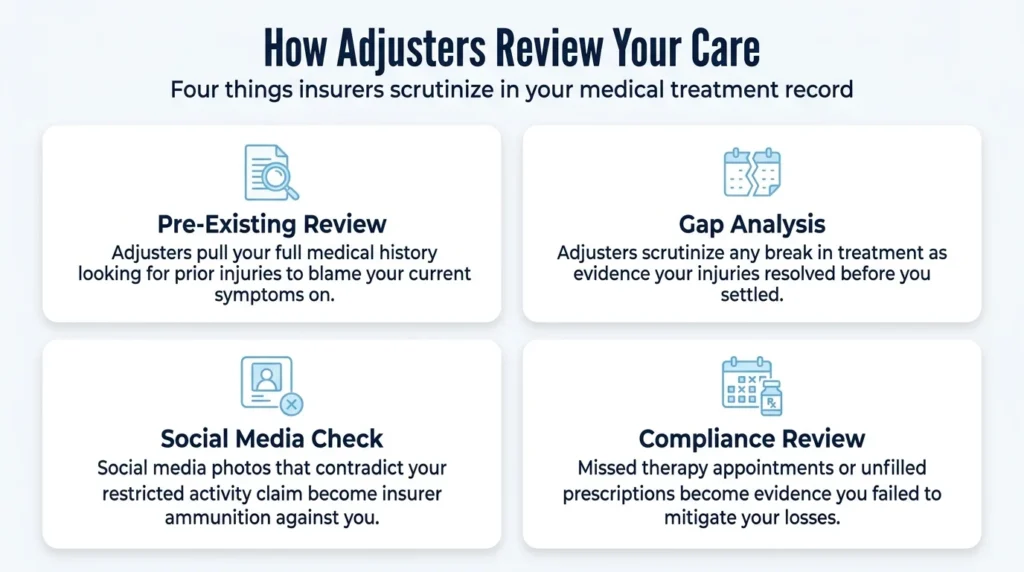
Adjusters check social media alongside your treatment history. If your treatment records reflect restricted activity but your accounts show otherwise, that conflict is ammunition. Insurance companies use underpayment tactics in Texas to close claims for less than they are worth.
A consistent treatment record combined with careful social media awareness helps counter that argument. When you seek medical care shortly after the crash and continue treatment as recommended, your records create a timeline that connects the accident to your injuries. That timeline becomes much harder to challenge when doctors document your symptoms, treatment, and recovery at each stage.
Talk to an Attorney Before Your Claim Is Final
Treatment gaps and documentation gaps are two of the fastest ways for an insurer to reduce the value of a motorcycle accident claim. Whether you have a complete record or a complicated one, understanding how it affects your position before you accept any offer can make a significant difference in what you ultimately receive.
Angel Reyes & Associates has helped injured Texans through situations like this for over 30 years. We can review how your medical record affects your claim, explain what your options are, and make sure you are not walking away from compensation you are entitled to. Our consultations are free, and we do not charge a fee unless we win.
Reach out to schedule a free consultation to discuss your situation with our motorcycle accident team.
Medical Treatment FAQs
What is a letter of protection, and can it help if I can't afford treatment?
A letter of protection (LOP) is an agreement between your attorney and a medical provider that guarantees the provider will be paid from your settlement once the case resolves. It allows you to receive ongoing care without paying out of pocket while your claim is still open.
Does standard Texas PIP insurance cover motorcycle accident injuries?
Standard personal injury protection (PIP) on a Texas auto policy typically does not cover injuries sustained on a motorcycle unless you added separate motorcycle-specific coverage. If you were injured on your bike, check your policy or speak with your insurer to confirm what medical coverage applies.
What should I do if I already have a gap in my treatment?
If you already have a gap, document the reason for it as clearly as possible, whether that was a cost issue, a scheduling problem, or a belief that you had recovered. Return to care if your physician recommends continued treatment. A documented reason is easier to defend than an unexplained absence from care.
Can I choose my own doctor after a motorcycle accident in Texas?
Yes. You are not required to see a doctor chosen by the insurance company. Seeing your own physician and following their recommended course of treatment is both allowed and beneficial for your claim, as it keeps the treatment narrative in your hands.
Will the insurance company pay for future medical treatment?
Future medical expenses may be recoverable if your doctor believes you will need additional care after your claim resolves. Medical records, treatment plans, and expert opinions often help establish the cost of future treatment needs.
About the Authors

Angel Reyes
Writer
Angel L. Reyes, III is the Founder and Managing Partner of Angel Reyes & Associates. A nationally recognized trial attorney and business leader, Angel has helped over 70,000 injury victims recover more than $1 billion since founding the firm in 1993. Named to the Texas Super Lawyers list annually since 2008, Angel brings Wall Street experience, Ivy League education, and a deep commitment to client advocacy. He is a frequent legal commentator and published author with extensive contributions to legal scholarship, trial strategy, and consumer protection.

Kyle Nicolas
Editor
Kyle Nicolas is the Web Content & SEO Manager at Angel Reyes & Associates. He has more than 10 years of experience as a marketing co...

Angel Reyes
Reviewer
Angel L. Reyes, III is the Founder and Managing Partner of Angel Reyes & Associates. A nationally recognized trial attorney and business...