How to File an Uber Accident Claim in Texas


Every article on this site is researched by our internal team, reviewed for legal accuracy against current Texas law, and held to State Bar of Texas advertising standards before publication. We do not publish content that overstates outcomes or makes promises about results.
Learn more about our
editorial standards .
Key Takeaways
- Report your Uber crash in the app the same day to open the official incident file.
- Uber's $1 million policy applies once your driver accepts the ride through drop-off.
- Texas gives you two years from the injury date to file an Uber accident lawsuit.
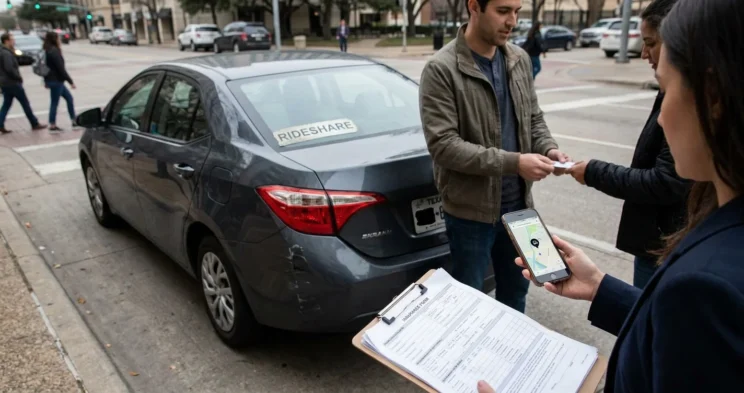
You were in the back of an Uber heading home from a late dinner in Deep Ellum when another driver ran a red light and slammed into your door. Your neck hurts, the police are taking statements, and Uber is asking for details through the app. Now you’re left wondering what happens next. What do you actually do to protect your right to compensation?
Report Your Uber Crash Right Away
The steps to take in the first hours after a rideshare accident can shape your entire Uber accident claim process. Move through the following steps carefully to begin.
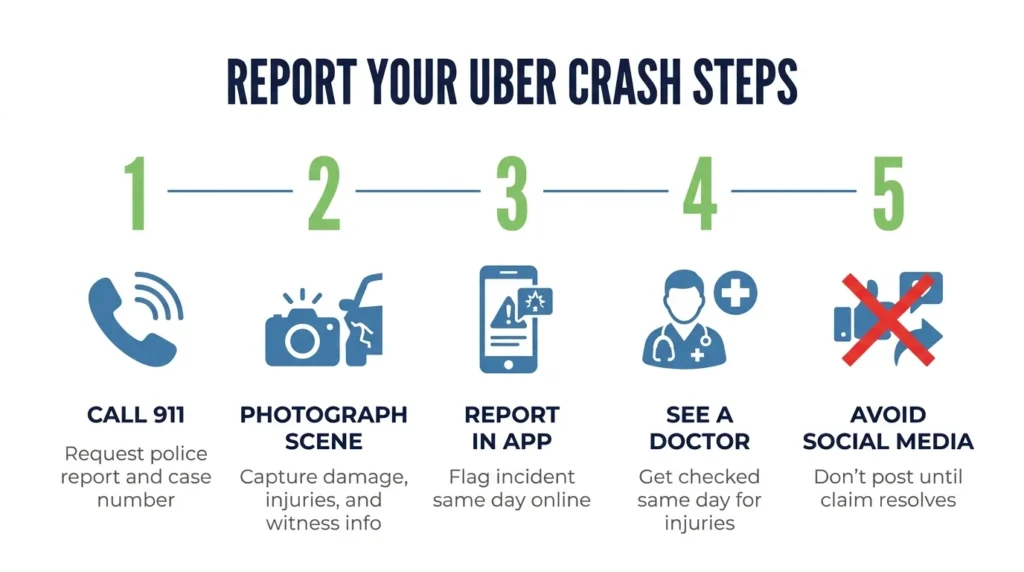
Step 1: Call 911 and request a police report. Officers will document the scene and assign a report number. Uber’s insurer requires that number, so get it before you leave.
Step 2: Photograph everything at the scene. Capture vehicle damage, your visible injuries, and the Uber driver’s information screen inside the app. Collect names and phone numbers from any witnesses while they are still standing there.
Step 3: Report the crash through the Uber app. Open the safety reporting feature and flag the incident the same day. This opens the official incident file on Uber’s side, and the company explains what to do after a crash on its safety pages.
Step 4: See a doctor that day. Get checked even if your injuries feel minor. Delayed treatment creates gaps that insurers use to argue you were not really hurt. Some injuries do not show their full symptoms right away, and early medical records help connect those injuries to the crash.
Step 5: Stay off social media. Do not post about the crash until the claim resolves. Insurance companies often review public social media profiles and look for anything they can use to dispute your injuries.
Uber’s Insurance Coverage by Period
The driver’s app status determines which insurance policy applies after a crash. Uber divides coverage into three periods, each with different coverage limits. Uber explains its rideshare insurance structure in its driver resources, but understanding the driver’s status at the moment of impact is often what matters most for your claim.
Period 1 Coverage (App On, No Ride Accepted)
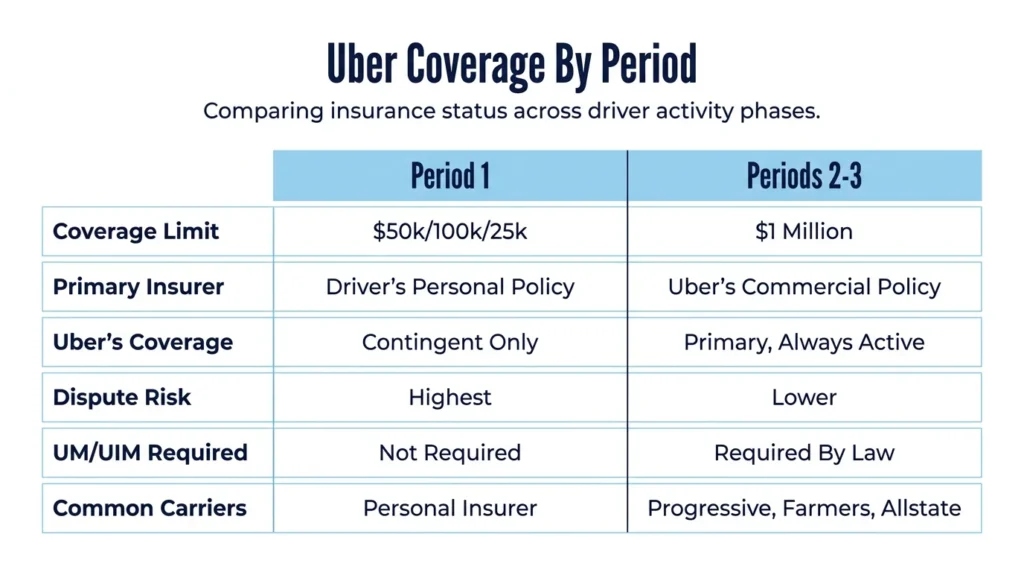
When the driver has the app on but has not yet accepted a ride, Uber’s coverage is contingent and lower. The limits are $50,000 per person, $100,000 per accident, and $25,000 for property damage.
The driver’s personal auto policy applies first. Uber’s contingent coverage only becomes available if the personal policy does not cover the loss. Because many personal auto policies exclude rideshare activity, claims often rely on Uber’s coverage during this period.
Period 1 crashes generate more disputes than any other type of rideshare claim. Document the driver’s app status as soon as possible, as Uber’s coverage may not apply if no one can show the app was active at the time of the crash.
Periods 2 & 3 Coverage (Ride Accepted Through Drop-Off)
Once the driver accepts your ride and until you are dropped off, Uber’s $1 million primary commercial liability policy is active. This is the strongest coverage available, and it applies to everyone injured during your trip.
During these periods, Uber’s commercial insurer handles the claim. The specific carrier may vary, so confirm which carrier is managing your claim through Uber before you start submitting records or communicating with an adjuster. Progressive is commonly involved in Texas, though Farmers, Allstate, and other carriers have administered Uber policies.
Texas law also requires uninsured and underinsured motorist coverage during these periods. That coverage can help protect you if the at-fault driver has no insurance or does not carry enough coverage to pay for your injuries. The same rules for rideshare insurance coverage periods apply to Lyft drivers.
File Your Claim with Uber’s Insurer
Filing an injury claim requires more than reporting the crash through the Uber app. You must also open a claim with the insurer handling your trip. After you report the crash through the Uber app, Uber will generate a case number and identify the insurer handling your claim. Keep that case number handy because you will use it throughout the claims process.
Before you contact the insurer, gather the documents that support your claim. Start with the police report, medical records and bills, scene photographs, the Uber trip receipt, any proof of lost wages, and your communications with Uber about the crash.
Once you open the claim, the insurer will assign an adjuster and begin investigating the crash. The adjuster may request additional records, ask questions about your injuries, or seek a recorded statement. Consider speaking to a rideshare accident attorney before you agree to give a statement. In some cases, a recorded statement could quietly lower your settlement for an Uber accident.
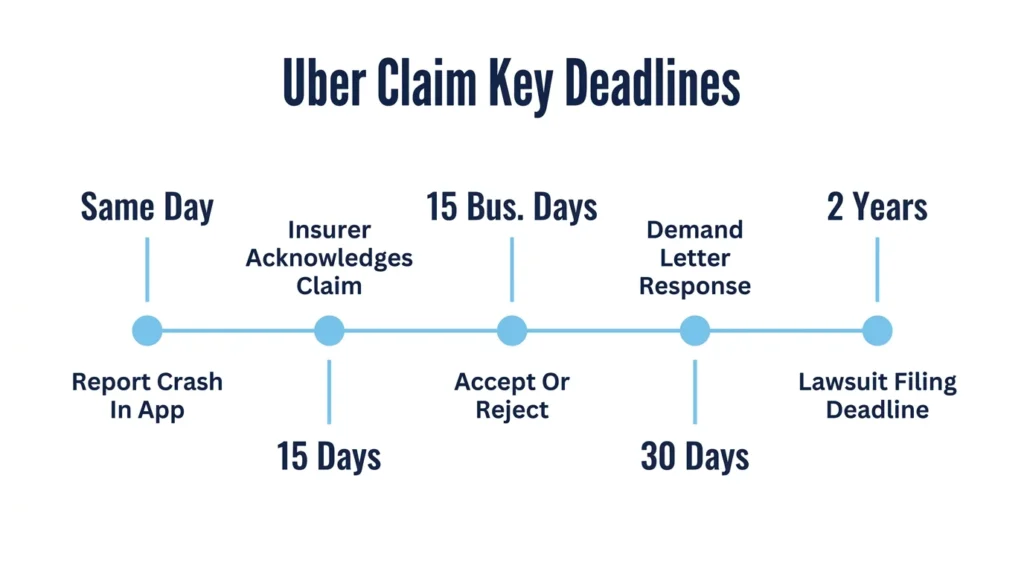
Texas law also requires insurers to respond within specific deadlines. Under Texas Insurance Code Chapter 542, the insurer must acknowledge your claim within 15 days and accept or reject it within 15 business days of receiving everything it needs. When an insurer misses those deadlines without a valid reason, it can owe an 18% annual interest penalty on the claim.
Prepare & Send a Demand Letter
Your demand letter is where you formally tell the insurer what happened and what you expect. It lays out the facts of the crash, the coverage period and policy that applies, a full accounting of your damages, and a specific dollar amount you are demanding.
Attach every piece of supporting proof to the letter. That means your medical records and bills, wage verification, any expert opinions, and documentation of future treatment costs your injuries will require.
Set a clear response deadline in the letter, usually 30 days. Insurance Code Chapter 542 still governs how quickly the insurer must respond once it has your complete package. Commercial insurers almost always start with an offer below the claim’s actual value. The demand letter opens a negotiation, not a final number.
You also have a hard deadline of your own. Texas Civil Practice and Remedies Code (CPRC) § 16.003 gives you two years from the date of injury to file a personal injury lawsuit. Miss that window, and your right to recover is likely gone no matter how strong your case is.
Talk to an Attorney About Your Case
A rideshare claim runs through layered insurance, strict deadlines, and an adjuster whose job is to pay as little as possible. You do not have to manage all of that alone while you are trying to heal.
Angel Reyes & Associates has guided injured Texans for over 30 years, including people hurt in rideshare and car accident crashes across the state. We work on a no-fee-unless-we-win basis, offer a free initial consultation, and have recovered more than $1 billion for clients over the years.
We are available 24/7 and serve the entire state of Texas, so help is ready whenever you need it. When you are ready to understand your options, reach out to us for a free consultation so we can review where your claim stands. You can also see what our clients say about working with us or learn more about our team and history.
Past results do not guarantee future outcomes.
Uber Accident Claim FAQs
How long does an Uber accident claim take to settle in Texas?
Simple claims with clear liability can settle in a few months, while serious injury cases involving negotiation or litigation often take a year or longer. Injury severity, how quickly you complete medical treatment, and the insurer’s responsiveness all affect the timeline.
What happens if Uber's insurer denies my claim?
A denial is not final. The insurer must give you a written reason, and you can demand reconsideration, file a complaint with the Texas Department of Insurance, or take the case to court if the denial does not hold up under Texas Insurance Code Chapter 542.
Can I still file an Uber accident claim if I did not report it through the app right away?
Yes. Late in-app reporting does not bar your claim, but it can complicate it. Use other documentation, such as the police report, medical records, and trip receipts, to establish the facts and the active ride period.
Does my health insurance cover medical bills from an Uber accident while the claim is pending?
Your health insurance can pay your medical bills upfront while the liability claim works through the process, so you are not left waiting on treatment. What they pay may need to be reimbursed from your settlement under a process called subrogation.
Can a pedestrian or cyclist hit by an Uber vehicle file a claim against Uber's insurance?
Yes. If the Uber driver was on an active trip when the crash occurred, the $1 million commercial liability policy also covers people outside the vehicle. The same coverage period rules apply, so confirming the driver’s app status at the time of impact matters for any third-party claim.
About the Authors

Angel Reyes
Writer
Angel L. Reyes, III is the Founder and Managing Partner of Angel Reyes & Associates. A nationally recognized trial attorney and business leader, Angel has helped over 70,000 injury victims recover more than $1 billion since founding the firm in 1993. Named to the Texas Super Lawyers list annually since 2008, Angel brings Wall Street experience, Ivy League education, and a deep commitment to client advocacy. He is a frequent legal commentator and published author with extensive contributions to legal scholarship, trial strategy, and consumer protection.

Kyle Nicolas
Editor
Kyle Nicolas is the Web Content & SEO Manager at Angel Reyes & Associates. He has more than 10 years of experience as a marketing co...

Spencer Browne
Reviewer
Spencer Browne is a partner at Angel Reyes & Associates and a Board Certified personal injury trial lawyer with nearly 100 jury trials a...