


Understanding How Weather Impacts Liability in Car Accidents
When rain pounds the windshield, fog reduces visibility to mere feet, or unexpected ice slicks the roadway, accidents become more likely.
But here’s what many Texas drivers don’t realize: bad weather doesn’t give anyone a free pass on liability. The driver who rear-ends you in a rainstorm can’t simply blame the weather and walk away.
Texas law still holds drivers accountable for accidents, even when Mother Nature complicates driving conditions.
The confusion around weather liability stems from a common misconception that weather-related accidents are “Acts of God” beyond anyone’s control.
Insurance companies love to reinforce this myth, especially when it helps them deny or reduce claims. The legal reality is far different.
Texas law requires all drivers to adjust their behavior based on conditions.
Failing to slow down in rain, increase following distance in fog, or avoid driving on known ice makes drivers legally responsible for resulting crashes.
Texas Law on Reasonable Driving for Weather Conditions
Texas law establishes clear expectations for drivers facing adverse weather. The Texas Transportation Code doesn’t excuse accidents because of rain, fog, or other conditions.
Instead, it requires drivers to exercise reasonable care appropriate to the circumstances, including weather conditions.
The Legal Standard That Applies
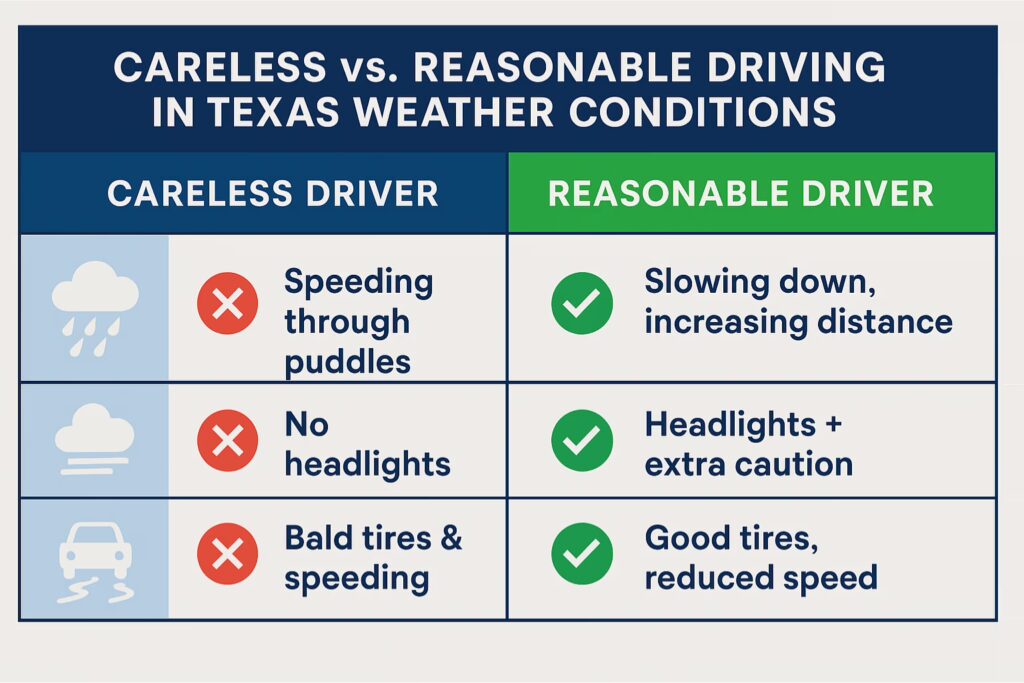
Under Texas law, “reasonable care” adapts to conditions. What’s reasonable on a sunny day becomes reckless during a thunderstorm.
This flexible standard means drivers must reduce speed below posted limits when weather demands, increase following distances based on visibility and road conditions, use appropriate lighting and safety equipment, and sometimes avoid driving entirely in extreme conditions.
Courts evaluate whether a driver’s behavior was reasonable by considering what an ordinarily prudent person would do under similar circumstances.
This objective standard prevents drivers from claiming they thought their behavior was safe when clearly it wasn’t.
The driver going 70 mph in heavy rain can’t defend themselves by saying they felt comfortable at that speed.
Common Texas Weather Hazards
Texas’s diverse climate creates various hazardous driving conditions throughout the year.
Heavy rainfall causes the most weather-related accidents, especially during spring storms and hurricanes. Water accumulation leads to hydroplaning, where vehicles lose contact with the road surface.
Sudden downpours reduce visibility and extend stopping distances dramatically.
Fog presents unique challenges, particularly in coastal areas and during temperature transitions.
Dense fog can reduce visibility to near zero, making pile-ups more likely on highways. Morning fog catches many commuters off guard, leading to speed-differential accidents when some drivers slow appropriately while others maintain highway speeds.
Ice and freezing rain might be less common than in northern states, but Texas ice storms create particularly dangerous conditions because many drivers lack experience with icy roads.
Black ice forms invisibly on bridges and overpasses, catching even careful drivers by surprise. The relative rarity of ice makes these conditions especially deadly when they occur.
High winds during storms can push vehicles out of lanes, especially high-profile vehicles like trucks and SUVs. Crosswinds on bridges and open highways require constant steering corrections and reduced speeds to maintain control.
How Texas Modified Comparative Negligence Applies
Texas follows a modified comparative negligence system under Civil Practice and Remedies Code Chapter 33 that significantly impacts weather-related accident claims.
This system determines how fault is shared between parties and what compensation injured victims can recover.
Weather-Specific Fault Scenarios
Real-world applications show how weather affects fault distribution without eliminating it.
Consider a multi-vehicle pile-up in fog. Each driver’s individual actions determine their fault percentage.
The driver who enters a fog bank at highway speed bears significant fault, even if they weren’t the first collision.
Drivers who could have avoided the pile-up by pulling off the road might share some responsibility.
Weather provides context but doesn’t eliminate individual accountability.
Insurance Company Weather Defense Tactics
Insurance companies aggressively use weather to manipulate fault assignments in their favor. They argue that weather was the sole cause, making accidents unavoidable.
They claim their insured driver couldn’t have driven any more carefully given conditions. They exaggerate your contribution while minimizing their insured’s fault.
Common tactics include focusing interviews on weather severity rather than driver behavior, cherry-picking evidence that emphasizes conditions over specific negligent acts, and using generic weather data rather than location-specific conditions.
They’ll request recorded statements hoping you’ll inadvertently accept blame by discussing weather rather than the other driver’s specific failures.
Building Strong Evidence for Weather-Related Accidents
Success in weather accident claims depends on gathering compelling evidence that shows specific driver negligence despite weather conditions.
Knowing what evidence matters and how to preserve it protects your rights from the moment of impact.
Critical Scene Documentation
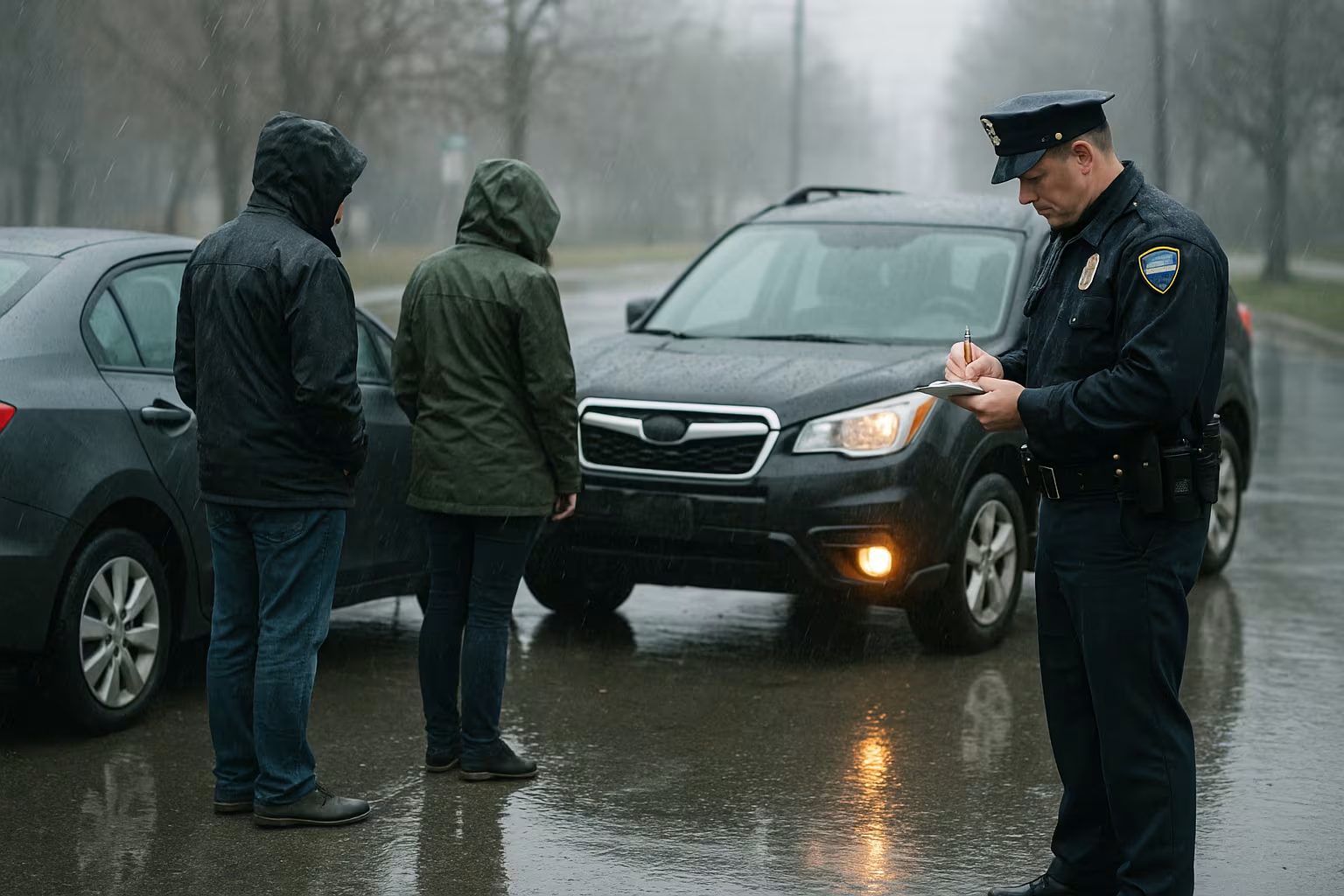
Time-sensitive evidence often determines weather accident outcomes. At the scene, photograph road conditions including standing water, ice patches, or visibility markers.
Capture multiple angles showing both specific hazards and overall conditions. Video recordings can document rain intensity or fog density that photos miss.
Witness information proves especially valuable in weather cases. Witnesses can testify about specific driver behaviors before impact, relative speeds in conditions, and safety equipment usage.
Their observations often contradict insurance company narratives about unavoidable weather accidents.
Weather Data and Official Records
Official weather data provides objective evidence countering insurance company exaggerations. Obtain National Weather Service records showing exact conditions at your accident time and location.
These include precipitation amounts, visibility measurements, wind speeds, and temperature readings.
Local weather station data often provides more specific information than regional reports. Time-stamped data matching your accident proves actual conditions rather than general weather patterns.
Road condition reports from TxDOT document known hazards, construction impacts on drainage, and whether authorities issued warnings.
Technology That Proves Your Case
Modern vehicles and devices create powerful evidence for weather accident cases. Dashboard cameras capture real-time footage of conditions and driver behaviors.
This objective evidence often contradicts insurance narratives about unavoidable weather accidents. Footage showing the at-fault driver’s excessive speed or unsafe following distance in conditions proves negligence.
Expert Analysis for Complex Cases
Weather accidents often benefit from expert analysis to counter insurance company arguments.
Accident reconstructionists can determine actual vehicle speeds, following distances, and whether driver actions were reasonable for conditions.
They use physical evidence to show what happened versus what insurance companies claim.
Common Weather Accident Types and Liability Patterns
Understanding how courts typically assign fault in specific weather scenarios helps set realistic expectations and identify strong arguments for your case.
Rear-End Collisions in Rain
Rear-end accidents during rainfall represent the most common weather-related crashes in Texas.
Despite wet conditions, the rear driver typically bears primary liability for failing to maintain safe following distance.
Texas law requires distances that allow stopping even with reduced traction.
The following driver’s common excuses fail under legal scrutiny.
“I couldn’t stop in time because of the rain” simply admits following too closely for conditions.
“The car ahead braked suddenly” doesn’t excuse inadequate following distance.
“I couldn’t see well” admits failing to adjust speed for visibility.
However, front drivers can share fault by brake-checking, cutting in front without adequate space, driving without working brake lights, or stopping suddenly without cause.
Weather increases the importance of gradual speed changes and clear signaling.
Multi-Vehicle Fog Accidents
Chain reaction accidents in fog create complex liability scenarios. Each driver’s individual actions determine their fault percentage.
The analysis considers whether drivers reduced speed appropriately for visibility, used proper lighting including fog lights and hazards, maintained safe following distances, and pulled off when conditions became too dangerous.
Texas courts recognize that fog usually develops gradually, giving drivers time to adjust. Entering a known fog bank at high speed shows clear negligence.
Drivers who could have avoided the pile-up by defensive positioning share fault. The first impact doesn’t excuse subsequent collisions by drivers who failed to adjust for conditions.
Hydroplaning and Loss of Control
Hydroplaning occurs when water prevents tire contact with the road surface. While this phenomenon is weather-related, driver behavior typically determines liability.
Key factors include vehicle speed relative to conditions, tire maintenance and tread depth, driver response to hydroplaning, and road drainage issues.
Excessive speed remains the primary hydroplaning cause and worn tires significantly increase hydroplaning risk.
Ice and Black Ice Accidents
Texas ice storms create unique challenges because of their relative rarity. Many drivers lack experience with icy conditions, but inexperience doesn’t excuse accidents.
The analysis focuses on whether drivers recognized ice potential from temperature and conditions, reduced speed appropriately or avoided travel, and maintained extreme following distances.
Bridge and overpass accidents receive special scrutiny. These structures ice first, and warning signs throughout Texas alert drivers.
Accidents on marked bridges typically assign significant fault to drivers who ignored warnings. Black ice on unexpected road sections might reduce driver fault, but only if they were driving appropriately for near-freezing conditions.
Commercial drivers face higher standards during ice conditions. Federal regulations require extreme caution or parking when conditions become hazardous. Trucking companies that pressure drivers to continue in dangerous conditions may share liability.
Why You Need an Experienced Texas Car Accident Attorney
Weather accident cases involve complex liability determinations that benefit from professional legal representation.
The stakes are too high to face insurance companies alone when they’re actively working to shift blame onto weather conditions.
Leveling the Playing Field
Insurance companies have teams of adjusters, investigators, and attorneys working to minimize their payout.
They know weather accidents offer opportunities to confuse fault issues and reduce compensation.
Without representation, you’re outnumbered and outgunned in negotiations.
Experienced attorneys understand weather accident dynamics and how to counter insurance tactics. They know which experts to hire, what evidence carries weight, and how to present compelling negligence cases despite weather involvement.
This expertise levels the playing field, forcing insurance companies to fairly evaluate claims.
Maximizing Your Recovery
Studies consistently show represented accident victims receive higher compensation than those handling claims alone. In weather cases, this difference becomes even more pronounced.
Attorneys prevent unfair fault assignments based on weather, ensuring you receive full compensation for injuries regardless of conditions.
Most importantly, attorneys handle all legal complexities while you focus on recovery.
FAQs About Weather and Car Accident Liability in Texas
Who is at fault in a car accident caused by rain or fog in Texas?
Fault depends on how each driver responded to the weather conditions, not the weather itself. Texas law requires drivers to adjust their speed, following distance, and driving behavior for conditions.
If one driver maintained highway speeds in heavy rain while another reduced speed appropriately, the speeding driver bears primary fault. Weather explains why an accident happened but doesn’t excuse negligent driving behaviors.
Can I still get compensation if weather was partly to blame?
Yes, you can still receive compensation as long as you’re 50% or less at fault under Texas’s modified comparative negligence law. Your compensation reduces by your fault percentage.
For example, if you’re found 30% at fault for not reducing speed enough in rain, you’d receive 70% of your total damages. Only when you’re 51% or more at fault do you lose the right to any compensation.
What evidence matters most in weather-related accident claims?
Critical evidence includes photos and videos of actual road conditions at the accident scene, official weather data from the specific time and location, witness statements about driver behaviors before impact, vehicle maintenance records (especially tire condition), dash cam footage if available, and police reports documenting weather conditions.
Does having an accident in bad weather automatically mean I share fault?
No. Being involved in a weather-related accident doesn’t automatically assign you any fault. Legal analysis focuses on whether your driving was reasonable for the conditions.
If you were driving appropriately with proper speed reductions, safe following distance, and working safety equipment, you may bear no fault even if weather contributed to the accident.
Getting Professional Help
At Angel Reyes & Associates, we understand the unique challenges weather accident cases present. For over 30 years, we’ve helped Texas accident victims overcome insurance company attempts to blame weather instead of negligent drivers.
Our approach to weather accident cases includes immediate evidence preservation before conditions change, coordination with weather and accident reconstruction experts, aggressive challenge of “Act of God” defenses, and strategic fault allocation protecting your recovery rights.
Don’t let insurance companies use weather as an excuse to deny fair compensation. Contact us today for a free consultation about your weather-related accident.