Who Is at Fault in a Weather-Related Car Accident?


Every article on this site is researched by our internal team, reviewed for legal accuracy against current Texas law, and held to State Bar of Texas advertising standards before publication. We do not publish content that overstates outcomes or makes promises about results.
Learn more about our
editorial standards .
Key Takeaways
- Weather never excuses a Texas crash; fault depends on the driver's response to conditions.
- The assured clear distance rule requires stopping within the distance you can see.
- Fault under 51 percent still allows recovery, reduced by your own share of blame.
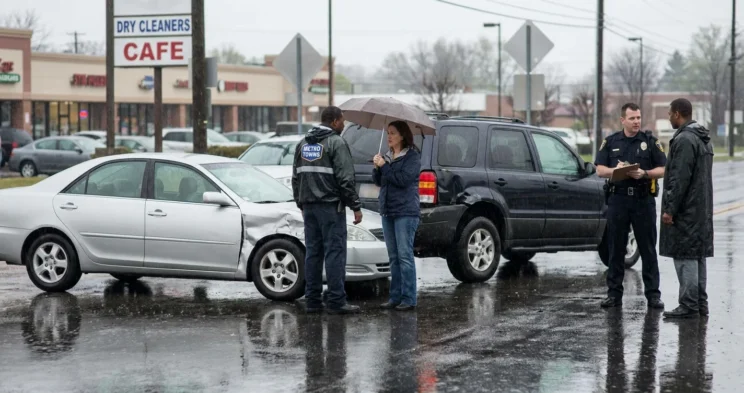
You’re driving home on Interstate 10 through Houston when a sudden downpour turns the freeway into standing water. Your tires lose grip, you hydroplane, and you rear-end the car ahead before you can react. The other driver’s insurance adjuster now says the storm made the crash unavoidable.
Texas law says otherwise.
Texas Assured Clear Distance Rule
A driver’s duty to drive safely does not pause for rain, fog, ice, or wind. Texas holds every driver to the same standard, no matter the forecast.
Under Texas Transportation Code § 545.062, drivers must travel slowly enough to stop within what they can see and control. This is the assured clear distance rule. When visibility drops or the road turns slick, that stopping distance shrinks even at the same speed limit.
Texas law also creates a separate duty to slow down for hazardous conditions. Texas Transportation Code § 545.351 requires drivers to reduce speed for weather and road hazards, no matter the posted limit. Driving the speed limit through a downpour or an icy patch can still count as too fast for conditions.
Some drivers worry that slowing down will get them cited. It will not. Driving under the speed limit in Texas is legal when conditions call for it.
Insurance companies often raise an “act of god” defense, arguing that weather alone caused the crash. That defense does not hold up under Texas law. Fault turns on how the driver responded to conditions, not on the weather itself. A driver who fails to adjust speed or following distance for rain, fog, ice, or wind can still be found negligent.
That holds true for any weather-related car accident in Texas.
Common Texas Weather Driving Hazards
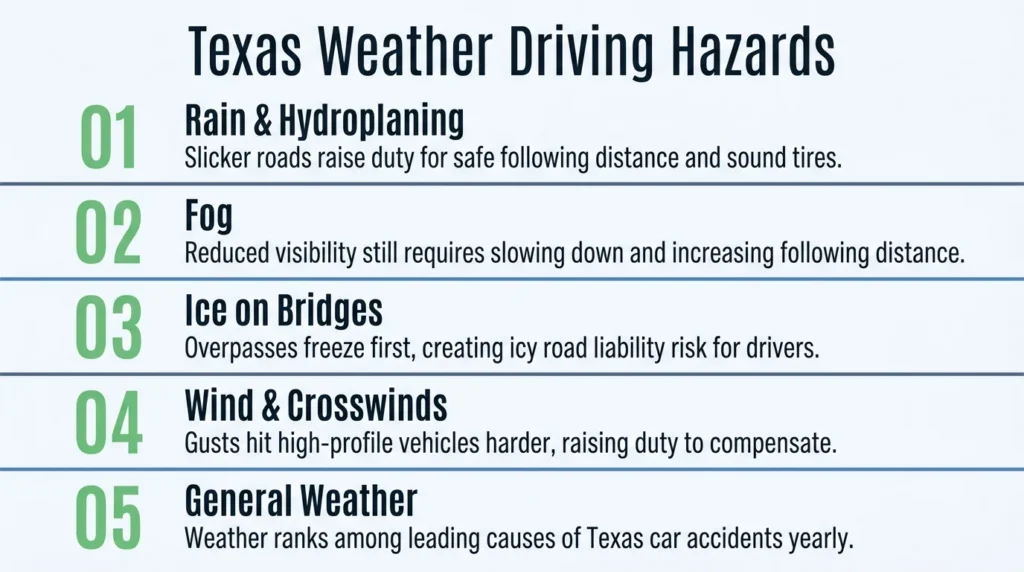
Each type of Texas weather changes what reasonable driving looks like. Rain, fog, ice, and wind each raise the bar for what a careful driver must do:
- Rain and hydroplaning. As roads get slicker, a driver’s duty to keep a safe following distance and maintain sound tires grows stronger, not weaker.
- Fog. Reduced visibility does not lower a driver’s duty to slow down and increase following distance. The Federal Highway Administration reports that fog causes a small share of weather related crashes but contributes to a higher share of the resulting deaths and injuries.
- Ice, including on overpasses and bridges. These surfaces freeze before the rest of the road, creating a real icy road car accident liability risk for Texas drivers. The National Highway Traffic Safety Administration recommends slowing well before you reach a bridge or overpass in freezing weather.
- Wind and crosswinds. Strong gusts affect high-profile vehicles like trucks and SUVs more than passenger cars. Drivers of those vehicles carry a higher duty to compensate.
- General weather. Weather ranks among the leading causes of car accidents across Texas every year. That is why courts and insurers look closely at driver behavior in every weather-related car accident liability dispute in Texas.
Texas Modified Comparative Negligence Rules
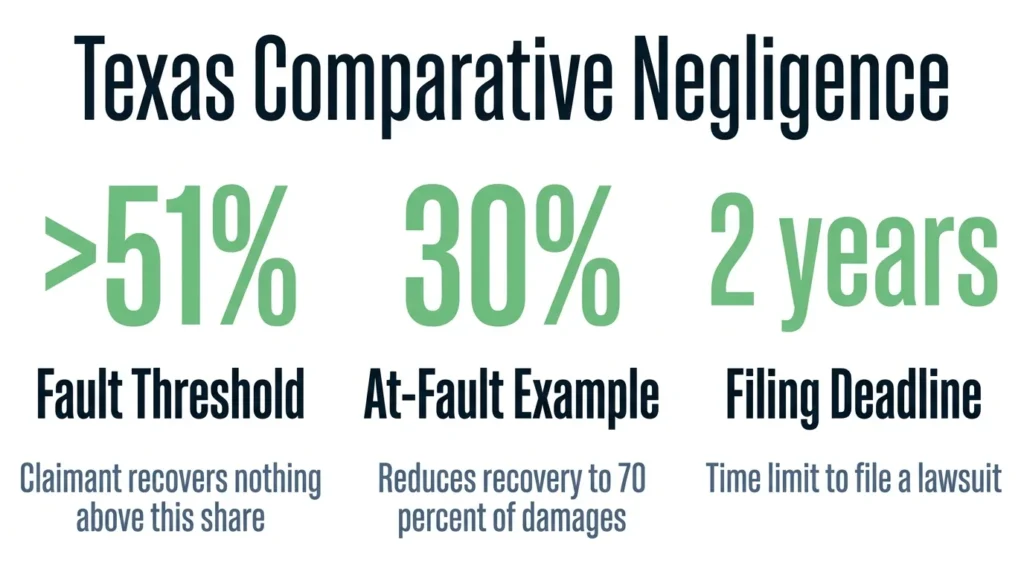
Texas uses a modified comparative negligence system to divide fault after a weather-related car accident. Under Texas Civil Practice and Remedies Code § 33.001, a claimant found more than 51 percent at fault recovers nothing.
Below that line, recovery is reduced by your share of fault. Texas Civil Practice and Remedies Code § 33.012 sets the formula: a driver found 30 percent at fault still recovers 70 percent of their damages. This is the core of how Texas modified comparative negligence applies to weather accident claims.
This is exactly where insurance companies push hardest during weather claims. Adjusters focus interviews on how severe the weather was, rather than on what the other driver did. They cherry-pick evidence and cite generic regional weather data instead of conditions at your exact location. They also push for a recorded statement early, before you know the full picture.
Before you accept any fault-split offer from an adjuster, have it reviewed.
How Fault Splits in Weather Crashes
Fault in a weather-related crash almost always comes down to one question: did the driver adjust for conditions? A few patterns show up again and again across Texas.
Rear-end collisions in rain are the most common. “I couldn’t stop in time because of the rain” is not a defense. It points straight back to the following distance, not to the rain itself.
Multi-vehicle pileups in fog often split fault between two drivers. A lead driver may brake suddenly, while a following driver failed to leave enough room to react. Both choices can carry weight in the final split.
Hydroplaning crashes are usually single-vehicle events, but that does not mean no one is at fault. The driver’s duty is to match their speed to standing water on the road, not to the posted limit.
Commercial vehicles carry a heightened duty in bad weather. Under 49 CFR § 392.14, truck drivers must exercise extreme caution, and stop driving entirely, when weather makes conditions hazardous. If a commercial truck was involved in your weather-related crash, this standard often becomes central to the case.
A fatal multi-vehicle weather pileup can also raise a separate wrongful death claim for surviving family members.
Document conditions as soon as you can. National Weather Service records and TxDOT crash data can confirm exactly what conditions looked like at the time and place of your crash. Gather that evidence before it disappears.
Dust Storm Crashes in West Texas
Dust storms create a hazard unlike fog or rain. Visibility can drop to near zero within seconds, often with almost no warning, especially across West Texas and the Panhandle.
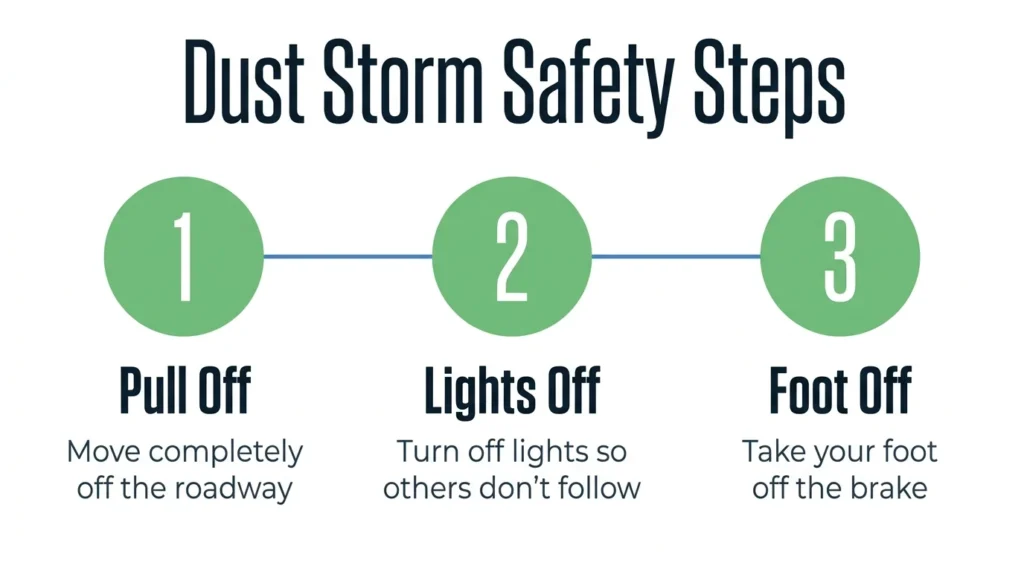
The National Weather Service has a clear protocol for drivers caught in a dust wall: pull off, lights off, foot off. That means pulling completely off the roadway and turning off your lights, so other drivers do not follow them into the dust. It also means taking your foot off the brake.
Fault in a dust storm crash rarely comes from the dust storm itself. It comes from the decision to keep driving into or through a wall of dust instead of pulling over.
Multi-vehicle dust storm pileups are common on West Texas highways. Fault is typically divided between drivers who kept driving through zero visibility and drivers who pulled over safely. Dust storms rank among the leading causes of serious crashes in the region.
Get Help After a Weather-Related Crash
Weather-related fault disputes are rarely simple, and insurance adjusters know how to use bad weather against you. Angel Reyes & Associates has represented Texas accident victims for more than 30 years.
We negotiate and litigate shared-fault weather claims and know how these percentages get inflated. Our case results reflect that experience.
We handle claims on a contingency basis. That means you pay no fee unless we win your case.
If you were in a car accident during rain, fog, ice, wind, or a dust storm, talk to Angel Reyes & Associates first. Do not accept an adjuster’s version of events before you do. Contact us today to discuss your claim.
Past results do not guarantee future outcomes.
Weather-Related Car Accident FAQs
How long do I have to file a lawsuit after a weather-related car accident in Texas?
Texas law gives you two years from the date of the crash to file a personal injury lawsuit. Missing this deadline usually means losing the right to sue, no matter how strong your case is.
Can a city or the state be held responsible if poor road maintenance made a weather-related crash worse?
Sometimes. Government agencies can be liable under the Texas Tort Claims Act for hazards like unaddressed ice or drainage failures, but sovereign immunity makes these claims harder to win than a typical driver-to-driver case.
Is there ever a true exception where a weather event is genuinely unavoidable?
Texas courts recognize a narrow unavoidable accident exception for sudden, unforeseeable events like a tornado or microburst striking without warning. That exception disappears if the driver was speeding, distracted, or otherwise failed to react safely once conditions turned dangerous.
Will my own insurance pay my medical bills after a weather-related crash regardless of fault?
Yes, if you carry personal injury protection coverage, it pays medical bills and lost wages no matter who caused the crash. Texas insurers must offer at least 2,500 dollars of this coverage unless you reject it in writing.
About the Authors

Angel Reyes
Writer
Angel L. Reyes, III is the Founder and Managing Partner of Angel Reyes & Associates. A nationally recognized trial attorney and business leader, Angel has helped over 70,000 injury victims recover more than $1 billion since founding the firm in 1993. Named to the Texas Super Lawyers list annually since 2008, Angel brings Wall Street experience, Ivy League education, and a deep commitment to client advocacy. He is a frequent legal commentator and published author with extensive contributions to legal scholarship, trial strategy, and consumer protection.

Kyle Nicolas
Editor
Kyle Nicolas is the Web Content & SEO Manager at Angel Reyes & Associates. He has more than 10 years of experience as a marketing co...

Angel Reyes
Reviewer
Angel L. Reyes, III is the Founder and Managing Partner of Angel Reyes & Associates. A nationally recognized trial attorney and business...