What Happens If Insurers Claim You Caused Your Own Injuries


Every article on this site is researched by our internal team, reviewed for legal accuracy against current Texas law, and held to State Bar of Texas advertising standards before publication. We do not publish content that overstates outcomes or makes promises about results.
Learn more about our
editorial standards .
Key Takeaways
- In Texas you can recover damages as long as you are found 50% or less at fault.
- An adjuster's fault assignment is a negotiating position, not a binding legal verdict.
- Police reports, witness accounts, and medical records help contest an inflated fault claim.
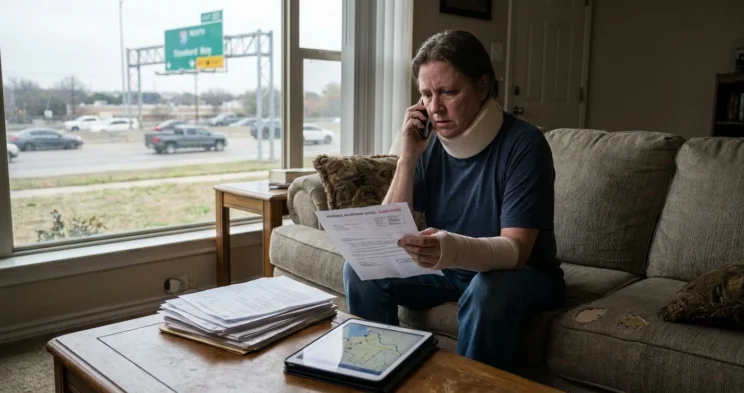
Another driver cut you off while driving down I-35 and you were rear-ended after slamming on your brakes. You don’t feel you were at fault, but the adjuster assigned to your case just told you they feel your actions behind the wheel caused your own injuries.
The insurance company is giving you an offer that feels low and they’re refusing to budge. Suddenly the recovery you were counting on feels like it might vanish right as the bills for your ongoing treatment are starting to pile up.
Before you accept that reduced offer or walk away, you need to know one thing: in Texas, an insurer’s word is not the final word.
How Texas Proportionate Responsibility Works
Insurers are eager to blame your injuries on your own actions because doing so lessens their financial burden, or even eliminates it entirely. Texas follows a modified comparative fault rule under Texas Civil Practice and Remedies Code (CPRC) § 33.012, which reduces your damages by your assigned percentage of fault. That is known as “proportionate responsibility,” and it is the rule that governs your recovery.
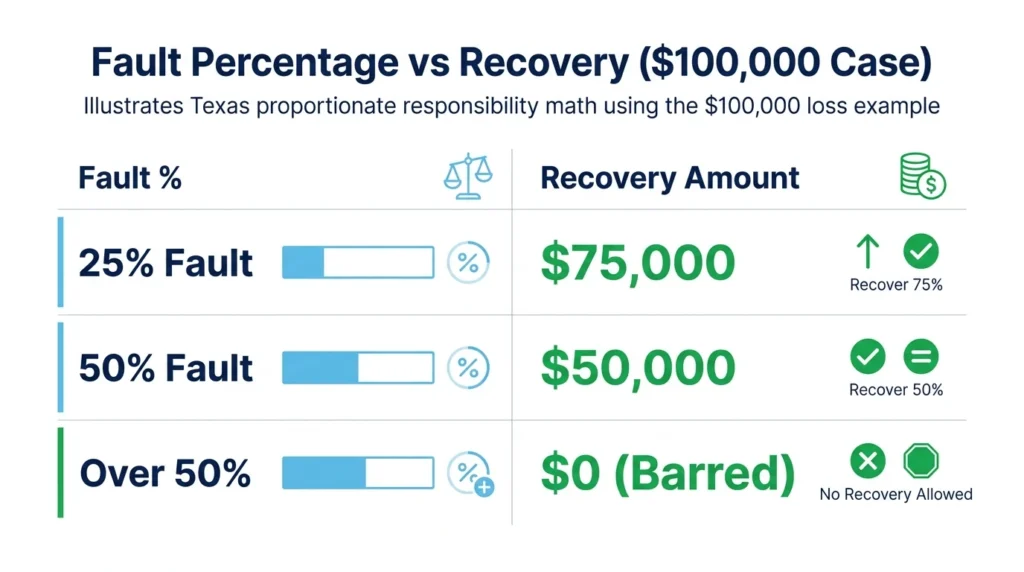
For example, if your losses are valued at $100,000, but you’re found to be 25 percent at fault for the incident, your recovery is reduced to $75,000. If the adjuster assigns you 50 percent fault, your recovery drops to $50,000.
Recovery is barred entirely only in one situation. Under Section 33.001, if you are found more than 50% responsible, you’re barred from recovering anything at all.
This makes it easy to see why insurers are so motivated to pin some of the blame for an incident on you, even if the facts around the incident might seem completely in your favor. Even assigning a small percentage of the fault on you could save that insurance company thousands of dollars, potentially at your expense.
How Insurers Manufacture Fault
This means insurers will often try to build fault against you throughout the investigation process. For example, they may claim that you drove recklessly or were on your phone, and that’s why you braked suddenly, creating the crash that injured you.
Their tactics are strategically designed to minimize your claim, not neutrally discover facts.
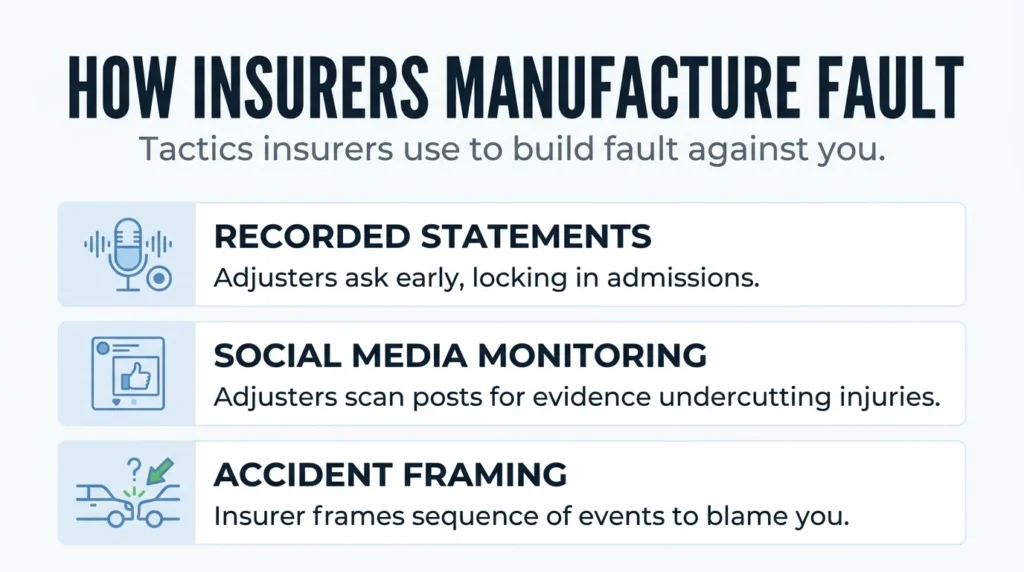
Recorded statements come first. An adjuster calls early, often while you are still shaken, and asks friendly questions. Small admissions get locked in and used against you later.
For example, you might say you were using your phone’s GPS as a navigation tool. The insurer logs that you were distracted by your phone. You weren’t even looking at your phone when the crash happened, but now the insurer is claiming the fault is 50-50.
Social media monitoring is next. Adjusters review your posts and photos looking for anything that undercuts your injury or your version of events. A single vacation picture, even if you’re still dealing with immense pain, can be twisted into evidence.
Accident framing ties it together. The insurer describes the sequence of events in a way that puts blame on you. How you tell your story from the start matters, which is why knowing what to do after a car accident protects you.
These tactics show up most in car accident claims, where comparative fault is invoked constantly. That is where an inflated fault number can cost you thousands.
Evidence to Counter a Fault Claim
An insurer’s fault assessment does not automatically end your case. An adjuster’s fault assignment is a negotiating position, not a binding legal verdict. Under Section 33.003, a trier of fact determines each party’s percentage of responsibility. That means a judge or jury, not the insurance company.
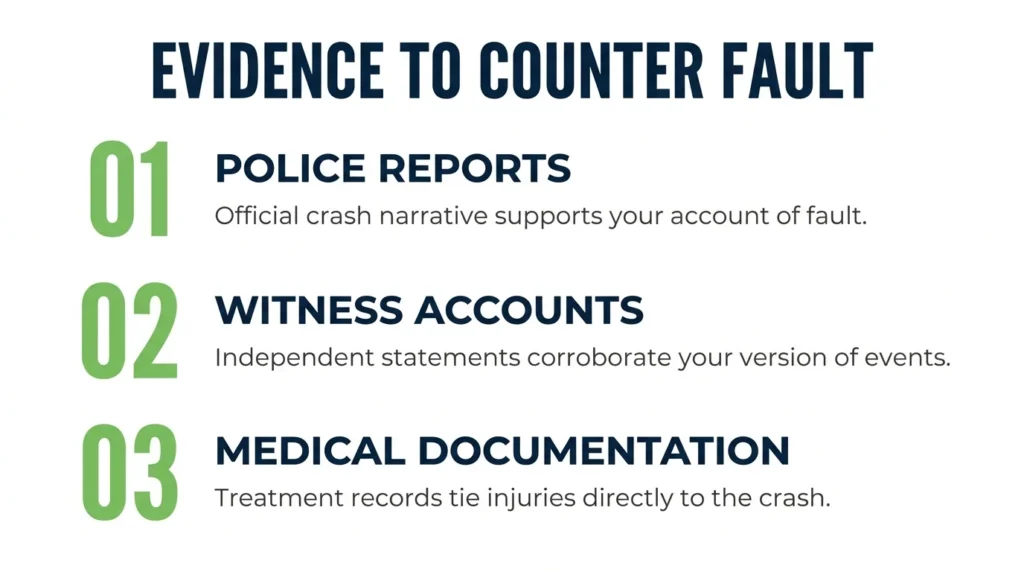
Solid evidence is your best answer to an inflated fault assignment. A few well-organized records can flip the insurer’s story. Start gathering them early.
- Police reports carry a great deal of weight. The official crash narrative and any citations issued at the scene support your account of who caused the collision.
- Witness accounts matter too. Independent statements from people with no stake in the outcome corroborate your version of events. Neutral voices are hard for an adjuster to dismiss.
- Medical documentation, such as treatment records, tie your injuries directly to the crash and rebut any claim that they were pre-existing. Consistent care builds a clear timeline.
If an insurer assigns fault improperly or acts in bad faith, you have another option. You can file a complaint with the Texas Department of Insurance, the state agency that oversees insurer conduct.
When to Involve an Attorney
When an insurer blames you, the fault percentage is negotiable, and an experienced advocate can push it down. Angel Reyes & Associates has spent decades contesting insurer fault assignments in Texas injury claims. Our team knows how adjusters build these arguments and how to take them apart.
Cost should not stop you from fighting a lowball offer, which is why we operate on contingency, meaning we don’t charge any fees unless we win. That means no upfront cost to challenge the fault number the insurer put on you.
We have recovered more than $1 billion for clients across Texas. You can learn about our experience and background and read client reviews and testimonials to see how we handle disputed claims.
Do not accept a reduced offer before you understand your rights. Contact Angel Reyes & Associates for a free consultation today.
Injury Fault FAQs
Does Texas proportionate responsibility law apply to pedestrian and bicycle accidents, or only car crashes?
Yes, Chapter 33 applies to all Texas personal injury claims, not just car accidents. Pedestrians, cyclists, and others injured by someone else’s negligence are subject to the same fault-percentage rules.
Can an insurer's recorded statement be used against you in court if your case goes to litigation?
Yes. Recorded statements are admissible and can be treated as prior statements that contradict your later testimony. This is why many attorneys advise against giving a recorded statement before consulting legal counsel.
How long do you have to file a personal injury lawsuit in Texas if you decide to dispute the insurer's fault assignment?
Texas sets a two-year statute of limitations for most personal injury claims under Texas Civil Practice and Remedies Code Section 16.003. Missing that deadline typically bars you from suing, regardless of how strong your evidence is.
If a settling party contributed to the accident, does their fault percentage affect how much you can recover from the remaining defendants?
Yes. Under Chapter 33, the trier of fact assigns a fault percentage to settling parties, and that percentage factors into the overall calculation. This can reduce what the non-settling defendants owe you.
Can you dispute a fault assignment after you have already accepted a partial settlement payment from the insurer?
Accepting a settlement payment and signing a release typically ends your right to pursue further recovery for that claim. You should review any release language carefully before accepting any payment.
About the Authors

Spencer Browne
Writer
Spencer Browne is a partner at Angel Reyes & Associates and a Board Certified personal injury trial lawyer with nearly 100 jury trials across Texas. He focuses on car, truck, and wrongful death cases, with notable verdicts including a landmark win in the Choctaw Casino bus crash case. A recognized speaker and legal educator, Spencer is a member of the American Board of Trial Advocates and has been honored as a Texas Super Lawyer and one of D Magazine’s Best Lawyers in Dallas. He brings deep trial experience and relentless advocacy to every client he represents.

Kyle Nicolas
Editor
Kyle Nicolas is the Web Content & SEO Manager at Angel Reyes & Associates. He has more than 10 years of experience as a marketing co...

Angel Reyes
Reviewer
Angel L. Reyes, III is the Founder and Managing Partner of Angel Reyes & Associates. A nationally recognized trial attorney and business...