Is a Truck Driver an Employee or an Independent Contractor?


Every article on this site is researched by our internal team, reviewed for legal accuracy against current Texas law, and held to State Bar of Texas advertising standards before publication. We do not publish content that overstates outcomes or makes promises about results.
Learn more about our
editorial standards .
Key Takeaways
- Federal law can treat a driver labeled a contractor as the carrier's employee
- Dispatch, exclusive use, and placard rules can prove the carrier's real control
- Lease terms, dispatch records, and pay statements build a liability case

You were hit by an 18-wheeler on I-35, and the crash report lists a trucking company you have never heard of. When you call about a claim, the carrier’s insurance adjuster says the driver was “just an independent contractor” and hangs up the phone on the idea that the company owes you anything.
That answer is not the end of the conversation. Federal trucking safety law can treat a driver labeled a “contractor” on paper as the placarded carrier’s employee for liability purposes. The label in a lease does not always control who pays when someone gets hurt.
What Does “Employee” Means Under Federal Trucking Safety Law?
A truck driver called an “independent contractor” in a lease can still count as the carrier’s employee under federal safety regulations, because those rules define the term far more broadly than an ordinary paycheck would suggest.
49 CFR 390.5 defines “employee” to include “a driver of a commercial motor vehicle (including an independent contractor while in the course of operating a commercial motor vehicle)” who affects commercial motor vehicle safety. The same section defines “employer” as any person who owns or leases a commercial motor vehicle in interstate commerce, or who assigns someone to drive it.
That wording means the private contract between a carrier and a driver does not decide how federal safety law classifies the relationship.
This is a safety and liability classification, not a tax or wage-and-hour test. A driver can be paid on a 1099 and still meet this federal definition. Current federal reference materials also carry a parallel section, 390.5T, with matching definitional text, so a citation to “49 CFR 390.5” reflects the same operative rule.
If you were hurt in a crash involving a leased truck, this distinction is the starting point for any truck accident claim against the carrier.
Why the Carrier Can’t Contract Its Way Out of Responsibility
Separate federal leasing rules place responsibility on the carrier for a truck it does not own, and that responsibility exists independent of the label in the lease.
Under 49 CFR 376.11, an authorized carrier that operates a truck it does not own must do so under a written lease. The carrier must obtain receipts identifying the equipment, carry documentation on board confirming its operation of the truck, and keep trip records tying the load back to its own responsibility.
49 CFR 376.12 goes further. The lease itself must give the carrier “exclusive possession, control, and use of the equipment for the duration of the lease” and make the carrier assume “complete responsibility for the operation of the equipment.”
Section 376.12(c)(4) adds a pointed clarification. That control requirement does not, by itself, decide whether the driver is an independent contractor or an employee. It only fixes who is responsible for the truck’s operation.
Courts apply these two theories together. In Morales v. OK Trans, Inc. (S.D. Tex. 2024), the court walked through both the definitional theory under 390.5 and the responsibility-and-control theory under Part 376, and granted partial summary judgment for the injured plaintiffs on statutory employee status.
Texas’s own appellate courts reached a similar result years earlier in Morris v. JTM Materials, Inc., holding that a carrier operating under federal authority cannot escape liability by calling the truck’s owner an independent contractor.
That said, this liability is not unconditional. In Morris, the appellate court sent the case back in part because a real dispute existed over whether the driver was dispatched under the carrier’s lease at the exact moment of the crash. The doctrine attaches while the driver operates under the carrier’s authority, not to every trip a leased driver ever makes.
Building the Case: Dispatch, Exclusive Use, Appearance, and Schedule
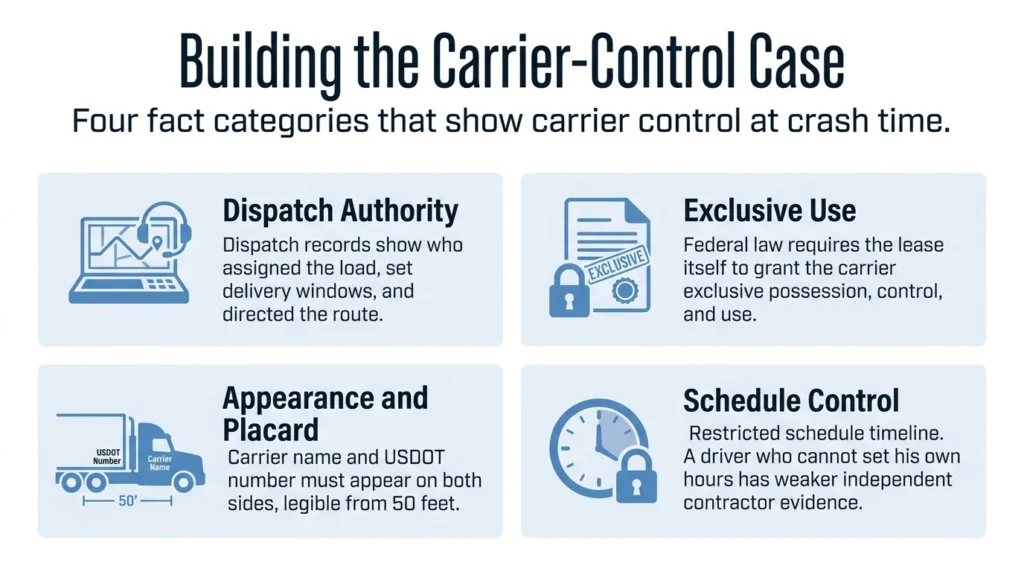
Four categories of facts show whether a carrier actually held, or was legally required to hold, control over the truck and the driver at the time of the crash:
- Dispatch authority. Dispatch records show who assigned the load, set the pickup and delivery windows, and directed the route. Morris shows why the timing recorded in these documents can decide the outcome of a case.
- Exclusive use of the equipment. 49 CFR 376.12(c)(1) requires the lease itself to grant the carrier exclusive possession, control, and use of the truck. This is a mandatory lease term, not something the parties can negotiate away.
- Appearance and placard requirements. 49 CFR 390.21 requires a carrier’s legal or trade name and USDOT number to appear on both sides of the truck, legible from 50 feet. 49 CFR 376.12(e) requires the lease to state who is responsible for putting those markings on and taking them off.
- Who set the schedule. No single federal regulation covers this factor directly. It functions as a common-law factor that reinforces the federal showing above, because a driver who cannot set his own hours or routes has much weaker evidence of independent contractor status.
A truck bearing the carrier’s name and running a load the carrier’s dispatcher assigned is strong evidence of a carrier-controlled operation, whatever the lease calls the driver.
The Paper Trail That Decides These Cases
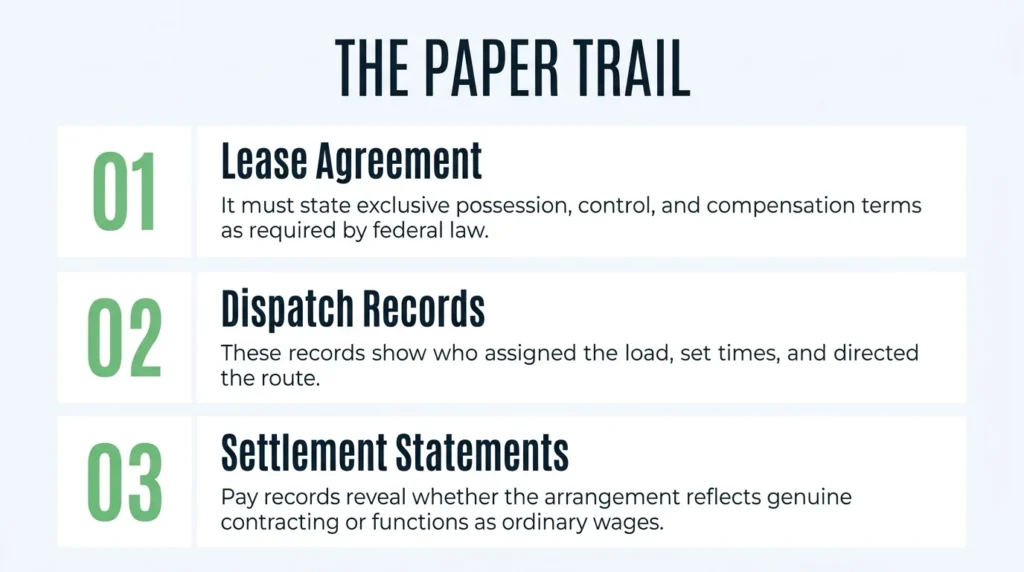
Three kinds of documents form the evidence spine of a statutory employee claim, and each one is worth preserving quickly after a crash:
- The lease agreement. A lease that satisfies 49 CFR 376.12 must state exclusive possession, control, and use of the equipment, compensation terms, who is responsible for identification devices, and payment timing. A lease that skips these mandatory terms, or a carrier that overrides its own “independent contractor” language in practice, supports the statutory employee showing.
- Dispatch records. These records show who assigned the load, who set the pickup and delivery times, and who directed the route the driver actually took.
- Settlement statements. Federal rules require the lease or an addendum to state driver compensation and require payment within a set window after delivery. These pay records show whether the arrangement reflects a genuine independent contractor deal, paid by a documented freight bill percentage, or functions as ordinary wages instead.
Preserving this paperwork early strengthens any resulting truck accident claim against the carrier.
Federal Statutory Employee vs. Texas Common-Law Independent Contractor
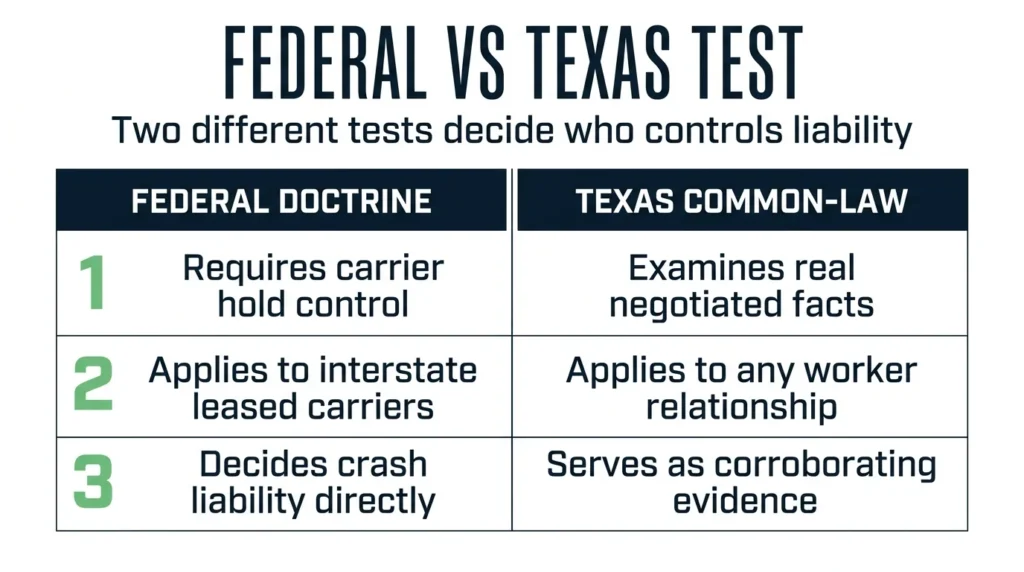
Texas actually recognizes two different tests for this question, and knowing which one applies changes how a case gets built.
The federal statutory employee doctrine under Part 376 and 390.5 is the stronger route. It applies specifically to authorized interstate carriers operating leased equipment, and it does not depend on proving the carrier actually exercised day-to-day control. It asks whether federal law required the carrier to hold that control.
Texas’s separate common-law right-to-control test looks at the real, negotiated facts of the relationship. Newspapers, Inc. v. Love set out factors including control over the progress of the work, the time the worker is employed, and the method of payment. In Limestone Products Distribution, Inc. v. McNamara, the Texas Supreme Court found a genuine independent contractor relationship where the driver owned his own truck, set his own routes and hours, paid his own expenses, and was paid by the load.
These two tests are not competing answers to the same question. The federal doctrine governs interstate carriers operating under a lease and their FMCSA authority. The common-law factors serve as corroborating, fact-level evidence within that federal showing, not a substitute for it. A driver’s pay stubs, dispatch history, and lease terms can support both tests at once.
Talk to a Lawyer About Who’s Responsible
A contractor label on a lease is not the end of the liability question after a truck crash. It is often the beginning of one.
Whether the driver was operating under the carrier’s dispatch, whether the truck carried the carrier’s placard, and how the driver was actually paid can all point toward the carrier’s responsibility, regardless of what the paperwork calls the relationship.
Angel Reyes & Associates has guided injured Texans through trucking liability questions such as this one. If you were hurt in a crash involving a leased commercial truck, get a free consultation to review the lease, dispatch records, and pay documentation in your case.
Past results do not guarantee future outcomes.
Truck Driver Liability FAQs
If I signed a 1099 as an owner-operator, does that mean the carrier isn't responsible if I'm hurt in a crash?
No. Federal trucking safety regulations use a broader definition of “employee” than a tax form does. 49 CFR 390.5 defines “employee” to expressly include “an independent contractor while in the course of operating a commercial motor vehicle,” so a driver can be paid on a 1099 and still meet that federal definition for liability purposes. Being classified as a 1099 contractor answers a tax question. It does not answer the separate question of who federal safety law holds responsible for the truck’s operation.
Does the statutory employee doctrine apply only to interstate hauls, or can it reach intrastate Texas trips too?
The statutory employee doctrine described here turns on interstate commerce. The federal leasing rules apply to an authorized carrier operating a commercial motor vehicle in interstate commerce, and the responsibility-and-control framework courts have applied requires that the vehicle be used in interstate commerce.
Can a driver be treated as a statutory employee for liability purposes but still be paid and taxed as a contractor?
Yes. The statutory employee doctrine under 49 CFR 390.5 and the Part 376 leasing rules is a safety and liability classification, not a tax or wage-and-hour test. A driver can be paid on a 1099, treated as an independent contractor for tax purposes, and still meet the federal definition of “employee” for purposes of who answers for a crash.
What records should a driver or their family try to preserve after a crash to support a statutory-employee claim?
Three categories of documents form the evidence spine of a statutory employee claim: the lease agreement, dispatch records, and settlement statements. The lease should show whether it grants the carrier “exclusive possession, control, and use” of the truck, along with the compensation and identification-device terms required under 49 CFR 376.12.
Does it matter which company's placard was on the truck if the driver was leased from someone else?
Yes. Federal law requires a carrier’s legal or trade name and USDOT number to appear on both sides of a truck it operates, and a lease must state which party is responsible for putting on and removing those markings. A truck marked with a carrier’s identity while running a load under that carrier’s authority is evidence of that carrier’s control.
About the Authors

Angel Reyes
Writer
Angel L. Reyes, III is the Founder and Managing Partner of Angel Reyes & Associates. A nationally recognized trial attorney and business leader, Angel has helped over 70,000 injury victims recover more than $1 billion since founding the firm in 1993. Named to the Texas Super Lawyers list annually since 2008, Angel brings Wall Street experience, Ivy League education, and a deep commitment to client advocacy. He is a frequent legal commentator and published author with extensive contributions to legal scholarship, trial strategy, and consumer protection.

Kyle Nicolas
Editor
Kyle Nicolas is the Web Content & SEO Manager at Angel Reyes & Associates. He has more than 10 years of experience as a marketing co...

Angel Reyes
Reviewer
Angel L. Reyes, III is the Founder and Managing Partner of Angel Reyes & Associates. A nationally recognized trial attorney and business...