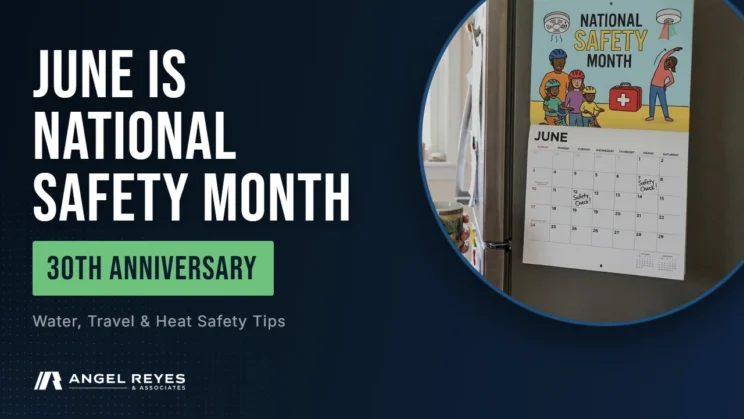
June Is National Safety Month


Every article on this site is researched by our internal team, reviewed for legal accuracy against current Texas law, and held to State Bar of Texas advertising standards before publication. We do not publish content that overstates outcomes or makes promises about results.
Learn more about our
editorial standards .
Key Takeaways
- June 2026 marks the 30th anniversary of National Safety Month, established by the NSC in 1996.
- Whether vacationing in-state, traveling abroad, or enjoying summer festivities, be prepared for road, water, and heat safety this summer.
- Taking a few extra safety-focused steps can help reduce preventable injuries or deaths.
For Texans, June means school’s out and summer in full swing. Families are heading to lakes, loading up for road trips, and enjoying life despite working and living through some of the hottest weeks of the year. That combination, water, travel, and heat, drives some of the most common and most preventable accidents of the summer.
This June, the National Safety Council (NSC) is marking 30 years of National Safety Month. This year’s milestone is both a good opportunity to recognize how far this campaign has come, and a reminder of how much work remains.
What Is National Safety Month?
The NSC established it in June 1996, and it has grown into one of the largest public safety observances in the United States. Preventable injuries claim a life in the U.S. roughly every two minutes, making the work of this month as relevant now as it was then.
Each week of June focuses on a different theme. This year’s lineup includes moving safety forward, staying safe on the roads, promoting worker health, and preventing slips, trips, and falls. The NSC offers free resources to anyone who wants to participate, from safety toolkits to weekly discussion guides.
Water Safety: Pools, Lakes, & Boats
Swimming is a popular pastime throughout the state, be it in a backyard swimming pool, local lake, or even one of our beautiful rivers. It’s a great way to beat the heat in summer, and many people will vacation to lakes or rivers specifically to enjoy a period of rest, relaxation, and water-based fun.
However, whenever around water, take safety seriously. The Texas Department of Family and Protective Services data shows Texas logged 103 fatal child drownings in 2024. More than 64% of those children were under three years old. Drowning is quiet, fast, and one of the most preventable causes of death in the state every summer.
Backyard pools are the most common site of child drowning incidents, but lakes, rivers, and canals claim lives too. The Guadalupe, Brazos, and Trinity rivers draw tubers and swimmers every summer, and their currents, sudden drop-offs, and submerged obstacles create risks that pools do not. On open water, the U.S. Coast Guard estimates that around 85% of people who drown in boating accidents were not wearing a life jacket at the time.
A few habits can make a real difference this summer:
- Designate a water watcher at any pool gathering. That person’s only job is watching the water. No phones, no distractions.
- Fence your pool. Texas law requires a barrier of at least 48 inches for residential pools with young children on the property. A self-closing, self-latching gate prevents children from accessing the water unsupervised.
- Wear life jackets when boating on open water. This applies to all passengers, not just children or non-swimmers.
- Know CPR. A few minutes without oxygen can cause permanent brain damage. Basic CPR training is available through the American Red Cross and local fire departments.
When a drowning happens because a property owner failed to fence a pool or maintain safe conditions, Texas premises liability law may hold them accountable.
Summer Travel: Road Trip Safety Tips
Summer road trips are a Texas tradition, but longer drives bring added risk. Vehicle fatalities rise during summer months, and distracted driving and driver fatigue are two of the biggest reasons why.
Texas recorded more than 91,000 crashes involving distracted drivers in 2024. These are the same roads you’ll drive to the coast, the Hill Country, or a national park this summer. The patterns behind distracted driving crashes show that no trip is too familiar to demand your full attention.
Before and during any road trip, take these steps:
- Check your vehicle. Tires, brakes, wiper blades, and coolant all take a beating in Texas summer heat. A pre-trip inspection takes less than an hour and can prevent a breakdown in triple-digit temperatures.
- Plan your stops. Drowsy driving is as dangerous as drunk driving. If you’re driving more than two hours, schedule a break to walk around and reset.
- Put the phone away before you leave. Set your GPS, connect your playlist, and let someone know your route before you pull out of the driveway.
- Share driving duties. Long stretches of Texas highway are monotonous by design. Trading off reduces fatigue for everyone.
- Build in time. Rushing makes every other risk worse. Plan to stop and take breaks. If the trip takes five hours, plan for six.
Heat Safety: Outdoor Work & Hot Cars
Texas summers are not just uncomfortable. They are dangerous, and the danger is most acute for two groups: people who work outdoors and young children.
Outdoor workers face heat exhaustion and heatstroke when they combine direct sun exposure with physical exertion and inadequate hydration. The risk peaks between 10 a.m. and 4 p.m., when sun exposure is the highest.
Employers with outdoor crews should schedule the heaviest work for early morning, provide shaded rest areas, and make sure water is always within reach. Workers should know the symptoms: heavy sweating, weakness, cool or pale skin, nausea, and a rapid pulse. Heatstroke adds confusion, a lack of sweating despite the heat, and a rapidly rising body temperature. Both are medical emergencies.
For children, a parked car is one of the most dangerous places in Texas during summer. A vehicle’s interior can rise nearly 20 degrees in 10 minutes on a hot day, even with windows cracked. A child’s body heats three to five times faster than an adult’s, meaning heatstroke can set in quickly. Texas leads the nation in child hot car deaths since 1998, with more than 146 recorded fatalities.
Texas Penal Code § 22.10 makes it a criminal offense to knowingly leave a child under seven years of age unattended in a vehicle for more than five minutes. Beyond the legal consequence, the physical one is even more urgent. Make it a habit to check the back seat every single time you park. If you see a child unattended in a hot vehicle, call 911 immediately.
If a Summer Accident Hurt You, We Can Help
National Safety Month is about prevention. But if a preventable accident has already changed your summer or your life, you have legal options worth understanding.
Texas personal injury law allows victims to recover compensation for medical bills, lost income, and pain and suffering when someone else’s negligence caused the harm. That includes pool accidents tied to inadequate supervision, car accidents caused by distracted or fatigued drivers, and heat-related incidents in the workplace.
Angel Reyes & Associates has spent over 30 years representing Texans injured in serious accidents across the state. Our attorneys have recovered more than $1 billion for our clients, and we take every case on a no-fee-unless-we-win basis. We offer free consultations, handle cases remotely from anywhere in Texas, and serve clients in Spanish as well.
If this summer has already taken something from you, contact us today. We are available 24/7.
Past results do not guarantee future outcomes.
About the Authors

Angel Reyes
Writer
Angel L. Reyes, III is the Founder and Managing Partner of Angel Reyes & Associates. A nationally recognized trial attorney and business leader, Angel has helped over 70,000 injury victims recover more than $1 billion since founding the firm in 1993. Named to the Texas Super Lawyers list annually since 2008, Angel brings Wall Street experience, Ivy League education, and a deep commitment to client advocacy. He is a frequent legal commentator and published author with extensive contributions to legal scholarship, trial strategy, and consumer protection.

Kyle Nicolas
Editor
Kyle Nicolas is the Web Content & SEO Manager at Angel Reyes & Associates. He has more than 10 years of experience as a marketing co...

Angel Reyes
Reviewer
Angel L. Reyes, III is the Founder and Managing Partner of Angel Reyes & Associates. A nationally recognized trial attorney and business...