Lyft Driver Accident Settlements in Texas


Every article on this site is researched by our internal team, reviewed for legal accuracy against current Texas law, and held to State Bar of Texas advertising standards before publication. We do not publish content that overstates outcomes or makes promises about results.
Learn more about our
editorial standards .
Key Takeaways
- Lyft drivers are independent contractors in Texas and cannot file a workers' comp claim through Lyft.
- Your coverage tier depends on app status: Period 1 is limited, Periods 2 and 3 reach $1 million.
- Texas gives injured Lyft drivers two years from the crash date to file a personal injury lawsuit.

You were dropping a rider near the Galleria when another car ran the light on Westheimer and slammed into your door. Now you have a hospital bill, a car you cannot drive, and no paycheck coming in. You are wondering whether Lyft covers any of this, or whether you are on your own.
Lyft Driver Accidents Are Legally Different
As a Lyft driver, you are an independent contractor, not an employee, so you cannot file a workers’ compensation claim through the platform. That single fact changes how you recover money after a crash.

Texas does not require private companies to carry workers’ compensation, and Lyft does not carry it for its drivers. Your path to recovery runs through two channels instead: a third-party claim against the at-fault driver, and Lyft’s commercial insurance.
The law treats your worker status this way on purpose. Texas Occupations Code Chapter 2402 classifies rideshare drivers as independent contractors.
Because you are not an employee, the rules under Texas Labor Code Chapter 406 do not reach you. Workers’ comp covers employees, and you do not qualify through Lyft.
This is why your settlement works differently than a passenger’s or a pedestrian’s.
Lyft’s Insurance Coverage by App Period
The period your app was in when the crash happened is the single most important fact for your claim. It decides how much coverage you have available.
Lyft’s insurance comes in three tiers, each tied to your app status at the moment of impact. The mandatory minimums come from Texas Insurance Code Chapter 1954, which governs coverage for rideshare drivers in every period.
Period 1 Coverage (App On, No Ride Accepted)
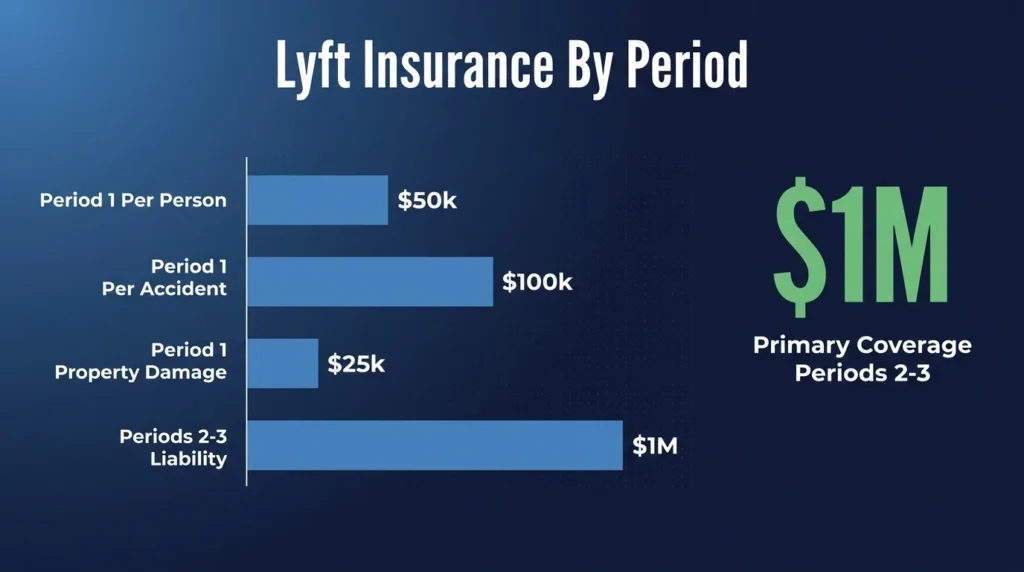
During Period 1, your app is on but you have not accepted a ride yet. Lyft provides only contingent liability coverage at the state minimums: $50,000 per person, $100,000 per accident, and $25,000 for property damage.
Contingent means Lyft’s coverage sits behind your personal auto policy. It pays only after your own insurer denies the claim or your policy limit runs out.
That creates a real gap. If your personal insurer excludes rideshare driving, which many do, you may find little coverage during this phase.
Period 1 leaves you the most exposed of any phase. Your compensation options are narrowest here.
Period 2 & 3 Coverage (Ride Accepted or Passenger Aboard)
Once you accept a ride (Period 2) or pick up a passenger (Period 3), Lyft’s $1 million primary liability policy turns on. This is the strongest coverage phase for you and your rider alike.
These periods also include uninsured and underinsured motorist coverage. If a hit-and-run driver or someone with too little insurance hurts you, that coverage can step in to pay.
This coverage is primary, not contingent. It applies no matter what your personal policy says or does.
What Damages Can a Driver Recover?
You can recover both economic and non-economic damages after a crash that was not your fault. The size of your Lyft accident settlement payout depends on your injuries and which coverage tier applies.
Economic damages cover your hard costs. These include emergency care, surgery, rehabilitation, future treatment, lost rideshare income, lost wages from any other job, and out-of-pocket expenses tied to the injury.
Non-economic damages cover the harm that has no receipt. Think pain and suffering, emotional distress, and the loss of activities you once enjoyed.
Your own share of fault can reduce or erase your recovery. Under Texas Civil Practice and Remedies Code Chapter 33, your damages drop by your percentage of fault.
If you are found more than 50 percent at fault, you recover nothing. Below that line, the court reduces your award by your fault share rather than ending it.
Lyft does not publish settlement figures, because confidentiality clauses keep them private. Public records for rideshare cases run from moderate injuries in the tens of thousands to catastrophic injuries above $1 million, and none of those are driver-specific numbers.
Proving lost rideshare income takes documentation. You will need your earning history from the Lyft app, your tax records, and statements covering the time you could not drive.
An attorney who knows rideshare cases can identify which coverage tiers apply and calculate your full lost income and future medical costs before you accept any offer.
Filing Deadlines & Next Steps for Injured Drivers
Texas gives you two years from the date of the crash to file a personal injury lawsuit. Miss that deadline under Texas Civil Practice and Remedies Code § 16.003, and you lose the right to recover in court.

A few early steps protect your claim and your coverage period. Take them as soon as you are able after the crash:
- Step 1: Screenshot your app status. Capture your ride status at the time of the crash. That screenshot helps prove which coverage period was active and how much insurance applies.
- Step 2: Gather the police report and witness details. Get the report number at the scene and collect contact information for anyone who saw what happened.
- Step 3: Seek medical care promptly. Prompt treatment documents your injuries and links them to the crash, which strengthens your claim.
Lyft’s insurer will contact you soon after a reported crash. Early statements can hurt your claim, and anything you say before getting advice may be used to limit your compensation.
If you want to understand your coverage period and options before an adjuster calls, you can have someone review your car accident claim at no upfront cost.
Work with an Experienced Attorney Today
A crash while driving for Lyft leaves you with bills and lost income but no easy answers about who pays. We can help you sort out which coverage applies and what your claim is worth.
Angel Reyes & Associates has represented injured Texas drivers for over 30 years, with more than $1 billion recovered for clients. We offer free initial consultations, charge no fee unless we win, and handle rideshare injury cases across the state.
You can read what our clients say before deciding. When you are ready, reach out to us for a free consultation.
Past results do not guarantee future outcomes.
Lyft Driver Accident Settlement FAQs
Can I add rideshare coverage to my personal auto policy in Texas?
Yes. Most major insurers in Texas offer a rideshare endorsement that fills the gap during Period 1. Without it, your personal policy may deny a claim that occurs while the app is on but no ride has been accepted.
How long does a Lyft accident settlement typically take to resolve?
Most rideshare injury claims settle within six months to a year, though simpler cases can close in a few months and disputed liability cases can run longer. The insurer has 15 days under Texas law to accept or deny a claim after receiving all required information, but negotiations after that vary widely.
Does the two-year filing deadline apply if the at-fault driver was uninsured?
Yes. Texas Civil Practice and Remedies Code Section 16.003 sets a two-year deadline regardless of whether the other driver had insurance. An uninsured motorist claim against Lyft’s own UM/UIM coverage is subject to the same deadline.
What is rideshare occupational accident insurance and does Lyft provide it?
Occupational accident insurance is a limited benefit that some rideshare companies offer independently contracted drivers to cover medical expenses and lost income from on-the-job injuries. Lyft has offered this coverage to drivers in some markets, but benefits are typically lower than what a personal injury settlement could recover, and the policy terms vary.
About the Authors

Angel Reyes
Writer
Angel L. Reyes, III is the Founder and Managing Partner of Angel Reyes & Associates. A nationally recognized trial attorney and business leader, Angel has helped over 70,000 injury victims recover more than $1 billion since founding the firm in 1993. Named to the Texas Super Lawyers list annually since 2008, Angel brings Wall Street experience, Ivy League education, and a deep commitment to client advocacy. He is a frequent legal commentator and published author with extensive contributions to legal scholarship, trial strategy, and consumer protection.

Kyle Nicolas
Editor
Kyle Nicolas is the Web Content & SEO Manager at Angel Reyes & Associates. He has more than 10 years of experience as a marketing co...

Angel Reyes
Reviewer
Angel L. Reyes, III is the Founder and Managing Partner of Angel Reyes & Associates. A nationally recognized trial attorney and business...