Underride and Override Truck Accidents


Every article on this site is researched by our internal team, reviewed for legal accuracy against current Texas law, and held to State Bar of Texas advertising standards before publication. We do not publish content that overstates outcomes or makes promises about results.
Learn more about our
editorial standards .
Key Takeaways
- Rear guards are federally required, but side guards remain optional under current law.
- A defective or damaged guard can create liability separate from driver negligence.
- Texas prohibits recovery if you are found more than 50% responsible for the crash.

You were driving down the Southwest Freeway in Houston when the semi truck ahead of you suddenly braked hard. Before you could react, your car slid beneath the trailer, crushing your roofline and leaving you trapped until rescue crews arrived.
In a crash like this, the truck’s underride guard can become a critical piece of evidence. Whether it worked as intended, failed, or was missing altogether could play an important role in determining who will pay for your recovery.
Underride & Override Crashes Explained
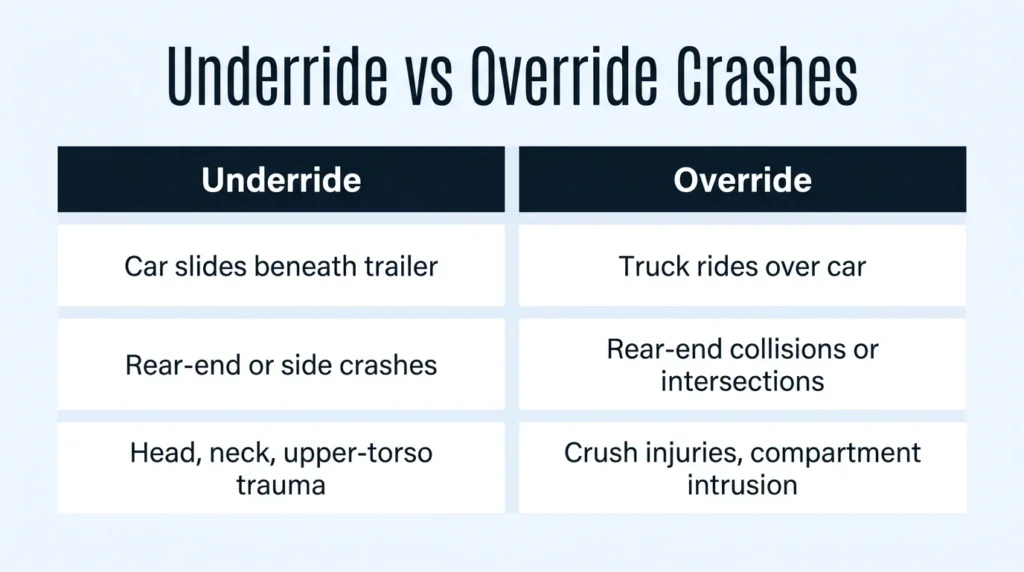
Underride and override crashes happen when a passenger vehicle is too low to match the height of a truck.
- In an underride crash, the car slides underneath the truck’s trailer.
- In an override crash, the truck can crush the vehicle beneath it.
In 2024, passenger vehicle occupants made up 62% of the 5,340 deaths in large truck crashes, according to the IIHS . These crashes are among the most dangerous types of truck accidents on Texas roads.
What Is an Underride Crash?
Rear underride happens when a vehicle crashes into the back of a trailer and slides beneath it.
Side underride happens when a vehicle slides underneath the side of a trailer, often at intersections or during lane changes.
Federal law requires most large trailers to carry a rear guard. However, side guards are not currently required by law.
Either type of underride can cause severe head, neck, and upper-torso trauma, especially when the truck’s trailer tears through your vehicle’s roof.
What Is an Override Crash?
A truck is much taller and heavier than a smaller vehicle, so it can ride over the smaller vehicle during an override crash, especially in rear-end collisions or at intersections.
Since the car’s structure is not strong enough to support the truck’s weight, the truck’s frame can ride over the car and crush the passenger compartment, causing severe crush injuries and allowing parts of the truck or car to intrude into the passenger compartment.
Federal Rules for Truck Trailer Guards
Federal law requires a rear guard on most large trailers, but it does not require a side guard. This is a common cause of underride crashes across Texas.
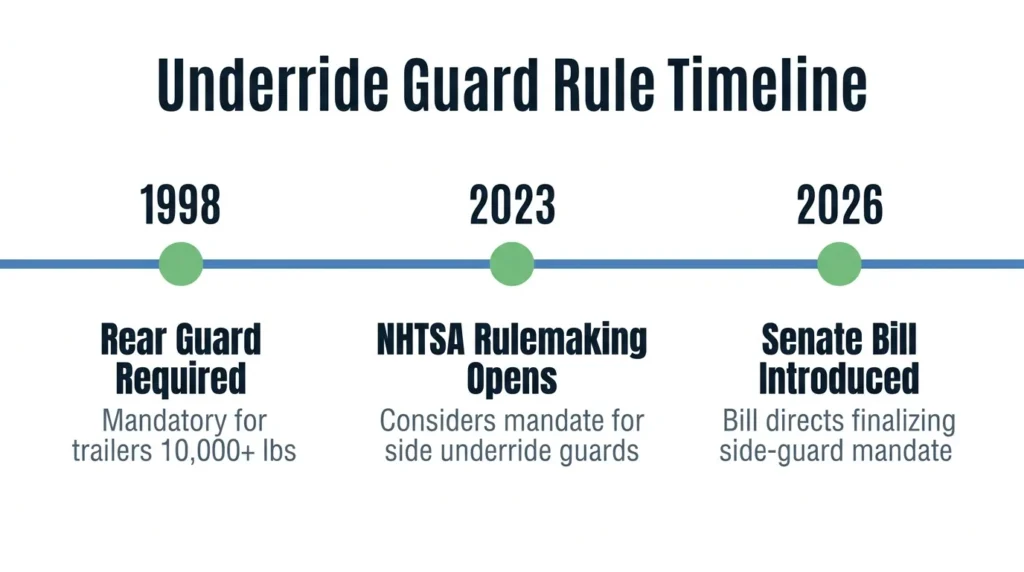
Trailers and semi trailers with a gross vehicle weight of 10,000 pounds or more that were built on or after January 26, 1998 must carry a rear guard that meets the federal strength and energy-absorption standard under 49 CFR 393.86 and FMVSS 223. FMVSS 224 mandates the guard’s required height, width, and position.
Operating a trailer without a compliant guard is a violation, but side underride guards are not required under current federal rules. The National Highway Traffic Safety Administration opened a rulemaking process in 2023 to consider a side-guard mandate, and a bill directing the agency to finalize one was introduced in Congress in February 2026, but as of this writing, neither law has been finalized.
Missing side guards also show up in other types of truck crashes, including rollover accidents.
Liability for Truck Underride & Override Crashes
In these cases, liability usually falls into one of two categories:
- Negligence by the people operating or supervising the truck
- Problems with the truck’s equipment, including the guard itself
Working with an attorney who understands Texas truck accident liability can help you identify which category applies to your case.
Who Is Liable for an Underride or Override Crash?
Driver behavior is often the starting point. Following too closely, driving too fast for road conditions, or failing to slow down in bad weather or poor visibility can all lead to a crash.
A trucking company may also be responsible. Hiring an unqualified driver, providing inadequate training, failing to supervise drivers, or not properly maintaining the truck can all contribute to underride and override collisions.
In some cases, a government entity may also be responsible if a road design flaw or maintenance failure contributed to a crash.
Guard Defects & Maintenance Failures
A missing, damaged, or non-compliant guard can create liability, even if the truck driver was not at fault. A manufacturer or parts supplier may be responsible for a design defect under Texas Civil Practice and Remedies Code Section 82.005 if the guard did not meet federal strength standards.
A trucking company or maintenance provider may also be liable if the guard was removed, damaged, or not properly repaired.
Texas Comparative Fault Rules Explained
Texas reduces your recovery by your percentage of fault. If you are found to be more than 50% responsible for the crash, then your claim is dismissed entirely, under Texas Civil Practice and Remedies Code Section 33.001. This is why it’s worth reviewing how shared fault could reduce your claim.
Types of Compensation for Underride & Override Crash Victims
Victims of underride and override crashes can pursue medical expenses, lost income, and pain and suffering. In fatal cases, their family can pursue wrongful death damages.
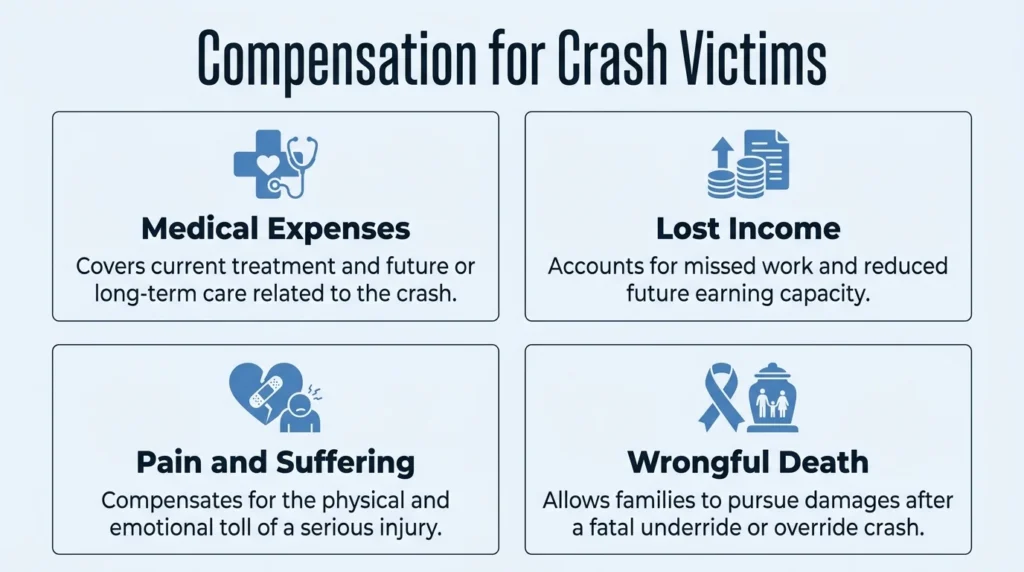
- Medical expenses cover current treatment and future or long-term care related to the crash.
- Lost income accounts for the work you missed while you were recovering from your injuries, as well as your reduced earning capacity in the future.
- Pain and suffering compensates you for the physical and emotional toll of a serious injury.
- Families who lose a loved one in an underride or override crash may pursue wrongful death damages. Learn more about how a wrongful death claim works after a fatal truck crash.
What to Do After an Underride or Override Crash
If you take the following steps early, it can help you protect your health and your claim:
- Seek medical attention immediately, even if your injuries are not immediately apparent.
- Document the scene, including the truck’s rear or side guard condition (only if it is safe to photograph it).
- Preserve evidence and avoid giving a recorded statement to the trucking company’s insurer before speaking with an attorney, especially if factors like shifting cargo may have contributed to the crash.
- Keep records of all your medical bills, missed work, and related expenses.
Talk to an Attorney About Your Underride or Override Truck Accident in Texas
An underride or override crash can leave you facing serious injuries, expensive medical bills and an uncertain recovery. You do not have to handle this alone.
Angel Reyes & Associates has represented injured Texans for more than 30 years. We work on contingency, which means we do not charge a fee unless we win your case. We have recovered more than $1 billion for our clients.
If you or a loved one has been injured in an underride or override crash, contact us today for a free consultation to discuss your legal options.
Past results do not guarantee future outcomes.
Underride & Override Truck Accident FAQs
Are front underride guards required on trucks?
No. Federal rules require rear guards on most large trailers, but there is no federal requirement for front underride protection, even though past crash investigations have recommended that regulators should consider one
What evidence helps show how an underride or override crash happened?
Investigators often pull data from a truck’s event data recorder (sometimes called a “black box” or “ECM”), which records speed, braking, and other details from just before the crash. This data is usually stored for only a short time, so it needs to be requested and preserved quickly after a crash.
How much insurance is a trucking company required to carry?
Federal rules typically require motor carriers that haul general freight to carry at least $750,000 in liability insurance, with higher minimums for hazardous materials or oil transport. This coverage level can affect how much money is actually available to pay your claim.
How long do I have to file a claim after an underride or override crash in Texas?
Texas law generally allows two years from the date of the crash to file an injury claim, and two years from the date of the death to file a wrongful death claim. Missing this deadline usually dismisses your claim.
About the Authors

Alex Ivanov
Writer
Alex Ivanov is a personal injury attorney at Angel Reyes & Associates, focused on car, truck, and motorcycle accident cases. Licensed in Texas and multiple federal districts, Alex brings international legal experience and a global education to his practice. He earned his LL.M. from Texas A&M University School of Law after graduating from Belarussian State University in 2016. Alex is fluent in Russian, English, Ukrainian, and Belarussian, and is recognized by multiple national trial lawyer associations for his results and leadership under 40.

Kyle Nicolas
Editor
Kyle Nicolas is the Web Content & SEO Manager at Angel Reyes & Associates. He has more than 10 years of experience as a marketing co...

Angel Reyes
Reviewer
Angel L. Reyes, III is the Founder and Managing Partner of Angel Reyes & Associates. A nationally recognized trial attorney and business...