Motorcycle Accident Reconstruction: How Experts Build Your Case


Every article on this site is researched by our internal team, reviewed for legal accuracy against current Texas law, and held to State Bar of Texas advertising standards before publication. We do not publish content that overstates outcomes or makes promises about results.
Learn more about our
editorial standards .
Key Takeaways
- Reconstruction experts use physical evidence and EDR data to prove fault in disputed crashes.
- Texas proportionate responsibility rules mean fault percentages directly affect your recovery amount.
- Preserving black box data quickly after a crash protects the strongest objective evidence in your case.
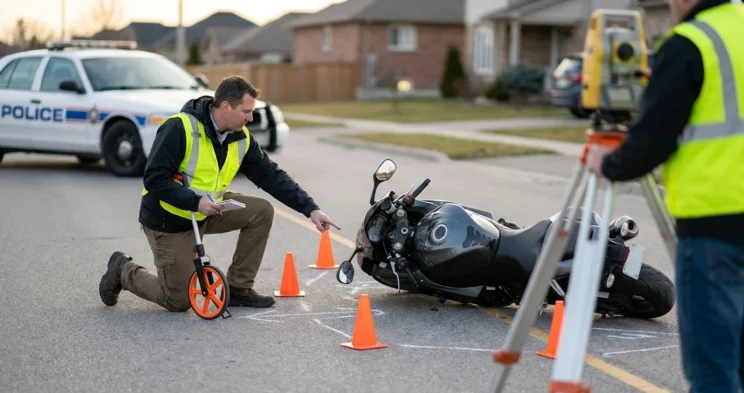
You were riding home through San Antonio on Culebra Road when a driver ran a red light near the 410 on-ramp and hit you broadside. You know exactly what happened. The other driver’s insurer isn’t so sure.
Their adjuster is asking questions that suggest the company is leaning toward blaming you for the crash.
This is where accident reconstruction changes the equation.
What a Motorcycle Accident Reconstruction Expert Does
A reconstruction expert works backward from the crash scene to prove what the physical evidence says, not what any party claims. These are engineers, physicists, and former law enforcement specialists who have training to extract measurable data from the aftermath of a collision.
They examine skid marks, gouge marks, debris fields, and the final resting positions of vehicles. Each of those details tells a story about speed, direction, and the sequence of events. A reconstruction expert translates that story into a formal written report explaining, step by step, what happened and who bears responsibility.
Reconstruction experts also test motorcycle performance as part of their analysis. They assess braking capabilities, handling characteristics, and sight-line distances to evaluate whether you could reasonably have avoided the crash. Their conclusions are grounded in physics, not opinion.
What Evidence Do Reconstruction Experts Analyze?
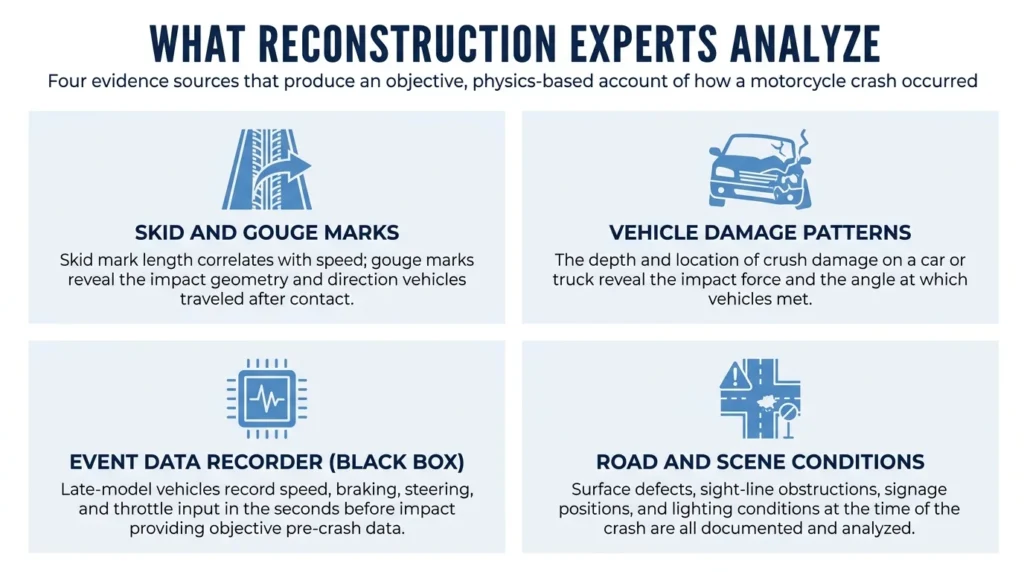
A reconstruction expert works with physical evidence that doesn’t change its story.
Skid Marks
Skid marks and gouge marks tell investigators where a vehicle braked, how hard, and where it made contact with the pavement. The length of a skid mark correlates with speed, and gouge patterns reveal the geometry of the impact. Debris fields show where the collision energy transferred and which direction vehicles traveled after contact.
Vehicle Damage
The depth and location of crush damage on a car or truck reveal the force of the impact and the angle at which the vehicles met. Undercarriage marks and scrape patterns provide additional data points that a reconstruction expert can map against the road surface.
Road Conditions
Road conditions also become part of the analysis. Surface defects, sight-line obstructions, signage positions, and lighting conditions at the time of day are all documented and factored into the expert’s conclusions.
EDR Data & the Other Vehicle’s Black Box
Many late-model passenger vehicles carry an event data recorder, commonly called a black box, that captures what the vehicle was doing in the seconds before a crash. Speed, throttle input, braking force, steering angle, and airbag deployment status are all recorded automatically.
The National Highway Traffic Safety Administration’s event data recorder information page explains what these devices capture and how data standards work. Title 49 CFR Part 563 governs the specific data elements that passenger vehicle EDRs must record. Those data elements include vehicle speed and brake application in the seconds before impact, which are often the most contested facts in a disputed crash.
Motorcycles generally are not required to carry EDRs. That makes the other vehicle’s data particularly valuable in motorcycle accident cases. If the driver who hit you claims they were traveling at the speed limit and braking normally, EDR data can confirm or contradict that account with objective numbers.
Your attorney can send a preservation letter to protect that data before it is lost. Vehicles that are repaired, totaled, or sold may have their EDR data overwritten or become inaccessible. Acting quickly after the crash gives your case the best chance of capturing that evidence.
An attorney familiar with motorcycle accident investigations can identify whether EDR evidence needs to be preserved and pursue it through the discovery process.
When Reconstruction Is Worth the Cost
Reconstruction is not necessary in every motorcycle accident case. It becomes most valuable in three situations, and knowing which category your case falls into is one of the first things an experienced attorney will evaluate.
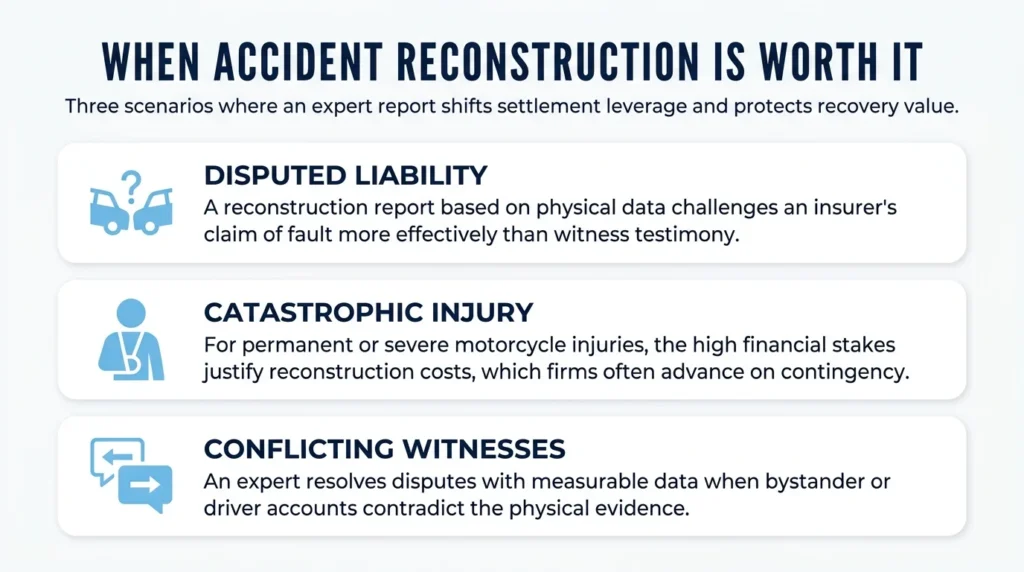
Disputed liability. When the other driver or their insurer claims the crash was your fault, a reconstruction report gives your attorney objective, third-party evidence. A report built from physical data is harder to dismiss than a competing witness account.
Serious injury. When motorcycle accident injuries are permanent or catastrophic, the financial stakes of the claim are higher. The cost of a reconstruction report, which can run from several thousand dollars to more than ten thousand, becomes proportionate to what you stand to recover.
Conflicting witness accounts. When what bystanders or the other driver say conflicts with what the physical evidence shows, a reconstruction expert resolves that conflict with measurable data. Courts and insurers give significant weight to expert analysis that is grounded in physics and engineering.
In cases handled on contingency, law firms typically advance the cost of reconstruction and recover it from the settlement or verdict. You don’t pay out of pocket upfront.
How Reconstruction Findings Are Used in Your Case
A reconstruction report changes the dynamics of both a settlement negotiation and a trial.
In settlement talks, the report gives your attorney a documented foundation to challenge the insurer’s version of events. Insurers know what a well-prepared expert report signals: if the case goes to trial, the same report will be presented to a jury. That knowledge alone shifts the negotiating position.
Under Texas Civil Practice and Remedies Code (CPRC) Chapter 33, Texas follows a proportionate responsibility system. Fault is allocated as a percentage between parties. The reconstruction expert’s findings directly affect how that percentage is assigned.
If your expert can show the other driver was entirely at fault, your recovery is not reduced. If the insurer’s version places partial blame on you, reconstruction evidence can rebut that argument with specifics.
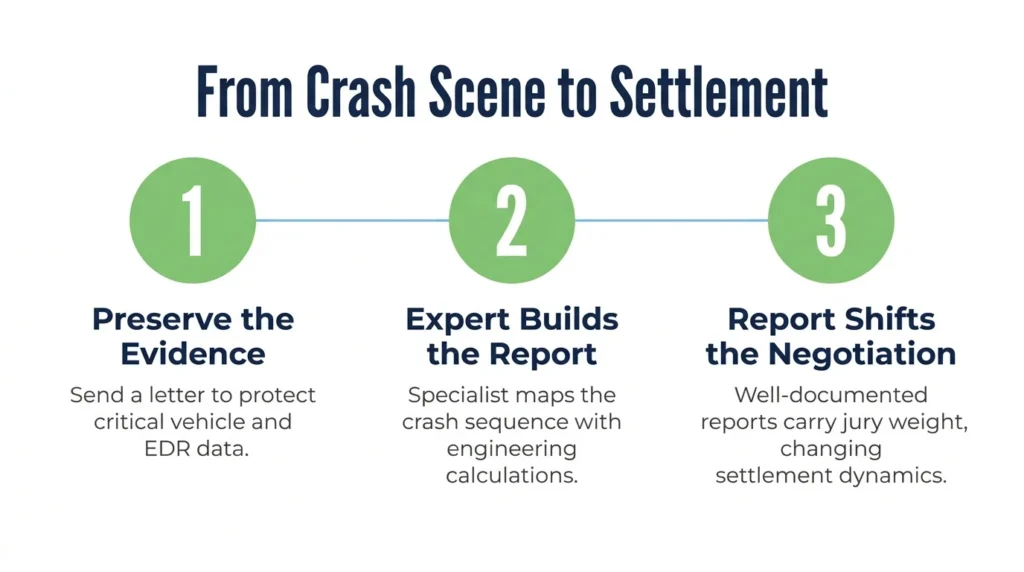
At trial, the expert testifies as a witness. Texas Rule of Evidence 702 requires expert witnesses to be qualified by knowledge, skill, experience, training, or education, and their methodology must be reliable. A reconstruction expert who meets that standard can walk a jury through the crash sequence with diagrams, measurements, and calculations that are far more persuasive than conflicting accounts from the drivers involved.
If your attorney has not yet discussed whether reconstruction evidence applies to your case, that conversation is worth having now.
Talk to an Attorney About Your Case
If liability is disputed in your motorcycle accident and the other driver’s insurer is pushing back on your account of the crash, you do not have to build your case alone.
Angel Reyes & Associates has guided injured Texans through motorcycle accident claims for over 30 years and successfully recovered more than $1 billion for injuy victims. We work on contingency, which means you pay nothing unless we win your case.
Our team of attorneys has the resources to bring in qualified reconstruction experts when the evidence calls for it, and we know how to present their findings in a way that carries weight with both adjusters and juries. To talk through your situation and find out whether reconstruction evidence could strengthen your case, contact us for a free consultation.
Past results do not guarantee future success.
Motorcycle Accident Reconstruction FAQs
What if the crash scene was already cleaned up before a reconstruction expert could visit?
Experts can still work from police reports, photos taken at the scene, vehicle damage patterns, and available EDR data when the scene itself has been cleared. Acting quickly helps your claim, though, because photographs, witness memories, and electronic data all become harder to recover as time passes.
Can the other driver's insurance company access the EDR data before my attorney does?
Yes, the other party’s insurer may move quickly to retrieve or evaluate EDR data from their insured’s vehicle. Sending a legal preservation letter as soon as possible after the crash protects against that data being lost or overwritten before your attorney can obtain it through discovery.
Who qualifies to work as a reconstruction expert in a Texas case?
Reconstruction experts in Texas typically hold backgrounds in engineering, physics, or law enforcement crash investigation, and many carry certifications from recognized organizations such as the Accreditation Commission for Traffic Accident Reconstruction (ACTAR). Under Texas Rule of Evidence 702, courts evaluate whether an expert’s qualifications and methods are reliable before allowing testimony.
Will the insurance company accept a reconstruction report, or does it only matter at trial?
Insurers regularly factor reconstruction reports into settlement evaluations because they know a credible expert report carries weight with juries. A well-documented report can shift the negotiating dynamic well before a case reaches trial.
About the Authors

Angel Reyes
Writer
Angel L. Reyes, III is the Founder and Managing Partner of Angel Reyes & Associates. A nationally recognized trial attorney and business leader, Angel has helped over 55,000 injury victims recover more than $1 billion since founding the firm in 1993. Named to the Texas Super Lawyers list annually since 2008, Angel brings Wall Street experience, Ivy League education, and a deep commitment to client advocacy. He is a frequent legal commentator and published author with extensive contributions to legal scholarship, trial strategy, and consumer protection.

Kyle Nicolas
Editor
Kyle Nicolas is the Web Content & SEO Manager at Angel Reyes & Associates. He has more than 10 years of experience as a marketing co...

Angel Reyes
Reviewer
Angel L. Reyes, III is the Founder and Managing Partner of Angel Reyes & Associates. A nationally recognized trial attorney and business...