How Motorcycle Accident Amputation Claims Work


Every article on this site is researched by our internal team, reviewed for legal accuracy against current Texas law, and held to State Bar of Texas advertising standards before publication. We do not publish content that overstates outcomes or makes promises about results.
Learn more about our
editorial standards .
Key Takeaways
- Texas gives motorcycle amputation victims two years from the crash date to file a personal injury lawsuit.
- Riders found 51% or more at fault under Texas comparative negligence law cannot recover any damages.
- Life-care planners and vocational experts are required to prove lifetime medical costs and damages related to lost earning capacity.

You were heading west on I-10 near the Galleria when a driver changed lanes without looking and clipped your front wheel. The crash sent you into the guardrail and crushed your leg, and the trauma surgeon at the hospital told you that your leg cannot be saved.
Now, the bills are stacking up, your employer is asking when you can return to work, and the other driver’s insurer has already called with an offer that feels nowhere close to what you will actually need to pay your medical expenses.
Why Amputation Claims Differ from Standard Cases
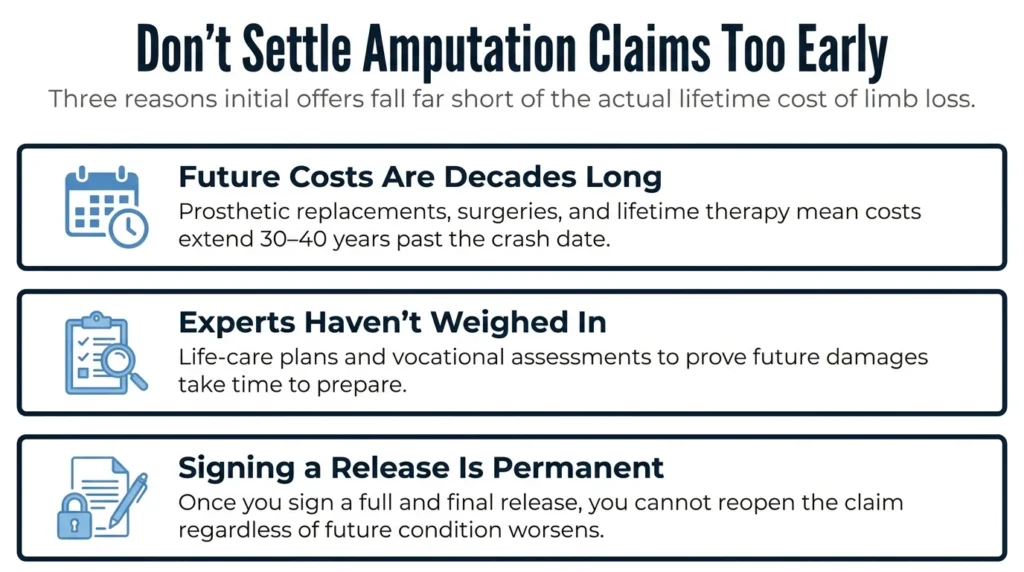
Amputation injuries are classified as “catastrophic,” which means the damages extend decades past the crash date. A standard injury claim centers on fixed past costs, like emergency room bills and a few months of therapy. An amputation claim must project expenses for a lifetime of medical care, prosthetic replacements, and lost earning capacity, all proven with expert evidence that the insurer hopes you will not be able to obtain.
In these cases, Texas law permits you to seek recovery for both economic and non-economic damages. You can recover more types of compensation than most injured riders realize.
This is why early settlement offers in motorcycle accident cases tend to dramatically undervalue the real cost of your injuries. Insurers know that projecting future damages requires specialists, and most claimants don’t know they have to hire them. If you agree to a settlement too early, you may end up settling for a fraction of what the injuries will actually cost over your lifetime.
Recoverable Damages in an Amputation Claim
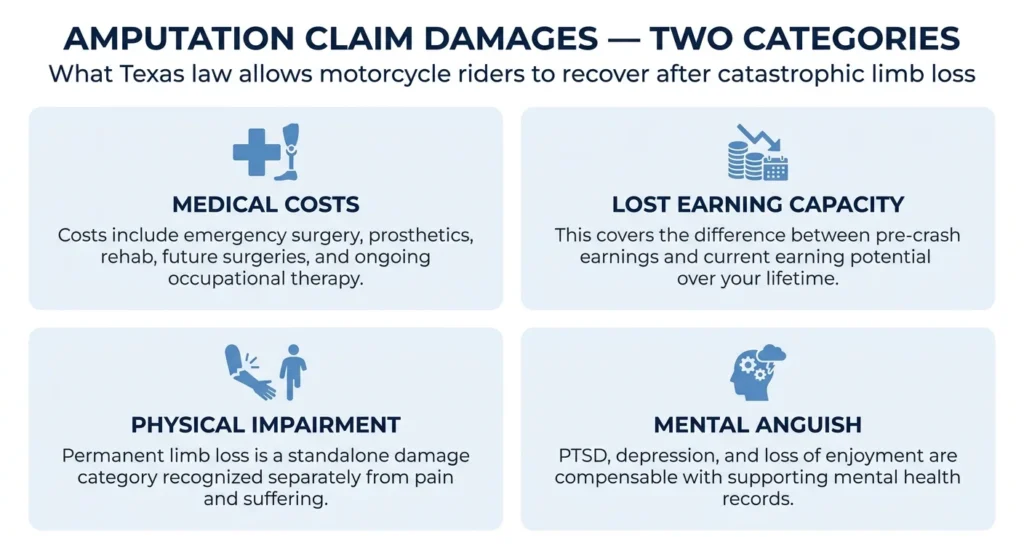
An amputation claim covers two distinct damage categories:
- Economic damages cover measurable financial losses that can be proven with documents and expert calculations.
- Non-economic damages cover the human cost of permanent limb loss.
Both are recoverable under Texas law, but the total claim value depends on proving both categories, rather than favoring one category over the other.
Economic Damages
Economic damages start with emergency surgery, intensive care, and your initial rehab stay. They continue into prosthetic costs, which are not a one-time expense. Modern prosthetic limbs require replacement every 3-5 years, and advanced devices can exceed $70,000 per unit.
Future medical expenses include follow-up surgeries, infection management, phantom pain treatment, and ongoing occupational therapy. Lost earning capacity covers the difference between what you could have earned before the crash and what you can earn now. You can also recover compensation for home and vehicle modifications, like ramps and adaptive driving equipment.
The deadline to file these claims is set by Texas Civil Practice and Remedies Code (CPRC) § 16.003, which gives you two years from the crash date to file your claim.
Non-Economic Damages
Non-economic damages address pain and suffering, phantom limb pain, and the pain of repeated corrective procedures. They also include loss of enjoyment of life. This means the activities, hobbies, and physical pursuits you can no longer participate in.
You can also recover compensation for mental anguish if you have mental health treatment records documenting anxiety, depression, or PTSD.
Disfigurement and physical impairment are also recognized as standalone damage categories under Texas law, and amputation in particular sits at the most severe end of the injury spectrum covered in our overview of common motorcycle accident injuries.
Finally, your spouse may also recover compensation for loss of consortium, which means the loss of companionship and household contribution.
How Life-Care Planners & Vocational Experts Build Your Case
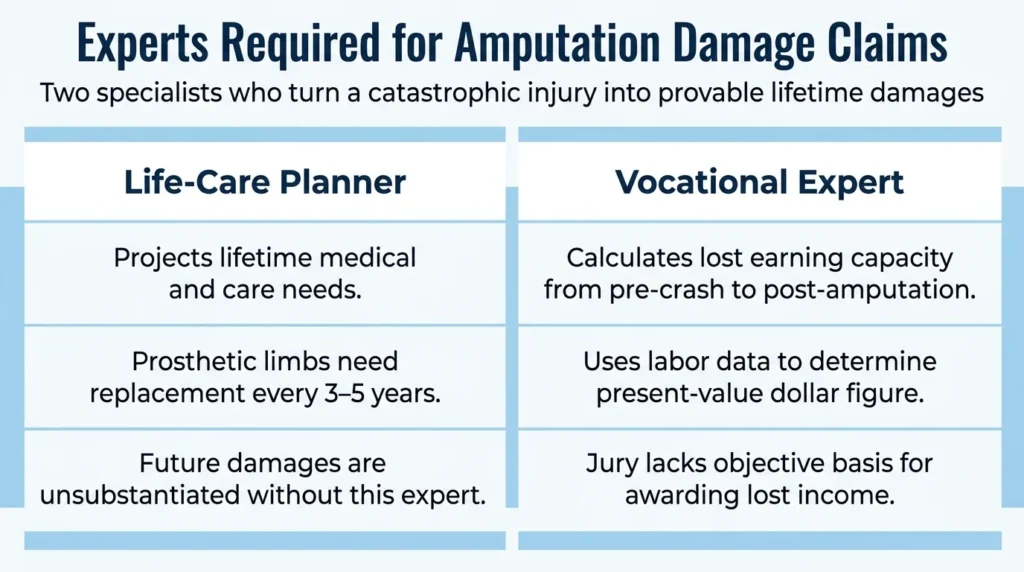
Two kinds of experts make the difference between a well-built amputation claim and an undervalued amputation claim: a life-care planner and a vocational rehabilitation expert.
- A life-care planner projects the cost of your lifetime medical and care needs. They are typically a certified nurse or rehabilitation specialist. They assess your medical condition, then make a written plan that includes prosthetic replacements, therapy sessions, medications, home care requirements, and anticipated future surgeries, along with the expected costs for each of these items. This life-care plan is the evidence required to estimate future damages. Texas courts require that future damages must be proven to be probable, not just possible. A properly prepared life-care plan can help you meet that standard.
- A vocational rehabilitation expert calculates your lost earning capacity by looking at your job, skills, education, and physical capacity before the crash. They then compare that to your post-amputation limitations and calculate the difference in lifetime earnings using labor market data. This turns your lost earning capacity into evidence.
Without both experts, your future damages are harder to prove, and the defense counsel will challenge every estimate you put in front of a jury.
Fault, Deadlines, & Texas Law
Texas uses a modified comparative fault system, which means fault is shared between all parties involved in a crash. The rule controls how much you can recover (if at all). In amputation cases, it is critical to investigate fault early because the damages are significant but can be easily lost if a percentage of fault is unfairly assigned to you, and you don’t challenge it.
Under Texas Civil Practice and Remedies Code Chapter 33, if you are found 50% or less at fault, you can still recover damages, but those damages are reduced by the assigned percentage of fault. If you are found 51% or more at fault then you cannot recover anything at all. Insurers know this and will try to aggressively push fault onto you. Our breakdown of the Texas 51 percent rule explains how this plays out in real-world scenarios.
When a commercial vehicle is involved, federal rules about driver qualifications and hours of service can affect who is responsible and extend liability to multiple parties. Exemplary damages (also called “punitive damages”) may also be available under CPRC Chapter 41 if the at-fault driver’s conduct can be considered “gross negligence” (reckless behavior such as drunk driving or extreme speeding).
Understanding how much fault you may be assigned early on will shape every decision that follows, which is why you may benefit from reviewing legal strategies after a Texas motorcycle accident before talking with an insurer.
Work with an Injury Attorney on Your Amputation Claim
Catastrophic limb loss claims require careful preparation that most claimants don’t know they must do. Angel Reyes & Associates has more than 30 years of experience handling serious amputation cases across Texas, with more than $1 billion recovered for clients.
We work on contingency, which means you pay no fee unless we win, and we offer free consultations with our team of experienced Texas trial attorneys, including board-certified specialists in personal injury trial law. Schedule a free consultation today to talk through your situation.
Past results do not guarantee future outcomes.
Motorcycle Amputation Claim FAQs
Can a motorcycle amputation claim be filed if the at-fault driver had no insurance or minimal coverage?
Yes. In this situation, you may be able to seek compensation through your own uninsured or underinsured motorist (UM/UIM) coverage, if you have it. UM/UIM coverage can apply to catastrophic losses when the at-fault driver’s policy limit cannot cover all of the actual damages.
Does Texas recognize a separate damages category for the loss of a specific limb (similar to workers' compensation scheduled loss benefits)?
No, the scheduled benefits chart for limb loss applies only to on-the-job injuries filed through workers’ compensation. A personal injury claim filed against an at-fault driver does not use scheduled benefits. Instead, it pursues the full economic and non-economic damages proven by evidence.
Can a motorcycle rider recover damages for prosthetic costs if they choose not to get a prosthetic limb?
It depends. Refusing to pursue recommended treatment can affect your damages under the “duty to mitigate” in Texas, which requires an injured person to take reasonable steps to limit their losses. Whether declining a prosthetic limb is considered a “failure to mitigate” depends on the medical facts and the reasons behind the decision.
What happens to an amputation claim if the injured rider dies from complications before the lawsuit is resolved?
In this case, the personal injury claim does not automatically continue on its own. Under Texas law, the claim may survive and be pursued by the estate of the deceased, but a wrongful death claim may also arise separately if the death resulted from crash-related injuries.
How does the two-year filing deadline apply if the injured rider was a minor at the time of the crash?
In this case, Texas law “tolls” (or pauses) the two-year filing deadline for minors. Therefore, the two-year clock generally does not begin counting down until the injured person turns 18, which gives them until their 20th birthday to file a claim.
About the Authors

Angel Reyes
Writer
Angel L. Reyes, III is the Founder and Managing Partner of Angel Reyes & Associates. A nationally recognized trial attorney and business leader, Angel has helped over 70,000 injury victims recover more than $1 billion since founding the firm in 1993. Named to the Texas Super Lawyers list annually since 2008, Angel brings Wall Street experience, Ivy League education, and a deep commitment to client advocacy. He is a frequent legal commentator and published author with extensive contributions to legal scholarship, trial strategy, and consumer protection.

Kyle Nicolas
Editor
Kyle Nicolas is the Web Content & SEO Manager at Angel Reyes & Associates. He has more than 10 years of experience as a marketing co...

Angel Reyes
Reviewer
Angel L. Reyes, III is the Founder and Managing Partner of Angel Reyes & Associates. A nationally recognized trial attorney and business...