More Than Half the Trucks Inspected in North Texas Weren’t Safe to Drive


Every article on this site is researched by our internal team, reviewed for legal accuracy against current Texas law, and held to State Bar of Texas advertising standards before publication. We do not publish content that overstates outcomes or makes promises about results.
Learn more about our
editorial standards .
Key Takeaways
- More than half of trucks inspected in North Texas enforcement operations were too unsafe to drive, more than double state and national rates.
- Brake, tire, and cargo failures come from skipped inspections and deferred maintenance. Federal law makes carriers responsible for both.
- Local truck enforcement units are shrinking, and Texas law limits what juries first hear about carriers, leaving fewer checks on unsafe trucks.
This is an opinion piece, and is intended to provide analysis and commentary on current events and issues facing personal injury law. While resources are provided to support claims, opinion statements should not be misconstrued as fact, evidence, or argument in favor of or against any particular legislation. This is not legal advice.
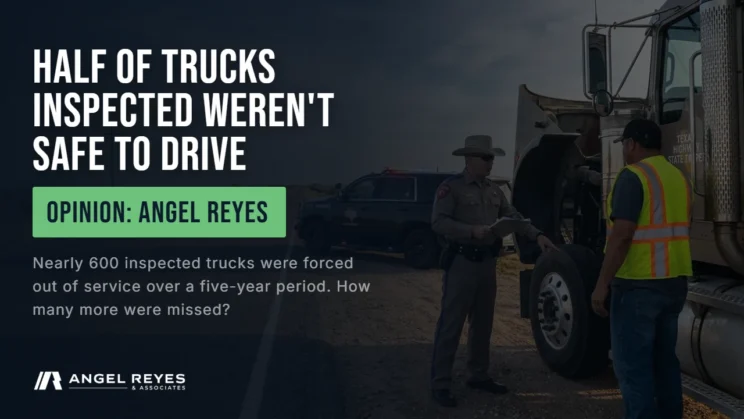
More than half the trucks North Texas officers inspected at random over a five-year period weren’t safe enough to drive another mile. That’s the finding from 28 coordinated roadside inspection operations run between April 2021 and July 2026. Officers inspected 1,205 commercial trucks, ordering 590 of them off the road. They logged 4,066 violations, more than three for every truck they checked.
The North Central Texas Council of Governments put the average out-of-service rate at 53%. Statewide, that rate is about 24%, and nationally, about 23%.
These trucks weren’t cherry-picked. Derek Malena, a commercial vehicle enforcement officer with the Allen Police Department, told regional officials the vehicles were selected at random. The rate has stayed at 50% or higher since 2023.
Every one of those 590 trucks was already hauling freight through North Texas before anyone checked it. You’ve driven next to some of them. So have I.
Out of Service Means Too Dangerous to Drive
Inspectors use the Commercial Vehicle Safety Alliance’s out-of-service criteria to decide whether a truck or driver is an imminent hazard. Trucks that have issues but are not necessarily an imminent hazard are given a citation, which usually includes a fine. Generally, the operator pays the fine, but the truck can continue operating.
An out-of-service order is different. Federal rules dictate that an out-of-service order is barred from operating until the issue can be rectified.
Jason Brown, the council of governments staffer who presented the findings, called these inspections “the last line of defense” between unsafe trucks and the public. In those 28 operations, that defensive mechanism caught 590 trucks.
Brakes Don’t Fail Overnight
Bad brakes and bald tires are business decisions. It’s easy to put off a repair to squeeze out a few more miles and save on operating costs. Everyone else on the road carries the risk of that choice.
Brake violations topped the list of equipment problems inspectors found, followed by tires and cargo securement, Malena said. He traced those failures to two sources: drivers doing poor pre-trip inspections, and carriers and owners failing to maintain their trucks.
Brakes were also the top vehicle out-of-service violation across North America during CVSA’s 2025 International Roadcheck. North Texas trucks fail for the same reasons as everyone else’s, but they fail far more often.
Inspectors also put drivers themselves out of service, most often for hours-of-service violations and missing medical cards. Those are on the carrier, too; federal rules bar a carrier from letting a driver run past the hours-of-service limits or drive without a valid medical certificate.
All of these obligations are clearly defined. Every motor carrier must systematically inspect, repair, and maintain the vehicles it controls. A driver must be satisfied a truck is in safe operating condition before driving it. Federal rules limit a driver’s hours, and a driver needs a valid medical certificate to drive. Yet, more than half of checked trucks were in violation of a rule in some way.
Brakes don’t wear out on the drive to the scale. If they’re worn, someone either skipped the check or put off the repair because the truck had a load to deliver. Those decisions are often made in an office before the truck reaches the highway.
When a truck case comes to our firm, the maintenance file, the driver’s inspection reports, and the logs are among the first records our lawyers request. What inspectors are finding at the roadside is what we find in those files after a crash. The difference is timing. If they find it at the roadside, nobody’s been hurt yet. That’s a good thing.
The Inspectors Are Disappearing
Despite the fact that the program is working, North Texas is asking fewer officers to catch more trucks.
Only four county sheriff’s offices and 39 municipal police departments in the region have officers trained in commercial vehicle enforcement. Malena says that isn’t enough for Dallas-Fort Worth. Some departments have gone from several certified officers down to just one or two. Others have shut their programs down entirely.
The problem is money. A unit costs about $100,000 to set up, Malena told the Regional Transportation Council, and a set of scales can add about $50,000. Local units aren’t eligible for the federal Motor Carrier Safety Assistance Program, which sends its formula grants to each state’s lead agency. Departments are also short on officers and need them on patrol.
Meanwhile, freight traffic keeps growing, and driverless trucks now haul freight between Dallas and Houston. I’m not against the technology. A truck with no one behind the wheel still runs on brakes and tires, and somebody still has to inspect them.
NCTCOG Transportation Director Michael Morris said his staff will map which jurisdictions have enforcement units and which don’t, and the council plans a regional working group. That’s a good start. If random inspections pull more than half the trucks they stop off the road, what about the trucks nobody stops?
The Other Safety Net
Inspections stop faulty or poorly-maintained trucks before a crash. Lawsuits make trucking companies pay after one. Texas law has weakened both, and injured families feel it in the courtroom.
Since 2021, Texas law has let any trucking defendant split a crash trial into two phases. Once that happens, the first phase is limited to the driver’s negligence and the injured person’s losses. The case must proceed to the second phase before gross negligence and punitive damages are considered.
The first phase is where the jury decides what the family is owed, and the law narrows what jurors get to see before they make that decision. If the company admits the driver was its employee on the job, the jury generally won’t hear how the company hired, trained, or supervised that driver, apart from a short list of exceptions. Safety violations come in only if they tend to prove the violation helped cause this crash. A carrier’s broader track record can stay out of the room.
The law does leave one door open: a family can still go after a carrier for negligent maintenance, and that evidence can come in during the first phase. A trucking company that skipped brake repairs can still answer for it. But that accountability only arrives after someone has been hurt.
Last session, Lt. Gov. Dan Patrick prioritized a bill to eliminate several of those exceptions. It died in a House committee, but its backers want it back next session. So regional inspectors are pulling half the trucks they check off the road, and the push in Austin is to show juries less about the companies running them.
The Trucks Nobody Stopped
The 590 trucks inspectors caught had to be repaired before they could move again. The trucks I worry about are the ones that weren’t caught.
Brown’s presentation included TxDOT crash data showing 81 fatal injuries in crashes involving commercial vehicles in 2024, 69 in 2025, and 49 through Aug. 30 of this year. That data doesn’t assign fault, but it does show what’s at stake.
Malena wants more resources for the agencies that inspect trucks. He’s right. A local unit with scales costs about $150,000. Our lawyers see what one skipped brake repair costs a family, and it’s a lot more than that.
North Texas cities should fund these units. Legislators in Austin should stop looking for new ways to keep a trucking company’s safety record away from a jury.
About the Authors

Angel Reyes
Writer
Angel L. Reyes, III is the Founder and Managing Partner of Angel Reyes & Associates. A nationally recognized trial attorney and business leader, Angel founded the firm in 1993, which has gone on to help over 70,000 injury victims recover more than $1 billion. Named to the Texas Super Lawyers list annually since 2008, Angel brings Wall Street experience, Ivy League education, and a deep commitment to client advocacy. He is a frequent legal commentator and published author with extensive contributions to legal scholarship, trial strategy, and consumer protection.

Kyle Nicolas
Editor
Kyle Nicolas is the Web Content & SEO Manager at Angel Reyes & Associates. He has more than 10 years of experience as a marketing co...

Angel Reyes
Reviewer
Angel L. Reyes, III is the Founder and Managing Partner of Angel Reyes & Associates. A nationally recognized trial attorney and business...