How to Obtain and Use Your Texas Motorcycle Accident Report


Every article on this site is researched by our internal team, reviewed for legal accuracy against current Texas law, and held to State Bar of Texas advertising standards before publication. We do not publish content that overstates outcomes or makes promises about results.
Learn more about our
editorial standards .
Key Takeaways
- Order your Texas CR-3 crash report online via TxDOT's CRIS portal for $6; most reports are ready in 10 to 14 days.
- The contributing factors section determines how fault is assessed and is the most contested part of any motorcycle claim.
- If the report contains errors, you can request a correction or add a written statement as an official addendum.
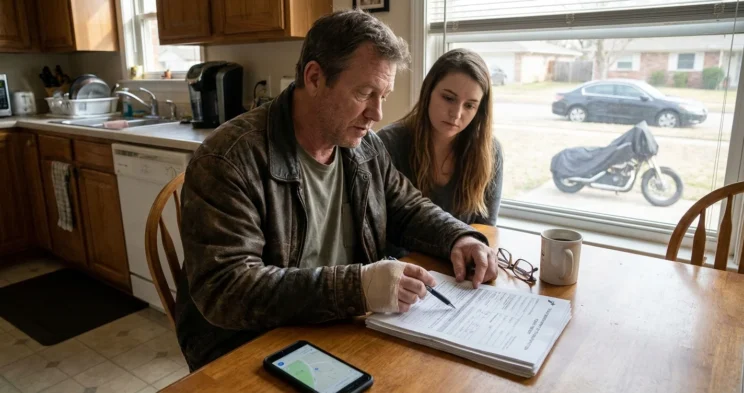
You walked away from the crash on I-35, but the weeks after have been harder than the impact itself. Medical bills are stacking up, the insurance adjuster keeps calling, and somewhere in a TxDOT database there is an official document that could make or break what you receive as compensation.
That document is the Texas Peace Officer’s Crash Report, known as the CR-3. Getting a copy quickly, knowing what it says, and knowing what to do when it is wrong are the three things riders most often wish they had understood earlier.
What Is the Texas CR-3 & Why You Need It
The CR-3 is the official written record of your crash, prepared by the investigating officer. Under the Texas Transportation Code § 550.062, the officer must file the report electronically with the Texas Department of Transportation within 10 days of the crash date.
Insurance companies and attorneys treat the CR-3 as the foundational document in any motorcycle injury claim. The weight a crash report carries in your case is significant: every checkbox, diagram, and written narrative becomes evidence that insurers use to evaluate fault in the accident and calculate what they are willing to pay.
Getting your copy early gives you time to review it before the claims process moves forward. Riders who wait often discover too late that errors in the report shaped an offer they already accepted.
How to Request Your Motorcycle Crash Report
You can order your CR-3 directly through TxDOT’s online portal in a few minutes. Here is the process:
Step 1: Go to the TxDOT Crash Records page. The official access point is the TxDOT Crash Reports and Records portal. From there, you will be directed to the Crash Records Information System (CRIS) purchase portal at cris.dot.state.tx.us.
Step 2: Search for your report. You can locate your report using any of the following: your name or the other driver’s name, a driver’s license number, the VIN of a vehicle involved, or the TxDOT crash ID if you have it.
Step 3: Pay and download. A standard copy costs $6. A certified copy, which is required for court filings, costs $8. Payment is made by debit or credit card.
Most reports are available within 10 to 14 days of the crash, because the officer has up to 10 days to file. If you need the report sooner and it is not yet in the system, contact the investigating agency directly.
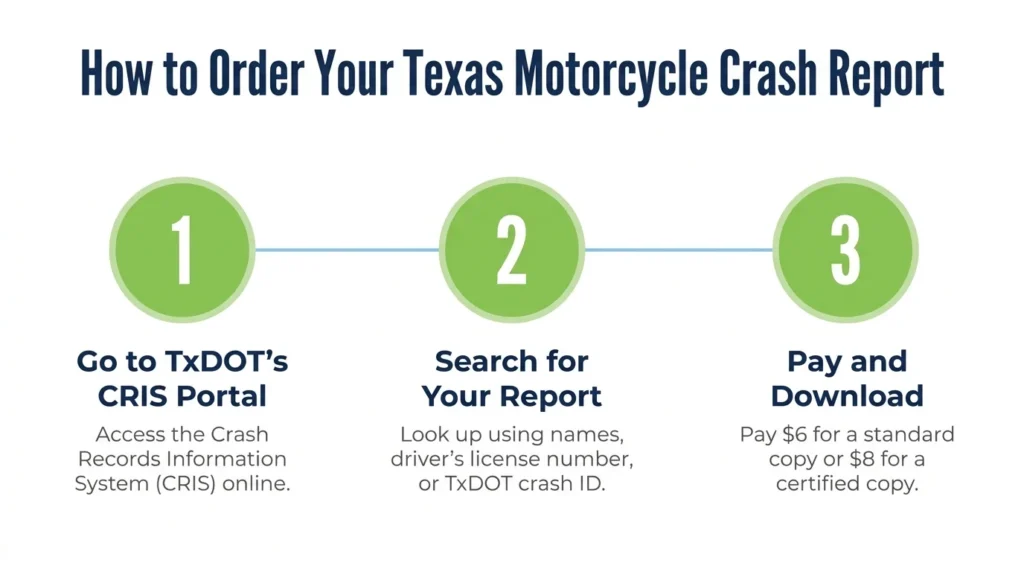
As of January 1, 2025, TxDOT no longer accepts crash report requests by mail. The CRIS online portal at cris.dot.state.tx.us is the only way to purchase your report. For a broader overview of the crash report request process in Texas, review how to look up your Texas accident report.
What Your Motorcycle Crash Report Contains
Once you have the CR-3, you will find several sections worth reviewing carefully. The report documents the crash date, time, location, road surface and weather conditions, every vehicle and driver involved, and each party’s insurance information.
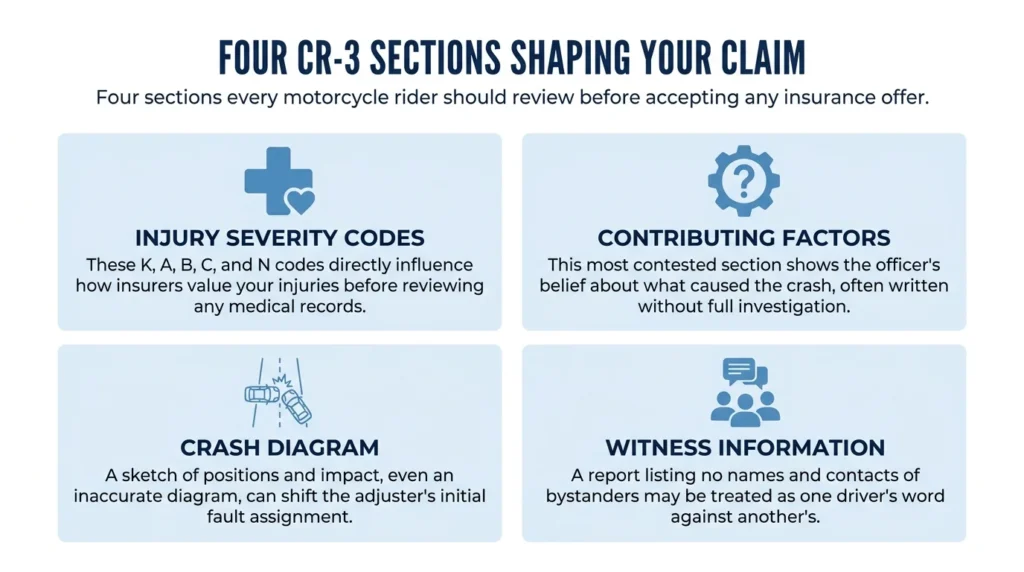
The injury severity codes tell you how the officer classified what happened. K means fatal, A means incapacitating injury, B means non-incapacitating, C means possible injury, and N means not injured. These codes influence how insurers value your claim, even before medical documentation is reviewed.
The contributing factors section is the most contested part of any motorcycle crash report. This is where the officer recorded what they believed caused the collision: speeding, failure to yield, following too closely, distracted driving, or road conditions. In motorcycle crashes, riders often find this section reflects assumptions about their behavior rather than a thorough review of the evidence.
The crash diagram shows the position and direction of each vehicle at the time of impact. Review it against your own recollection and any photos from the scene. When the diagram does not match reality, you must address it before your claim is settled.
Witness information, including names and contact details, appears in a dedicated section near the end of the report. This is frequently overlooked, but witnesses who saw the crash from a clear vantage point can change the entire fault picture. Contact them early, while the event is still fresh.
Understanding how motorcycle accident settlements are calculated starts with these essential documents.
Disputing Errors in Your Crash Report
Two types of errors show up on CR-3 reports, and how you handle each one is different.
Clerical errors include misspelled names, a wrong license plate number, an incorrect crash date, or a missing vehicle. These are the easiest to fix. Contact the investigating officer’s agency, explain the error, and provide documentation. The agency can fix the report with a corrected version.
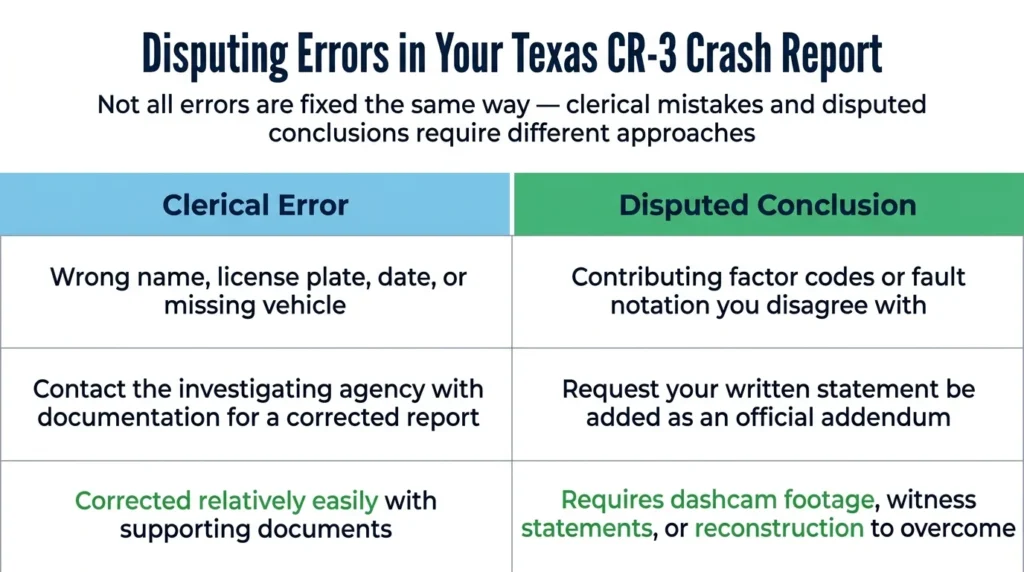
Disputed conclusions are harder. The officer’s determination about contributing factors or who is at fault is a professional judgment call. Officers rarely change those findings without compelling physical evidence or witness statements that directly contradict what they wrote. Photos from the scene, dashcam or traffic camera footage, and statements from independent witnesses are the strongest tools for challenging a disputed entry.
If the officer declines to amend the report, you have another option. Request that your written statement be added as an addendum to the official record. This does not change the original report, but it becomes part of the file. Insurers and courts can then see your account alongside the officer’s.
For a detailed walkthrough of the dispute process, including what documentation to gather and how to approach the conversation with the reporting agency, review how to dispute a police report in Texas.
Get Legal Help With Your Motorcycle Claim
If the report raises questions about how fault was recorded, an attorney experienced with motorcycle claims can review the CR-3 and advise you on your options before the insurance process goes further.
The CR-3 is where your claim starts, not where it ends. Angel Reyes & Associates has helped injured motorcyclists across Texas for over 30 years. We review crash reports as part of every free consultation and can identify errors or disputed entries that affect your compensation.
We work on contingency. You pay nothing unless we win. If you have questions about what your report says, what it means for your claim, or how to challenge what is in it, reach out to us today to schedule your free consultation.
Our motorcycle accident attorneys understand how insurers use the CR-3 against riders. We work with investigators and accident reconstruction specialists to build a picture of what actually happened. You do not have to read the report alone or accept the conclusions.
Past results do not guarantee future outcomes.
Motorcycle Accident CR-3 Report FAQs
Can anyone request my Texas motorcycle crash report?
Texas law restricts access to the full unredacted CR-3. Parties directly involved in the crash, their insurers, and their legal representatives can receive the complete report. Third parties who are not connected to the crash receive a redacted version with personal information removed.
What if the police did not file a crash report for my motorcycle accident?
Texas requires officers to file a CR-3 when a crash causes injury or property damage of at least $1,000. If no report was filed and your crash meets that threshold, contact the investigating agency or TxDOT directly. You can also file your own report in some cases, though an officer-filed CR-3 carries more weight with insurers.
Does the crash report decide who is at fault in Texas?
The CR-3 is one factor insurers consider, but it does not legally determine fault. Texas follows a proportionate responsibility system where fault is assigned by percentages, and you can recover compensation as long as you are not more than 50 percent responsible. An insurer’s fault decision based on the report can be challenged with additional evidence.
How long do I have to request my crash report in Texas?
There is no deadline to request the report from TxDOT, but older reports may be harder to access. Getting your copy within the first few weeks after the crash gives you the most time to review it, address any errors, and use it during the active insurance claims process.
About the Authors

Angel Reyes
Writer
Angel L. Reyes, III is the Founder and Managing Partner of Angel Reyes & Associates. A nationally recognized trial attorney and business leader, Angel has helped over 70,000 injury victims recover more than $1 billion since founding the firm in 1993. Named to the Texas Super Lawyers list annually since 2008, Angel brings Wall Street experience, Ivy League education, and a deep commitment to client advocacy. He is a frequent legal commentator and published author with extensive contributions to legal scholarship, trial strategy, and consumer protection.

Kyle Nicolas
Editor
Kyle Nicolas is the Web Content & SEO Manager at Angel Reyes & Associates. He has more than 10 years of experience as a marketing co...

Angel Reyes
Reviewer
Angel L. Reyes, III is the Founder and Managing Partner of Angel Reyes & Associates. A nationally recognized trial attorney and business...