Who Is Liable for a Road Rage Accident in Texas?


Every article on this site is researched by our internal team, reviewed for legal accuracy against current Texas law, and held to State Bar of Texas advertising standards before publication. We do not publish content that overstates outcomes or makes promises about results.
Learn more about our
editorial standards .
Key Takeaways
- A civil claim can proceed, even if the other driver faces no criminal charges.
- Insurers may deny road rage claims because many policies do not cover intentional acts.
- Uninsured motorist coverage may help provide compensation when the other driver's insurer denies the claim.
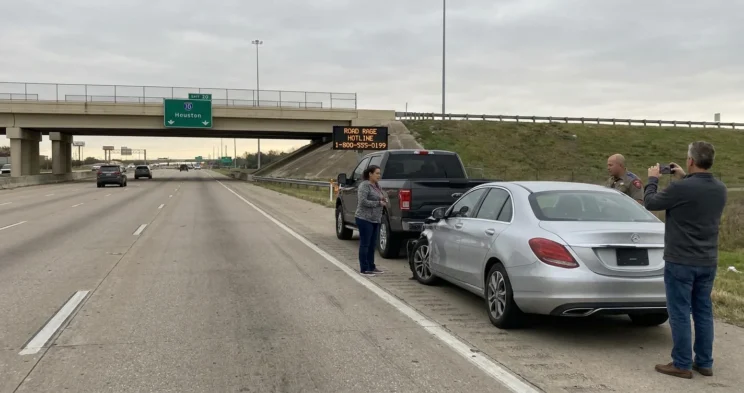
You are driving along Loop 410 when the driver behind you starts tailgating, swerves in front of you, and suddenly slams on the brakes. The impact sends your car into the guardrail, leaving you with a broken wrist, a totaled bumper, and a long list of questions about what happens next.
Once the adrenaline fades, you wonder who is responsible when the other driver causes the crash intentionally. A road-rage crash is different from an ordinary rear-end collision, especially if the other driver’s actions were deliberate or reckless.
Two Paths to Recovery After a Road Rage Crash
When a road rage incident causes a crash, Texas law opens two separate paths to recovery:
- A criminal case
- A civil claim for damages
Research from the AAA Foundation for Traffic Safety found that 96% of drivers reported engaging in aggressive driving or road rage behavior at least once in the past year, which shows how often this conduct can turn into a crash.
Criminal Charges for Road Rage
Road rage that involves bodily injury, threats, or offensive contact is typically charged as assault under Texas Penal Code § 22.01.
A road rage accident charge is separate from a civil claim filed against the driver. In a criminal case, prosecutors decide whether to pursue charges, but even if they decide not to, you may still have the right to file a civil claim for your injuries and other losses.
Civil Liability for Your Injuries
The other driver does not need to be charged with a crime or convicted for you to file a civil claim after a road rage crash. Depending on the driver’s actions, you may be able to sue for negligence, gross negligence, or intentional wrongdoing.
If a road rage crash proves fatal, surviving family members may also pursue a wrongful death claim under Texas law.
Do Criminal Cases Affect Civil Claims?
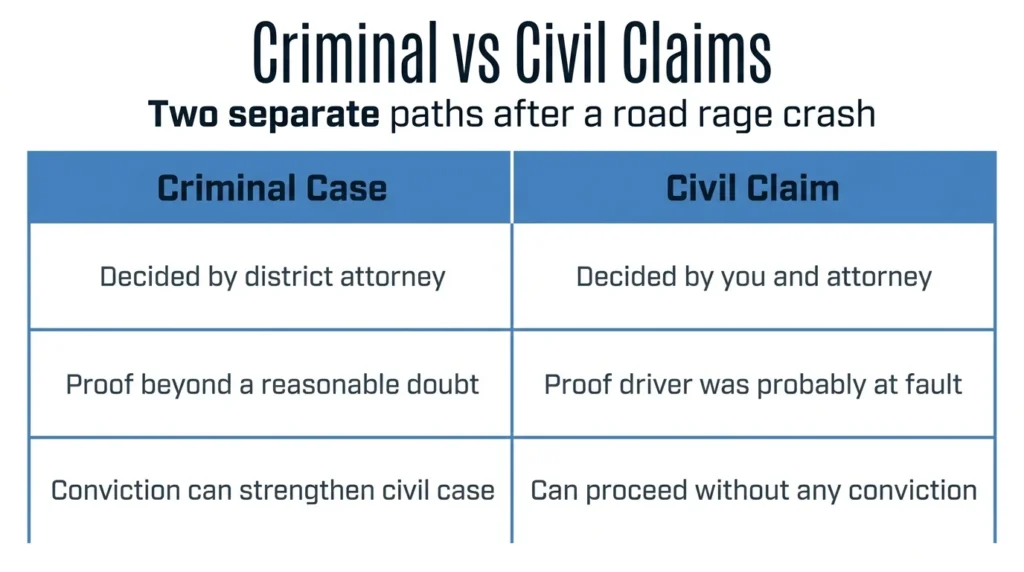
Criminal and civil cases are separate tracks, so a pending criminal case against the other driver does not determine the outcome of your civil claim. The district attorney controls the criminal case, while you and your attorney handle the civil lawsuit, and the two cases can move at very different speeds.
A criminal conviction against the other driver shows that they were at fault, which can strengthen your civil case. That is a real advantage, but it is not the only path to compensation. Criminal cases require proof beyond a reasonable doubt, but civil cases only need you to prove that the driver was probably at fault. This is a lower standard, and it means you may be able to recover compensation even if the other driver was never convicted.
Even if the other driver is never charged with a crime, you may still have a valid civil claim. Your case depends on whether the driver’s actions meet the legal standards for negligence or intentional wrongdoing, not on the criminal outcome. Before assuming your case is invalid because there were no criminal charges against the other driver, it may help you to understand how reckless driving is defined under Texas law.
What Evidence Proves a Road Rage Case?
Strong evidence can make it harder for an insurer to dismiss a road rage claim. Start collecting evidence as soon as possible after the crash, while the details are still fresh.
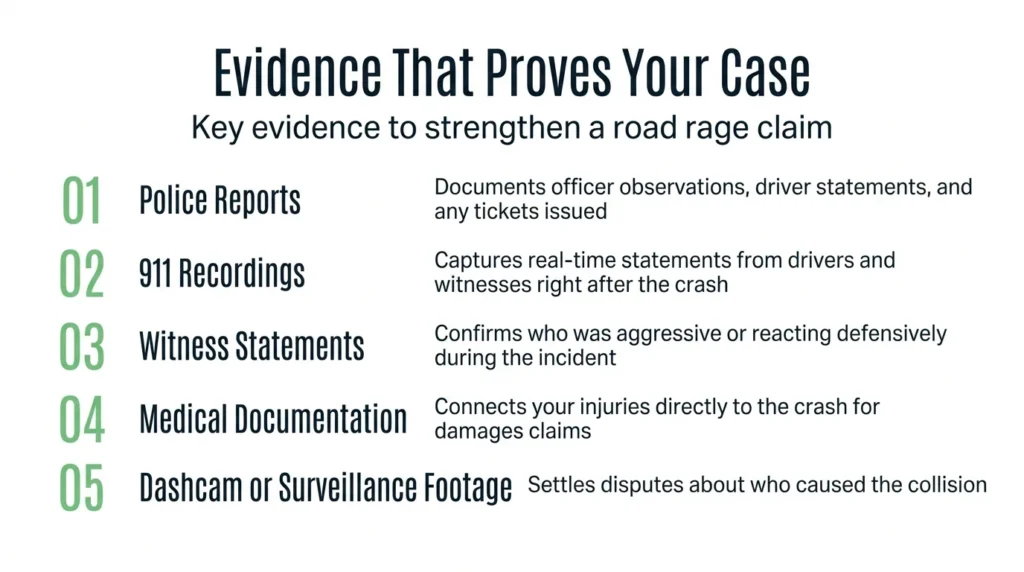
Here is the evidence that will help prove your road rage case:
- Police reports: A police report documents the officer’s observations at the scene, including statements from both drivers and any tickets that were issued. It can serve as the foundation of your claim.
- 911 recordings: Calls placed during or right after the crash capture real-time statements from drivers and witnesses, before anyone has had time to reconsider what they said.
- Witness statements: Other drivers or bystanders who saw the incident can confirm who was aggressive or reacting defensively.
- Medical documentation: Medical records connecting your injuries directly to the crash will support both the criminal case and your damages claim.
- Dashcam or surveillance footage: Footage from your dashcam, a nearby business, or a traffic camera can settle disputes about who caused the collision.
Does Insurance Cover Road Rage Accidents?
Texas auto liability policies generally exclude coverage for intentional acts. If a driver’s conduct is classified as intentional rather than negligent, the insurer may deny the claim. This exclusion is usually part of the insurance policy itself, rather than a Texas law about road rage specifically. Insurers use it to avoid paying claims tied to actions that were deliberate, rather than careless.
The consequences of this can be serious. If the driver’s insurer denies the claim, then you may have to seek payment directly from the driver. If the driver has few assets, then collecting the money you are awarded may be difficult or even impossible.
The Coverage Problem After Road Rage
Texas law allows exemplary (or punitive) damages when a driver’s conduct involved malice, fraud, or gross negligence, under Texas Civil Practice and Remedies Code § 41.003. These damages are meant to punish the driver, rather than simply to compensate you for your losses.
Exemplary damages are capped under Section 41.008. The limit is generally the greater of $200,000, or two times economic damages plus an amount equal to your non-economic damages, up to $750,000. For a simple explanation of how this limit is calculated, read our punitive damages explainer.
Here’s the catch. The same intentional conduct that may allow you to seek punitive damages in the first place may also give the insurance company a reason to deny covering them. Even if you receive a large award, that does not guarantee you will actually receive the payment.
Your Options After an Insurance Claim Is Denied
An insurance denial does not necessarily end your options for recovering compensation.
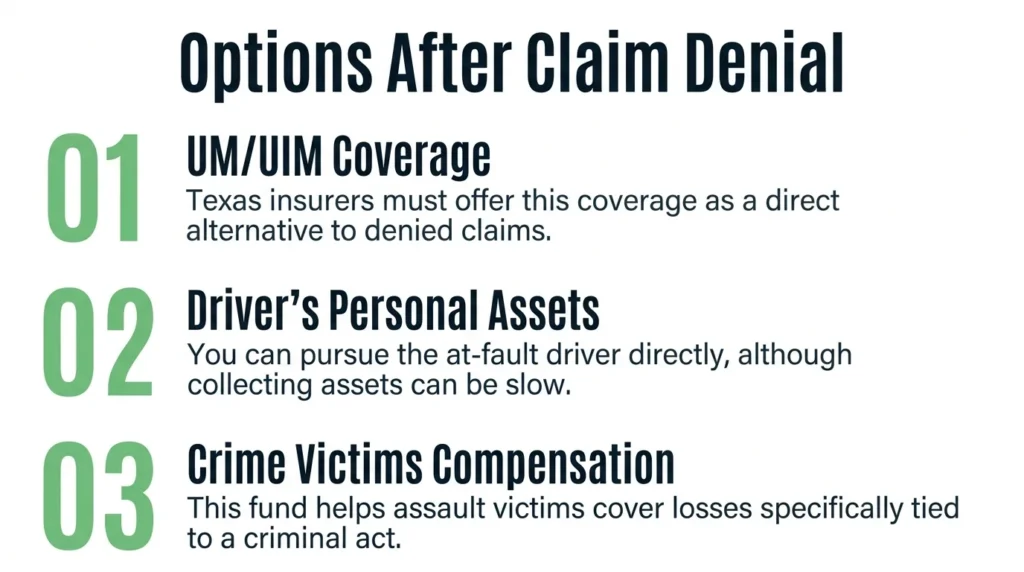
Uninsured or underinsured motorist coverage, which Texas insurers must offer under Texas Insurance Code § 1952.101, is often the most direct alternative when the at-fault driver’s own liability coverage denies your claim. The Texas Department of Insurance explains how this coverage works and when it applies, and our guide to uninsured motorist claims explains the next steps you can take.
Finally, pursuing the at-fault driver’s personal assets also remains an option, though collection can be slow and uncertain. For victims of a road rage assault, the Texas Crime Victims’ Compensation Program can also help cover certain losses tied to the criminal act.
How Long Do You Have to File a Road Rage Lawsuit?
You generally must file a road rage lawsuit within two years of the crash date under Texas Civil Practice and Remedies Code § 16.003.
Missing that deadline can dismiss your right to recover, regardless of what happens in criminal court.
Work with an Attorney on Your Road Rage Crash Claim in Texas
A road rage crash can leave you facing medical bills, vehicle repairs, and an insurance company that is searching for reasons to deny your claim. You should not have to handle criminal proceedings, damage caps, and uninsured motorist coverage on your own.
Angel Reyes & Associates has recovered more than $1 billion for our clients, including cases built on intentional conduct and gross negligence, such as road rage crashes. Our firm works on contingency, which means you pay no fees unless we win your case.
Contact Angel Reyes & Associates today to discuss the next steps of your claim.
Past results do not guarantee future outcomes.
Road Rage Crash FAQs
What if I was partially responsible for the confrontation that led to the crash?
Texas follows a modified comparative negligence rule, so you can still recover damages if you were 50% or less at fault, but your compensation is reduced by your share of fault. If a jury finds you 51% or more responsible, then state law prevents you from recovering anything.
Can I hold the other driver's employer responsible if the road rage crash happened while they were on the job?
Texas courts generally treat intentional acts like road rage as falling outside an employee’s job duties, so the employer is usually not liable under vicarious liability rules. An employer can still be held responsible in rare cases when the aggressive conduct was closely tied to the work that the employee was performing at the time of the crash.
What if the other driver flees the scene before police arrive?
An unidentified driver who causes a crash and leaves is treated as an uninsured motorist under Texas law, so your own uninsured motorist coverage can still pay for your injuries. If there was no physical contact between vehicles, then insurers typically require an independent witness who can confirm that the other vehicle caused the crash.
Can I use my own auto insurance to pay my medical bills while my case is still pending?
Yes, if you carry personal injury protection (PIP) coverage. Texas insurers are required to offer PIP coverage, unless you reject it in writing. PIP coverage can pay your medical bills and part of your lost income, regardless of who caused the crash. This coverage often pays faster than a liability claim because it does not require a fault determination first.
Can I recover damages for emotional distress, even if I had no physical injuries caused by the crash?
Yes. Texas law allows a claim for intentional infliction of emotional distress when the other driver’s conduct was extreme and intentional, even without a physical injury. However, you generally need medical or mental health records showing that the distress was severe.
About the Authors

Angel Reyes
Writer
Angel L. Reyes, III is the Founder and Managing Partner of Angel Reyes & Associates. A nationally recognized trial attorney and business leader, Angel has helped over 70,000 injury victims recover more than $1 billion since founding the firm in 1993. Named to the Texas Super Lawyers list annually since 2008, Angel brings Wall Street experience, Ivy League education, and a deep commitment to client advocacy. He is a frequent legal commentator and published author with extensive contributions to legal scholarship, trial strategy, and consumer protection.

Graham Griffin
Editor
Graham Griffin is the Web & Content Manager at Angel Reyes & Associates, where he oversees content strategy, AI-powered workflows, a...

Angel Reyes
Reviewer
Angel L. Reyes, III is the Founder and Managing Partner of Angel Reyes & Associates. A nationally recognized trial attorney and business...