Should the Truck Have Had a Blind Spot Camera?


Every article on this site is researched by our internal team, reviewed for legal accuracy against current Texas law, and held to State Bar of Texas advertising standards before publication. We do not publish content that overstates outcomes or makes promises about results.
Learn more about our
editorial standards .
Key Takeaways
- Federal law requires only two mirrors, not cameras, radar, or alarms.
- Camera and radar systems are commercially available fleet options today.
- A carrier's tech choice can still support a Texas negligence claim.
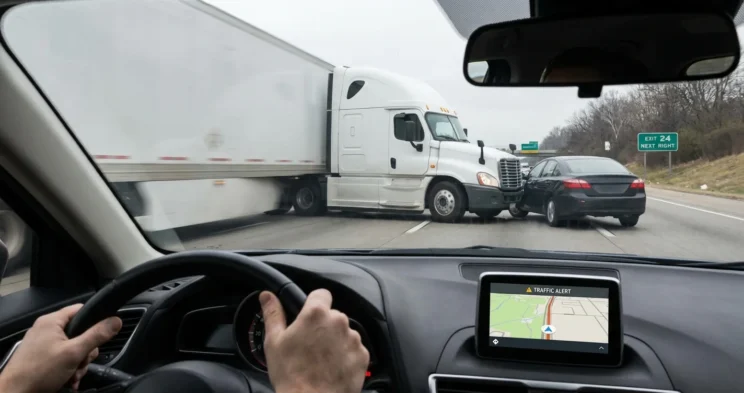
You keep replaying the moment the semi drifted into your lane. The driver never saw you.
When you pull the crash report, you learn something confusing. The truck had two mirrors, and that satisfied federal law.
No camera. No radar sensor. No alarm. That single fact does not end your case. It starts a different one.
Federal trucking law sets a mirror minimum written decades before camera systems existed. Meeting that minimum does not automatically mean the carrier acted with reasonable care. Texas negligence law asks what a reasonably prudent carrier would have done, given the safety technology already sitting on dealer lots and fleet order sheets.
What Federal Law Actually Requires: The Two-Mirror Rule Under 49 CFR 393.80
Federal law does not require a blind spot camera on a semi truck. 49 CFR 393.80, Rear-vision mirrors requires only two exterior rear-vision mirrors, one on each side of the tractor, firmly attached and free of damage that would block the driver’s view.
Those mirrors must meet FMVSS No. 111, the federal mirror performance standard that dates back to 1976. The rule itself was last amended in 2001.
A handful of narrow exceptions exist.
- Trucks built before 1981 can keep older mirrors if they are not replaced
- Some trucks with an interior mirror only need one exterior mirror
- Towed vehicles in a driveaway operation need at least one mirror with a clear rear view
None of those exceptions change the basic truck mirror requirements most fleets operate under.
A Rule Written Before Cameras Existed, & Technology FMCSA Still Treats as Optional
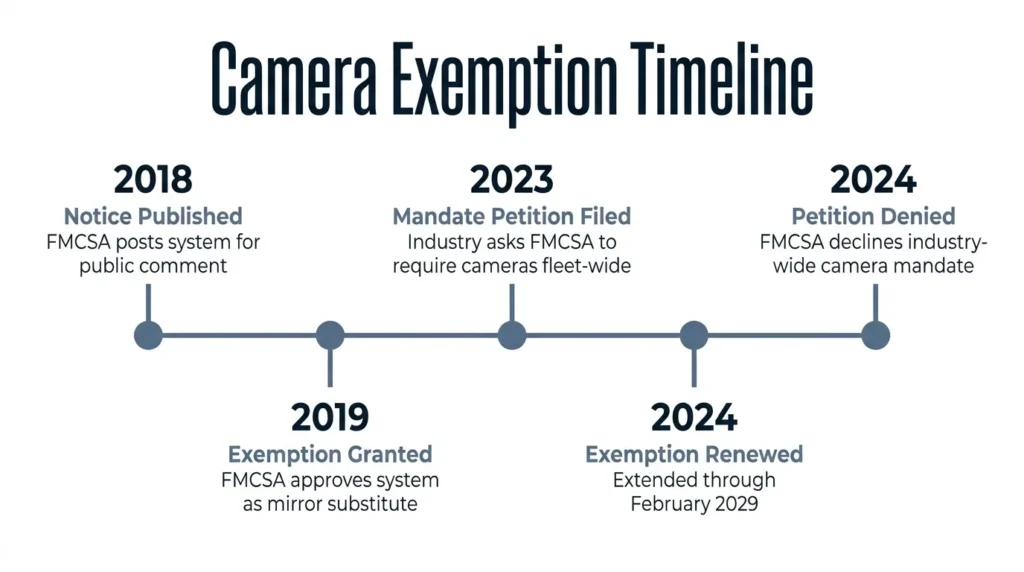
The mirror requirement predates camera-monitor technology by decades, and federal regulators still treat cameras as optional rather than mandatory. FMVSS No. 111 was written in 1976 for glass and convex mirrors, not electronic imaging.
The first federal approval for a camera system to replace mirrors did not arrive until 2019. The Federal Motor Carrier Safety Administration (FMCSA) published Stoneridge’s MirrorEye camera-monitor system for public comment on April 5, 2018, and granted the exemption on February 21, 2019.
FMCSA renewed that exemption on February 2, 2024, for the period from February 13, 2024 through February 12, 2029. In that notice, FMCSA restates the two-mirror requirement in its own words and confirms that carriers “may install and use” the camera system “in lieu of” the required mirrors. That is voluntary substitution, not an added mandate.
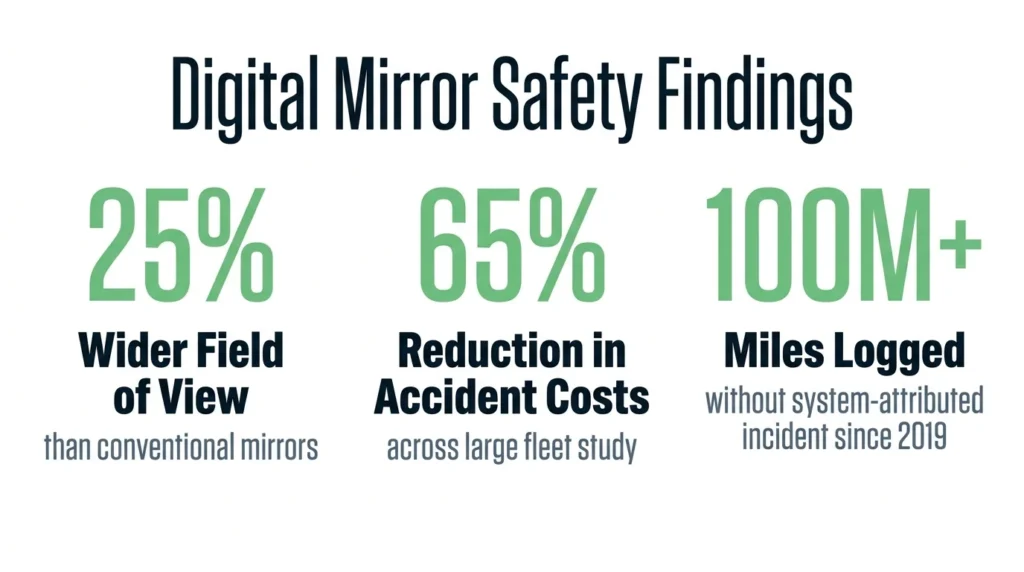
The same notice includes FMCSA’s own safety findings. The agency credits the camera system with:
- roughly a 25% wider field of view than conventional mirrors and elimination of blind spots on both sides of the truck
- an estimated 65% reduction in accident costs across a large fleet study
- more than 100 million miles logged without a system-attributed incident since 2019
FMCSA has also declined to force the issue industry-wide. A 2023 petition asked the agency to require side cameras and cabin monitors on all trucks. FMCSA denied that petition on June 12, 2024, according to trade press covering the decision (CDLLife; Overdrive).
None of this means a truck without a camera broke federal law. It means the technology has existed and been recognized as safer by the agency that writes these rules, for years without becoming mandatory. If a truck that hit you never carried this equipment, our truck accident attorneys can help you understand whether that gap matters to your case.
Camera, Radar, & Alarm Systems Carriers Can Already Buy
Camera systems, radar-based detection, and turn alarms are not experimental. Fleets order and install all three today.
Camera-monitor systems. Stoneridge’s MirrorEye system, the same technology covered by the FMCSA exemption, is offered as a factory option on the fifth-generation Freightliner Cascadia beginning with 2025 production, marketed as MirrorCam. Fleet reporting on the program’s development named J.B. Hunt and Schneider National among the carriers testing it.
Radar-based blind spot detection. The Bendix BlindSpotter Radar System can be ordered on a new tractor or added by a certified installer, and it integrates with Bendix’s broader Wingman Fusion and SafetyDirect fleet safety platforms. WABCO’s OnSide system uses short-range radar covering roughly 65% of a standard 53-foot trailer and escalates to an audible alert or seat vibration once the driver signals a turn. Bosch sells a comparable two-sensor-per-side radar system with an indicator light and an audible warning.
Turn-activated alarms. WABCO OnSide’s turn-signal-triggered alert functions as a built-in turn alarm. Established truck-equipment suppliers also sell comparable warning alarm hardware as standard catalog equipment, not a specialty add-on.
A carrier deciding whether to buy any of these systems is not choosing between something proven and something unproven. It is choosing between the mirror minimum and equipment already running on other companies’ trucks.
Why Meeting the Mirror Minimum Doesn’t End the Legal Question
A carrier with two compliant mirrors has not violated 49 CFR 393.80, and the absence of a camera is not a federal violation. However, that regulatory compliance merely sets the floor for safety; it was never written to define the ceiling. Because this is a question of common-law negligence rather than regulatory failure, compliance does not end the analysis.
Texas negligence law asks a separate question: whether the carrier acted the way a person of ordinary prudence would have acted under the same or similar circumstances. That standard, described in the Texas Pattern Jury Charges as ordinary care, is not capped by any single regulatory minimum. A jury applying it can weigh more than whether the mirrors met specification.
A jury can weigh whether the carrier knew camera, radar, and alarm technology existed. It can weigh whether that technology was priced and available for its trucks, and whether a reasonably prudent carrier would have added it given the safety benefit involved.
The Evidence That Turns “Available Technology” Into a Provable Choice
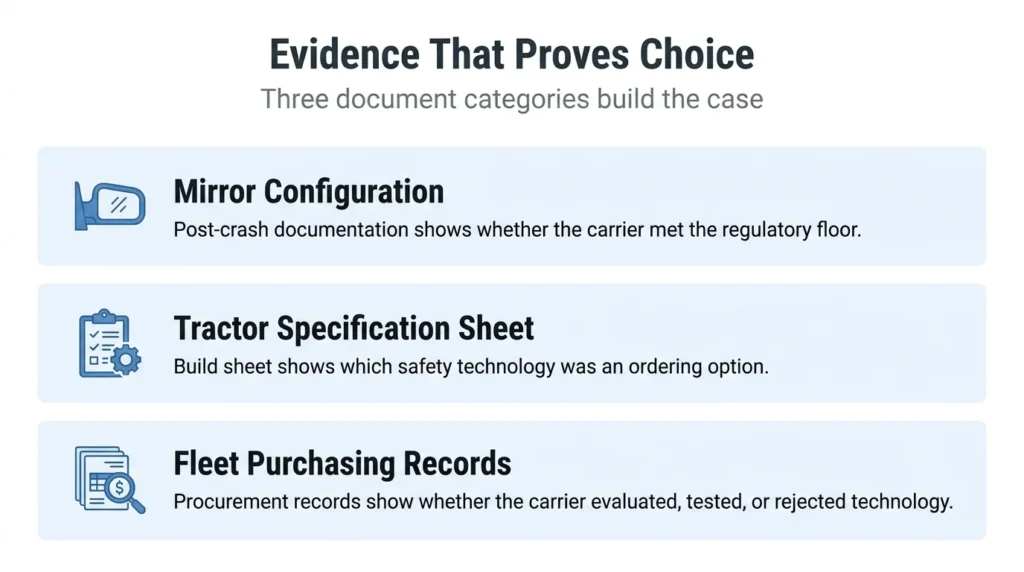
Proving this kind of claim depends on documents, not assumptions. Three categories of evidence typically matter most.
- Mirror configuration. Post-crash documentation of the truck’s actual mirrors, including make, model, FMVSS 111 markings, and condition, establishes whether the carrier met the regulatory floor in the first place.
- Tractor specification sheet. The manufacturer’s build sheet shows which safety technology, including camera and radar packages, was an actual ordering option for that tractor’s model and year, and whether the carrier chose it or declined it.
- Fleet technology purchasing records. Company-wide procurement and safety records can show whether the carrier evaluated, tested, purchased, or rejected this technology across its fleet, which speaks to both notice and choice.
An attorney who knows how to request and read these records can turn a general question about available technology into specific proof about what one carrier knew and decided.
Talk to Angel Reyes & Associates About Your Truck Accident Case
Whether a trucking company should have equipped its trucks with available blind spot technology is a fact-specific question. You should not have to answer it alone.
Angel Reyes & Associates has spent more than 30 years guiding injured Texans through claims against trucking companies and their insurers. Our team of more than 600 dedicated professionals can review the mirror configuration, the tractor’s spec sheet, and the carrier’s purchasing history to see whether this carrier had the chance to do more and chose not to.
With more than 20 offices across Texas, our team is available 24/7 to offer service in English and Spanish, with no fees unless we win. Contact us for a free consultation to talk through what happened to you and learn how we have recovered more than $1 billion for our clients.
Past results do not guarantee future outcomes.
Truck Blind Spot Camera Requirements FAQs
Does federal law require a trucking company to install a blind spot camera?
No. Under 49 CFR 393.80, a truck or truck-tractor only has to have two exterior rear-vision mirrors, one on each side, that meet the FMVSS No. 111 mirror standard. The rule does not require a camera, radar sensor, or proximity alarm of any kind, so a truck with two compliant mirrors and nothing else still meets the federal floor.
Can a semi truck legally use cameras instead of mirrors?
Yes, but only under a specific federal exemption, not as a general rule. The Federal Motor Carrier Safety Administration granted Stoneridge, Inc. an exemption in February 2019, later renewed in February 2024 through February 2029, allowing carriers to install and use its MirrorEye camera-monitor system “in lieu of” the required mirrors. That makes camera substitution a voluntary option FMCSA has approved for one system, not a change to what 49 CFR 393.80 itself requires.
If a carrier's mirrors were compliant, does that protect it from a negligence claim?
Not necessarily. Meeting the two-mirror rule means the carrier did not violate 49 CFR 393.80, but Texas negligence law asks a separate question: whether the carrier acted as a person of ordinary prudence would have acted under the same or similar circumstances. That standard is not capped by a single regulatory minimum, so a jury can still weigh whether a reasonably prudent carrier, aware of available camera, radar, or alarm technology and its demonstrated safety benefit, should have added it.
What kind of evidence shows a carrier knew about & declined available blind-spot technology?
Three categories typically matter. Post-crash documentation of the truck’s actual mirror setup shows whether the carrier met the regulatory floor. The tractor’s manufacturer specification sheet shows what camera or radar packages were an actual, priced ordering option for that model and year, and whether the carrier chose or declined them. Fleet-wide procurement or safety-committee records can show whether the carrier evaluated, tested, purchased, or rejected the technology across its trucks, which speaks to both notice and choice.
Are radar-based blind-spot systems & turn alarms already available to trucking fleets?
Yes. Systems such as the Bendix BlindSpotter Radar System and WABCO’s OnSide are ordered on new tractors or added by certified installers, and they detect objects in a truck’s blind spot with visual, audible, or vibration alerts, including alerts triggered when the driver signals a turn. These are established commercial products offered by mainstream truck-safety-equipment manufacturers, not experimental or unproven technology.
About the Authors

Alex Ivanov
Writer
Alex Ivanov is a personal injury attorney at Angel Reyes & Associates, focused on car, truck, and motorcycle accident cases. Licensed in Texas and multiple federal districts, Alex brings international legal experience and a global education to his practice. He earned his LL.M. from Texas A&M University School of Law after graduating from Belarussian State University in 2016. Alex is fluent in Russian, English, Ukrainian, and Belarussian, and is recognized by multiple national trial lawyer associations for his results and leadership under 40.

Kyle Nicolas
Editor
Kyle Nicolas is the Web Content & SEO Manager at Angel Reyes & Associates. He has more than 10 years of experience as a marketing co...

Angel Reyes
Reviewer
Angel L. Reyes, III is the Founder and Managing Partner of Angel Reyes & Associates. A nationally recognized trial attorney and business...