Uber Accident in a Construction Zone in Texas


Every article on this site is researched by our internal team, reviewed for legal accuracy against current Texas law, and held to State Bar of Texas advertising standards before publication. We do not publish content that overstates outcomes or makes promises about results.
Learn more about our
editorial standards .
Key Takeaways
- A rideshare work zone crash can name the driver, Uber, a contractor, and TxDOT
- Uber's $1 million policy applies if the driver was on an active trip during the crash
- A TxDOT claim needs written notice within six months, far shorter than the 2-year limit
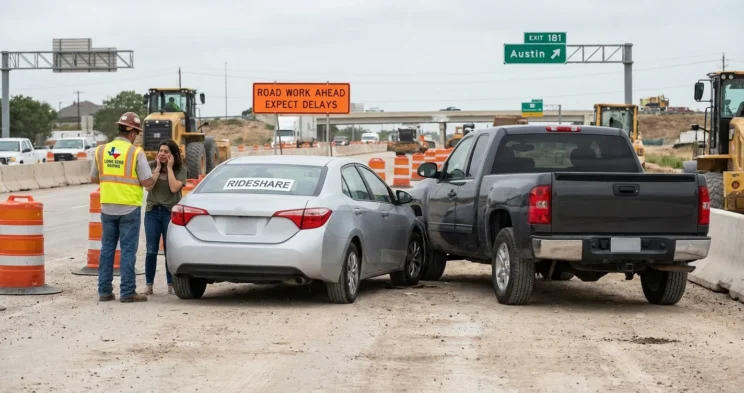
You were riding in an Uber through a narrowed work zone on I-35 outside Austin when traffic suddenly merged, barriers closed in, and the crash happened in seconds. Now you are hurt, and the questions are piling up faster than answers. Who pays for this when the road itself was part of the problem?
Rideshare Crashes in Texas Work Zones
A rideshare crash inside a construction zone is legally different from a normal collision because more than one party usually shares the blame. The road conditions themselves can become part of the case.
Texas work zones stack hazards on top of each other. You face reduced speed limits, temporary lane closures, missing or confusing signage, and road layouts that change overnight. Even an attentive driver can get caught off guard. The Texas Department of Transportation tracks these dangers through its statewide work zone safety program.
Now add a rideshare driver following GPS through an unfamiliar setup. The mix of distraction and shifting road conditions changes the usual fault analysis. The people who may share blame reach well beyond the driver.
A standard two-car wreck names two parties. A rideshare work zone crash can name the driver, the rideshare company, the construction contractor, and a government entity in the same claim. That is why these cases get complicated, and why pinning down every responsible party early can change what you recover.
Uber’s Insurance Coverage in a Work Zone
Uber’s coverage depends on the driver’s app status at the moment of the crash, not on where the crash happened. If you were a passenger on an active trip, a $1 million commercial policy applies.
Uber uses a three-period model tied to what the driver was doing in the app. The active period decides how much coverage you can reach.
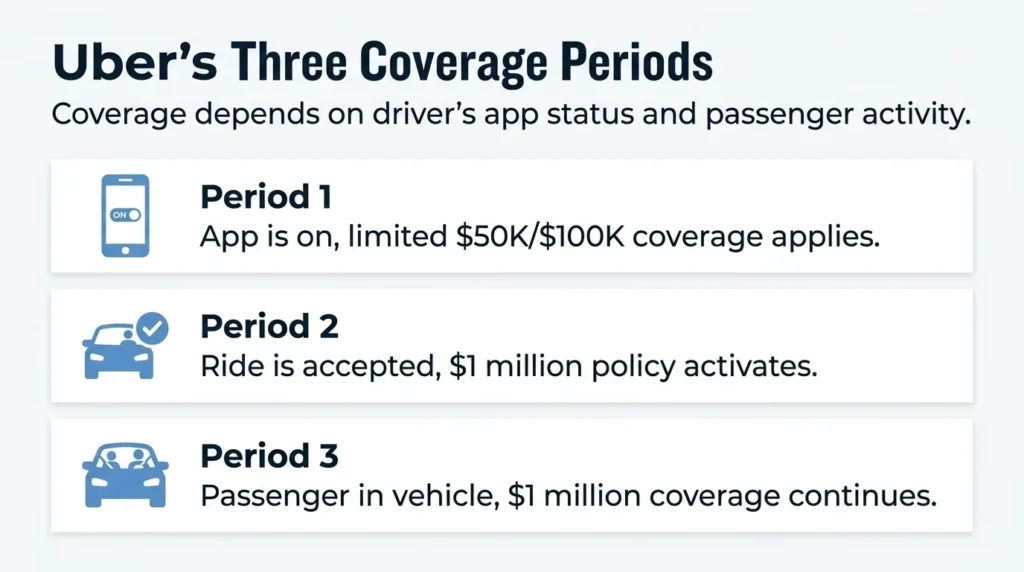
Here is how the three periods break down:
- Period 1 (app on, no ride accepted): Uber provides limited contingent coverage — $50,000 per person, $100,000 per incident, and $25,000 for property damage — as required by Texas Insurance Code Chapter 1954.
- Period 2 (ride accepted, driver en route): A $1 million liability policy activates.
- Period 3 (passenger in the vehicle): The $1 million policy stays active and covers injuries from the work zone crash.
The construction zone does not void or shrink this coverage. If your driver was on an active trip, the commercial policy applies no matter how bad the road conditions were. You can read more about whether you can sue Uber after a Texas crash and how its policy responds.
Uber calls its drivers independent contractors, which limits how directly the company answers for a driver’s mistakes. The mandatory insurance tiers under Texas Occupations Code Chapter 2402 still apply. That keeps the commercial policy available even when Uber disputes the employment question.
Who Is Liable for a Work Zone Crash?
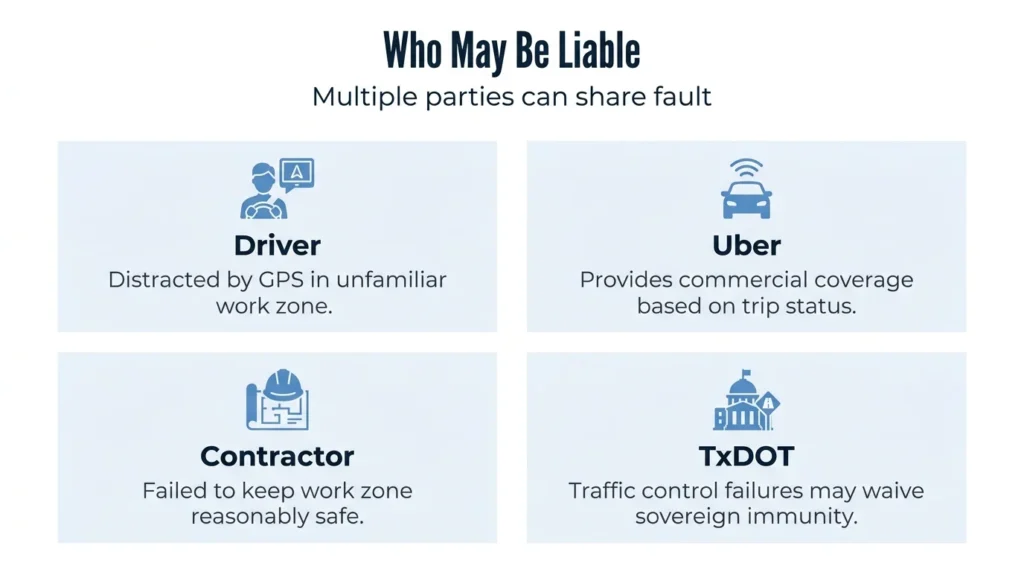
Liability can spread across the driver, the construction contractor, and a government agency like TxDOT. Texas Civil Practice and Remedies Code (CPRC) Chapter 33 controls how fault gets divided when several parties are at fault.
Under this system, each defendant is responsible for a percentage of the total damages equal to their share of fault. A defendant whose fault share exceeds 50 percent also becomes jointly and severally liable, meaning they can be held responsible for the full judgment.
You recover nothing if your own fault exceeds 50 percent — that is the rule that matters most when the driver, contractor, and TxDOT are all named.
Construction Contractor Liability
A contractor that fails to keep its work zone reasonably safe can be held liable like any private party under ordinary negligence rules. The protections that shield the government do not apply to a private company.
Contractor duties cover the basics of a safe site: proper signage, adequate lighting, debris-free lanes, and compliance with the Texas Manual on Uniform Traffic Control Devices. A failure in any of these can establish negligence. TxDOT publishes the standards contractors must follow for work zone traffic control.
Proving contractor fault means gathering the right records. Lane control plans, TxDOT project oversight documents, signage inspection logs, and any prior complaints or citations tied to the site all help show what went wrong.
Government Entity Liability
When TxDOT or the managing agency contributed through its own negligence, a separate and stricter process applies because government entities carry sovereign immunity. That immunity is not absolute.
Texas Tort Claims Act, found in CPRC Chapter 101, waives that immunity in limited situations, including dangerous conditions on government-controlled premises. TxDOT can face liability if its own traffic control failures helped create the crash conditions.
The distinction is practical, not just technical. A private contractor doing TxDOT work is not automatically shielded by sovereign immunity. A claim against that contractor is a standard negligence claim, while a claim against TxDOT itself means working through the Tort Claims Act and its tighter rules.
Deadlines That Affect Your Claim
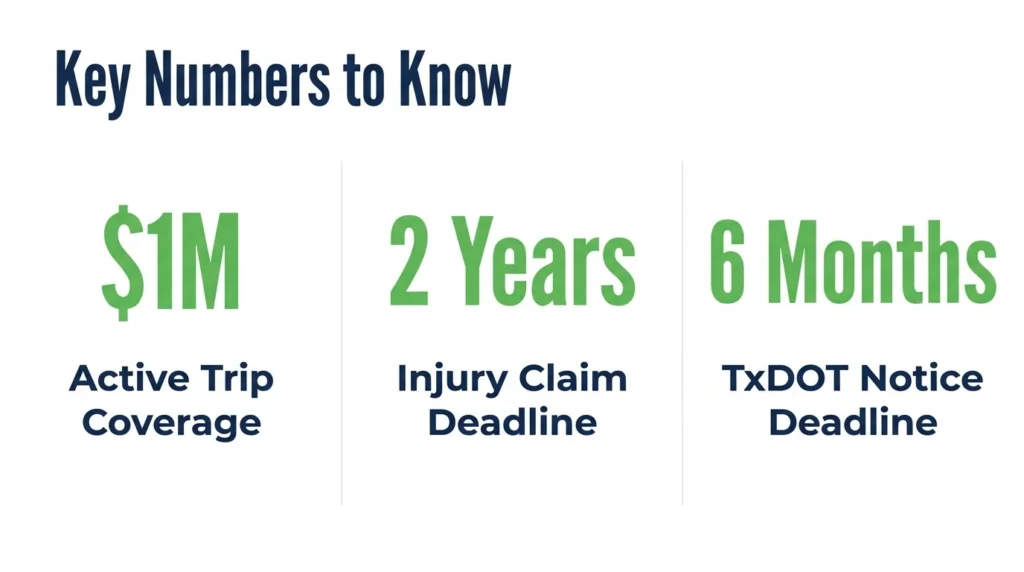
You generally have two years from the date of the crash to file a personal injury claim under Texas Civil Practice and Remedies Code (CPRC) SS 16.003. This deadline applies to claims against the driver, the rideshare company, and the construction contractor.
A government claim runs on a much shorter clock. When TxDOT or another agency is a potential defendant, the Texas Tort Claims Act requires written notice within six months of the crash. Miss that notice and you can lose the government claim for good, even with the two-year window still open.
A crash involving both a private contractor and TxDOT means two deadlines run at once. Identifying every potential defendant early decides which deadlines apply to your case. Acting quickly to pin down every responsible party helps make sure no notice deadline slips past while you focus on recovering.
Work with an Experienced Attorney Today
A rideshare construction zone crash rarely involves a single party or a single deadline, and sorting through overlapping coverage and notice rules is hard while you are healing.
Angel Reyes & Associates has spent over 30 years helping injured Texans untangle exactly this kind of multi-party claim. We can identify every responsible party, line up the right insurance coverage, and protect each filing deadline before it passes.
We work on contingency, so there is no fee unless we win, and our team has recovered more than $1 billion for clients across Texas injury claims. If you were hurt in a rideshare work zone crash, reach out for a free consultation to learn what your case may involve.
Past results do not guarantee future outcomes.
Rideshare Accidents in Construction Zones: FAQs
What evidence should I collect after a rideshare crash in a Texas work zone?
Take photos of the crash scene, including lane markings, signage, barriers, and any debris before it is cleared. Get the police report number, your driver’s trip receipt from the app, names of any witnesses, and records of all medical treatment you receive.
Can I be held partially at fault for a rideshare crash if I was a passenger?
As a seated passenger with no control over the vehicle, you are rarely assigned any fault under Texas law. Fault in these cases typically falls on the driver, the contractor, or the government agency, not the person riding in the backseat.
What if the Uber driver's app was completely off at the time of the crash?
If the driver had no active rideshare app session, Uber’s commercial policy does not apply. Your claim would be limited to the driver’s personal auto insurance, which often carries much lower limits than the commercial coverage.
Can I sue the construction contractor directly if the Uber driver did nothing wrong?
Yes. If the contractor’s failure to maintain a safe work zone caused the crash, you can bring a negligence claim against the contractor alone. You do not need to show the rideshare driver was at fault to hold the contractor responsible.
Does the 180-day government notice deadline apply if a city or county managed the work zone instead of TxDOT?
Yes. The Texas Tort Claims Act applies to all Texas governmental units, including cities and counties. Some cities also have their own charter notice requirements that can be even shorter than 180 days, so the specific managing agency matters.
About the Authors

Angel Reyes
Writer
Angel L. Reyes, III is the Founder and Managing Partner of Angel Reyes & Associates. A nationally recognized trial attorney and business leader, Angel has helped over 70,000 injury victims recover more than $1 billion since founding the firm in 1993. Named to the Texas Super Lawyers list annually since 2008, Angel brings Wall Street experience, Ivy League education, and a deep commitment to client advocacy. He is a frequent legal commentator and published author with extensive contributions to legal scholarship, trial strategy, and consumer protection.

Graham Griffin
Editor
Graham Griffin is the Web & Content Manager at Angel Reyes & Associates, where he oversees content strategy, AI-powered workflows, a...

Angel Reyes
Reviewer
Angel L. Reyes, III is the Founder and Managing Partner of Angel Reyes & Associates. A nationally recognized trial attorney and business...