Uninsured Motorist Claims for Passengers in Texas


Every article on this site is researched by our internal team, reviewed for legal accuracy against current Texas law, and held to State Bar of Texas advertising standards before publication. We do not publish content that overstates outcomes or makes promises about results.
Learn more about our
editorial standards .
Key Takeaways
- Texas passengers can file negligence claims against the driver of the car they were riding in.
- Your own UM coverage usually follows you as a passenger in someone else's vehicle.
- Uninsured drivers stay personally liable for damages through wages and non-exempt assets.
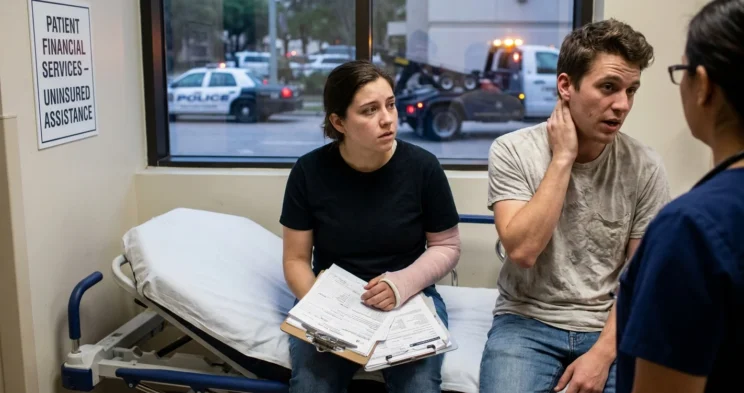
You climbed into a friend’s car for a quick ride across Houston, never thinking to ask about insurance. Then a sudden lane change turned into a crash, and now you’re sitting in an ER bay with mounting medical bills. Your friend admits the truth: no coverage.
Now you’re left wondering: who pays for any of this?
Passenger Rights Against Uninsured Drivers
Texas law lets you bring a negligence claim against any driver whose carelessness resulted in injuries, including the friend or family member who was behind the wheel. Under Texas Civil Practice and Remedies Code § 33.001, a claimant may not recover damages, or compensation for their injuries, if their percentage of responsibility for the accident is greater than 50 percent.
Your relationship to the driver does not change that calculation.
This surprises most injured passengers. The legal duty of a driver does not stop at strangers in other cars. It extends to the people sitting next to them.
You have the same rights as any other accident victim. That means you can seek compensation for medical bills, lost wages, and general pain and suffering. Riding with someone you know does not affect any of these rights.
The hard part for many passengers is the personal feeling of “suing” a friend. In practice, the claim usually targets an insurance policy, not the person. When the driver is uninsured, the compensation strategy changes.
Uninsured Motorist Coverage for Passengers
Your own auto insurance often follows you as a passenger in someone else’s vehicle. Under Texas Insurance Code § 1952.101, uninsured/underinsured motorist coverage must be offered with every auto policy in Texas unless you reject it in writing.
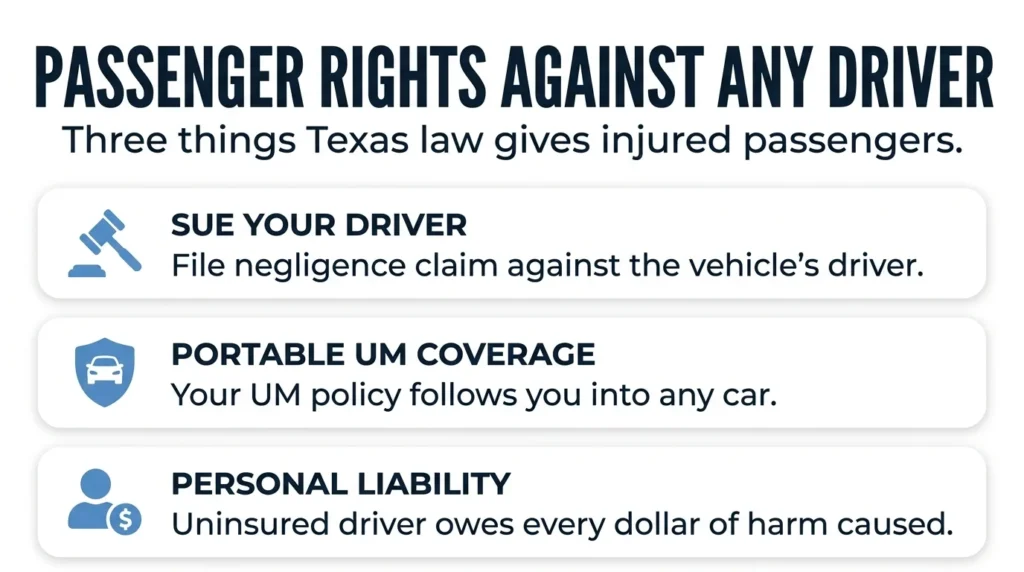
That portability is the most important fact for an injured passenger to understand. If you carry UM coverage, you may file a claim under your own policy even though you were riding in a different car driven by someone else.
When more than one policy could apply, a coverage hierarchy decides which pays first. This means the vehicle you were in is generally checked first, then your own policy, then policies of household members.
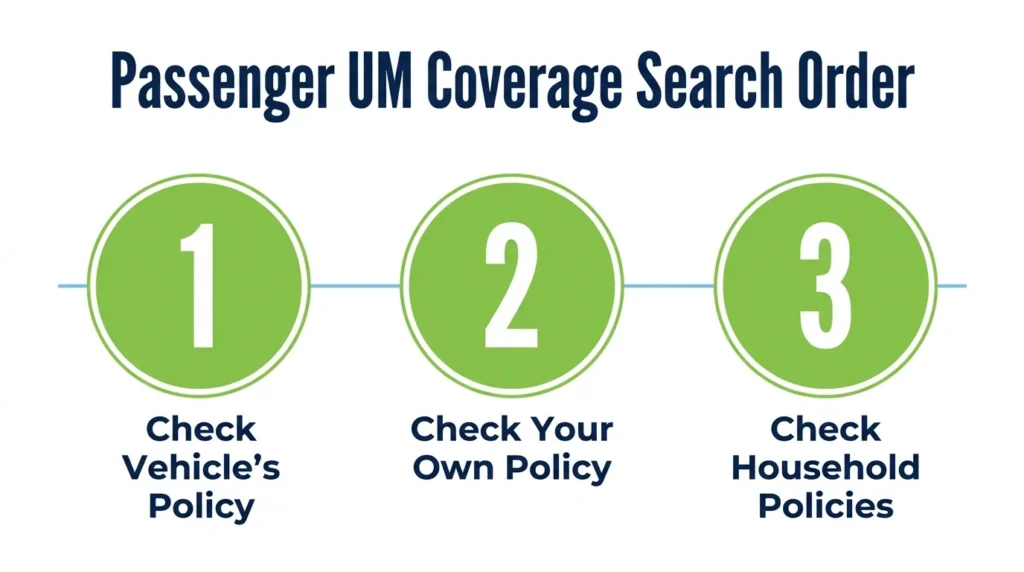
Do not assume you have no coverage just because you do not own a car. A parent, spouse, or relative in your household may carry UM benefits that extend to you. A careful policy review often shows options passengers did not know existed, and our uninsured motorist claims team handles these coverage questions every day.
Personal Liability of Uninsured Drivers
An uninsured driver remains personally responsible for every dollar of harm they cause. Texas Transportation Code § 601.051 requires drivers to carry minimum liability insurance, and skipping coverage does not erase the financial duty when someone gets hurt.
A court judgment against an uninsured driver becomes a collectible debt. Wages can be garnished, or withheld to pay a debt, in limited ways under Texas law. Bank accounts and non-exempt property, or property that is not legally protected from lenders, are reachable through standard collection tools.
Texas homestead protections shield a primary residence from collection, but they do not shield everything. Future earnings, tax refunds, and assets acquired later may still be sought out years after the judgment. The Texas Department of Insurance outlines how driving without insurance also triggers license suspensions and SR-22 requirements. An SR-22 requirement is a Certificate of Financial Responsibility.
The reality is uncomfortable for both sides. A driver without insurance often lacks the finances to pay a large compensation request. That is exactly why UM coverage helps when passengers are the ones holding hospital bills.
Recovery Options & Next Steps
The strongest passenger claims start with careful documentation in the first days after the crash. What you gather now affects every financial recovery option later.
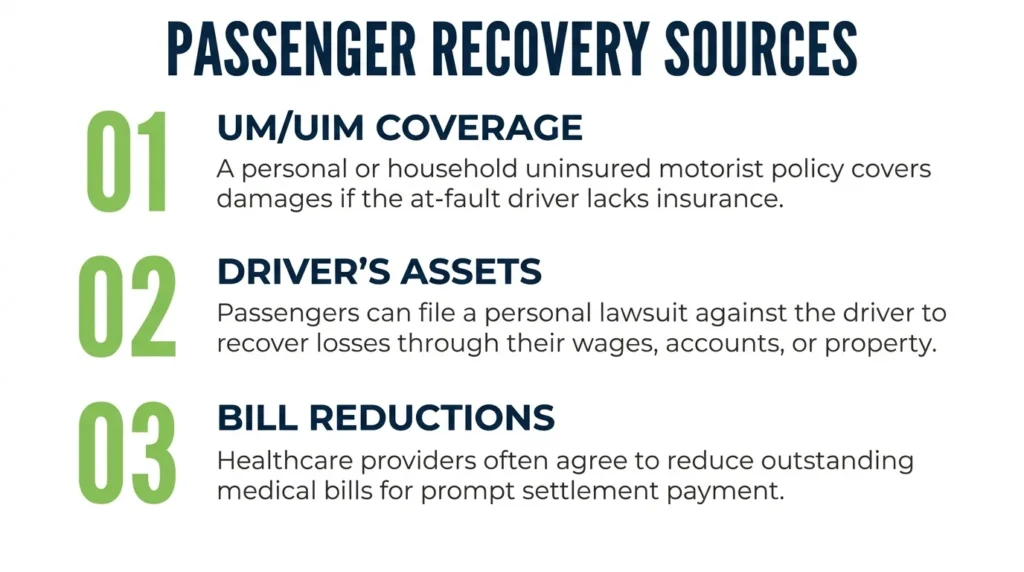
A simple intake checklist helps:
- Save every medical record, prescription receipt, and discharge instruction
- Photograph injuries as they heal and keep a daily symptom log
- Track missed work hours, lost shifts, and any reduced pay
- Request the crash report and any citations issued at the scene
- Identify every auto policy in your household and any policy covering the vehicle you rode in
Review all available coverage before deciding how to proceed. Many passengers discover UM benefits through a spouse, parent, or relative they live with. Our case results show how layered coverage often results in meaningful financial recoveries even when the at-fault driver was uninsured.
Timing matters too. A claim against UM coverage follows the contract terms in your policy, while a claim against the driver personally follows the two-year personal injury deadline. Coordinating both paths usually requires a careful strategy with an attorney rather than a rushed decision.
Speak with an AttorneyToday
Angel Reyes & Associates has recovered more than $1 billion for clients in car crash cases, including passenger injury claims involving uninsured drivers. Our attorneys work on a contingency fee basis, so you pay no attorney fees unless we recover compensation for you.
Contact Angel Reyes & Associates today for a free consultation about your passenger injury claim.
Uninsured Driver Coverage FAQs
How long do I have to file a claim if I was injured as a passenger by an uninsured driver?
You have two years from the date of the accident to file a personal injury lawsuit against the uninsured driver under Texas law. However, UM insurance claims may have shorter deadlines based on your policy terms, so review your coverage promptly.
Can an uninsured driver's car insurance still cover passenger injuries if they let their policy lapse?
No, a lapsed insurance policy provides no coverage for any injuries or damages. Once coverage ends because of non-payment or cancellation, passengers must look to their own UM coverage or pursue the driver’s personal assets.
What happens if both the driver and passenger are uninsured and have no UM coverage?
The injured passenger can still sue the at-fault driver personally for damages. Recovery depends on the driver’s assets, income, and ability to pay, though Texas law limits wage garnishment to certain types of debts.
Do I need to report the accident to my own insurance company if I was just a passenger?
Yes, you should notify your insurance company even as a passenger, especially if you plan to use your UM coverage. Most policies require immediate notice of accidents if they could result in claims.
Can multiple passengers in the same uninsured vehicle each file separate injury claims?
Yes, each injured passenger can file their own individual claim for their specific damages. However, if the passengers are requesting the driver’s personal assets for compensation reasons, multiple judgments may compete for the same limited financial resources.
About the Authors

Spencer Browne
Writer
Spencer Browne is a partner at Angel Reyes & Associates and a Board Certified personal injury trial lawyer with nearly 100 jury trials across Texas. He focuses on car, truck, and wrongful death cases, with notable verdicts including a landmark win in the Choctaw Casino bus crash case. A recognized speaker and legal educator, Spencer is a member of the American Board of Trial Advocates and has been honored as a Texas Super Lawyer and one of D Magazine’s Best Lawyers in Dallas. He brings deep trial experience and relentless advocacy to every client he represents.

Kyle Nicolas
Editor
Kyle Nicolas is the Web Content & SEO Manager at Angel Reyes & Associates. He has more than 10 years of experience as a marketing co...

Angel Reyes
Reviewer
Angel L. Reyes, III is the Founder and Managing Partner of Angel Reyes & Associates. A nationally recognized trial attorney and business...