Was the Truck Driver Medically Cleared to Drive?


Every article on this site is researched by our internal team, reviewed for legal accuracy against current Texas law, and held to State Bar of Texas advertising standards before publication. We do not publish content that overstates outcomes or makes promises about results.
Learn more about our
editorial standards .
Key Takeaways
- A truck driver needs a current Medical Examiner's Certificate to legally drive.
- 49 CFR 391.41 lists the conditions that disqualify a driver from operating a truck.
- The carrier's driver qualification file shows whether anyone checked the paperwork.

The 18-wheeler that changed your life on I-35 was operated by someone who was supposed to pass a federal medical exam before ever climbing into the cab. Whether that driver passed one, and whether the trucking company ever confirmed it, is a question the records can answer.
A commercial driver may not legally operate a truck without a current Medical Examiner’s Certificate showing they meet the physical qualification standards in 49 CFR 391.41(b).
The DOT physical requirements bind the trucking company as much as the driver. If a carrier put someone on the road without a valid certificate, or simply never looked, that failure belongs in your case.
What Counts as “Medically Cleared” Under Federal DOT Rules (and Texas Law)
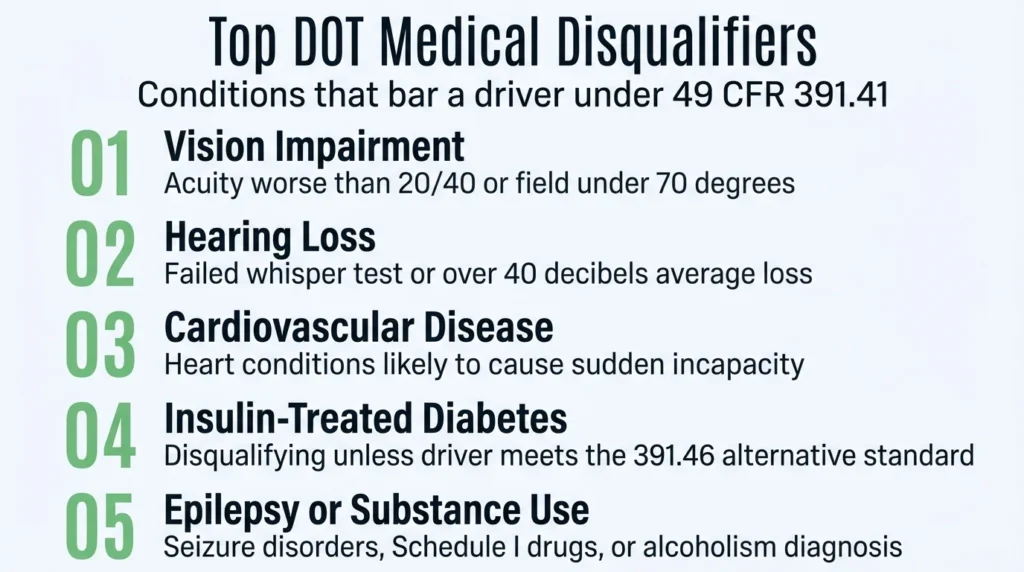
A driver is legally cleared only when a medical examiner has certified them as physically qualified under 49 CFR § 391.41. Section 391.41(a) also requires the driver to carry the original or a copy of that current certificate while operating.
The regulation then lists the conditions that disqualify a driver:
- Loss of a foot, leg, hand, or arm, absent an approved Skill Performance Evaluation certificate
- Distant visual acuity worse than 20/40 (Snellen) in either eye even with corrective lenses, a field of vision under 70 degrees in the horizontal meridian in either eye, or an inability to recognize standard red, green, and amber traffic signals
- Inability to perceive a forced whispered voice in the better ear at 5 feet, with or without a hearing aid, or an average hearing loss in the better ear greater than 40 decibels on an audiometric test
- A current clinical diagnosis of myocardial infarction, angina pectoris, coronary insufficiency, thrombosis, or other cardiovascular disease likely to cause sudden incapacity
- Diabetes mellitus currently treated with insulin, unless the driver qualifies under the alternative standard in 391.46
- Respiratory dysfunction or high blood pressure likely to interfere with safe operation
- Epilepsy or any other condition likely to cause loss of consciousness
- A mental, nervous, organic, or functional disease or psychiatric disorder likely to interfere with safe operation
- Use of a Schedule I controlled substance or a non-prescribed Schedule II through V substance, or a current clinical diagnosis of alcoholism
None of this is limited to trucks crossing state lines. Texas adopts the federal motor carrier safety rules, including 49 CFR Parts 390 through 393, for motor carriers operating in this state under 37 Tex. Admin. Code § 4.11, with only a short list of unrelated intrastate modifications such as the minimum driver age.
That counts for the local hauler running gravel between Fort Worth and Waco just as much as it does for the national fleet. In a Texas truck accident claim, the same physical qualification standard applies to both.
The Medical Examiner’s Certificate, Exam Records, and the National Registry
Only a medical examiner listed on the FMCSA National Registry may perform the exam and issue the certificate. 49 CFR § 391.43 sets those rules, with narrow exceptions allowing an ophthalmologist or optometrist to handle the vision component and allowing VA examiners to examine veteran drivers.
The examiner completes the Medical Examiner’s Certificate on Form MCSA-5876, gives the original to the driver, and signs and dates it with an office address and phone number. Since June 2018, examiners have also had to report exam results to FMCSA electronically on Form MCSA-5850 and to keep their exam records for at least three years.
One 2025 change closed a real gap. Under 391.43(g)(3), effective June 23, 2025, an examiner who finds a driver not physically qualified must tell the driver and report it to FMCSA, and every previously issued certificate for that person becomes void. A driver who fails an exam can no longer shop for a friendlier one.
Recertification timing comes from 49 CFR § 391.45. The default cycle is 24 months, insulin-treated drivers under 391.46 and vision-exception drivers under 391.44 recertify annually, and a driver must be reexamined after a condition that affects job performance or after a 391.43(g)(3) disqualification.
The verification mechanism changed on that same 2025 date, and the difference shapes what a carrier can be asked to produce:
- FMCSA now sends driver identification, exam results, and restriction or variance data from the National Registry to State Driver Licensing Agencies, which post it to the driver’s CDLIS motor vehicle record (Federal Register doc. 2021-13177)
- For CDL and CLP holders, the carrier’s primary verification path is now that CDLIS motor vehicle record rather than a manual National Registry check
- That electronic pathway is keyed to CDL and CLP holders, so for a driver who holds neither, the certificate itself remains the qualification record
The public National Registry of Certified Medical Examiners search tool is still live, and it still answers an important question after a crash. It confirms whether the specific examiner who signed a specific certificate was actually listed as certified when the exam happened.
When an unqualified driver causes a fatal collision, that same paper trail supports wrongful death claims brought by the family left behind.
Variance and Exemption Pathways: When a Driver Can Still Qualify
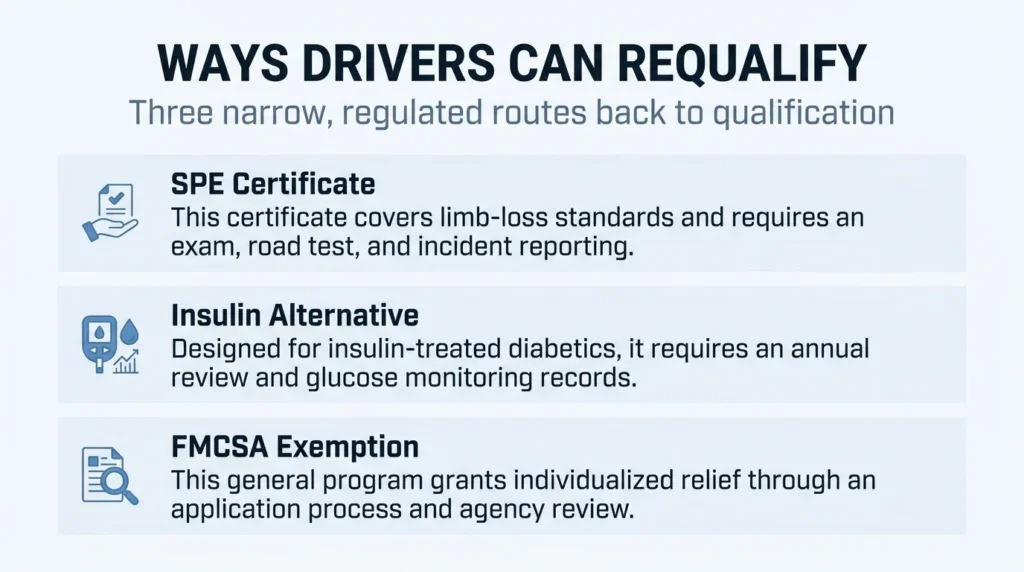
Failing one of the 391.41(b) standards does not ban a driver for life, but the routes back are narrow, regulated, and documented. A carrier cannot hand out an informal waiver.
Three pathways are active today:
- Skill Performance Evaluation certificate under 49 CFR § 391.49, for drivers who fail the limb-related standards in 391.41(b)(1) and (b)(2). It requires a medical evaluation, a road test, and documentation of the vehicle and route, lasts up to two years, and is renewable. The carrier must report any accident, arrest, or conviction involving that driver within 30 days.
- Alternative standard for insulin-treated diabetes under 49 CFR § 391.46. The treating clinician completes the Insulin-Treated Diabetes Mellitus Assessment Form (MCSA-5870), the medical examiner reviews it within 45 days and recertifies annually, and the driver self-monitors blood glucose with a data-logging glucometer while keeping at least three months of records. Unstable control, severe or proliferative retinopathy, or a severe hypoglycemic episode disqualifies the driver and triggers mandatory reporting.
- The general FMCSA exemption program under 49 CFR Part 381, Subpart C, which handles individualized relief from a physical qualification standard through an application, agency review, and decision.
Disagreement between doctors does not create a loophole either. Under 49 CFR § 391.47, when the driver’s examiner and the carrier’s examiner reach different conclusions, the party seeking review must submit an independent medical opinion and the driver’s full medical history to FMCSA, and the driver is deemed disqualified until FMCSA rules.
A trucking company holding two conflicting opinions does not get to keep the convenient one and send the truck out.
Building the Case: Did the Carrier Know or Fail to Check?
The carrier carries its own legal duty here, separate from the driver’s. 49 CFR § 391.11 makes physical qualification a baseline condition of being a qualified driver at all, and it prohibits a motor carrier from permitting an unqualified driver to operate a commercial vehicle.
49 CFR § 391.51 is where that duty becomes visible. Every motor carrier must maintain a driver qualification file containing the medical examiner’s certificate or a legible copy, along with any Skill Performance Evaluation certificate or variance documentation, and for CDL holders the carrier may instead rely on the medical certification status shown on the CDLIS motor vehicle record.
Most qualification documents stay in that file through employment plus three years, and medical certificates, annual motor vehicle records, and variance documents may be removed three years after they are created. That limited shelf life is why a preservation request should go out early.
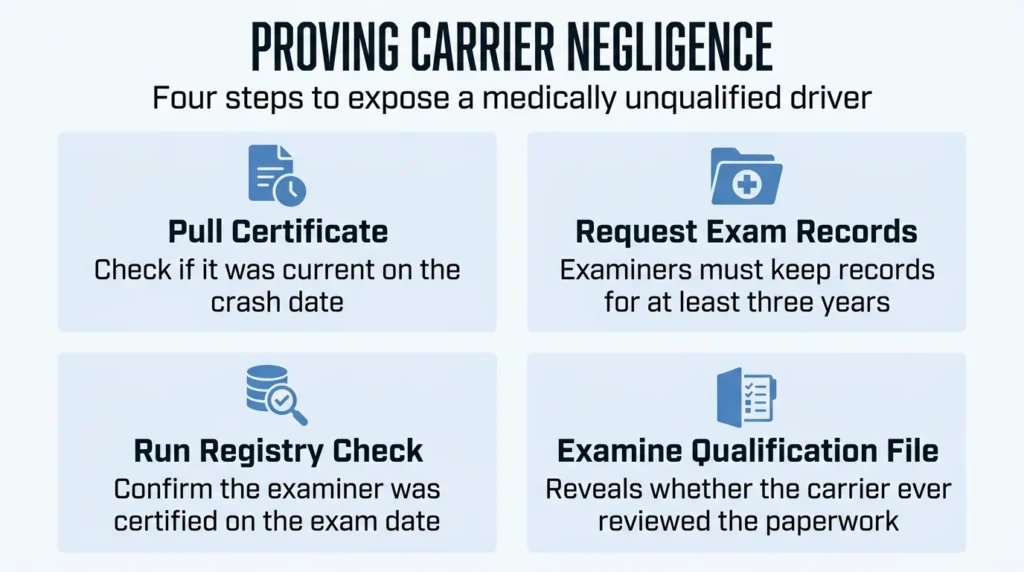
Proving that a carrier knew or never checked follows a sequence:
- Pull the Medical Examiner’s Certificate. Was it current on the date of the crash, and does the certified condition match what the driver’s medical history actually shows?
- Request the underlying exam records. The examiner has to keep them for at least three years, and they show what was measured and what was reported.
- Run a National Registry lookup on the signing examiner. Confirm the examiner was listed as certified on the date of the exam, not merely at some point.
- Examine the driver qualification file itself. The file reveals whether the carrier ever collected and reviewed any of this, or whether the truck went out with nobody looking.
This is the regulatory framework, not a description of any particular lawsuit. Every crash has its own facts, and the records decide what those facts turn out to be.
Talk to a Lawyer About a Medically Unqualified Driver
You should not have to chase down a trucking company’s medical paperwork while you are still healing. That work belongs to a legal team that knows which records exist, how long they survive, and how quickly to ask for them.
Angel Reyes & Associates has guided injured Texans through the legal process for over 30 years. If a truck driver may not have been medically qualified to be on the road when you were hurt, request a free consultation and let us review what happened.
Past results do not guarantee future outcomes.
Truck Driver Medical Clearance FAQs
If the examiner who signed a truck driver's medical certificate wasn't listed on the National Registry, does the certificate still count?
No. Federal rules require the exam to be performed by an examiner listed on the FMCSA National Registry of Certified Medical Examiners, with only narrow exceptions for certain vision specialists and VA examiners treating veteran drivers. A certificate signed by someone who was not actually registered on the exam date does not satisfy 49 CFR 391.43, no matter how complete the paperwork looks.
How often does a commercial truck driver have to renew DOT medical certification?
The default recertification cycle is every 24 months, and drivers who qualify under an exception recertify annually: insulin-treated diabetics under 49 CFR 391.46 and vision-exception drivers under 391.44. A driver must also be reexamined ahead of schedule if a condition develops that could affect job performance, or if a disqualifying exam finding voids an existing certificate.
What happens if a truck driver was operating on an expired Medical Examiner's Certificate at the time of a crash?
A driver without a current Medical Examiner’s Certificate does not meet the baseline qualification standard in 49 CFR 391.11, and the motor carrier is separately prohibited from permitting an unqualified driver to operate. An expired certificate at the time of a crash points straight at the carrier’s driver qualification file, which 49 CFR 391.51 requires the carrier to build and keep.
About the Authors

Angel Reyes
Writer
Angel L. Reyes, III is the Founder and Managing Partner of Angel Reyes & Associates. A nationally recognized trial attorney and business leader, Angel has helped over 70,000 injury victims recover more than $1 billion since founding the firm in 1993. Named to the Texas Super Lawyers list annually since 2008, Angel brings Wall Street experience, Ivy League education, and a deep commitment to client advocacy. He is a frequent legal commentator and published author with extensive contributions to legal scholarship, trial strategy, and consumer protection.

Kyle Nicolas
Editor
Kyle Nicolas is the Web Content & SEO Manager at Angel Reyes & Associates. He has more than 10 years of experience as a marketing co...

Angel Reyes
Reviewer
Angel L. Reyes, III is the Founder and Managing Partner of Angel Reyes & Associates. A nationally recognized trial attorney and business...