What Are Class 1, 2, and 3 E-Bikes?


Every article on this site is researched by our internal team, reviewed for legal accuracy against current Texas law, and held to State Bar of Texas advertising standards before publication. We do not publish content that overstates outcomes or makes promises about results.
Learn more about our
editorial standards .
Key Takeaways
- Class 1 and Class 3 are pedal-assist only; Class 2 adds a throttle; Class 3 reaches 28 mph and requires a speedometer and a minimum rider age of 15.
- No license, registration, or insurance is required for any Class 1, 2, or 3 e-bike in Texas under state law.
- Texas does not define a Class 4 e-bike; bikes exceeding 28 mph or 750 watts may be subject to motor vehicle regulations.
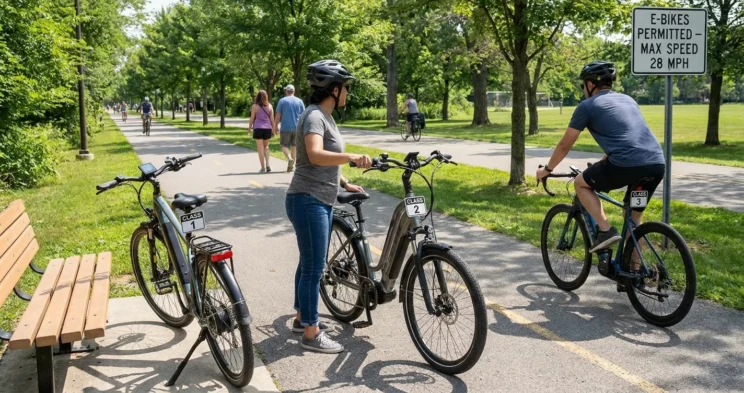
Electric bikes are sold in three distinct classes, and the class determines how the motor works, how fast it goes, and what rules apply when you ride it in Texas. If you are buying an e-bike or trying to figure out which type you already have, the class system is the right place to start.
How Texas Defines an Electric Bicycle
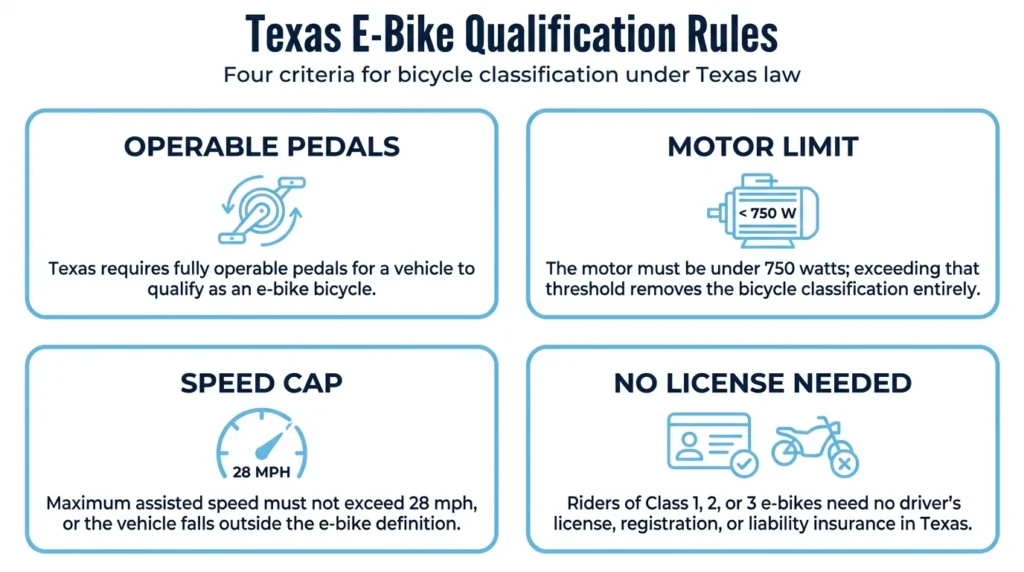
Texas draws its definitions from Texas Transportation Code Chapter 551, which classifies e-bikes as bicycles rather than motor vehicles. To qualify as an electric bicycle under Texas law, a bike must have fully operable pedals, a motor of less than 750 watts, and a maximum assisted speed of 28 mph or less.
That classification determines what riders need: no driver’s license, vehicle registration, or insurance for any e-bike that falls within the definition.
Bikes that exceed 28 mph or use motors over 750 watts fall outside this classification. Those vehicles may be subject to motor vehicle regulations, including licensing and registration requirements, depending on their specifications.
Class 1, 2, and 3 — What Each One Means
The three ebike classes share the same basic structure but differ in how the motor engages and how fast the bike can go.
What Is a Class 1 E-Bike?
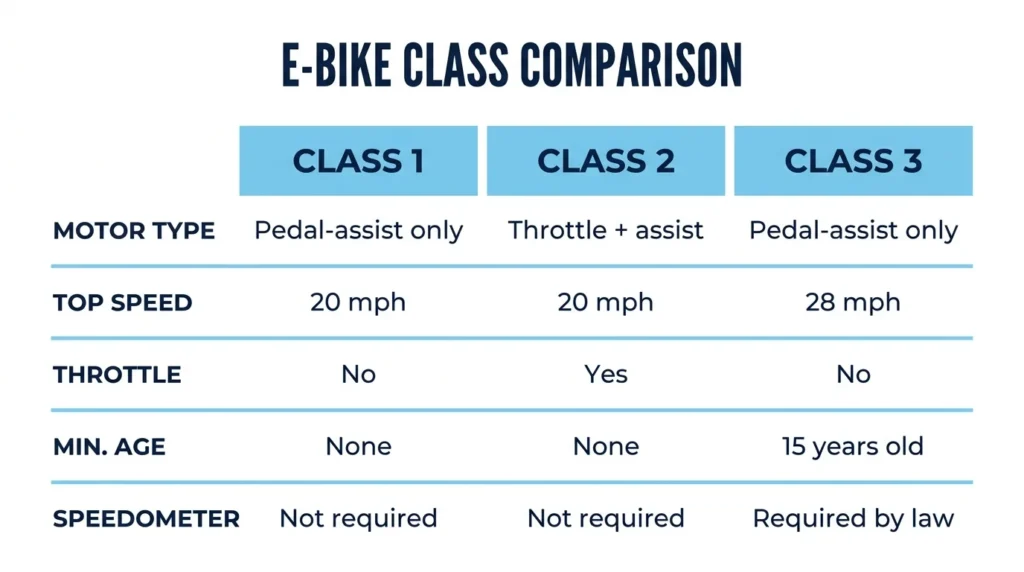
A Class 1 e-bike is a pedal-assist bike. The motor helps only when the rider is pedaling and stops when the rider stops or applies the brakes. The top assisted speed is 20 mph. There is no throttle on a Class 1 bike. It provides a natural riding feel, meaning the bike feels like a regular bicycle that gets easier when you need it.
What Is a Class 2 E-Bike?
A Class 2 e-bike adds a throttle. The motor can propel the bike forward without the rider pedaling at all, up to a maximum assisted speed of 20 mph. Most Class 2 bikes also function as pedal-assist when the rider chooses to pedal. Class 2 is the only class where you can ride without pedaling at all.
What Is a Class 3 E-Bike?
A Class 3 e-bike is a higher-speed pedal-assist bike. The motor assists only when the rider is pedaling, the same as Class 1, but the top assisted speed is 28 mph rather than 20 mph. Texas law requires Class 3 bikes to be equipped with a speedometer. Riders must be at least 15 years old to operate a Class 3 e-bike in Texas.
No License, Registration, or Insurance Required in Texas
All three ebike classes are classified as bicycles under Texas law, not motor vehicles. Riders do not need a driver’s license, vehicle registration, license plates, or liability insurance to operate a Class 1, 2, or 3 e-bike anywhere in Texas.
This classification is set at the state level. Local ordinances can go further. The City of Prosper, for example, requires e-bike registration within city limits. Before riding in an unfamiliar city, it is worth checking whether any local requirements apply.
Where Each Class Can Be Ridden in Texas
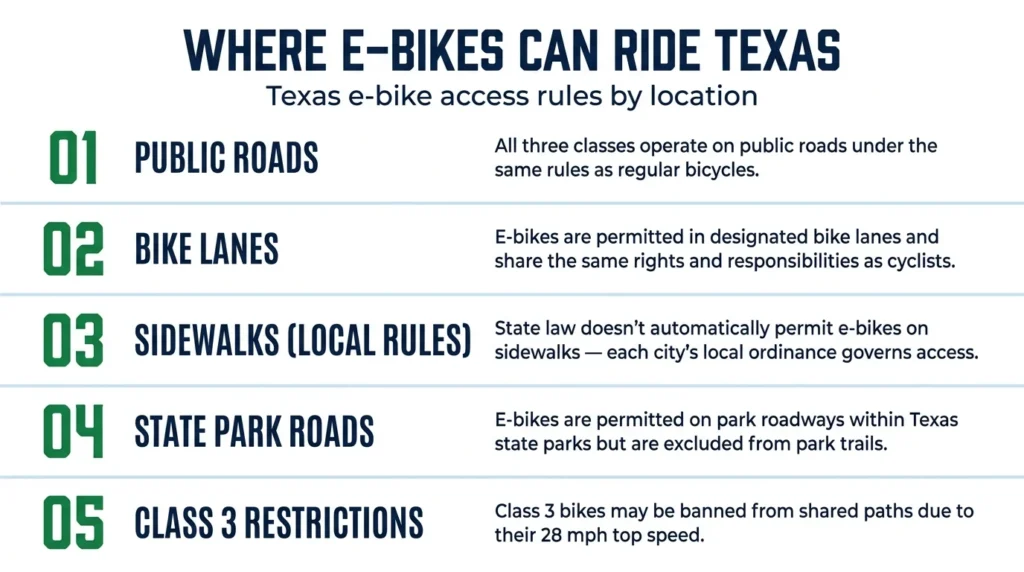
All three classes may operate on public roads and in designated bike lanes under the same rules that apply to regular bicycles. E-bike riders have the same rights and responsibilities as other cyclists on the road.
Sidewalks: State law does not automatically grant e-bikes access to sidewalks. Whether you can ride an e-bike on a sidewalk in a given city depends on that city’s local ordinance. Some Texas cities restrict or prohibit it. Check your city’s code before riding on the sidewalk.
Texas State Parks: E-bikes are permitted on park roadways within Texas state parks. They are not permitted on park trails.
Class 3 note: Class 3 e-bikes may be restricted from shared-use paths or trails where the trail authority has closed access to that class. The higher top speed of Class 3 bikes makes them better suited to roadways than to shared pedestrian paths.
What About Class 4 E-Bikes?
Texas Transportation Code does not define a Class 4 e-bike. Bikes marketed under that label typically exceed 28 mph or use motors over 750 watts, both of which put them outside the bicycle classification in Texas.
Depending on their speed and motor output, those vehicles may be classified as motor vehicles or mopeds under Texas law. That classification would bring licensing, registration, and insurance requirements that do not apply to Classes 1 through 3.
If you are evaluating a bike marketed as Class 4, check its actual top speed and motor output against the 28 mph and 750-watt thresholds before assuming it follows the same rules as the classified bike classes.
Work with a Texas Personal Injury Attorney
If you were injured while riding an e-bike in Texas, understanding your rights starts with knowing which rules applied to your ride.
Angel Reyes & Associates has represented injury victims across Texas for more than 30 years. We have recovered more than $1 billion for our clients. We offer free initial consultations and work on a no-fee-unless-you-win basis. To talk through your situation, contact us for a free consultation.
Past results do not guarantee future outcomes.
FAQs
What is the difference between Class 1, 2, and 3 e-bikes?
Class 1 and Class 3 are pedal-assist only, meaning the motor helps only while the rider is pedaling. Class 2 adds a throttle that can propel the bike without pedaling. Class 1 and Class 2 both have a top assisted speed of 20 mph; Class 3 reaches 28 mph. Class 3 also requires a speedometer and a minimum rider age of 15 in Texas.
Do you need a license to ride an e-bike in Texas?
No. Texas classifies Class 1, 2, and 3 e-bikes as bicycles, not motor vehicles. No driver’s license, vehicle registration, or insurance is required. Local ordinances may add their own requirements, so check your city’s rules before riding.
Can you ride an e-bike on the sidewalk in Texas?
State law does not automatically permit e-bikes on sidewalks. Sidewalk access is governed by local city ordinances, and some Texas cities restrict or prohibit e-bike use on sidewalks. Check your city’s code before riding on the sidewalk.
How fast does a Class 3 e-bike go?
A Class 3 e-bike has a maximum assisted speed of 28 mph. The motor assists only when the rider is pedaling and disengages at 28 mph. Texas law requires a speedometer on Class 3 bikes and sets a minimum rider age of 15 years old.
Is a Class 4 e-bike legal in Texas?
Texas Transportation Code does not define a Class 4 e-bike. Bikes marketed under that label typically exceed 28 mph or have motors over 750 watts, which puts them outside the bicycle classification. Depending on their specifications, those vehicles may be classified as motor vehicles or mopeds under Texas law, with corresponding licensing and registration requirements.
About the Authors

Angel Reyes
Writer
Angel L. Reyes, III is the Founder and Managing Partner of Angel Reyes & Associates. A nationally recognized trial attorney and business leader, Angel has helped over 70,000 injury victims recover more than $1 billion since founding the firm in 1993. Named to the Texas Super Lawyers list annually since 2008, Angel brings Wall Street experience, Ivy League education, and a deep commitment to client advocacy. He is a frequent legal commentator and published author with extensive contributions to legal scholarship, trial strategy, and consumer protection.

Graham Griffin
Editor
Graham Griffin is the Web & Content Manager at Angel Reyes & Associates, where he oversees content strategy, AI-powered workflows, a...

Angel Reyes
Reviewer
Angel L. Reyes, III is the Founder and Managing Partner of Angel Reyes & Associates. A nationally recognized trial attorney and business...