What Are the Main Parts of a Tractor-Trailer?


Every article on this site is researched by our internal team, reviewed for legal accuracy against current Texas law, and held to State Bar of Texas advertising standards before publication. We do not publish content that overstates outcomes or makes promises about results.
Learn more about our
editorial standards .
Key Takeaways
- A tractor and trailer are two separate vehicles joined at the fifth wheel and kingpin.
- 49 CFR 390.5 defines truck tractor, trailer, semitrailer, and pole trailer separately.
- Precise terminology in a demand letter signals real command of a truck accident claim.
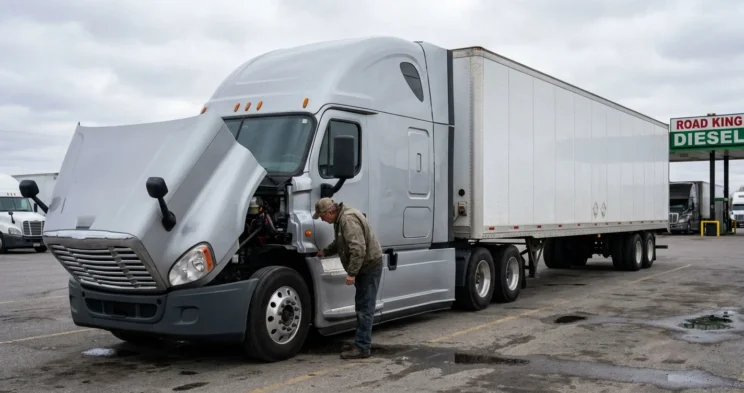
You’re standing on the shoulder of I-35 outside Dallas. A state trooper is walking the length of an 18-wheeler that just jackknifed across three lanes.
In the crash report and the claim letter that follows, one distinction will shape how the case gets read: did the failure happen on the tractor or the trailer? A tractor-trailer is not one vehicle. It is two vehicles, built and regulated separately, locked together at a single coupling point.
Tractor and Trailer: The Federal Definitions Under 49 CFR 390.5

A tractor-trailer, often called an 18-wheeler or a semi, is legally two separate vehicles coupled together. Federal regulation treats them as distinct machines with distinct names.
49 CFR 390.5, the definitions section of the Federal Motor Carrier Safety Regulations, defines the truck tractor as “a self-propelled commercial motor vehicle designed and/or used primarily for drawing other vehicles.” The tractor is the power unit. It carries the engine, the cab, and the wheels that drive the whole rig forward.
The same regulation defines the trailer through its subtypes. A full trailer carries all of its own weight on its own axles, with no part resting on the tractor except the towing device. A semitrailer, the type used on most 18-wheelers, is built so that some of its weight rests on the tractor itself.
A pole trailer is a third category, built to carry long or irregularly shaped loads by attaching through a reach or pole.
The regulation also defines “motor vehicle” and “commercial motor vehicle,” the broader categories that bring tractors and trailers under federal safety rules in the first place.
In plain terms, a semi is two distinct vehicles operating under one name. That distinction counts even more once you’re describing a wreck to an insurance adjuster or in a demand letter.
Where the Tractor Ends and the Trailer Begins: The Fifth Wheel and Kingpin
The tractor and trailer meet at a single coupling point: the fifth wheel and kingpin. Everything forward of that coupling is the tractor. Everything behind it is the trailer.
The fifth wheel is a horseshoe-shaped plate mounted on the tractor’s frame, usually just above the rear axles. It stays fixed in place and does not rotate. Instead, the trailer pivots against it whenever the rig turns.
The kingpin is a vertical steel pin, most commonly two or three and a half inches in diameter, welded to the trailer’s upper coupler at its front end. The kingpin always belongs to the trailer, never the tractor, and it’s tapered so the fifth wheel’s locking jaws can clamp around it. JOST International, which manufactures fifth-wheel and kingpin hardware, confirms this setup and how the locking jaws capture the pin.
Coupling happens when the driver backs the tractor under the trailer until the fifth wheel’s jaws close around the kingpin. That connection point is the real boundary between the two vehicles, not just a visual one.
Everything from the fifth wheel forward, including the cab, engine, and frame rails, is the tractor.
Everything from the kingpin back, including the trailer’s own axles, suspension, and cargo box, is the trailer.
Fifth wheel and kingpin are standard industry terms used throughout trucking and trailer manufacturing. Neither term appears in the text of 49 CFR 390.5 itself, but they describe the exact mechanical boundary the regulation’s definitions are built around. Arrow Truck Sales’ glossary of trucking terms confirms the same definitions from the trailer side of the industry.
Day Cab vs. Sleeper Cab

The tractor comes in two cab configurations: the day cab and the sleeper cab. Both describe the driver-occupied front of the tractor, not the trailer.
A day cab has no sleeping compartment. It’s shorter and lighter than a sleeper cab, and it’s typically used for local or regional routes where the driver returns home at the end of the shift. Arrow Truck Sales describes it as a short tractor built for drivers who get home every night.
A sleeper cab has a built-in sleeping compartment behind or integrated into the driver’s compartment. It’s heavier and longer than a day cab, built for long-haul routes where the driver rests in the vehicle between drives. Penske Truck Rental confirms the same distinction from the commercial fleet side.
The difference isn’t just cosmetic. Cab type affects the tractor’s length, wheelbase, weight distribution, and the driver’s sightlines, all details that matter once a crash gets reconstructed. This section describes the two configurations. It doesn’t rank one as more dangerous than the other, because the anatomy alone doesn’t support that conclusion.
Frame Rails, Cab Guard, and Catwalk: The Tractor’s Structural Components
Three more components round out the tractor’s structural anatomy: the frame rails, the cab guard, and the catwalk. Each plays a specific role in how the tractor carries its own weight, protects the driver, and connects to the trailer.

Frame rails run the length of the tractor’s chassis: two parallel steel beams, or in some cases aluminum alloy, connected by crossmembers in what’s called a ladder-frame design. The frame rails carry the engine mounts, cab mounts, and fifth wheel mounting plate, and they transmit the towing load back to the trailer.
Rail strength and material vary by manufacturer and application. No single figure applies to every tractor.
The cab guard, also called a headache rack, is a welded metal frame or grille mounted directly behind the tractor cab. It’s built to stop shifting or falling cargo from crushing into the cab during a sudden stop or collision.
“Cab guard” and “headache rack” are industry terms, not language drawn from 49 CFR 390.5. The closest federal standard is 49 CFR 393.114, which sets minimum height, width, and strength requirements for a front-end structure used as part of a cargo securement system.
The catwalk, also called a deck plate, is a metal platform bridging the frame rails directly behind the cab, near the drive-axle fuel tanks and battery boxes. It gives a driver or technician solid footing to connect air and electrical lines to the trailer, and it shields the wiring and hoses along the frame from road debris.
The terms catwalk and deck plate are often used interchangeably. Some in the industry treat catwalk as the narrower, walkable version of a deck plate.
Cab guard, catwalk, day cab, and sleeper cab are all industry terms used throughout trucking and trailer manufacturing. None of them appear in the text of 49 CFR 390.5, which limits itself to the tractor, trailer, and motor vehicle definitions covered above.
Why Getting the Terminology Right Matters in a Truck Accident Claim
Tractor-trailer vocabulary is used in federal regulation, Texas crash reports, and the engineering analysis that reconstructs how a collision happened.
When a demand letter blurs the tractor and the trailer, or misidentifies where a defect or failure actually occurred, it signals to the insurance company that the writer doesn’t fully understand the vehicle. That impression can shape how seriously your claim gets taken from the very first response.
Correctly identifying whether a coupling failure happened at the fifth wheel, whether a frame rail cracked on the tractor side or the trailer side, or whether a cargo shift involved the cab guard rather than the trailer’s own straps, can be the difference between a claim that gets read carefully and one that gets dismissed as unfocused.
If you’re building a truck accident claim after a wreck on a Texas highway, getting this vocabulary right from the start puts you and your attorney in a stronger position.
Talk to Angel Reyes & Associates About Your Truck Accident Claim
You don’t have to become a trucking engineer to bring a strong claim after a tractor-trailer accident. Angel Reyes & Associates has guided Texans through situations like this for over 30 years, and the firm’s investigators and accident reconstruction specialists can help pinpoint which part of the rig was involved and how the failure happened.
Get a free consultation to talk through what happened and understand your options.
Past results do not guarantee future outcomes.
Tractor-Trailer Part FAQs
Is a "semitrailer" legally different from a "full trailer"?
Yes. Under 49 CFR 390.5, a full trailer carries all of its own weight on its own axles, with no part resting on the towing vehicle except the towing device itself. A semitrailer, the type used on most tractor-trailers, is built so that some of its weight rests on the tractor through the fifth wheel and kingpin coupling. Both are trailers, but they’re separately defined subtypes based on how they distribute weight to the tractor.
Does "18-wheeler" mean something different from "tractor-trailer"?
Not legally. “18-wheeler,” “semi,” and “tractor-trailer” are common names for the same combination vehicle. Federal regulation doesn’t use the term “18-wheeler”; it defines the vehicle as two separate units, a truck tractor and a trailer, coupled together at the fifth wheel and kingpin. The everyday names just describe, less precisely, the same two-vehicle combination that 49 CFR 390.5 defines by unit.
Are "cab guard" and "headache rack" the same part?
Yes. Both terms describe the welded metal frame or grille mounted behind the tractor cab, or at the front of certain flatbed trailers, to stop shifting or falling cargo from crushing into the cab. Neither name comes from 49 CFR 390.5; they’re industry terms. The closest federal standard, 49 CFR 393.114, sets minimum height, width, and strength requirements for a front-end structure used in cargo securement, without using either trade name.
Is a catwalk the same thing as a deck plate?
The two terms are often used interchangeably for the metal platform bridging the tractor’s frame rails directly behind the cab, near the drive-axle fuel tanks and battery boxes. It gives a driver or technician solid footing to connect air and electrical lines and shields the wiring and hoses along the frame from road debris. Some in the industry treat “catwalk” as the narrower term for the walkable version of a deck plate, but that isn’t a firm technical rule.
Why does it matter in a claim whether a defect was in the tractor or the trailer?
Because the tractor and trailer are separately built, separately defined vehicles joined at the fifth wheel and kingpin, correctly identifying which unit failed, such as a cracked frame rail on the tractor versus a problem with the trailer’s own axle, is part of describing the vehicle accurately. That’s the same vocabulary used in federal regulation and crash reports, so a demand letter that blurs which unit was involved can be read as imprecise about the underlying facts of the case.
About the Authors

Alex Ivanov
Writer
Alex Ivanov is a personal injury attorney at Angel Reyes & Associates, focused on car, truck, and motorcycle accident cases. Licensed in Texas and multiple federal districts, Alex brings international legal experience and a global education to his practice. He earned his LL.M. from Texas A&M University School of Law after graduating from Belarussian State University in 2016. Alex is fluent in Russian, English, Ukrainian, and Belarussian, and is recognized by multiple national trial lawyer associations for his results and leadership under 40.

Kyle Nicolas
Editor
Kyle Nicolas is the Web Content & SEO Manager at Angel Reyes & Associates. He has more than 10 years of experience as a marketing co...

Angel Reyes
Reviewer
Angel L. Reyes, III is the Founder and Managing Partner of Angel Reyes & Associates. A nationally recognized trial attorney and business...