What Are the Rules for Moving an Oversized Load in Texas?


Every article on this site is researched by our internal team, reviewed for legal accuracy against current Texas law, and held to State Bar of Texas advertising standards before publication. We do not publish content that overstates outcomes or makes promises about results.
Learn more about our
editorial standards .
Key Takeaways
- A load is oversize in Texas past 8 feet 6 inches wide, 14 feet high, or state length limits.
- A TxDMV permit authorizes one vehicle, one set of dimensions, and one designated route.
- Texas escorts are required above 14 feet wide, 17 feet high, or 110 feet long.
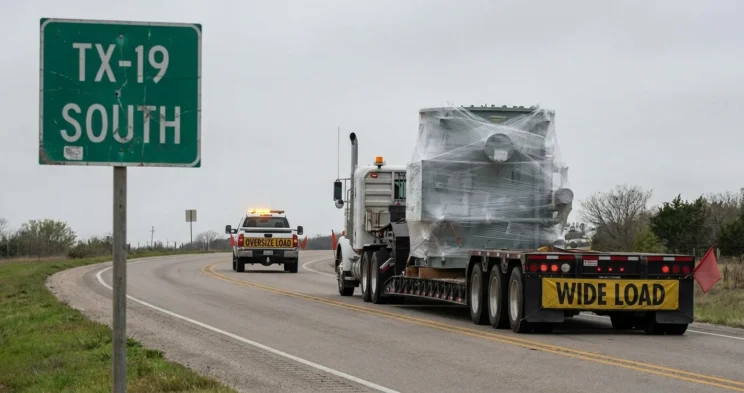
A load becomes oversized in Texas the moment it crosses a measured line, not when a driver decides it looks big. Anything wider than 8 feet 6 inches, taller than 14 feet, or longer than the state length limits needs an oversize load permit in Texas from the Texas Department of Motor Vehicles before it moves on a public highway.
That permit is a specific document, not a blanket license. It names one vehicle, one set of dimensions, and one route, and it can require escort vehicles and restrict the hours the load may travel.
That precision is what makes these moves different after a crash. The permit either covered the load that actually moved or it did not. The truck either stayed on the route the permit designated or it did not. The escorts the permit required were either there or they were not.
What Counts as an Oversized Load in Texas?
Texas sets a single legal envelope for vehicles on its highways, and exceeding any one dimension puts the move outside the law unless TxDMV has issued a permit for it.
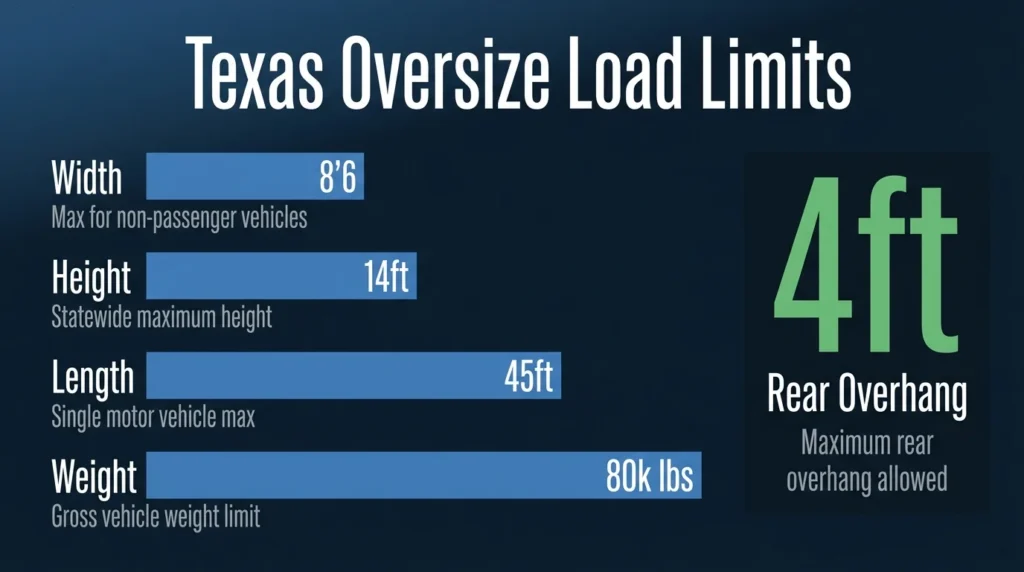
Texas Transportation Code Sec. 621.502 makes it unlawful to operate or move a vehicle larger than the maximum size authorized, separately reaches the owner who permits that operation, and separately reaches transporting a load that exceeds the maximum authorized for that vehicle.
The maximums published by TxDMV are the numbers that decide the question:
- Width: 8 feet 6 inches (102 inches) for all vehicles other than passenger vehicles, and 8 feet for passenger vehicles (Sec. 621.201).
- Height: 14 feet (Sec. 621.207(a)).
- Length: 45 feet for a single motor vehicle, 59 feet for a semitrailer in a two-vehicle combination, 65 feet for a two-vehicle combination other than a truck-tractor combination, and 28.5 feet for each trailer in a twin-trailer combination.
- Overhang: 3 feet at the front and 4 feet at the rear.
Weight runs on its own track: 80,000 pounds gross, 20,000 on a single axle, 34,000 tandem, 42,000 triple, and 50,000 quad.
Height carries a duty of its own. An operator of a vehicle taller than 13 feet 6 inches must make sure the vehicle clears overhead structures under Sec. 621.207(b). A strike against a bridge or an overpass puts that duty directly in issue.
None of this turns on judgment, rather a tape measure answers it.
The TxDMV Permit and the Route It Designates
A TxDMV oversize permit authorizes one move, not a category of moves. It is issued under Transportation Code Chapter 623 and the TxDMV rules at 43 Tex. Admin. Code Sec. 219.11, and it must be carried in the permitted vehicle in the manner the department prescribes under Sec. 623.007.
TxDMV issues single-trip permits for general oversize moves, manufactured housing, portable buildings, superheavy loads, house moves, and intermodal shipping containers. It also issues annual and time-based permits, including company specific and vehicle specific envelope permits and commodity permits for loads such as hay, timber, utility poles, and ready-mixed concrete.
Carriers apply through the Texas Permitting and Routing Optimization System (TxPROS), the Permit Wizard, or the TxDMV Oversize/Overweight Permits Office. The application must carry a complete load description, including maximum width, height, length, overhang, and gross weight.
Fees follow the permit type, the dimensions, and the duration rather than a single flat rate. For a permit covering excess axle or gross weight, Sec. 623.011 sets a base fee, a one-year term, and a windshield sticker.
Every one of those conditions is fixed in writing before the truck rolls. That paperwork gives a Texas truck accident claim involving an oversize load a documentary spine.
How TxDMV Designates the Route
Routing is part of the permit, not a suggestion attached to it. Under 43 TAC Sec. 219.11(e)(2)(A), a permitted vehicle is routed over the most practical route available, taking clearances, roadway geometrics, and construction into account.
An applicant who asks for something other than the optimal route does not simply get it. Sec. 219.11(e)(2)(B) provides that a requested non-optimal route requires more than one permit for the trip unless an exception is granted.
The largest loads get inspected before a permit issues at all. TxDMV requires a certified route inspection when the vehicle or load exceeds 20 feet wide, 18 feet 11 inches high, or 125 feet long.
That inspection has to be done in house. A representative of the applicant’s own company, not a third party, must physically inspect the route and sign and date the route inspection proposal.
TxDMV asks for submission three to five days before the movement date and requires operating authority compliance, meaning MCR or UCR registration or a $10,000 permit bond, before it processes the request.
Cities have a role as well. For superheavy or oversize equipment that cannot reasonably be dismantled, Sec. 623.071 lets a municipality with a state highway in its territory designate the route, and the department shows it on the map routing the equipment.
Texas Oversize Load Escort Requirements
Escorts are conditions written into the permit, not optional safety extras, and the thresholds are numeric. Escorts become mandatory above 14 feet wide, above 17 feet high, and above 110 feet long, with a second escort added at the higher tiers:
| Dimension | Threshold | Escorts required |
|---|---|---|
| Width | Over 14 feet to 16 feet | 1 front escort on two-lane highways, or 1 rear escort on multi-lane highways |
| Width | Over 16 feet | 1 front and 1 rear on all roads |
| Height | Over 17 feet | 1 front escort equipped with a height pole |
| Height | Over 18 feet | 1 front and 1 rear on all roads, front equipped with a height pole |
| Length | Over 110 feet to 125 feet | 1 front escort on two-lane highways, or 1 rear escort on multi-lane highways |
| Length | Over 125 feet | 1 front and 1 rear on all roads |
These triggers stack across dimensions. A load wide enough to require an escort and separately long enough to require one needs both.
Sec. 623.008 supplies the definitions behind that table. An escort flag vehicle precedes or follows the permitted vehicle to help move it safely, and an escort flagger is a person who has completed traffic direction training meeting the basic peace officer course curriculum set by the Texas Commission on Law Enforcement. Sec. 623.008(b) lets the department require escort flag vehicles and flaggers when the Texas Department of Transportation or safety calls for them.
Escort vehicles carry their own equipment requirements:
- Two flashing amber lights, one rotating amber beacon of at least 8 inches, or alternating blue and amber lights, roof-mounted and visible from all sides.
- An OVERSIZE LOAD or WIDE LOAD sign with a yellow background and black lettering, 5 to 7 feet long and 12 to 18 inches high, with letters 8 to 10 inches tall.
- Two-way radio contact with the permitted vehicle and every other escort on the move.
- A height pole of nonconductive material on the front escort for loads over 17 feet high.
- A gross vehicle weight of not less than 1,000 pounds and not more than 10,000 pounds.
The load itself must be marked:
- 12-inch red flags at the extremities of the load.
- Two red lamps visible from at least 500 feet to the rear.
- Two red reflectors visible from 100 to 600 feet at night.
- An amber rotating or pulsating beacon of at least 8 inches at the rear top of the load.
When an Oversize Load Is Allowed to Move
Timing is regulated as tightly as size. Under 43 TAC Sec. 219.11(l)(1)(A), a permitted oversize vehicle may move only during daytime, with two exceptions: a permit that is overweight only, and travel on an interstate highway where the load stays within 10 feet wide and 100 feet long with legal front and rear overhang.
Daytime is a defined term, not a general sense of the sky. 43 TAC Sec. 219.2 points to Texas Transportation Code Sec. 541.401, which sets daytime as the period beginning one-half hour before sunrise and ending one-half hour after sunset.
Three constraints govern when a permitted load may travel:
- Daytime only by default, subject to the two exceptions above.
- Holiday caps under 43 TAC Sec. 219.11(l)(2)(A), which limit holiday movement to 14 feet wide, 16 feet high, and 110 feet long unless an exception is granted.
- Published curfews under 43 TAC Sec. 219.11(l)(3), which require the operator to observe the curfew movement restrictions the department publishes.
Curfews are location specific and they change, so the controlling version is always the current Time Permit Curfews list TxDMV publishes rather than a window repeated in an article.
That is what makes timing useful after a collision. A move made after dark, a holiday move over the caps, or a move inside a published curfew window is a timestamped fact, and GPS, electronic logging device records, and dashcam footage either match the permit or they do not.
When a Permit Violation Becomes a Truck Accident Case
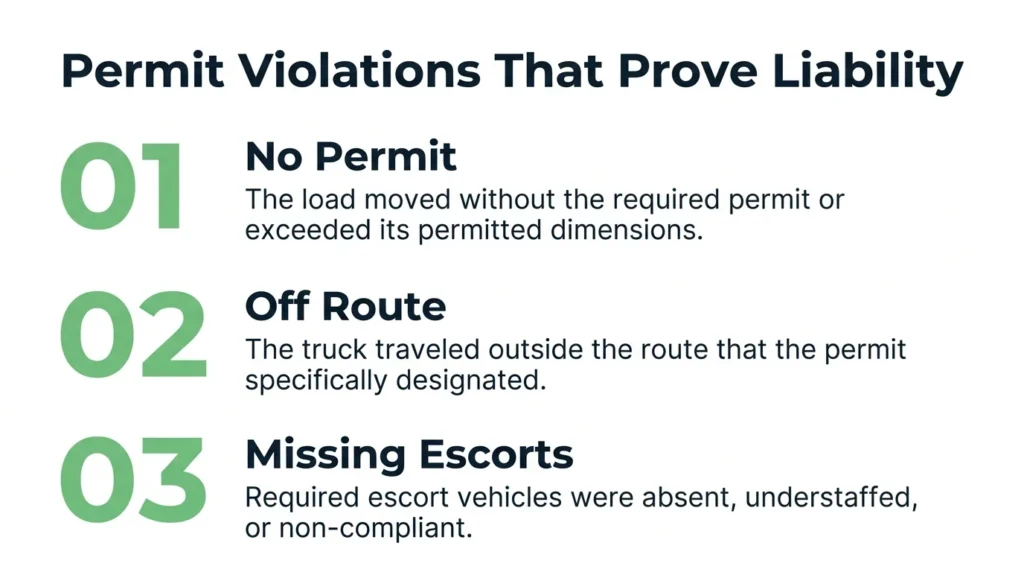
Three failures stand out because they are documented rather than debatable. The load moved without the permit it required, the truck traveled off the route the permit designated, or the escorts the permit specified were not there:
- No permit for the load that actually moved. Sec. 621.502 prohibits operating or moving an over-maximum vehicle, reaches the owner who permits it, and reaches the transport of an oversize load. The proof is the measured load set against the permit file, or the absence of any permit at all. Sec. 623.007 adds a separate failure when no permit is in the vehicle at the scene.
- Off the designated route. The route is written into the permit under 43 TAC Sec. 219.11(e)(2), and a non-optimal route requires additional permits or a granted exception. Sec. 623.019(a)(2) makes it an offense for a weight permit holder to operate over the limit in a county not designated in the application. The proof is the permitted route map against the truck’s actual track.
- Missing or non-compliant escorts. Sec. 623.008 authorizes the requirement, and 43 TAC Sec. 219.11(k) and the TxDMV escort page fix the numeric triggers, the positions, the equipment, and the flagger training standard. The proof is the escort condition on the permit against escort dispatch records, invoices, and driver logs.
The evidence spine in an oversize load case is short and specific:
- The permit file, including the application, the stated dimensions, and every condition on the permit’s face.
- The designated route, compared against GPS and electronic logging device data.
- Escort records, including dispatch documentation, invoices, and radio or phone communications.
Those records are easiest to secure early. When an oversize load collision takes a life, the same paper trail supports a wrongful death claim by showing what the carrier was authorized to do and what it did instead.
Texas treats these breaches seriously on the regulatory side. Sec. 623.019 sets out offenses with escalating fines and requires the convicting court to report the conviction to the Texas Department of Public Safety.
That regulatory picture is not the same thing as civil liability. A permit violation is an objective breach of a written rule and strong evidence about how a carrier ran the move, and it does not by itself establish legal responsibility for a crash. Its value is that it can be proved on paper while the rest of a case is still being reconstructed.
Talk to Angel Reyes & Associates About an Oversize Load Crash
Permit files, designated routes, and escort records all exist somewhere right now. They sit with the carrier, the permit service, and the state permitting system, and they need to be requested before retention schedules thin them out.
Angel Reyes & Associates has guided injured Texans through the legal process for over 30 years, handles cases across the entire state of Texas, and can manage most of a case remotely.
Consultations are free, the team is available 24 hours a day, and se habla español.
If an oversize load was involved in your crash, contact Angel Reyes & Associates for a free consultation and a straight answer about your options.
Past results do not guarantee future outcomes.
Oversize Load Rule FAQs
Who is responsible when an oversize load hits a bridge or overpass in Texas?
Texas Transportation Code Sec. 621.207(c) places liability for damage to a bridge or underpass caused by a vehicle’s height on the owner of the vehicle. The statute carves out four exceptions: the vehicle was stolen, the clearance was misposted, the driver was acting at the direction of law enforcement, or the movement was covered by a valid permit.
Does a permit violation automatically mean the trucking company is liable for a crash?
No. A permit violation is a documented failure to follow a written rule, and an injury claim still has to connect that failure to how the collision happened and to the harm it caused. What the violation adds is certainty of proof. The permit application, the route TxDMV designated, and the escort conditions were all recorded before the trip began, so they do not depend on anyone’s memory of the seconds before impact.
What penalties does Texas impose for moving an oversize or overweight load illegally?
Texas Transportation Code Sec. 623.019 creates offenses with escalating fines, including criminally negligent operation at a weight heavier than the permit authorizes and operating over the limit in a county not designated in the application, and it requires the convicting court to report the conviction to the Texas Department of Public Safety. DPS publishes the overweight fine schedule that enforcement officers work from. These are regulatory consequences imposed by the state. They run on a separate track from any civil claim brought by someone injured in a crash.
What happens if the driver cannot produce the permit during a stop or after a crash?
Texas Transportation Code Sec. 623.007 requires the permit to be carried in the permitted vehicle in the manner the department prescribes, so a permit that is not in the truck is its own documented failure, separate from the question of whether TxDMV ever issued one for that load. Weight permits add a second visible requirement. Sec. 623.011 provides for a windshield sticker, and DPS treats failure to display the required permit sticker as a Class C misdemeanor.
About the Authors

Angel Reyes
Writer
Angel L. Reyes, III is the Founder and Managing Partner of Angel Reyes & Associates. A nationally recognized trial attorney and business leader, Angel has helped over 70,000 injury victims recover more than $1 billion since founding the firm in 1993. Named to the Texas Super Lawyers list annually since 2008, Angel brings Wall Street experience, Ivy League education, and a deep commitment to client advocacy. He is a frequent legal commentator and published author with extensive contributions to legal scholarship, trial strategy, and consumer protection.

Kyle Nicolas
Editor
Kyle Nicolas is the Web Content & SEO Manager at Angel Reyes & Associates. He has more than 10 years of experience as a marketing co...

Angel Reyes
Reviewer
Angel L. Reyes, III is the Founder and Managing Partner of Angel Reyes & Associates. A nationally recognized trial attorney and business...