What Do Skid Marks Reveal About a Crash?


Every article on this site is researched by our internal team, reviewed for legal accuracy against current Texas law, and held to State Bar of Texas advertising standards before publication. We do not publish content that overstates outcomes or makes promises about results.
Learn more about our
editorial standards .
Key Takeaways
- Skid, yaw, and scuff marks show vehicle movement, but no mark alone proves fault or speed.
- ABS brakes can leave faint, broken, or no visible marks even when the driver braked.
- Photograph marks promptly with a scale and ask about measurements and vehicle EDR data.
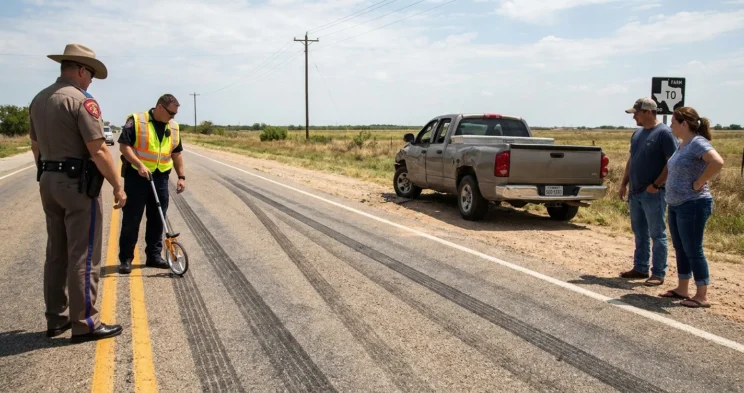
After a crash, tire skid marks can help investigators reconstruct where a vehicle traveled, whether its tires slid or slipped sideways, and how much speed it lost during a measured slide. They cannot establish an exact pre-crash speed or fault on their own.
Trained investigators combine measured marks with road friction, scene photographs, vehicle damage, and any available event data recorder information. Together, this evidence can help answer whether a driver was going too fast for the conditions under Texas law.
What Can Different Tire Marks Tell Investigators?
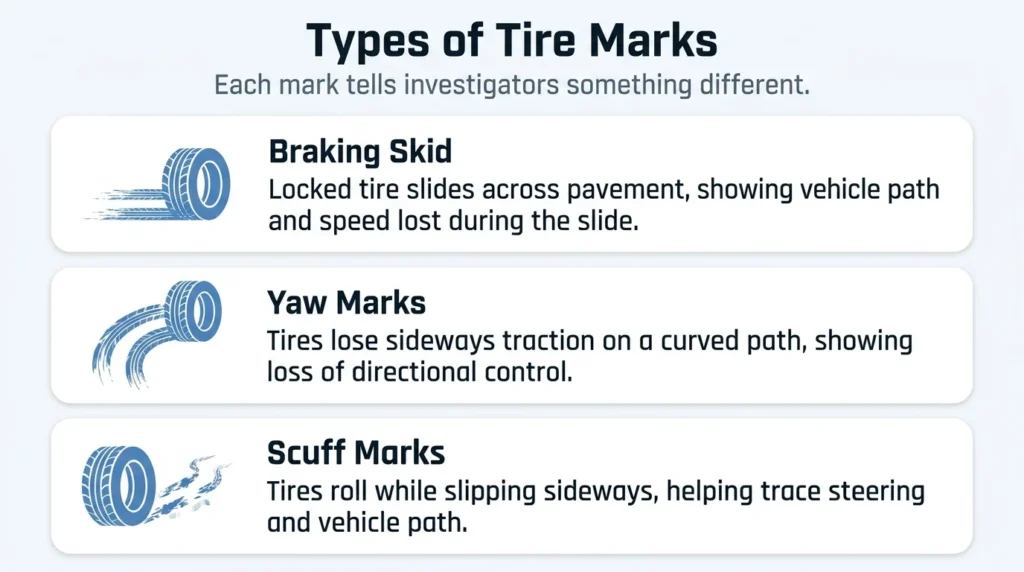
Tire marks provide clues about braking and sideways movement, but the terms investigators use can overlap. No mark by itself proves who caused the crash or exactly how fast anyone was going.
Braking Skid Marks
A conventional braking skid forms when a locked tire slides across the pavement instead of rolling.
When investigators measure it carefully, a skid can show the vehicle’s path and help estimate the speed lost during the slide. The length of the mark alone does not settle the question.
Yaw Marks
A yaw mark appears when a vehicle moves along a curved path and its tires lose sideways traction. These marks can help investigators understand a loss of directional control.
A curved mark does not automatically mean the driver was speeding. Investigators must classify the mark correctly before they choose a method to analyze it.
Scuff Marks
The National Transportation Safety Board describes scuff marks as marks from tires rolling while slipping sideways. In one NTSB highway accident investigation, scuffs helped investigators trace a vehicle’s steering and path toward the shoulder. The investigation still left the initial reason for the loss of control undetermined.
These labels overlap in practice. Law enforcement crash-investigation training lists “scuff or yaw marks” together, so you may see investigators use “scuff” broadly. Investigators also have to separate marks from this crash from older marks already on the road.
Why Might Anti-Lock Brakes Leave Faint or Broken Marks?
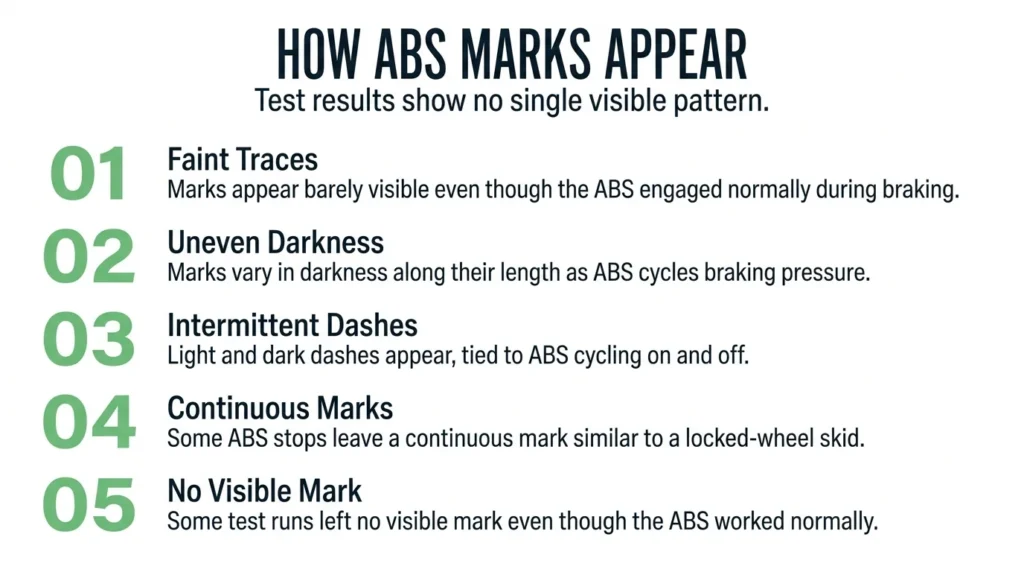
Anti-lock brakes (ABS) adjust braking pressure to keep the wheels from staying locked. ABS braking can leave faint marks, uneven darkness, intermittent dashes, continuous marks, or no visible mark at all.
In instrumented braking tests of ABS-equipped cars, researchers recorded faint traces, marks that varied in darkness, and continuous marks. Some test runs left no visible mark even though the ABS worked normally. Earlier observations also described light and dark dashes tied to ABS cycling.
This counts for your case in two ways. No visible skid does not mean the other driver never hit the brakes. A dashed or broken mark also does not prove the ABS activated, because ABS traces follow no single pattern.
Can Skid Marks Show Whether a Driver Was Going Too Fast?
Skid marks can help answer that question as part of a larger analysis. A qualified reconstructionist uses measured marks, tire-road friction, and road conditions to estimate the speed lost during a slide. Those findings can help assess whether the driver’s speed fits the conditions.
The Texas Speed Standard
Texas Transportation Code §545.351 sets the basic speed rule. According to TxDOT’s guidance on the Basic Speed Law, a driver must keep a speed that is reasonable and prudent for the circumstances that exist at the time.
That standard considers conditions as well as the posted limit. A speed suitable for dry pavement along US-290 on a clear afternoon may be too fast when the road is wet or icy.
The presence or length of a skid mark does not automatically prove a violation, negligence, or liability. It is one piece of evidence that helps show how the driver approached the crash.
Why Friction & Measurement Count
Investigators measure mark length and assess how much grip the tires had on that pavement. Engineering research on speed from skids describes combining slide distance with road friction to estimate the energy lost. Braking can begin before visible marks appear, so the marked distance may not capture the full braking event.
Road friction testing measures available tire-road grip. Federal Highway Administration friction guidance addresses wet and dry conditions and roadway characteristics. A reconstructionist needs an appropriate friction assessment rather than an assumed “average asphalt” value.
Yaw marks need their own approach. Curvature and roadway geometry shape that analysis, and braking friction and cornering friction require appropriate methods. A Texas car accident lawyer can help you understand how the marks fit with the rest of the evidence.
How Should Temporary Roadway Marks Be Documented?
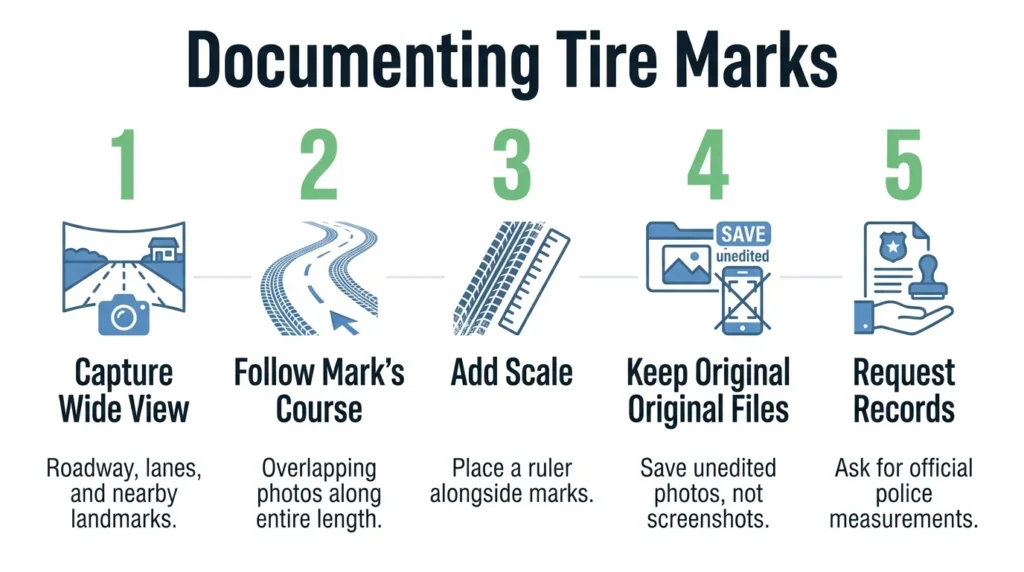
Document tire marks promptly, because they can change or disappear and there is no dependable preservation window. Passing traffic and activity at the scene can alter or destroy this short-lived evidence.
Crash-investigation training directs officers to measure and photograph tire marks promptly. Follow these steps only when it is safe. Never enter active traffic on I-35 or any other road to photograph or measure a mark:
- Capture the wide view. Take photos that show the roadway, lanes, and fixed landmarks so the marks have context.
- Follow the mark’s course. Take closer, overlapping photos along the full length of each mark.
- Add a scale. For detail shots, place a ruler or other accurate scale alongside the mark in the same plane, without disturbing the evidence. Forensic photography supports scale placement and overlapping images for long tire impressions.
- Keep the original files. Save the unedited photos from your phone or camera, not just screenshots or cropped copies.
- Request the professional records. Ask about the police report, scene photographs, and the officer’s or reconstructionist’s measurements of each mark’s location and dimensions. For yaw marks, those measurements should include curvature.
Photos of skid marks on road surfaces help preserve what was visible. They do not produce a reliable speed calculation on their own.
How Can Vehicle Data Help Check the Roadway Evidence?
When a vehicle’s event data recorder holds usable crash data, readings such as vehicle speed or braking status can help investigators test their reconstruction against the marks on the road. What a recorder captures, and whether usable data exists for this crash, varies.
The National Highway Traffic Safety Administration describes event data recorders as devices that record technical vehicle and occupant information around a crash. An EDR is not a video camera. EDR information has limits and should be used alongside other sources.
NHTSA’s Special Crash Investigations program takes that combined approach. Its investigators collect EDR data when available, along with scene marks, vehicle inspections, photographs, witness interviews, and police reports. That comparison can help when ABS leaves faint or missing marks.
Ask a lawyer promptly about preserving the vehicle and any available electronic evidence before repair or disposal.
Talk With Angel Reyes & Associates About Your Crash Evidence
Skid-mark photos, police measurements, road conditions, and vehicle data each contribute to understanding a crash. Angel Reyes & Associates has guided injured Texans for over 30 years. Our team includes investigators and accident reconstruction specialists who review this kind of evidence together.
Contact Angel Reyes & Associates for a free consultation, and bring any photos, the crash report, and repair records you have. You can reach us 24/7.
Past results do not guarantee future outcomes.
Crash Skid Mark FAQs
How can skid marks affect a Texas car accident claim when multiple drivers may share responsibility?
Skid marks may provide evidence about each vehicle’s movement and actions, which can become relevant when responsibility is disputed; under Texas Civil Practice and Remedies Code §33.003, responsibility may be apportioned among parties and other legally relevant persons when supported by sufficient evidence.
Can road debris make tire marks harder to interpret after a crash?
Yes. Debris, fluid, dirt, weather, and subsequent traffic can obscure or alter marks, which can make accurate documentation and interpretation more difficult.
Can tire marks help reconstruct a hit-and-run accident?
Potentially. Tire marks can help establish a vehicle’s path and direction of travel, which may be useful when combined with debris, vehicle damage, surveillance footage, and witness accounts.
About the Authors

Angel Reyes
Writer
Angel L. Reyes, III is the Founder and Managing Partner of Angel Reyes & Associates. A nationally recognized trial attorney and business leader, Angel has helped over 70,000 injury victims recover more than $1 billion since founding the firm in 1993. Named to the Texas Super Lawyers list annually since 2008, Angel brings Wall Street experience, Ivy League education, and a deep commitment to client advocacy. He is a frequent legal commentator and published author with extensive contributions to legal scholarship, trial strategy, and consumer protection.

Graham Griffin
Editor
Graham Griffin is the Web & Content Manager at Angel Reyes & Associates, where he oversees content strategy, AI-powered workflows, a...

Angel Reyes
Reviewer
Angel L. Reyes, III is the Founder and Managing Partner of Angel Reyes & Associates. A nationally recognized trial attorney and business...