What Does Proximate Cause Mean in a Texas Injury Case?


Every article on this site is researched by our internal team, reviewed for legal accuracy against current Texas law, and held to State Bar of Texas advertising standards before publication. We do not publish content that overstates outcomes or makes promises about results.
Learn more about our
editorial standards .
Key Takeaways
- Texas proximate cause requires proof of both cause in fact and foreseeability.
- But-for causation alone is not enough; conduct must be a substantial factor.
- A foreseeable intervening act is a concurring cause and does not break the chain.
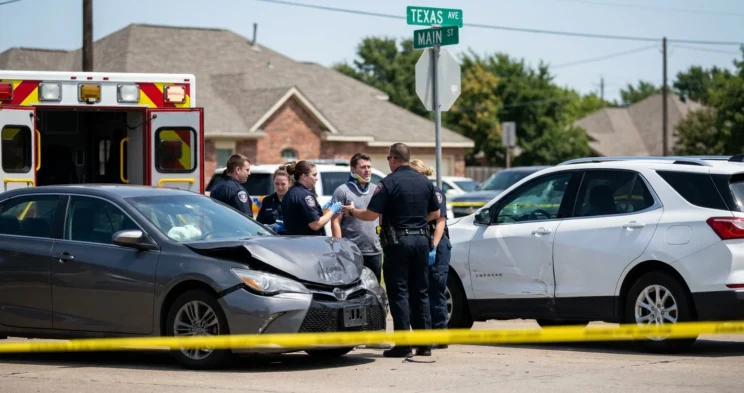
The adjuster admits the other driver was careless but argues that something else caused your injuries. The dispute is no longer only about what the driver did. It is about whether that conduct is legally connected to your harm.
Texas law calls that connection proximate cause. You must show that the negligent conduct was a substantial factor in causing your injury and that the general danger was reasonably foreseeable.
What Is Proximate Cause Under Texas Law?
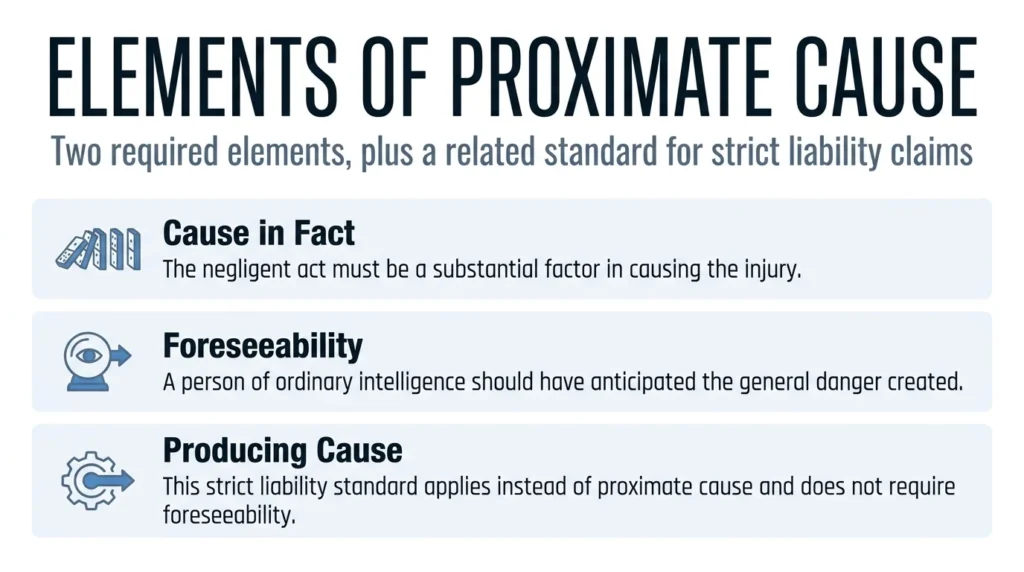
Texas requires proof of two elements. The Texas Supreme Court explained the test in IHS Cedars Treatment Center of DeSoto, Texas, Inc. v. Mason, 143 S.W.3d 794 (Tex. 2004).
- Cause in fact. The act or omission was a substantial factor in bringing about the injury, and without it the harm would not have occurred.
- Foreseeability. A person of ordinary intelligence should have anticipated the danger the negligent act created.
The first element trips up more claims than injured Texans expect. Showing that an injury would not have happened “but for” someone’s conduct is not enough by itself. The conduct must have contributed to the injury in a substantial way rather than merely creating the conditions in which it occurred.
That principle comes from Mason and from Union Pump Co. v. Allbritton, 898 S.W.2d 773 (Tex. 1995), where a worker slipped on a wet pipe rack about two hours after a pump fire had been put out. The fire was not a substantial factor in the fall.
Foreseeability does not require the defendant to predict precisely how the injury would happen. The defendant only needs to have reasonably anticipated the general type of danger.
Texas courts continue to apply this distinction closely. In Werner Enterprises, Inc. v. Blake, No. 23-0493 (Tex. June 27, 2025), a pickup lost control on ice and crossed a 42-foot median before colliding with a truck. Although the truck’s speed was a but-for cause of the collision, the Texas Supreme Court found that it was not a substantial factor in causing the crash.
Proximate cause applies to negligence claims and requires foreseeability. Producing cause, which applies in strict liability claims, does not require foreseeability.
The “New and Independent Cause” Defense
A defendant may argue that a separate event broke the connection between the original negligence and your injury. Texas calls this a new and independent cause. The defense applies only when two conditions are met.
First, the intervening event must not have been reasonably foreseeable when the original negligence occurred. Second, the original negligence must have run its course and no longer be actively contributing to the harm.
Texas courts consider six factors when deciding whether an intervening event replaces the original negligence as the legal cause. The Texas Supreme Court applied these factors in Dew v. Crown Derrick Erectors, Inc., 208 S.W.3d 448 (Tex. 2006):
- Whether the harm differs in kind from what the defendant’s negligence would otherwise have produced
- Whether the intervening force operates in an extraordinary rather than a normal way under the circumstances
- Whether it operates independently of the situation the defendant created, or instead follows from it normally
- Whether it is the act of a third person
- Whether that third person’s act is itself wrongful toward the injured person
- How culpable any wrongful third-party act was
In Dew, a worker fell to his death through an unguarded ladder opening on an offshore rig platform after others removed rope barriers put up by a subcontractor.
The Texas Supreme Court concluded the jury should have been instructed on new and independent cause because some evidence showed the subcontractor did not foresee the barriers’ removal.
This issue may arise in premises liability claims and wrongful death claims when several parties handled the same hazard before the injury occurred.
If the intervening act’s general character was foreseeable, it is not a new and independent cause.
When an Intervening Act Is Foreseeable
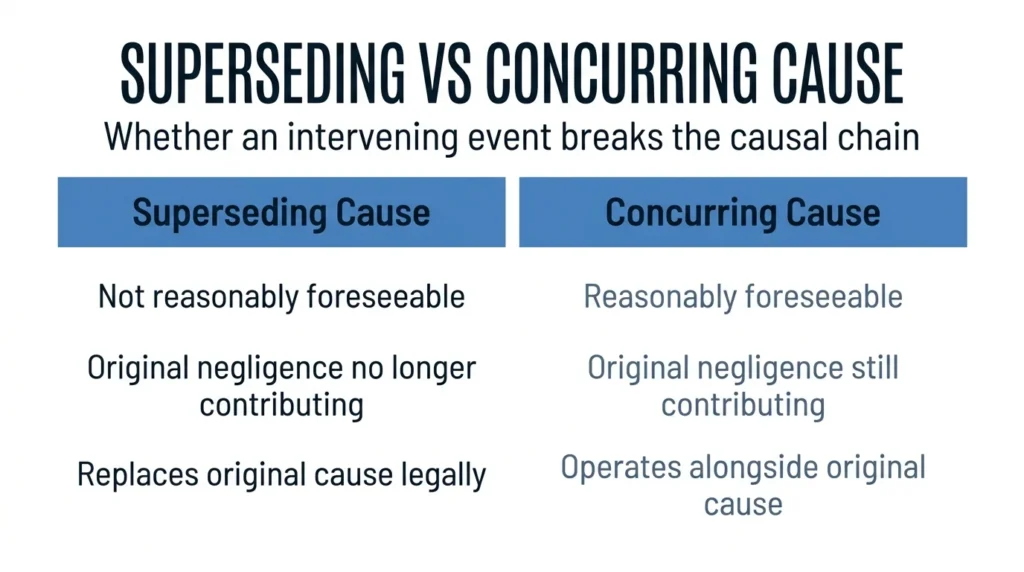
When an intervening event was reasonably foreseeable, Texas may treat it as a concurring cause. The original party’s negligence can remain a proximate cause because it was still contributing to the injury.
A superseding cause replaces the original negligence as the legal cause of the harm. A concurring cause operates alongside the original negligence.
In Bell v. Campbell, 434 S.W.2d 117 (Tex. 1968), the Texas Supreme Court framed the inquiry as whether the original wrongdoer could reasonably have anticipated the intervening cause and its probable consequences.
For example, say a driver causes a first collision that blocks a lane of I-35 during heavy traffic, and a following driver strikes the stopped vehicles moments later. A second impact is generally foreseeable after a wreck stops traffic, so the second driver’s negligence would not automatically erase the first driver’s.
Questions about concurring causes commonly arise in multi-vehicle accidents, where several drivers and separate impacts may contribute to the injuries.
Whether an intervening event was foreseeable depends on the facts of the individual car accident claim.
How Reconstruction & Expert Testimony Prove Proximate Cause
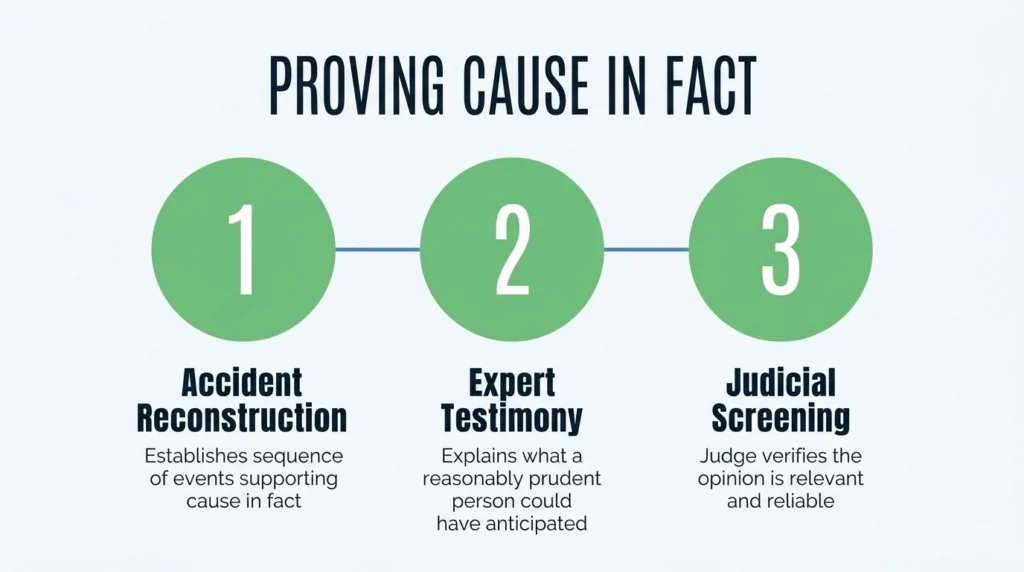
Accident reconstruction can establish the sequence of events supporting cause in fact. Relevant evidence may include vehicle speed, braking, timing, and points of impact. Expert testimony may help explain what a reasonably prudent driver, employer, or property owner could have anticipated.
Texas judges screen that testimony before a jury ever hears it. Under E.I. du Pont de Nemours & Co. v. Robinson, 923 S.W.2d 549 (Tex. 1995), and Texas Rule of Evidence 702, an expert’s opinion must be relevant and reliable.
Courts may consider:
- Whether the theory or technique has been tested
- How much it depends on the expert’s subjective interpretation
- Whether it has been subjected to peer review or publication
- Its known or potential rate of error
- Whether it is generally accepted in the relevant field
- Whether it has uses outside the courtroom
An opinion that does not satisfy these requirements may be excluded. The quality of your reconstruction work shapes the causation fight long before trial.
Talk to an Injury Lawyer About Your Case
Proving a Texas injury claim means establishing both halves of proximate cause, and insurers routinely raise a new and independent cause argument to shift the blame elsewhere.
Angel Reyes & Associates has guided injured Texans through that fight for over 30 years, with investigators and accident reconstruction specialists who start building the causal record early.
Get a free consultation to review your situation.
Past results do not guarantee future outcomes.
Texas Proximate Cause FAQs
Can I recover compensation if a Texas car accident aggravated a pre-existing injury?
Yes. Texas law allows you to seek compensation when another person’s negligence aggravates a pre-existing condition. Still, you must show that the accident worsened your condition, not just that the condition existed before the crash.
Does a delay in seeking medical treatment affect proximate cause in a Texas injury claim?
A delay in treatment does not automatically prevent you from establishing causation, but it may make it harder to connect your injuries to the accident. Medical records documenting when symptoms appeared, how they progressed, and what caused them can help address disputes about the source of your injuries.
Can I recover damages if I was partially responsible for my injuries in Texas?
Under Texas Civil Practice and Remedies Code Section 33.001, you may recover damages if your percentage of responsibility is 50% or less, although your assigned percentage of fault will reduce your compensation. If you are found more than 50% responsible, you cannot recover damages under the state’s proportionate responsibility rules.
Does a Texas personal injury claim require medical expert testimony to prove causation?
Not every injury claim requires medical expert testimony, particularly when the connection between an accident and an injury is within a jury’s common understanding. However, complex medical conditions or disputes involving multiple possible causes generally require expert testimony to establish the connection between the negligent conduct and the claimed injuries.
Can negligent medical treatment after a car accident affect the original driver's liability?
A driver who causes an accident may also be liable for additional injuries resulting from subsequent medical treatment when those complications are a foreseeable consequence of the original injury. Whether the driver’s liability extends to those complications depends on the treatment circumstances and the connection between the original accident and the additional harm.
About the Authors

Angel Reyes
Writer
Angel L. Reyes, III is the Founder and Managing Partner of Angel Reyes & Associates. A nationally recognized trial attorney and business leader, Angel has helped over 70,000 injury victims recover more than $1 billion since founding the firm in 1993. Named to the Texas Super Lawyers list annually since 2008, Angel brings Wall Street experience, Ivy League education, and a deep commitment to client advocacy. He is a frequent legal commentator and published author with extensive contributions to legal scholarship, trial strategy, and consumer protection.

Graham Griffin
Editor
Graham Griffin is the Web & Content Manager at Angel Reyes & Associates, where he oversees content strategy, AI-powered workflows, a...

Angel Reyes
Reviewer
Angel L. Reyes, III is the Founder and Managing Partner of Angel Reyes & Associates. A nationally recognized trial attorney and business...