What Happens If a Cop Hits Your Car During a Chase?


Every article on this site is researched by our internal team, reviewed for legal accuracy against current Texas law, and held to State Bar of Texas advertising standards before publication. We do not publish content that overstates outcomes or makes promises about results.
Learn more about our
editorial standards .
Key Takeaways
- Written notice to the police agency is due within six months, sometimes sooner.
- A municipality caps injury damages at $250,000 per person and $500,000 per occurrence.
- Pursuit claims require reckless disregard, not just ordinary negligence.
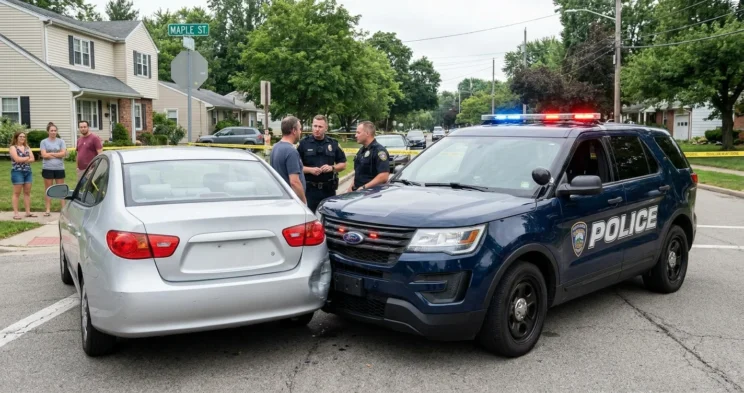
If you are ever involved in a car accident, it can be an incredibly traumatic experience. If you are dealing with personal injury or property damage caused by the incident, it can be even more challenging to get through. When a police car hits your vehicle during a police chase, the situation becomes even more complex, especially if you were not the fleeing suspect but an innocent bystander.
You may wonder, “What happens if a cop hits your car during a chase?” In these cases, determining police liability is crucial. The police department and law enforcement agency involved may be held accountable, but these cases often involve complex claims against government agencies. Collecting witness statements and evidence is crucial to strengthen your personal injury claim and prove that the police officers’ actions were negligent.
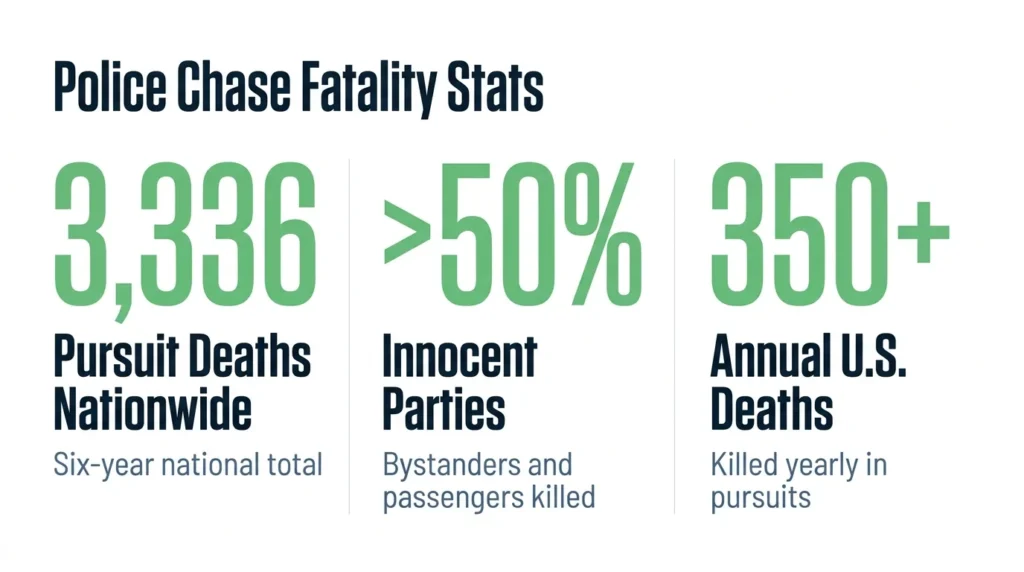
A San Francisco Chronicle investigation identified 3,336 police pursuit deaths nationwide from 2017 through 2022. More than half of these fatalities involved innocent parties, such as non-driving passengers and bystanders. If you’ve been injured in an incident like this, you can seek compensation for medical bills, lost wages, and emotional distress.
Navigating claims against a law enforcement agency can be difficult because the insurance company representing the agency may attempt to minimize payouts. Understanding your rights and seeking legal support will ensure that you receive fair compensation for your damages and the justice you deserve.
Understanding How Police Chase Accidents Happen
When a police officer is in pursuit of a suspect, it usually becomes a high-speed chase, and the officer may not have time and or the ability to focus on their surroundings, meaning they can’t always react to other vehicles or pedestrians in the area.
Officers are authorized to pursue suspects in a high-speed chase during an emergency situation, but they still have a duty to drive safely and minimize the risk of harm to others, especially those who are not involved in the pursuit. That same investigation found that more than 25% of those who died in police pursuits were completely innocent bystanders.
Take These Steps Immediately After a Police Chase Accident
Texas records a high number of injuries and fatalities during high-speed chases every year. It is important to know how to protect yourself in these situations.
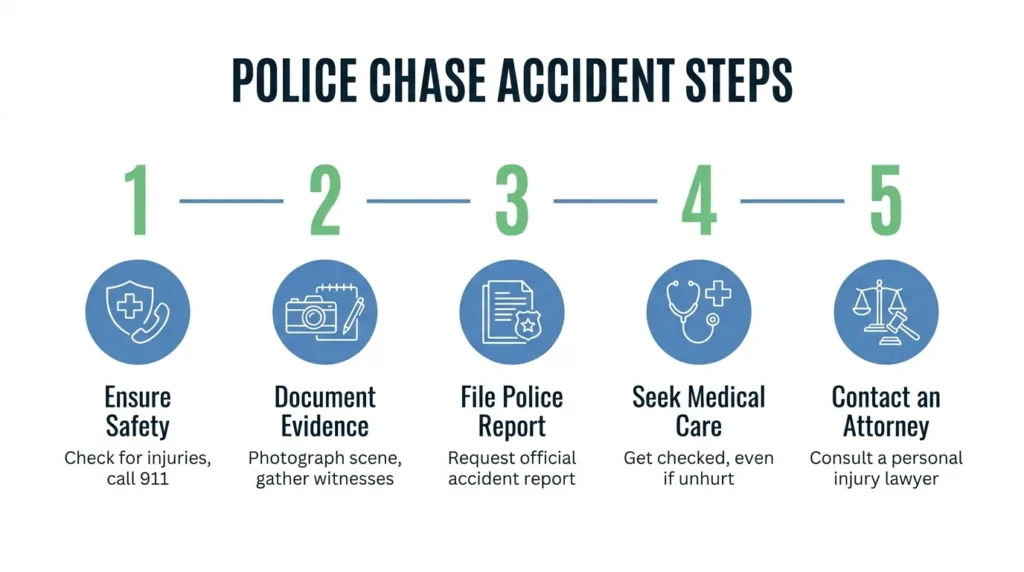
If you’ve been injured by a police car during a high-speed chase, please take the following steps immediately after the incident to protect yourself:
Your safety is the #1 priority. Check yourself for injuries, and then examine anyone else who was involved. If anyone is hurt, even with a minor injury, call 911 for medical assistance immediately.
Document as much evidence as you can find. If it’s safe and you are physically able to do so, then take photos of everything you can, including the accident scene, the police vehicle, your vehicle, and any visible injuries. This evidence can be extremely valuable for your case if you decide to pursue a police chase accident lawsuit.
Gather information and witness statements. Be sure to exchange contact and insurance information with any police officers who were involved in the incident. If there are any witnesses who can vouch for you, try to get their names, contact details, and statements.
File an official police report. Just like any other accident, you’ll want to have an official record on file. Request a copy of the police report to keep for your records, as this will be helpful for your case.
Seek immediate medical attention. Even if you feel okay, make sure you get checked by a medical professional. While some injuries are obvious, others may not be noticeable until after the adrenaline and shock have worn off.
Contact a dedicated personal injury attorney. Police chase accidents can be extremely complex, so consult with an expert personal injury attorney as soon as possible.
Texas Police Video Retention Rules
Under Texas Code of Criminal Procedure Article 2B.0106, law enforcement agencies with body camera programs must retain the video footage for at least 90 days.
Under Article 2B.0111, footage connected to a use-of-force incident or an internal investigation cannot be deleted until the investigation is closed.
Dashcam video footage from a pursuit may be subject to similar agency retention policies, which is why sending a written preservation request as soon as possible is the most reliable way to stop important evidence from being deleted.
The law enforcement agency’s written pursuit policy may also be an important source of evidence that is worth requesting. It can help determine whether the officers followed their department’s rules for starting, continuing, or ending the chase. This becomes a discoverable record once a claim is filed.
Understanding Liability After a High-Speed Chase Accident
The Houston Police Department has announced policy changes that limit pursuits for traffic offenses, but high-speed chase accidents still occur across Texas. More than 350 people are killed in the United States every year in police chase accidents. Many more are injured, and a large percentage are completely innocent bystanders.
Determining liability after a police chase accident can be challenging because these cases involve public safety considerations and law enforcement duties. In Texas, claims against a police department fall under the Texas Tort Claims Act, which establishes the legal framework that applies to most of these cases.
Notice Deadlines for Claims Against Government Agencies
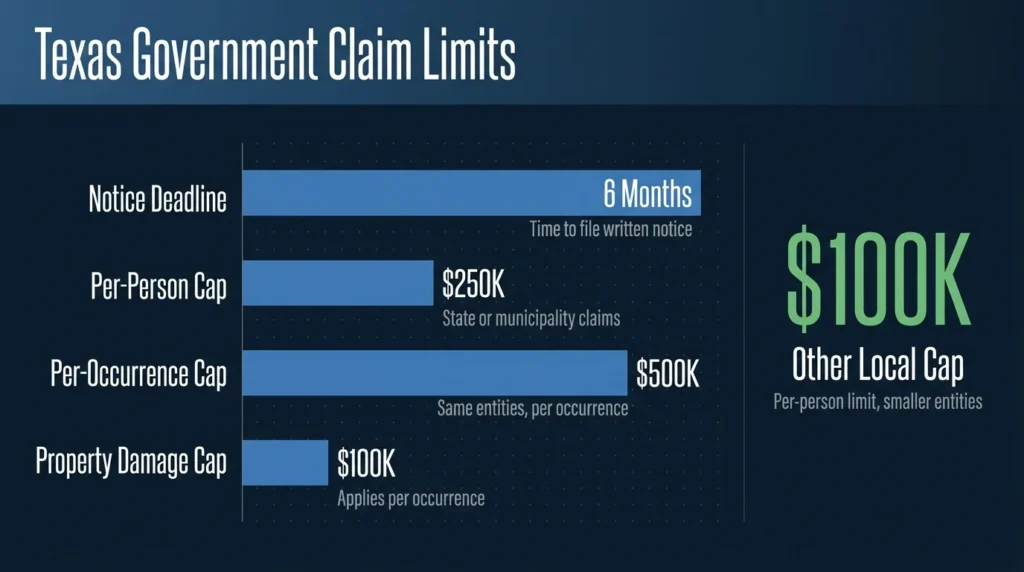
Under Texas Civil Practice and Remedies Code § 101.101, a claim against a government agency requires written notice to be sent within six months after the crash. Some local government entities may have a shorter deadline, so it’s important to verify the specific agency involved.
Notice may not be required if the government agency already has actual knowledge that the crash caused death, injury, or property damage.
Government Claim Damage Limits in Texas
Under § 101.023, claims against government agencies are subject to statutory damage limits. For injury or death claims, the Texas Tort Claims Act generally limits recovery against the state or a municipality at $250,000 per person and $500,000 per occurrence.
Other local government units have lower caps of $100,000 per person and $300,000 per occurrence.
Property damage claims are capped at $100,000 per occurrence.
Governmental Immunity in Texas Police Pursuit Claims
Under § 101.055, governmental immunity applies in police pursuit cases unless the officer’s conduct violated an applicable law or ordinance. Alternatively, if no such law applies, then the officer must have acted with conscious indifference or reckless disregard for the safety of others. Ordinary negligence alone is not enough, which is why these claims often depend on the officer’s conduct during the chase.
Recoverable Damages in a Police Chase Claim
Even with these hurdles, you may still be entitled to compensation in the form of:
Medical expenses
Vehicle repairs or replacement
Lost wages if you’re unable to work
Pain and suffering
Due to the complex nature of a police chase accident lawsuit against a government entity, it is critical that you hire an attorney who will help you navigate the specific procedures and deadlines involved.
Why Police Chase Claims Require Legal Guidance
When a car accident involves a police car, it must be handled differently than a typical collision between civilians. A police chase accident lawsuit involves complex traffic laws, insurance coverage issues, and difficulties determining the responsible party. These legal processes require specialized knowledge that an experienced lawyer can provide.
An attorney who handles this kind of claim will also manage the insurance side of the process, from negotiating with the adjuster who represents the government agency to making sure a valid claim is not denied on a technicality, like a missed notice deadline.
Gathering evidence (such as traffic signal violations, dashcam footage, and the law enforcement agency’s pursuit policy) is crucial when determining liability. Whether the claim involves medical bills, lost wages, or property damage, the goal is to recover the maximum compensation available under Texas law.
Navigating complex government liability and insurance negotiations can be challenging. An experienced attorney can allow you to focus on recovering from your injuries, instead of navigating unfamiliar legal procedures.
Taking the Next Steps with Angel Reyes & Associates
If you or a loved one has been involved in a police chase accident, the compassionate team at Angel Reyes & Associates is committed to protecting your rights under Texas law and helping you seek justice. Our attorneys will help you get the compensation you deserve.
We’ve spent more than 30 years guiding Texas accident victims through complex claims, including cases against government agencies, and our case results reflect more than $1 billion recovered for clients. You pay nothing unless we win.
It’s important to act fast, due to the strict notice deadline for claims against government entities. Contact us today for a free consultation to discuss your police chase accident claim.
Police Chase Accident FAQs
What happens if the agency denies my public records request for the dashcam footage?
You can appeal the denial through the Texas Attorney General’s office under the Texas Public Information Act, which reviews most government withholding decisions.
Is a 911 dispatcher's decision to keep authorizing a chase an issue that I can raise in a claim?
Dispatch conduct during an active pursuit is generally analyzed under the same emergency response exception in Section 101.055 that applies to the pursuing officer and is based on the same standard of reckless disregard.
Can I sue the fleeing driver if a police chase causes my crash?
Yes. A fleeing driver whose conduct causes or contributes to a collision may be held independently responsible, even if a police vehicle was also involved.
What if the police car had its lights and siren on when it hit me?
Emergency lights and sirens do not automatically eliminate governmental immunity issues or establish liability. Instead, Texas law looks at the officer’s conduct and the emergency response protections that may apply.
Can I recover damages if the fleeing suspect hits my car, instead of the police officer?
Potential claims may exist against the fleeing driver, but holding a government entity responsible for an officer’s decision to pursue the suspect involves separate and more restrictive rules.
About the Authors

Spencer Browne
Writer
Spencer Browne is a partner at Angel Reyes & Associates and a Board Certified personal injury trial lawyer with nearly 100 jury trials across Texas. He focuses on car, truck, and wrongful death cases, with notable verdicts including a landmark win in the Choctaw Casino bus crash case. A recognized speaker and legal educator, Spencer is a member of the American Board of Trial Advocates and has been honored as a Texas Super Lawyer and one of D Magazine’s Best Lawyers in Dallas. He brings deep trial experience and relentless advocacy to every client he represents.

Kyle Nicolas
Editor
Kyle Nicolas is the Web Content & SEO Manager at Angel Reyes & Associates. He has more than 10 years of experience as a marketing co...

Angel Reyes
Reviewer
Angel L. Reyes, III is the Founder and Managing Partner of Angel Reyes & Associates. A nationally recognized trial attorney and business...