What Happens If a Truck’s Air Lines Come Loose?


Every article on this site is researched by our internal team, reviewed for legal accuracy against current Texas law, and held to State Bar of Texas advertising standards before publication. We do not publish content that overstates outcomes or makes promises about results.
Learn more about our
editorial standards .
Key Takeaways
- A trailer's spring brakes release under air pressure, not because the driver applies them.
- Federal rules already require daily inspections of tractor-trailer components such as glad hands and brake connections.
- A missing or ignored inspection record can be evidence of a maintenance failure.
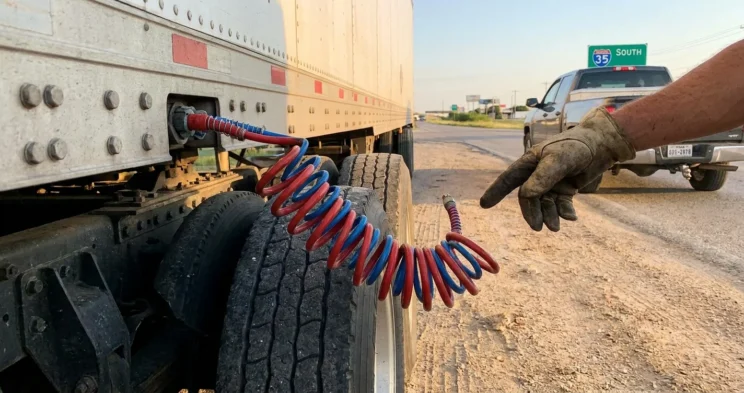
You’re driving behind a loaded semi on I-35 through Dallas when the trailer suddenly swerves and locks up without warning. The truck’s air lines came loose, and that single connection failure means the trailer’s brakes might slam too hard or stop working entirely.
A tractor-trailer’s air brake system is a fail-safe design. The trailer’s spring brakes are held released by air pressure, not applied by it. When the connections between the tractor and trailer lose pressure, cross, or disconnect, the trailer either locks up in an unintended emergency stop or loses its ability to brake on command.
Federal rules require the equipment to be in certain condition and daily inspections to prevent exactly this failure, which is why a loose air line often points to a violation, not bad luck.
The Glad Hands, Air Lines, Pigtail, and Seven-Pin Connector
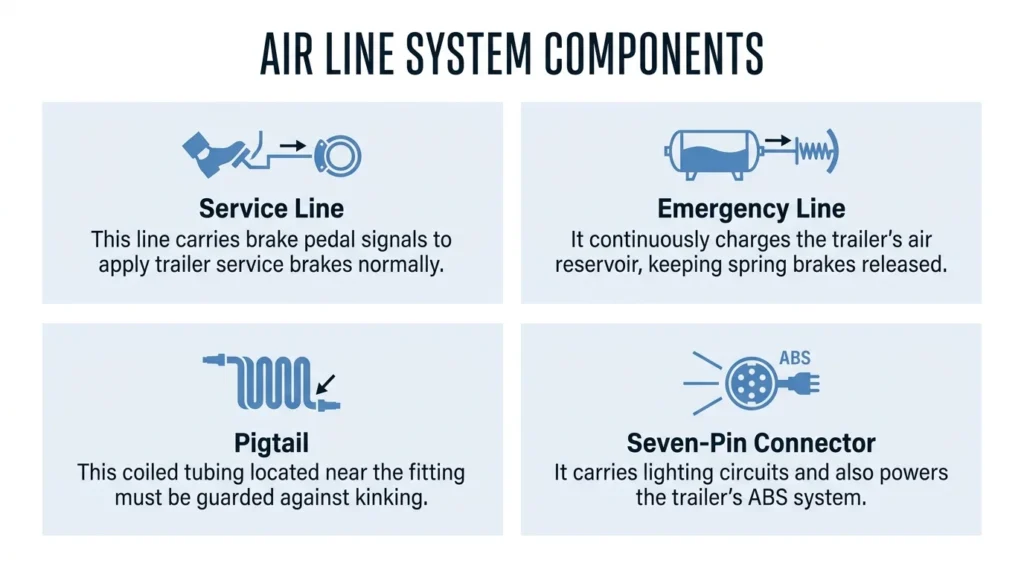
Glad hands are the interlocking couplers that join a tractor’s air hoses to a trailer’s air hoses. Every combination truck uses two of them: one for the service line, one for the emergency line.
The service line carries the signal generated when the driver presses the brake pedal, applying the trailer’s service brakes for a normal stop. The emergency line, sometimes called the supply line, continuously charges the trailer’s air reservoir and keeps the trailer’s spring brakes in the released position. As long as that emergency line holds pressure, the trailer’s spring brakes stay off.
Each line runs through a pigtail, the short segment of coiled brake tubing nearest the fitting. Under 49 CFR § 393.45(c), that pigtail must be guarded against kinking where it meets the glad hand. A chafed or poorly supported pigtail is a common starting point for the leaks that lead to a lost connection.
A seven-pin, or seven-way, electrical connector runs alongside the air lines. It carries the tractor’s lighting circuits and powers the trailer’s antilock braking system. No specific federal statute addresses the seven-pin connector by name, but the industry standard SAE J560 governs its design, and a loose or corroded connector can knock out trailer ABS and brake lights at the same moment an air line problem develops.
Drivers sometimes confuse this air and electrical coupling with the mechanical coupling. The mechanical coupling includes safety chains, cables, and tow-bar connections addressed separately under § 393.70. That section governs how the trailer physically attaches to the tractor. It doesn’t cover the air or electrical lines discussed here.
Truckers commonly rely on color-coded grips—blue for the service line and red for the emergency line—to confirm the lines are matched before pulling out. This is an industry convention, not a federal mandate. It is still one more check meant to catch a crossed connection before the truck ever leaves the yard, and trucking companies that skip it put every driver near their trucks at risk.
What Happens When the Lines Are Crossed, Leaking, or Disconnected?
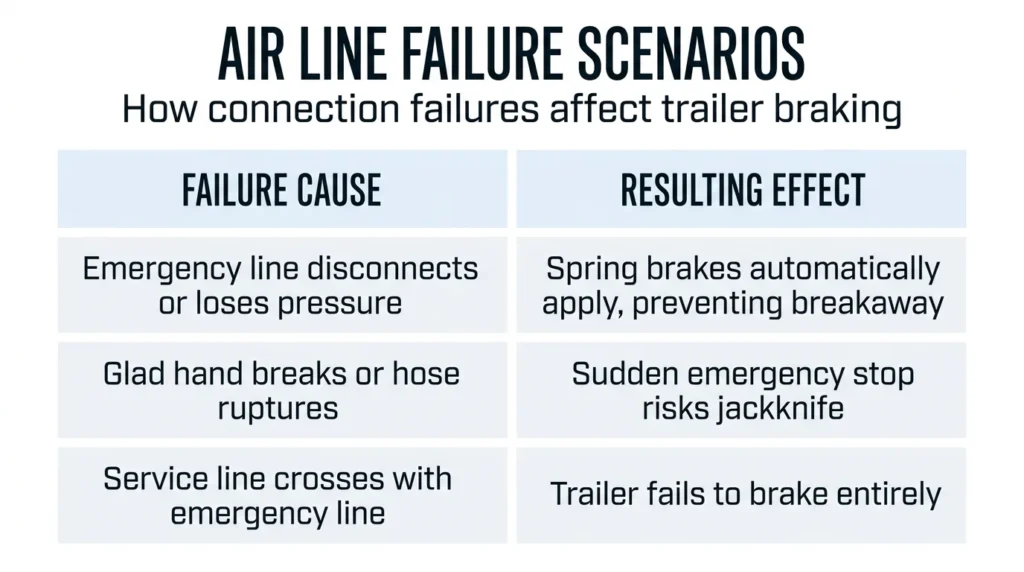
A bad air line connection produces one of two distinct failures.
If the emergency line disconnects, crosses, or loses pressure, the trailer’s air supply falls. Once that pressure drops into the 20 to 45 psi range, § 393.43 requires the trailer’s spring brakes to apply automatically and immediately. That design protects against a true breakaway.
If a glad hand breaks or a hose ruptures while the trailer is still attached, the driver gets a sudden, full emergency application while underway, which is a leading cause of jackknifes and hard-stop pileups.
If the service line crosses with the emergency line, the brake pedal signal never reaches the trailer’s service brakes. The trailer fails to brake, and the tractor’s own brakes absorb the full stopping load they were never designed to carry alone.
Any of these scenarios can trace back to the same construction requirement. § 393.45(d) requires every brake system connection to be installed free of leaks, constrictions, or any condition that would affect brake performance. A crossed, improperly seated, or worn-seal glad hand connection falls squarely within that rule, not within the mechanical coupling standard in § 393.70.
A failing seven-pin connector can also cause accidents. If the tractor loses ABS and brake-light function at the same moment the trailer’s braking behavior changes, the driver behind the truck has even less warning of what is coming.
The Federal Duty To Inspect and Document Trailer Brake Connections
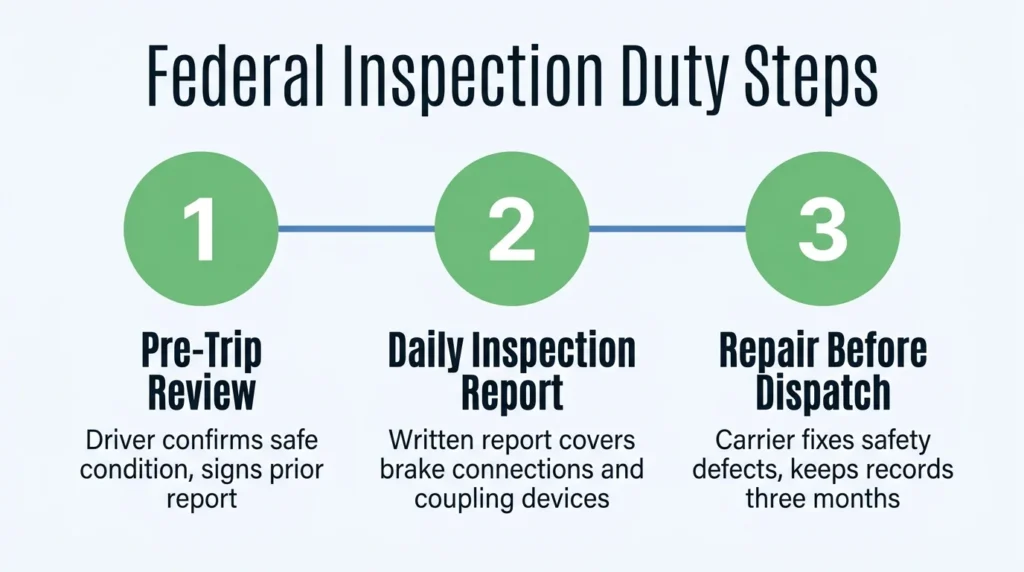
Federal law already requires truck drivers and carriers to catch a bad glad hand, pigtail, or connection before it becomes a crash. That duty runs in three steps:
- Before operating the truck, § 396.13 requires the driver to be satisfied that the vehicle is in safe operating condition and to review and sign off on the prior driver vehicle inspection report.
- At the end of each day’s work, § 396.11 requires a written driver vehicle inspection report covering, at minimum, “service brakes including trailer brake connections” and coupling devices.
- Before the truck goes back on the road, the carrier must repair any listed defect likely to affect safety. Carriers must keep paper or electronic records for three months.
A missing, falsified, or ignored inspection entry, or a defect that was noted but never repaired, is direct evidence of a maintenance failure separate from the equipment standard in § 393.45.
Brake-system defects are not rare paperwork issues. The Commercial Vehicle Safety Alliance’s 2025 International Roadcheck found brake systems were the single most-cited out-of-service violation category nationwide.
Why a Loose Air Line Matters in a Texas Truck Accident Case
A crossed or disconnected air line is not just a mechanical fluke. It is a failure to meet a federal equipment and inspection standard that exists to prevent malfunctions and accidents.
An unintended emergency application or a trailer that will not brake on pedal input can each cause a loss-of-control crash, a jackknife, or a rear-end collision with everyone behind the truck. When that happens, the case usually turns on two verified duties: whether the equipment met the connection standards in §§ 393.45 and 393.43, and whether the driver and carrier met the inspection and documentation duties in §§ 396.11 and 396.13.
No separate Texas statute changes these federal equipment or inspection requirements for interstate trucking. Texas commercial vehicle enforcement follows the same federal standards used nationwide, so a Texas case built on a loose air line still runs through this federal framework.
Talk to Angel Reyes & Associates About a Truck Coupling or Brake-Failure Accident
If a truck’s air lines came loose and caused your crash, you are dealing with a mechanical failure that federal law required someone to catch. Whether the truck driver, the carrier, the maintenance crew, or another party didn’t catch it, someone may be liable for the accident. Angel Reyes & Associates has guided injured Texans through truck accidents like this for over 30 years.
Our team can review the truck’s inspection records, maintenance history, and coupling components to find out whether a required duty was ignored. Consultations are free, there is no fee unless we win, and we are available 24/7 to injured Texans across the state.
Contact Angel Reyes & Associates today for a free consultation. Every case is different, and past results do not guarantee future outcomes.
Past results do not guarantee future outcomes.
Truck Air Line Frequently Asked Questions
What is a glad hand on a truck, and how many does a tractor-trailer use?
A glad hand is the interlocking coupler that joins a tractor’s air hoses to a trailer’s air hoses. Every tractor-trailer uses two—one connects the service line, and one connects the emergency line—and federal rules require both connections to be free of leaks or conditions that would affect brake performance.
What is the difference between the service line and the emergency line on a semi truck?
The service line carries the signal from the driver’s brake pedal to apply the trailer’s service brakes for a normal stop. The emergency line continuously charges the trailer’s air reservoir and holds the trailer’s spring brakes in the released position, so as long as it holds pressure, those spring brakes stay off.
Why do a truck's trailer brakes apply automatically if the air lines disconnect?
A trailer’s spring brakes are held in the release position by air pressure, so federal rules require them to apply automatically once system pressure drops into the 20 to 45 psi range. This fail-safe design should stop a runaway trailer during a true breakaway, but a crossed or disconnected line can trigger an unintended stop while the trailer is still attached, which can lead to accidents.
What federal inspection records apply to a truck's coupling devices and trailer brake connections?
Federal law requires a written driver vehicle inspection report at the end of each day covering, at minimum, trailer brake connections and coupling devices, and it requires the driver to review and sign off on that report before the next trip. Any listed defect that could affect safety must be repaired before the truck is dispatched again, and these records must be kept for at least three months.
About the Authors

Angel Reyes
Writer
Angel L. Reyes, III is the Founder and Managing Partner of Angel Reyes & Associates. A nationally recognized trial attorney and business leader, Angel has helped over 70,000 injury victims recover more than $1 billion since founding the firm in 1993. Named to the Texas Super Lawyers list annually since 2008, Angel brings Wall Street experience, Ivy League education, and a deep commitment to client advocacy. He is a frequent legal commentator and published author with extensive contributions to legal scholarship, trial strategy, and consumer protection.

Kyle Nicolas
Editor
Kyle Nicolas is the Web Content & SEO Manager at Angel Reyes & Associates. He has more than 10 years of experience as a marketing co...

Angel Reyes
Reviewer
Angel L. Reyes, III is the Founder and Managing Partner of Angel Reyes & Associates. A nationally recognized trial attorney and business...