What Is a Truck Driver Qualification File?


Every article on this site is researched by our internal team, reviewed for legal accuracy against current Texas law, and held to State Bar of Texas advertising standards before publication. We do not publish content that overstates outcomes or makes promises about results.
Learn more about our
editorial standards .
Key Takeaways
- Federal law requires six documents in every truck driver qualification file.
- A missing previous-employer inquiry means the carrier never verified safety history.
- Some file records can be purged three years after their date, so send a hold early.

The 18-wheeler that hit you on I-35 had a person behind the wheel, and somewhere in that trucking company’s records is a file explaining how that person got there.
It is called a driver qualification file, and it is often where a Texas truck accident case shifts from what happened on the road to who put that driver there.
Federal law spells out exactly what belongs in it. What is missing can matter as much as what is there.
What a Driver Qualification File Is, & Why Federal Law Requires One

A driver qualification file, or DQF, is the recordkeeping file every motor carrier must create and keep for each driver of a commercial motor vehicle under 49 CFR § 391.51. It is a federal requirement, not a company courtesy, and it applies to the interstate carriers running Texas corridors every day.
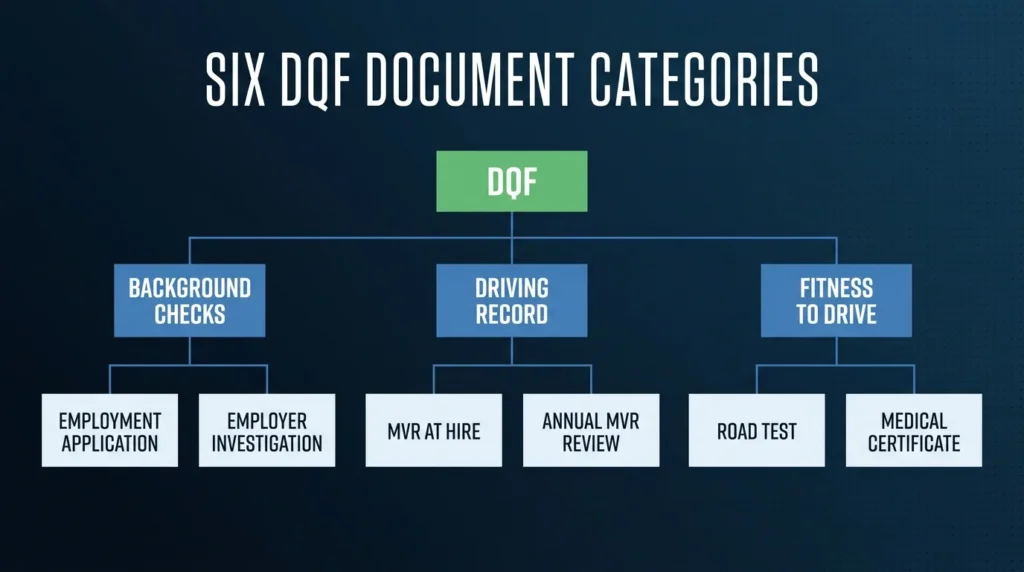
The regulation calls for six categories of documentation:
- the driver’s employment application
- motor vehicle records pulled at hire and each year after
- a road test certificate or an accepted equivalent
- a record of the previous-employer safety performance investigation
- a signed annual review of the driving record
- the medical examiner’s certificate
A carrier may combine the DQF with the driver’s regular personnel file; combining the paperwork does not shorten the list.
Together, those six documents make up a carrier’s truck driver hiring records, the paper trail regulators and courts use to test a hiring and retention decision. They show what the company knew about a driver, when it knew it, and what it did with that information. That is why truck accident cases so often begin with a request for this one file.
The Six Required Documents & What Each One Must Show
Each of the six documents answers a different question about the driver, with its own rules about who completes it and when. Here is what the regulation demands.
The Employment Application (§ 391.21)
The application is the driver’s own account of his history, and a signed copy must be on file before he drives. 49 CFR § 391.21 requires it to contain:
- Three years of detailed prior-employer history, including names, addresses, employment dates, and the reason for leaving each job
- An additional seven years of history with commercial motor vehicle employers, for ten years of employment history disclosed on the application (Federal Motor Carrier Safety Administration (FMCSA) guidance on § 391.21(b)(11))
- A three-year record of motor vehicle law violations and convictions, excluding parking
- The applicant’s signed certification that every entry is true and complete
That ten-year figure is the driver’s disclosure duty. The carrier’s separate duty to independently verify safety history is narrower and reaches back three years, and that difference matters later.
Motor Vehicle Records at Hire & Every Year After (§ 391.23, § 391.25)
The Motor Vehicle Record (MVR) is the state’s version of the driver’s record, and the carrier has to pull it more than once. The rules break down this way:
- At hire, an MVR covering the driver’s prior three years from every state where he has held a license (49 CFR § 391.23)
- At least once every 12 months after that, a fresh MVR covering at least the preceding 12 months (49 CFR § 391.25)
- A review of each record for violations of the federal safety regulations, accidents, and evidence of unsafe driving
The Road Test or an Accepted Equivalent (§ 391.31, § 391.33)
Before a driver takes the wheel, someone has to watch him operate the equipment. 49 CFR § 391.31 requires a road test covering eight skill areas:
- pre-trip inspection
- coupling and uncoupling
- starting
- use of controls and emergency equipment
- operation in traffic
- turning
- braking and slowing
- backing and parking
The examiner then signs a certificate of the driver’s road test.
49 CFR § 391.33 allows two substitutes in place of a new test:
- A valid Commercial Driver’s License (CDL) issued after a road test in a matching type of commercial vehicle, excluding double and triple trailer and tank endorsements
- A copy of a road test certificate issued within the preceding three years
Accepting a substitute is the carrier’s choice, not an automatic pass. The carrier must keep a legible copy of whichever license or certificate it relied on, and it may still require its own road test.
The Previous-Employer Safety Performance Investigation (§ 391.23, § 391.53)
This is the step where a carrier is supposed to call the driver’s past Department of Transportation-regulated employers and ask hard questions. Section 391.23 requires the carrier to:
- Investigate the driver’s safety performance history for the preceding three years
- Investigate accidents within that three-year window
- Investigate alcohol and controlled substance violations within that window
- Document the effort within 30 days of the driver’s start date, recording each previous employer’s name and address, the date contacted or the attempts made, and the information received
- Document any prior employer’s failure to respond and report that failure to FMCSA through the complaint process.
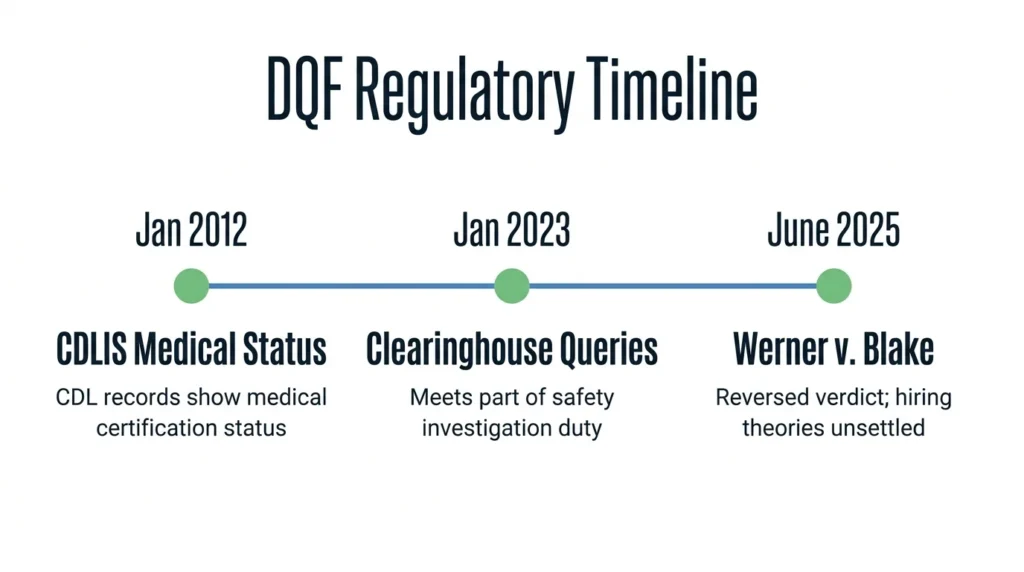
Since January 6, 2023, part of this duty can be met through FMCSA Clearinghouse queries rather than direct contact alone.
The responses themselves do not live in the DQF. 49 CFR § 391.53 places them in a separate driver investigation history file with restricted access, limited to people involved in the hiring decision and usable only for that decision. The DQF itself only has to reflect that the investigation was performed.
The Annual Review of the Driving Record (§ 391.25)
Pulling the annual MVR is only half the requirement. A reviewing official must also:
- Evaluate that record against the minimum safe-driving requirements
- Sign and date a note documenting the review, with the reviewer’s name
The Medical Examiner’s Certificate (§ 391.43, § 391.51(b))
A driver has to be medically certified to be on the road, and the file has to prove it. 49 CFR § 391.43 and § 391.51(b) call for:
- A dated, signed certificate from the examining medical examiner, whose National Registry listing the carrier must verify and note
- For CDL holders, the Commercial Driver’s License Information System (CDLIS) motor vehicle record where that record carries medical certification status, a requirement in place since January 30, 2012
- Retention of the medical examination report and certificate copy for at least three years from the date of the examination
What Gaps in the File Reveal About the Hiring Decision
A gap in a driver qualification file is not only a paperwork problem. It is evidence of what the carrier checked, what it skipped, and what it decided to accept.
A complete application shows a company that made the driver account for their history in writing. Blank employer fields, a missing signature, or no certification shows one that accepted an incomplete self-report at the door.
A current MVR shows a carrier deciding on the driver’s actual record. A stale one, predating the annual window or never refreshed after a known citation or crash, shows a carrier running on outdated information. Missing annual pulls are among the violations most commonly cited in FMCSA compliance reviews.
A retained road test certificate or qualifying CDL copy shows the driver was tested on the equipment they were assigned. Without either document, there is no record they were ever tested on that configuration, which carries weight when the crash involved a tank, a set of doubles, or a trailer type outside what any prior test covered.
A documented previous-employer inquiry shows a carrier that verified safety history before handing over the keys. No contact record, no good-faith attempt, and no Clearinghouse query shows the opposite, another finding that turns up often in compliance reviews.
A signed annual review shows the carrier applied what the MVR said to the decision to keep the driver qualified. An MVR with no review note shows data collected and never used.
A valid medical certificate shows a driver cleared to work. An expired or missing one at the time of a crash shows, by the carrier’s own file, a driver who was not currently certified to be on the road.
These gaps support negligent hiring, entrustment, and retention theories in a Texas truck accident case, separate from the driver’s own conduct. Texas law here is still moving.
The Texas Supreme Court’s June 2025 decision in Werner Enterprises, Inc. v. Blake reversed a large verdict on proximate cause and left open whether an employer’s stipulation forecloses those independent theories. A gap proves something real. It is not, on its own, a decided case.
How Long the File Must Be Kept, & Why Timing Matters for a Preservation Demand
The whole file has to survive for as long as the driver is employed by that carrier plus three years after they leave, under § 391.51(c). The driver investigation history file under § 391.53 carries its own employment-plus-three-years period.
A second clock catches people off guard. Under § 391.51(d), specific documents inside an active driver’s file may be removed three years after their own execution date, including annual MVRs, annual review notes, medical certificates, medical variance documentation, and examiner registry verification notes.
Parts of a current driver’s file can therefore be destroyed lawfully while they are still driving for the company. The stale MVR or the missing review note that would have proven the gap can be gone before anyone asks for it.
Timing drives everything on the preservation side of a Texas truck accident case. A preservation and spoliation letter needs to reach the carrier before an individual document’s three-year clock runs out, not merely before the employment-plus-three-years clock does.
Talk to a Texas Truck Accident Attorney About a Carrier’s Driver Qualification File
If a commercial truck hurt you or someone in your family, the carrier’s driver qualification file is one of the first records worth requesting, and one of the easiest to lose to a routine retention schedule. A law firm can send the preservation demand, obtain the file, and read it against what § 391.51 requires.
Angel Reyes & Associates has guided injured Texans for more than 30 years from over 20 locations across the state, backed by more than 20 attorneys on staff and over $1 billion recovered for clients. Our investigators and accident reconstruction professionals can review your options, and clients don’t pay any legal fees unless we win.
Contact Angel Reyes & Associates for a free consultation to review your situation and your options.
Past results do not guarantee future outcomes.
Understanding Driver Qualification Files FAQs
Is the driver qualification file the same thing as the driver investigation history file?
No; the driver qualification file (DQF) is the six-document file every motor carrier must keep under 49 CFR § 391.51. The actual responses from the previous-employer safety performance investigation, however, are kept in a separate, access-restricted “driver investigation history file” under 49 CFR § 391.53, limited to the people involved in the hiring decision. The DQF itself only has to show that the investigation was performed, not hold the responses. Both files carry the same retention period, employment plus three years, but they are distinct records with different access rules.
Does an FMCSA Clearinghouse query replace the carrier's duty to contact previous employers directly?
Only in part. Since January 6, 2023, a carrier may satisfy part of the previous-employer safety performance investigation through an FMCSA Clearinghouse query rather than direct contact alone. The underlying three-year investigation duty under 49 CFR § 391.23, including looking into accidents and alcohol or controlled-substance violations, still has to be documented. A Clearinghouse query on its own does not close out the full investigation requirement.
Can a driver qualification file be obtained during a lawsuit against a trucking company?
Yes. A carrier’s driver qualification file is a business record, and it can be requested and produced once a lawsuit or a formal preservation demand is underway. That is why a Texas truck accident case often starts with a request for this specific file. Because some of the file’s contents can be legally destroyed on a rolling schedule even while the driver is still employed, requesting the file early matters as much as requesting it at all.
How soon after a crash should a preservation letter go out to protect driver qualification file records?
As soon as possible. Under 49 CFR § 391.51(d), documents such as annual MVRs, annual review notes, and medical certificates can be purged three years after their own execution date, even during an active driver’s employment, separate from the employment-plus-three-years rule for the whole file. Waiting to send a preservation letter risks losing exactly the record, a stale MVR, or a missing review note, that would have proven the gap in a Texas trucking case.
About the Authors

Alex Ivanov
Writer
Alex Ivanov is a personal injury attorney at Angel Reyes & Associates, focused on car, truck, and motorcycle accident cases. Licensed in Texas and multiple federal districts, Alex brings international legal experience and a global education to his practice. He earned his LL.M. from Texas A&M University School of Law after graduating from Belarussian State University in 2016. Alex is fluent in Russian, English, Ukrainian, and Belarussian, and is recognized by multiple national trial lawyer associations for his results and leadership under 40.

Kyle Nicolas
Editor
Kyle Nicolas is the Web Content & SEO Manager at Angel Reyes & Associates. He has more than 10 years of experience as a marketing co...

Angel Reyes
Reviewer
Angel L. Reyes, III is the Founder and Managing Partner of Angel Reyes & Associates. A nationally recognized trial attorney and business...