What’s the Difference Between a Semi & a Box Truck?


Every article on this site is researched by our internal team, reviewed for legal accuracy against current Texas law, and held to State Bar of Texas advertising standards before publication. We do not publish content that overstates outcomes or makes promises about results.
Learn more about our
editorial standards .
Key Takeaways
- A semi is a two-unit combination vehicle; a box truck is one continuous chassis.
- At 10,001 pounds a truck becomes a CMV; 26,001 pounds is what triggers a CDL.
- Texas Transportation Code Ch. 522 mirrors the federal 26,001-pound CDL threshold.
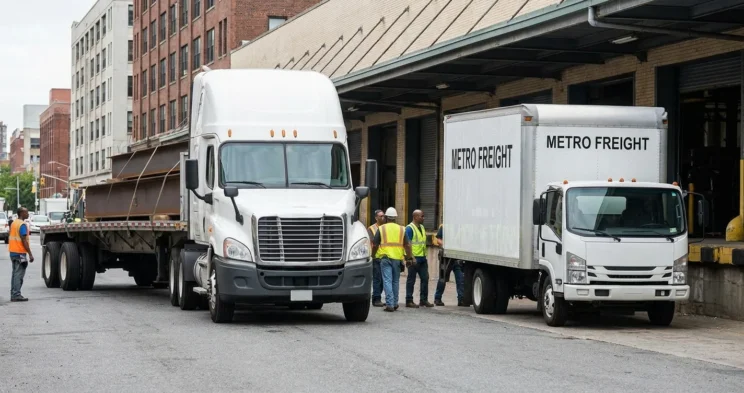
After a crash with a large truck, most people can describe what they saw but not what it was. It may have been a long trailer swinging behind a cab, or a tall white box with a rental logo on the side.
The difference between those two vehicles is structural. A semi is two separate units coupled together that can be detached, and a box truck is a single unit built on one continuous frame.
That build difference, combined with the truck’s certified weight rating, decides which federal rules the carrier had to follow, how much liability insurance it was required to carry, and what records now exist about the driver who hit you. The semi vs. box truck question tells you a great deal about what your claim can file.
Semi vs. Box Truck: The Core Configuration Difference
Of all the types of commercial trucks moving freight across Texas, the combination vehicle (semi) and single-unit vehicle (box) split is the one that changes the legal analysis most.
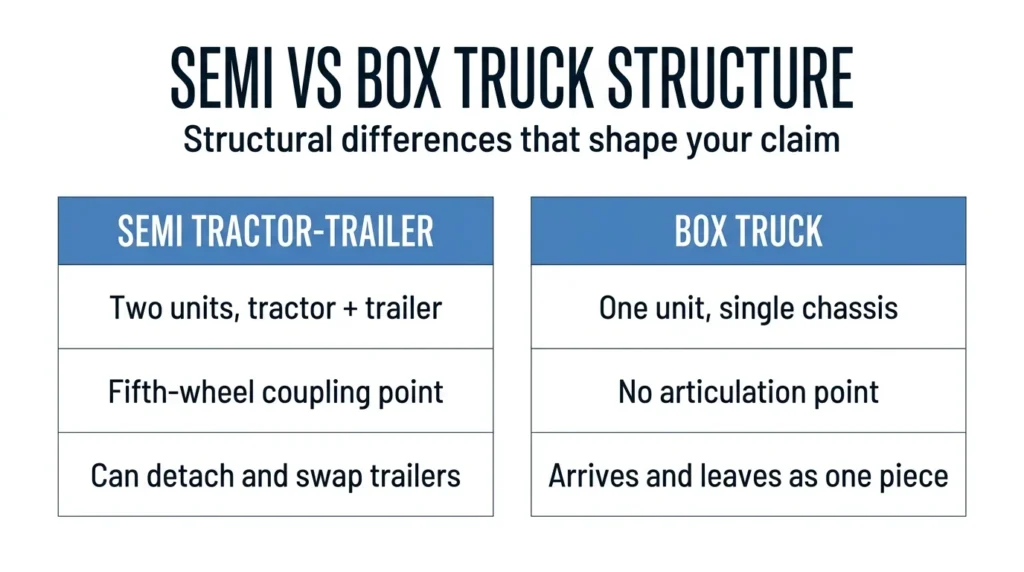
The front half of a semi is a truck tractor, defined in 49 CFR § 390.5 as a self-propelled commercial motor vehicle designed or used primarily for drawing other vehicles. It carries no cargo body of its own. It exists to pull.
The back half is a semitrailer, which rests part of its weight on the towing unit through a fifth-wheel coupling. That coupling is the articulation point, and it is why a tractor can drop one trailer in a Dallas yard and leave with another an hour later. A full trailer, by contrast, carries all of its own weight.
A box truck has no articulation point. The cab, the engine, and the enclosed cargo box are permanently mounted on one continuous chassis, so the vehicle arrives and leaves as one piece.
Box trucks belong to the broader family of straight trucks, which also includes flatbeds, dump trucks, and stake trucks built the same way on a single frame.
Two terms worth separating from the start:
- “Straight truck” and “box truck” are industry terms, not definitions written into 49 CFR § 390.5.
- “Commercial motor vehicle,” “gross vehicle weight rating” (GVWR), and “gross combination weight rating” (GCWR) are the regulatory hooks that actually decides how a truck is treated.
Federal highway data draws the same structural line. The Federal Highway Administration’s Traffic Monitoring Guide vehicle classification scheme counts single-unit trucks on one frame separately from combination trucks made of a tractor plus a semitrailer.
Knowing which category struck you is the first practical step in a Texas truck accident claim, because the two categories carry different rulebooks.
Why Weight Ratings, Not Size or Shape, Determine Which Rules Apply
Classification turns on the truck’s certified weight rating, not on how big it looked from your driver’s seat. Those ratings are assigned by the manufacturer and printed on the door-jamb certification label, and they do not change based on how much freight the truck happened to be carrying that day.
Under 49 CFR § 390.5, a vehicle used on a highway in interstate commerce to transport passengers or property is a commercial motor vehicle when any one of these applies:
- It has a GVWR, GCWR, or actual gross weight of 10,001 pounds or more.
- It is designed or used to transport more than 8 passengers for compensation, or more than 15 passengers without compensation.
- It is used to transport hazardous materials in a quantity requiring placards.
GVWR is the manufacturer’s maximum loaded weight for a single vehicle. GCWR generally means the greater of the manufacturer’s posted combination rating or the combined GVWRs of the power unit and whatever it tows, and that combination rating does not create commercial motor vehicle status unless the truck is actually towing something.
The 10,001-pound line arrives long before the CDL threshold most people have heard of. A box truck rated at 15,000 pounds and running interstate freight is already a commercial motor vehicle, so its carrier is already subject to hours-of-service and record-of-duty-status obligations, driver-qualification recordkeeping, and, if it hauls for hire, federal minimum insurance levels.
What that box truck’s driver does not need yet is a commercial driver’s license. The 26,001-pound figure is a licensing threshold, not the moment federal regulation begins, and treating the two numbers as one line is a common mistake.
The 26,001-Pound Line: CDL Requirements Under 49 CFR Part 383 and Texas Law

The commercial driver’s license requirement comes from the vehicle groups in 49 CFR § 383.91, and Texas adopts the same numbers. Three groups control the question:
- Group A, Combination Vehicle: any combination of vehicles with a GCWR of 26,001 pounds or more, where the GVWR of the unit being towed exceeds 10,000 pounds. This is the classic tractor-semitrailer, and it requires a Class A CDL.
- Group B, Heavy Straight Vehicle: any single vehicle with a GVWR of 26,001 pounds or more, including such a vehicle towing a unit with a GVWR of 10,000 pounds or less. A large box or straight truck belongs to this category and requires a Class B CDL.
- Group C, Small Vehicle: a vehicle or combination that meets neither Group A nor Group B, but is designed to carry 16 or more passengers including the driver, or is used to transport placarded hazardous materials.
Most semi-tractor combinations clear the Group A threshold, so their drivers hold Class A licenses. Box trucks straddle the line. One rated at 26,001 pounds or above is a Group B vehicle and requires a driver with a Class B CDL, while one rated below that figure generally needs no CDL at all, unless its passenger capacity or hazardous cargo pulls it into Group C.
A box truck below the CDL line may still be a regulated commercial motor vehicle.
Texas does not deviate from the federal figure. Texas Transportation Code Chapter 522 uses the same 26,001-pound threshold, the same 10,000-pound towed-unit qualifier for combinations, and the same Class A and Class B structure. Texas also sets minimum ages for CDL holders at 18 for intrastate-only driving and 21 for interstate driving.
The Texas Department of Public Safety publishes an interactive CDL classifications tool that walks through vehicle and trailer combinations. It is a useful starting point, though the statute and the federal regulation remain the governing authority.
One Texas-specific layer sits alongside all of this. Intrastate motor carriers must obtain a TxDMV Number for any commercial vehicle or combination with a gross weight, registered weight, or GVWR exceeding 26,000 pounds, whether or not the driver needs a CDL.
How Configuration Changes the Insurance and Evidence in a Truck Accident Claim
Configuration reaches your claim through two practical channels: the insurance money that has to be available, and the paperwork that has to exist. Neither one tracks the size of the truck as you recall it from the scene.
What Classification Means for Available Insurance Coverage
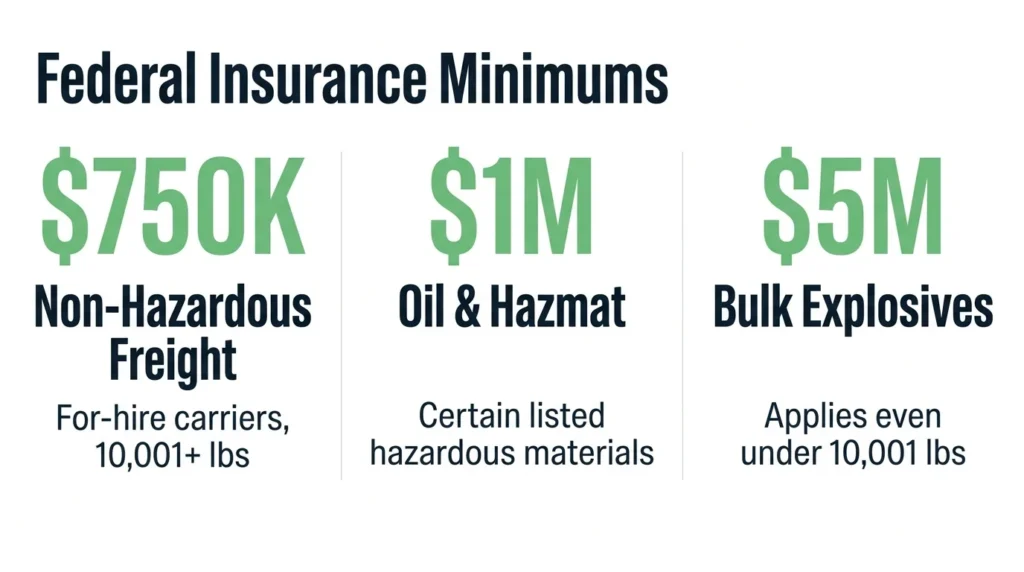
Federal minimum coverage attaches to commercial motor vehicle status and cargo type, not to the CDL line. The public liability schedule in 49 CFR § 387.9 sets these floors for motor carriers operating in interstate commerce:
- $750,000 for for-hire carriers hauling non-hazardous freight in vehicles of 10,001 pounds or more.
- $1,000,000 for oil and certain listed hazardous materials.
- $5,000,000 for bulk Division 1.1, 1.2, and 1.3 explosives and comparable bulk hazardous materials, which applies even to vehicles under 10,001 pounds.
A large box truck and a semi hauling the same class of freight face the same statutory floor once both qualify as commercial motor vehicles. Where they diverge is probability.
Most semis operate for-hire and interstate as Group A equipment, so the federal minimums reliably apply, while a small box truck running only inside Texas below 10,001 pounds may fall outside the federal scheme and be covered by ordinary state auto or commercial liability limits instead.
Trucking cases also frequently involve the MCS-90 endorsement, described in trucking litigation as a
backstop that requires a carrier’s insurer to satisfy a judgment up to the federal minimum even when the underlying policy would otherwise exclude the loss. Whether it applies depends on the carrier, the vehicle, and the policy, and it is worth checking early when coverage looks thin.
What Classification Means for Available Evidence
The heavier and more regulated the operation, the more federally mandated paperwork exists to be requested. Two record sets carry most of the weight.
Under 49 CFR § 391.51, a motor carrier must keep a driver qualification file for each driver containing the employment application, motor vehicle record checks, the road test certificate, annual review documentation, and medical certification. The carrier must retain that file for the length of the driver’s employment plus three years.
Hours-of-service records follow their own schedule. 49 CFR § 395.8 requires carriers to keep records of duty status and supporting documents for at least six months from receipt, and requires drivers to carry the previous seven days of records while on duty.
Those duties attach to commercial motor vehicle operation generally, but they are fullest in practice at Group A and Group B carriers running electronic logging devices. A semi operation usually leaves behind a driver qualification file, ELD data, a DOT number, and a carrier safety and inspection history.
A smaller intrastate box truck below 26,001 pounds may leave behind far less. The absence of a CDL, an ELD, or a DOT number does not make that truck less accountable for the harm it caused. It means the evidence has to be built from other sources, and that work starts earlier.
Injured by a Semi or Box Truck in Texas? Talk to Angel Reyes & Associates
What the truck was called matters less than how it was classified. Its configuration and certified weight rating determine which rules its carrier had to follow, which insurance minimums apply, and which records the carrier must preserve.
Those answers are rarely obvious from the crash scene, and the records that prove them do not stay available forever. An attorney can identify the vehicle’s classification, send preservation demands to the right carrier, and pursue the coverage that classification opens up.
Angel Reyes & Associates has guided injured Texans through the legal process for over 30 years. If a semi, box truck, or any other commercial vehicle hurts you or someone in your family, contact Angel Reyes & Associates for a free consultation to review your options.
Past results do not guarantee future outcomes.
Semi vs. Box Truck FAQs
What's the difference between a box truck and other straight trucks, like flatbeds or dump trucks?
A box truck is one body style within the broader straight-truck category: the cab, engine, and cargo area are permanently mounted on a single continuous chassis, with no articulation point separating a tractor from a trailer. Flatbeds, dump trucks, and stake trucks are built on that same single-chassis design. What changes from one to the next is the cargo body attached to the chassis, whether that is an enclosed box, an open flat bed, a dumping bed, or a stake-sided bed.
Does a truck's actual cargo weight at the time of a crash change its legal classification, or only its certified rating?
Only the certified rating matters. GVWR and GCWR are fixed figures the manufacturer assigns and prints on the vehicle’s door-jamb certification label, and those figures determine whether a truck is a commercial motor vehicle and whether it falls into a CDL-required group under 49 CFR Part 383. A truck’s classification doesn’t shift because it was running light, empty, or overloaded on the day of a particular crash.
What is Group C under 49 CFR 383.91, and does it ever apply to box trucks?
Group C is the category in 49 CFR § 383.91 for vehicles that meet neither the Group A (combination vehicle) nor the Group B (heavy straight vehicle) weight definition, but are designed to carry 16 or more passengers including the driver, or are used to transport placarded hazardous materials. Most box trucks carry cargo rather than passengers, so Group C rarely comes up for them.
Why might a box truck need a TxDMV Number even if its driver doesn't need a CDL?
The CDL requirement and the TxDMV Number requirement come from two different rules. Texas requires intrastate motor carriers to obtain a TxDMV Number for any commercial vehicle or combination with a gross weight, registered weight, or GVWR exceeding 26,000 pounds, and that state registration obligation applies on its own, separate from the federal CDL licensing rules in 49 CFR Part 383.
About the Authors

Alex Ivanov
Writer
Alex Ivanov is a personal injury attorney at Angel Reyes & Associates, focused on car, truck, and motorcycle accident cases. Licensed in Texas and multiple federal districts, Alex brings international legal experience and a global education to his practice. He earned his LL.M. from Texas A&M University School of Law after graduating from Belarussian State University in 2016. Alex is fluent in Russian, English, Ukrainian, and Belarussian, and is recognized by multiple national trial lawyer associations for his results and leadership under 40.

Kyle Nicolas
Editor
Kyle Nicolas is the Web Content & SEO Manager at Angel Reyes & Associates. He has more than 10 years of experience as a marketing co...

Angel Reyes
Reviewer
Angel L. Reyes, III is the Founder and Managing Partner of Angel Reyes & Associates. A nationally recognized trial attorney and business...