Are Truck Drivers Still Allowed to Use Paper Logs?


Every article on this site is researched by our internal team, reviewed for legal accuracy against current Texas law, and held to State Bar of Texas advertising standards before publication. We do not publish content that overstates outcomes or makes promises about results.
Learn more about our
editorial standards .
Key Takeaways
- Federal law has required ELDs for most truck drivers since Dec. 18, 2017.
- Only four narrow exceptions still let a trucker use a paper log instead.
- The trucking company must prove any claimed logging exception actually applied.

You are reading through the crash report after a wreck on I-35, and one detail stops you. The truck driver who hit you was running a paper logbook instead of an electronic device to track hours behind the wheel. You want to know whether that is even legal anymore, and whether it says anything about how the crash happened.
Federal law has required most commercial truck drivers to use an electronic logging device, or ELD, since December 18, 2017. The same regulation that created that mandate, 49 CFR 395.8(a), still allows a narrow set of drivers to keep a paper record of duty status instead.
What Information Does a Truck Driver Log Include?
Every record of duty status has to contain the same core information, whether it is handwritten or generated by an ELD. Under 49 CFR § 395.8, that record must include:
- The date and a 24-hour starting time
- Total miles driven and the vehicle identification number
- The carrier’s name and business address
- The driver’s certification that the record is accurate
- The location of each change in duty status
- A reference to the shipping documents or commodity hauled
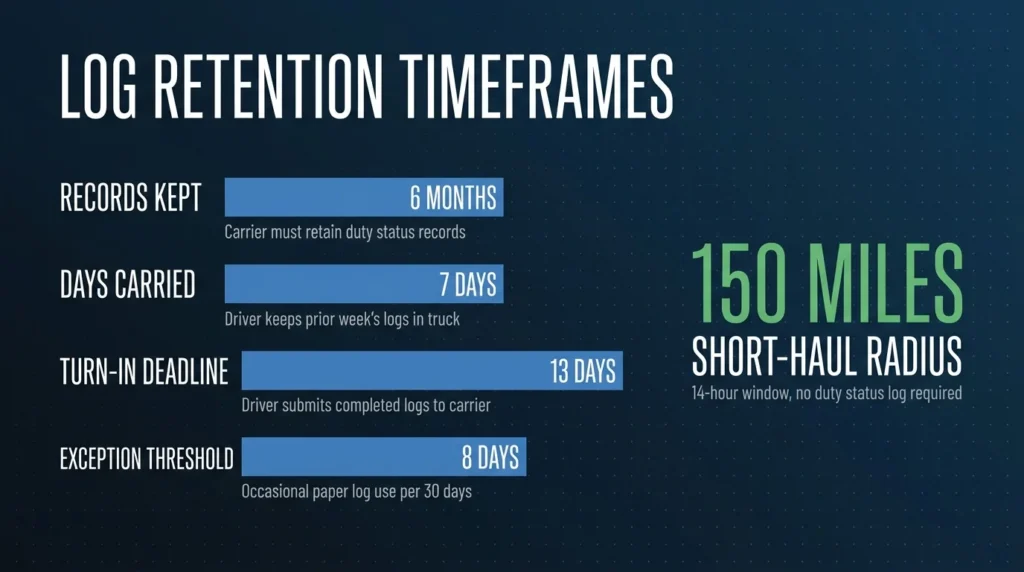
The motor carrier has to keep these records for at least six months. The driver has to carry the previous seven consecutive days of records in the truck and turn completed logs in to their carrier within 13 days.
Texas does not run a separate rule on top of the federal one. The Texas Department of Public Safety incorporates the Federal Motor Carrier Safety Regulations, including Part 395, directly into state law under 37 Tex. Admin. Code § 4.11. That means the same federal standard governs a Texas-based carrier running between Houston and Amarillo and an out-of-state carrier passing through on I-10.
The Narrow Exceptions That Still Allow a Paper Log
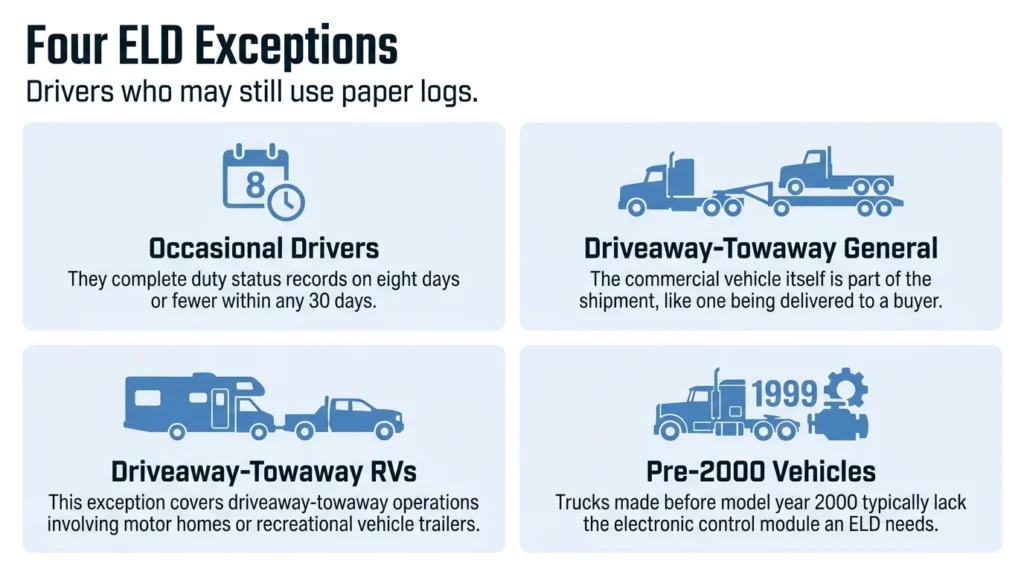
Four specific categories of drivers may use a paper record of duty status instead of an ELD under 49 CFR § 395.8(a)(1)(ii)(A). These categories affect any Texas truck accident claim:
- Occasional long-haul drivers. Drivers who only need to complete a record of duty status on eight days or fewer within any 30-day period.
- Driveaway-towaway, general. The commercial vehicle being driven is itself part of the shipment, such as a truck being delivered to a buyer.
- Driveaway-towaway, motor homes and RV trailers. A separate category covering driveaway-towaway operations involving motor homes or recreational vehicle trailers.
- Pre-2000 vehicles. Trucks manufactured before model year 2000, as shown on the vehicle identification number and registration. These older engines generally lack the electronic control module an ELD needs to pull data from.
A related but different rule often gets mixed in with this list. Under 49 CFR § 395.1(e), a driver who works within a 150 air-mile radius of the normal reporting location, returns there, and is released from work within 14 hours does not have to keep any record of duty status at all, paper or electronic. The carrier keeps time records instead, showing when the driver reported and when the driver was released each day.
That 150-mile, 14-hour window is wider than it used to be. FMCSA’s 2020 Hours-of-Service rule expanded the short-haul exception from 100 air miles and 12 hours to the current 150 miles and 14 hours, effective September 29, 2020.
A driver who normally qualifies for that short-haul exception does not become a “paper log driver” the moment a single trip runs long. That driver only moves into the eight-days-or-fewer paper exception on the occasional day a route exceeds the 150-mile or 14-hour window, and stays exempt from any duty-status record the rest of the time.
Why Paper Logs Are Weaker Evidence Than ELD Data After a Crash
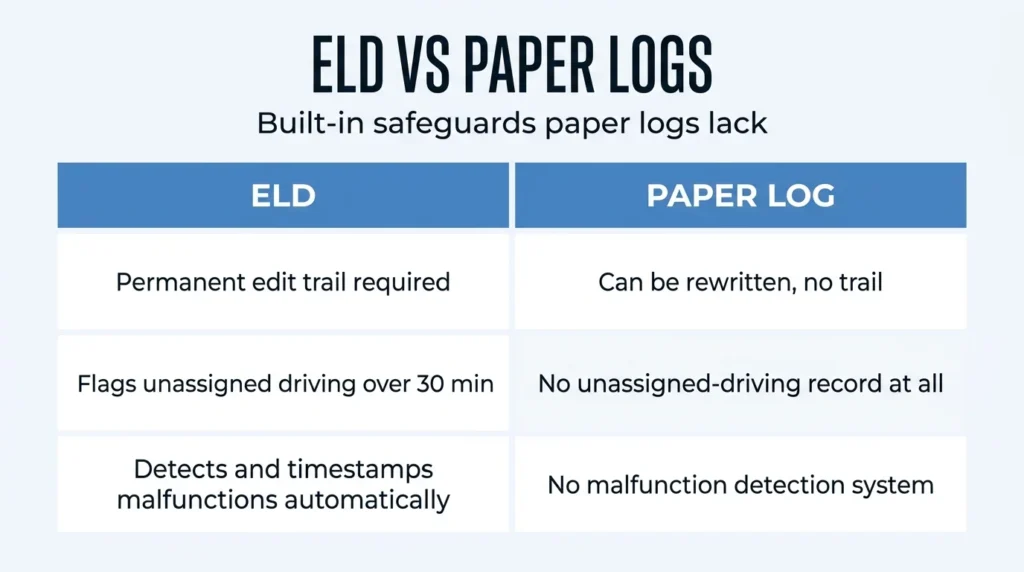
Paper logs are missing three built-in safeguards that federal law requires of every ELD, and that gap can matter a great deal when a crash is under investigation:
- Paper has no edit trail. 49 CFR § 395.30(f) bars a motor carrier from altering or erasing the original hours-of-service data an ELD collects. The device has to preserve the original record alongside any later edits, creating a permanent, discoverable change history. A rewritten line in a paper logbook can be redrawn to eliminate what happened, when it happened, or who made the change.
- Paper creates no unassigned-driving record. 49 CFR § 395.32(c) requires an ELD to automatically log any movement of the truck that is not tied to a driver who is logged in, flag that movement once it passes 30 minutes in a 24-hour period, and force the carrier to either assign the time to a specific driver or explain in writing why it cannot. A paper log has no equivalent.
- Paper generates no malfunction log. 49 CFR § 395.34 requires an ELD to detect and timestamp its own malfunctions, requires the driver to notify the carrier in writing within 24 hours of a malfunction, and gives the carrier eight days to fix it. Even the fallback to paper during an ELD outage is itself logged and timestamped by the system. A driver with a paper log has no such second system.
Supporting documents count more when the underlying record is paper. 49 CFR § 395.11 requires carriers to keep corroborating paperwork tied to a driver’s duty status, including bills of lading, dispatch and trip records, and fuel and toll receipts. When the record itself has no independent edit trail, those supporting documents become the main outside check on whether it holds up.
How to Tell Whether a Trucking Company’s Claimed Exception Actually Applied
The burden of proving an exception applied falls on the trucking company, not on the person hurt in the crash. Each exception leaves behind a paper trail of its own, and that trail can be checked:
- Short-haul, time-card exception. The carrier has to independently create and keep time records showing the driver reported and was released within the 150-mile, 14-hour window. A missing record undercuts the claimed exception rather than simply leaving it unproven.
- Pre-2000 vehicle claim. This is checkable against the vehicle identification number and model year on the truck’s registration.
- Driveaway-towaway claim. This is checkable against the shipping and dispatch paperwork the carrier is already required to keep under 49 CFR § 395.11.
- Eight-days-or-fewer claim. This is checkable by counting the driver’s actual duty-status entries across the prior 30 days. A ninth day in that window disproves the exception.
Texas law gives this documentation real weight, though it is not an automatic finding. The state recognizes negligence per se, where a court adopts a violated statute or regulation as the standard of care in a case. The Texas Supreme Court has made clear in Perry v. S.N., 973 S.W.2d 301 (Tex. 1998), that this adoption is discretionary and requires proof of an unexcused violation.
A documented mismatch between a carrier’s claimed exception and its actual records is strong
evidence of an hours-of-service or record-keeping violation. It is not, on its own, a guaranteed finding of negligence.
Injured by a Truck With Missing or Questionable Logs? Talk to Angel Reyes & Associates
The format of a truck driver’s log, paper or electronic, can be central evidence in a truck accident claim. Whether a claimed exception actually applied often takes a records request, a VIN check, and a careful read of dispatch paperwork that most people cannot run down on their own while also recovering from a crash.
Angel Reyes & Associates has guided injured Texans through situations like this for over 30 years. If you were hurt in a crash with a commercial truck and something about the driver’s hours or logbook does not add up, contact Angel Reyes & Associates for a free consultation to review your options.
Past results do not guarantee future outcomes.
Truck Driver Paper Log FAQs
Can a driver's paper logbook still be used as evidence if the driver was actually required to use an ELD that day?
Yes. A record’s format does not determine whether it can be examined after a crash. If a driver used a paper log without qualifying for one of the four narrow exceptions, that logbook is still part of the record, and its existence can itself point to an hours-of-service compliance failure rather than a valid exception.
How long is a trucking company required to keep hours-of-service records after a crash?
Under 49 CFR § 395.8, a motor carrier must keep a driver’s records of duty status, whether paper or ELD-generated, for at least six months. The driver is separately required to carry the prior seven consecutive days of records in the truck. This retention duty applies regardless of which format was used.
What happens in a claim if a trucking company can't prove its claimed paper-log exception actually applied?
A documented mismatch like that is strong evidence of an hours-of-service or record-keeping violation, though Texas courts still decide case by case whether to treat a specific regulatory violation as the standard of care in a given claim.
About the Authors

Alex Ivanov
Writer
Alex Ivanov is a personal injury attorney at Angel Reyes & Associates, focused on car, truck, and motorcycle accident cases. Licensed in Texas and multiple federal districts, Alex brings international legal experience and a global education to his practice. He earned his LL.M. from Texas A&M University School of Law after graduating from Belarussian State University in 2016. Alex is fluent in Russian, English, Ukrainian, and Belarussian, and is recognized by multiple national trial lawyer associations for his results and leadership under 40.

Kyle Nicolas
Editor
Kyle Nicolas is the Web Content & SEO Manager at Angel Reyes & Associates. He has more than 10 years of experience as a marketing co...

Angel Reyes
Reviewer
Angel L. Reyes, III is the Founder and Managing Partner of Angel Reyes & Associates. A nationally recognized trial attorney and business...