When Can Drivers Use the Bike Lane?


Every article on this site is researched by our internal team, reviewed for legal accuracy against current Texas law, and held to State Bar of Texas advertising standards before publication. We do not publish content that overstates outcomes or makes promises about results.
Learn more about our
editorial standards .
Key Takeaways
- Bike-lane entry depends on local rules, lane layout, and a safe turning movement.
- A turn signal shows intent. It does not make crossing a cyclist's path safe.
- Preserve the original video and scene photos after a right-hook bike crash in Texas.
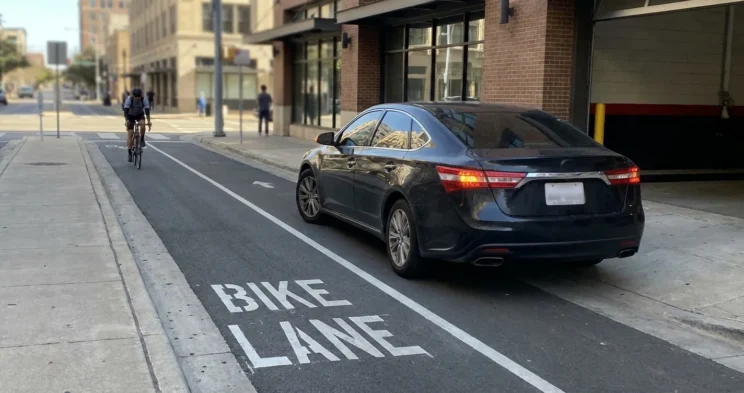
If a bike lane separates your car from a right turn, you may cross or enter it only when local rules, traffic controls, and the maneuver allow it. The move must also be safe. Crossing a bike lane is different from driving along it, and a turn signal does not give you priority over a cyclist.
When Can You Drive in a Bike Lane in Texas?
Texas turning rules do not establish a universal bike-lane entry distance. The lawful crossing or entry point depends on the lane configuration and applicable local rules.
The state’s turning rules start with § 545.101 of the Texas Transportation Code. Under subsection (a), a driver must approach and make a right turn at an intersection as close as practicable to the right curb or edge of the roadway. “Practicable” means as close as you reasonably can. Subsection (e) lets authorized traffic-control devices require a different turning course.
Two related rules shape how that turn happens:
- § 545.103 allows a driver to turn or move left or right only when it is safe.
- § 545.104 requires a signal for turns and lane changes, including a continuous signal during at least the last 100 feet before a turn.
That 100-foot figure is a signaling rule. It does not let you drive in a bike lane for the last 100 feet before you turn.
Dashed bike-lane markings may show a transition or a conflict area, but they do not give drivers unconditional permission to travel in the lane.
Can You Use the Bike Lane to Turn Right?
A right turn may cross a bike lane where the layout and rules permit it. Texas Department of Transportation’s (TxDOT) intersection design guidance describes different layouts.
How Common Bike-Lane Layouts Differ at Intersections
Some bike lanes end and feed into a shared right-turn lane, where drivers and cyclists use the same space. Other bike lanes continue straight beside a separate right-turn lane.
Protected intersections use physical separation to keep bikes and cars apart until the crossing. These designs use markings and signals to show who should yield.
TxDOT’s designs are engineering guidance. They do not create a statewide legal exception or a set distance for entering a bike lane. Never cross a curb, post, or other physical separator to get around traffic.
Steps to Take Before Turning Across a Bike Lane
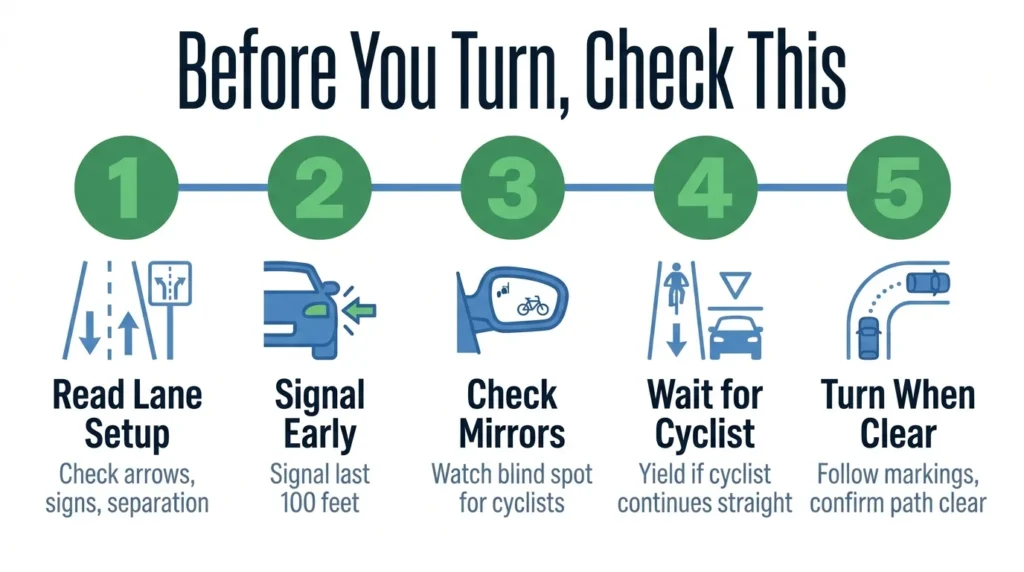
Before turning across a bike lane:
- Read the lane setup, arrows, signs, and any separation.
- Signal for at least the final 100 feet before the turn.
- Check your right mirror and blind spot for cyclists approaching from the right rear.
- Wait if a cyclist is continuing straight through the area you plan to cross.
- Turn only when the path is clear, along the route the markings show.
What Do City Bike-Lane Rules Say About Driving and Parking?
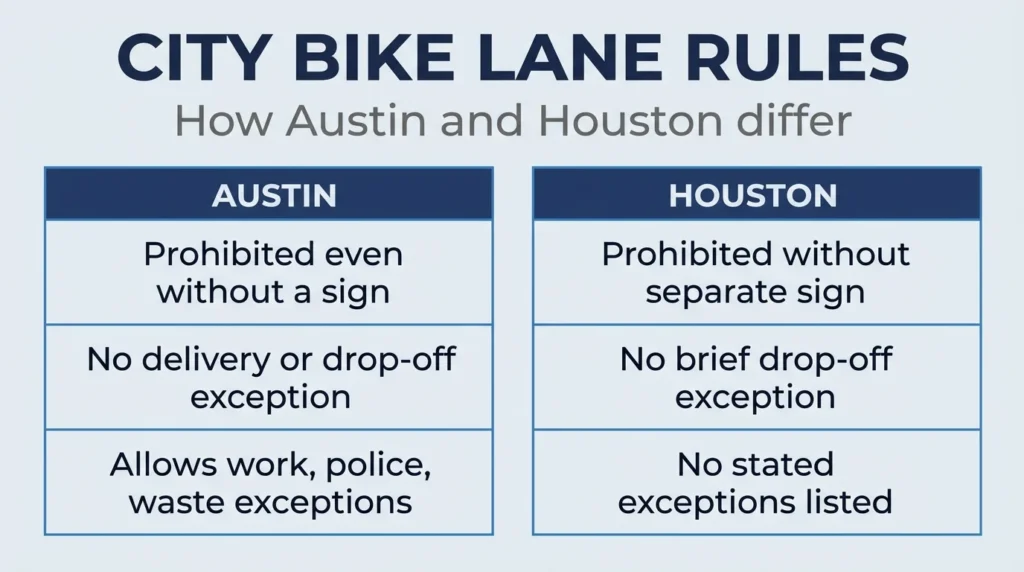
Local ordinances can prohibit stopping or parking in bike lanes. Austin and Houston have restrictions that drivers must follow within those cities.
Austin Bans Stopping and Parking in Bike Lanes
Austin’s city guidance says stopping, standing, and parking in a bicycle lane are prohibited even when no “No Parking” sign is posted. Turning on your hazard lights does not make a delivery or a passenger pickup in the bike lane allowed.
The city lists limited exceptions. They include permitted work under traffic-control procedures, police direction, waste collection, emergencies, and authorized signed uses. An inoperable vehicle may remain for less than two hours while it is cleared, and drivers may briefly enter the lane to yield to an emergency vehicle.
Austin’s 2005 driving ordinance restricted motor vehicles in bike lanes, establishing specific exceptions for drivers. However, that historical amendment does not outline every modern exception or grant a general right to turn across a lane. Instead, current local traffic controls and municipal rules govern precisely when and how a vehicle may execute the maneuver.
Houston Prohibits Even Brief Drop-Offs
Houston’s parking program identifies dedicated bike lanes by striping or barriers. The city’s information card prohibits stopping, standing, or parking in those lanes. A quick package drop-off is not an exception, and the lane does not need a separate no-parking sign.
How State Guidance Fits With City Rules
TxDOT’s bicycle laws FAQ says Texas has no general statewide ban on parking in bike lanes. It directs drivers to local signs and ordinances.
That statement does not override Austin or Houston rules. A missing sign or a broad state statement does not give you permission at a particular spot.
How Does a Right-Hook Bike Crash Happen?
A right-hook crash happens when a driver turns right across the path of a cyclist who is going straight. The cyclist may be beside the car or coming up from behind when the driver starts the turn.
In one common Houston scenario, a driver signals right and slows for a driveway while a cyclist continues straight beside the car. The driver turns across the cyclist’s path before the cyclist clears the driveway, causing a collision.
Visibility, relative position, speed, and timing all shape how that conflict develops. The cyclist may sit in the driver’s blind spot or move faster than the driver expects.
NHTSA’s bicycle safety guidance tells drivers to yield to bicyclists as they would to other motorists. It warns against underestimating a cyclist’s speed and advises looking right and behind before turning right on red.
Checking mirrors is practical safety guidance rather than a separate statutory step. Still, the safe-turn rule in § 545.103 means a driver must account for a cyclist’s path before turning across it. A crash alone does not prove the driver was distracted or at fault.
How Is Fault Evaluated After a Driver Turns Across a Cyclist?
A driver who turns without checking the bike lane may have made an unsafe turn, but liability depends on the evidence. The driver’s approach, signal, and turn path get compared with the turning rules, signs, signals, and local restrictions. The cyclist’s direction and position matter too.
What Evidence Helps Show What Happened
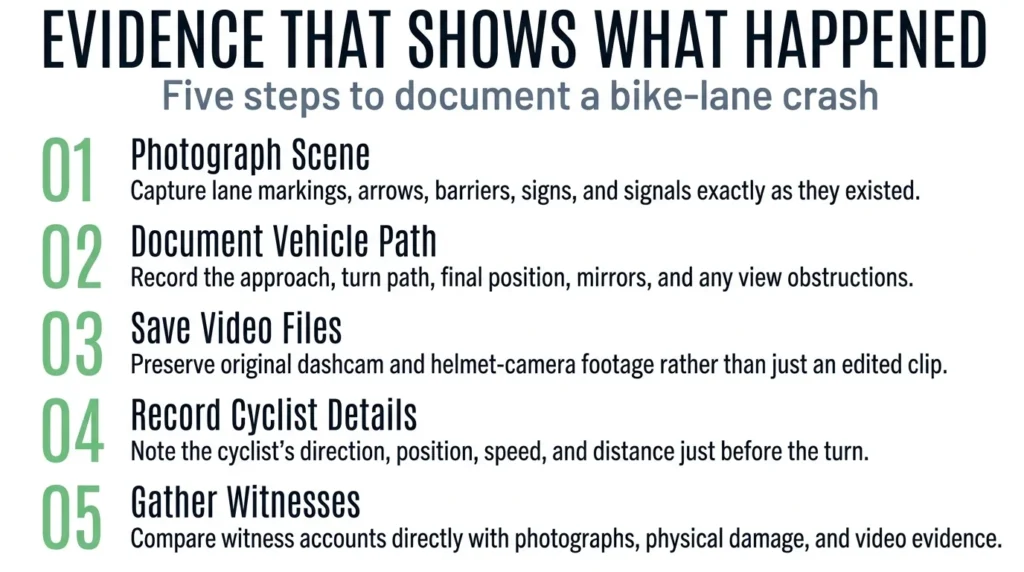
After a crash, take these steps when you safely can:
- Photograph lane markings, arrows, barriers, signs, and signals as they existed on the crash date.
- Document the vehicle’s approach, turn path, final position, mirrors, and anything blocking the driver’s view.
- Save the original dashcam and helmet-camera files, including the approach and aftermath, not just a short edited clip.
- Record the cyclist’s direction, position, speed, and distance before the turn.
- Gather witness accounts and compare them with photos, damage, and video.
No single item settles fault. Mirror position cannot prove whether the driver actually looked.
Speed estimates need care. A driver’s failure to see a cyclist does not mean the cyclist was speeding.
How Texas Law Treats the Cyclist’s Position
§ 551.101 of the Transportation Code generally gives bicycle riders the rights and duties of vehicle drivers, subject to stated exceptions.
§ 551.103 includes exceptions to the rule that cyclists ride near the right. A cyclist outside a bike lane is not automatically at fault.
How Shared Fault Affects a Claim
In an applicable negligence claim, Chapter 33 of the Texas Civil Practice and Remedies Code allows responsibility to be divided among the people involved. An injured person who is 51 percent or more responsible cannot recover. Otherwise, any recovery is reduced by that person’s percentage of responsibility.
An adjuster may dispute the cyclist’s speed or lane position. Neither fact decides the allocation alone; compare it with the full record.
Speak With Angel Reyes & Associates About a Bicycle Crash
If a bike-lane crash left you injured and facing questions about fault, help is available. Angel Reyes & Associates has guided injured Texans through situations like this for over 30 years, and our team is available 24/7. Our firm provides service in English and Spanish across more than 20 offices in Texas, backed by a dedicated team of more than 600 professionals.
We operate on a contingency basis, with no fees unless we win, and have recovered more than $1 billion for our clients. Angel Reyes & Associates can review the lane markings, video, and crash circumstances with you.
Contact Angel Reyes & Associates for a free consultation to talk through what happened and understand your options.
Past results do not guarantee future outcomes.
When Drivers May Use Bike Lanes FAQs
At what point can you enter the bike lane before turning right in Texas?
Texas turning rules do not establish a universal distance for bike-lane entry before a right turn. Follow the intersection’s markings and signals, applicable local rules, and the requirement to move only when it is safe; the 100-foot rule concerns signaling, not bike-lane entry.
Can you cross a bike lane to make a right turn if a cyclist is going straight?
Wait until you can cross the cyclist’s path safely, following the intersection’s markings and traffic controls. A cyclist traveling straight may reach the crossing while your vehicle is turning, even if the cyclist was behind you when you began to slow.
Does a turn signal give a driver the right to move across a bike lane?
No. A turn signal communicates your intended movement, but Texas law still requires the turn or lateral movement to be safe.
Can you stop briefly in a bike lane for a delivery in Austin or Houston?
No. Austin prohibits stopping, standing, and parking in bicycle lanes for routine deliveries, even with hazard lights or without a no-parking sign. Houston likewise prohibits stopping, standing, and parking in dedicated bike lanes, including brief package drop-offs.
What evidence matters when a driver turns right across a cyclist's path?
Lane markings, signs, traffic signals, and video of the approach can help show where each person was expected to travel. The vehicle’s turn path, possible view obstructions, witness accounts, and the cyclist’s position and speed also matter; no single item establishes fault by itself.
About the Authors

Angel Reyes
Writer
Angel L. Reyes, III is the Founder and Managing Partner of Angel Reyes & Associates. A nationally recognized trial attorney and business leader, Angel founded the firm in 1993, which has gone on to help over 70,000 injury victims recover more than $1 billion. Named to the Texas Super Lawyers list annually since 2008, Angel brings Wall Street experience, Ivy League education, and a deep commitment to client advocacy. He is a frequent legal commentator and published author with extensive contributions to legal scholarship, trial strategy, and consumer protection.

Kyle Nicolas
Editor
Kyle Nicolas is the Web Content & SEO Manager at Angel Reyes & Associates. He has more than 10 years of experience as a marketing co...

Angel Reyes
Reviewer
Angel L. Reyes, III is the Founder and Managing Partner of Angel Reyes & Associates. A nationally recognized trial attorney and business...