When to Hire an E-Scooter Accident Lawyer


Every article on this site is researched by our internal team, reviewed for legal accuracy against current Texas law, and held to State Bar of Texas advertising standards before publication. We do not publish content that overstates outcomes or makes promises about results.
Learn more about our
editorial standards .
Key Takeaways
- Serious injuries, including TBI and permanent disability, require legal representation to document the full scope of damages that an insurer's first offer will not cover.
- Rental company liability waivers are not automatically enforceable in Texas; gross negligence and product liability theories can still apply.
- Government entity claims under the Texas Tort Claims Act require written notice within 90 to 180 days, far earlier than the two-year personal injury deadline.
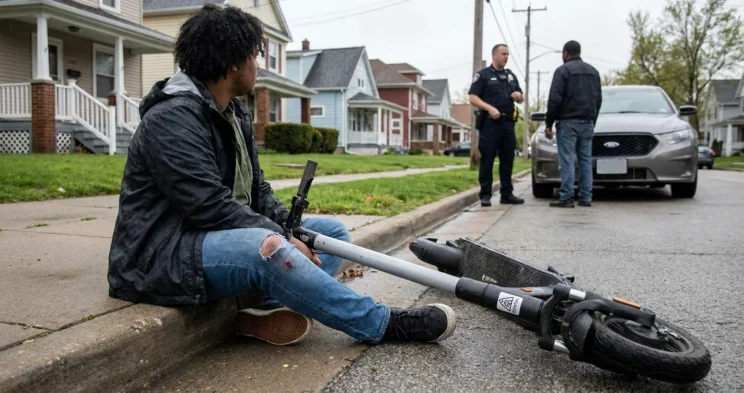
You rented a scooter in Austin, hit a cracked curb that the city had been ignoring for months, and went over the handlebars. The emergency room treated a wrist fracture and a concussion, only to be told by the rental company that their user agreement limits their liability, and by your auto insurer that e-scooters aren’t covered. Naturally, you’re not sure whether any of that is actually true or what to do next.
When the Injuries Are Serious or May Be Permanent
Minor scrapes and bruises from an e-scooter fall rarely require legal representation if the other party’s liability is clear and the insurer pays without resistance. But e-scooter crashes produce serious injuries at rates most people don’t expect.
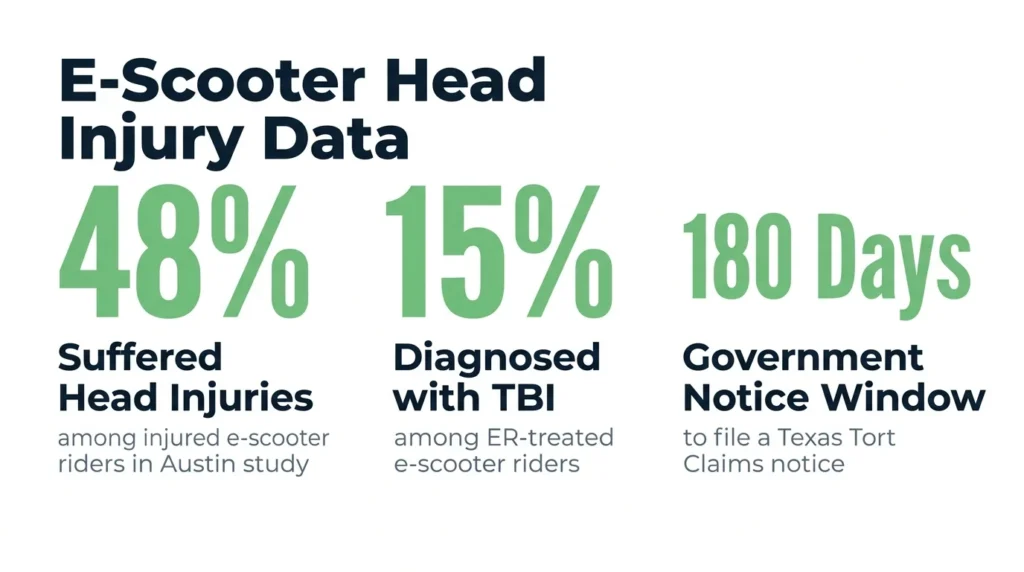
A 2019 Austin study found that 48 percent of injured e-scooter riders sustained head injuries. About 15 percent of those treated in emergency departments had evidence of a traumatic brain injury (TBI), including concussions. Fractures, permanent scarring, and joint damage that requires surgery or long-term rehabilitation are also common outcomes.
Serious injuries create a legal problem that mirrors the medical one: the full extent of harm isn’t always known at the time of the crash. Cognitive effects from a TBI may not appear until weeks later. Future medical costs are difficult to estimate from the ER visit alone, and an insurer’s first offer almost always reflects only immediate documented costs, not the full picture.
An electric scooter accident lawyer works with medical experts to document the complete injury picture: current treatment costs, anticipated future care, lost earning capacity, and non-economic harm. That work cannot happen meaningfully until the scope of the injury is clear. For permanent or long-term injuries, hiring legal representation early preserves the evidence and sets the foundation for a complete claim.
Understanding the Texas e-scooter liability framework is a useful starting point before any legal action.
When Liability Is Disputed or Involves Multiple Parties
E-scooter accidents frequently involve more than one responsible party: a rental company, a motor vehicle driver, a city with defective infrastructure, or some combination of all three. Each defendant has its own insurer and its own incentive to shift blame.
Texas uses a proportionate responsibility framework where, under the Texas Civil Practice and Remedies Code (CPRC) Chapter 33, you recover nothing if a court finds you 51% or more responsible for the crash. Each defendant in a multi-party case will argue that someone else, including you, bears more of the fault. That argument, if successful, can eliminate your recovery.
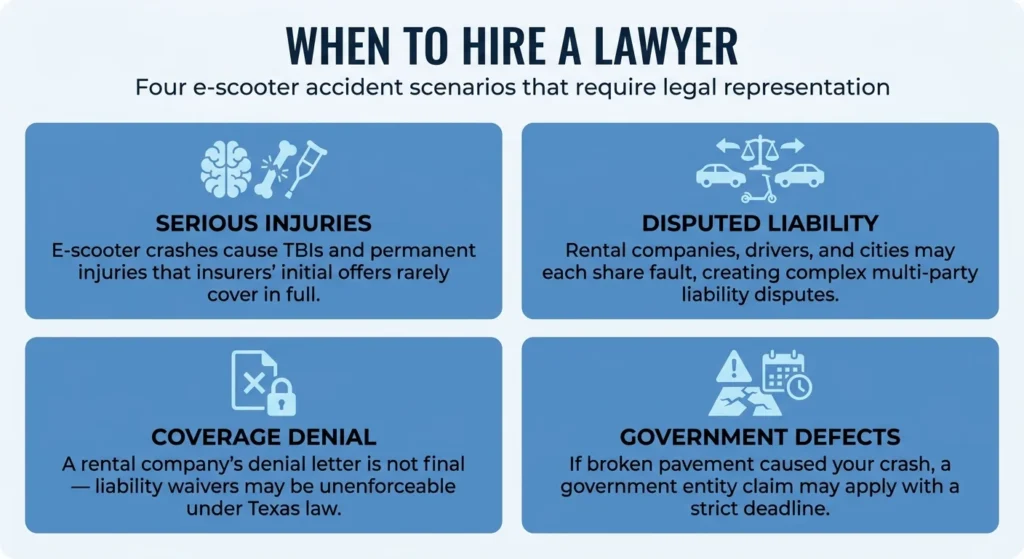
Rental companies like Bird and Lime put liability waivers in their user agreements, but those waivers are not automatically enforceable in Texas. Most Texas appeals courts have held that pre-injury waivers cannot release claims for gross negligence, treating such releases as against public policy. Consequently, if a company deployed a known defective scooter or failed to maintain its fleet to a reasonable safety standard, the waiver’s enforceability becomes a legal question rather than a settled fact, and a product liability theory may also be applied independently of the negligence claim.
A scooter accident lawyer analyzes how fault should be allocated across the parties, builds the evidence that supports your position, and counters the arguments each defendant will make to push liability elsewhere. In a multi-party case, that analysis is not optional. See the Texas e-scooter laws and liability guide for background on how Texas distributes responsibility in these crashes.
When the Rental Company Denies Coverage
A coverage denial from a rental company is not a final legal determination. It is a position the company has taken, and it can be challenged.
Rental company user agreements are written to minimize the company’s exposure. They transfer maintenance responsibility to the rider, limit the company’s liability for equipment defects, and include sweeping releases of claims. When an injury occurs, the company’s first response is typically to point to that agreement.
A denial letter does not resolve whether the waiver is actually enforceable on your specific facts, nor does it address whether the company’s conduct rises to gross negligence. Ultimately, it fails to account for whether a product liability theory based on a design defect, a manufacturing defect, or a failure to warn applies separately from the negligence claim.
An attorney evaluates those questions and determines what the company’s actual legal exposure is. Coverage denial is one of the most common reasons injured riders seek legal representation. It means the company is treating your injury as a contested claim, and you should treat it the same way.
When the Crash Was a Hit-and-Run or Involved an Uninsured Driver
If a motor vehicle struck your scooter and fled the scene, or if the driver who caused the crash has no insurance, your recovery path runs through your own policies, and those policies may not be straightforward.
Texas does not classify e-scooters as motor vehicles, so most standard auto policies exclude them. That said, if a car or truck caused the crash, your auto policy’s uninsured motorist (UM) or underinsured motorist (UIM) coverage may still apply to your injuries. Because policy terms vary, and Texas’s physical contact requirement for hit-and-run UM claims creates an additional threshold, understanding UM/UIM and PIP coverage in Texas provides useful background on what these policies are designed to cover.
An uninsured motorist accident guide covers the process in more detail. The short version: identifying what coverage exists and whether it applies to your specific crash is exactly the problem a lawyer is equipped to solve.
Pedestrians struck by e-scooter riders face a related problem. The rider typically carries no insurance on the device, and e-scooter companies do not insure third-party pedestrian injuries as a standard matter. If you were hit by a scooter as a pedestrian, identifying a path to recovery requires the same kind of coverage analysis.
When a Government Entity May Be Responsible
Road and sidewalk defects are a contributing factor in a meaningful share of e-scooter crashes. Cracked pavement, uncovered utility cutouts, broken curb cuts, and gaps between surfaces can send a scooter rider to the ground without any fault by the rider.
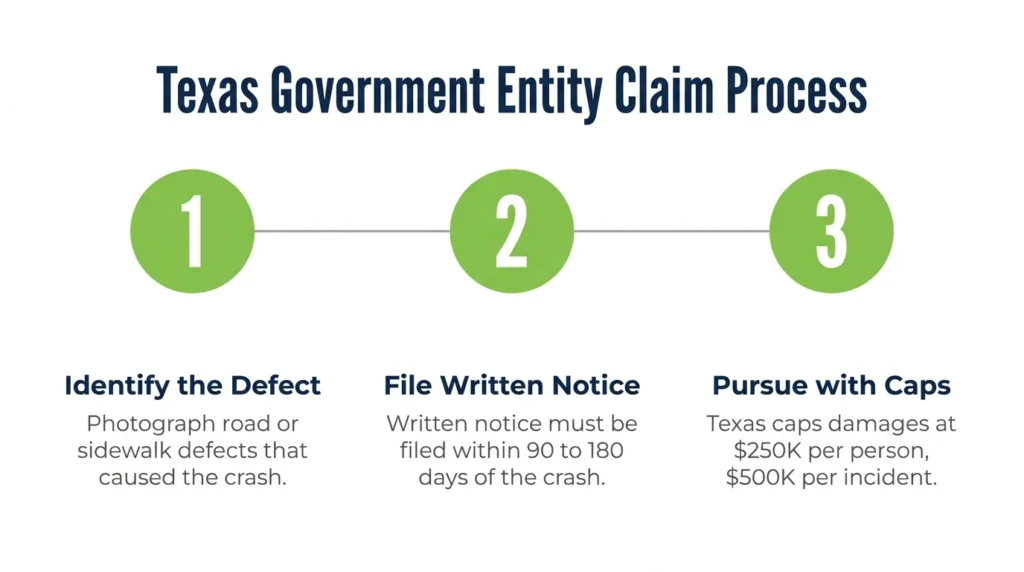
If a defective public road or sidewalk contributed to your crash, you may have a claim against the city or county under the Texas Tort Claims Act (TTCA) (CPRC Chapter 101). These claims operate differently from standard personal injury claims, and the most important difference is the notice deadline.
Government entity claims require formal written notice filed within 180 days of the crash for state entities, and some cities (for example, the City of Houston) shorten that window to 90 days. Missing that deadline typically bars the claim entirely, regardless of how strong the evidence is. The two-year personal injury statute of limitations does not save a TTCA claim where notice was not filed on time.
Damage caps also apply, limiting recovery against municipalities to $250,000 per person and $500,000 per incident.
If a road or sidewalk defect contributed to your crash, the notice window may already be running. A lawyer can determine whether a government claim applies, file the required notice before the deadline, and preserve your ability to pursue that path.
Work with a Texas Personal Injury Attorney
An e-scooter injury claim can involve a rental company, a private driver, a city, and a coverage dispute, all at once. The decision of whether to hire a lawyer rarely requires certainty about the outcome. It requires an honest assessment of the complexity.
Angel Reyes & Associates has represented injury victims across Texas for more than 30 years, with more than 20 offices across Texas and a team of over 600 dedicated professionals to recover more than $1 billion for our clients. We offer free initial consultations, provide service in both English and Spanish, and work on a no-fee-unless-you-win basis; we invite you to review outcomes from past cases we have handled to see how we handle complex liability situations. To talk through your situation and get an honest assessment of your options, contact us for a free consultation.
Past results do not guarantee future outcomes.
When to Hire an E-Scooter Lawyer FAQs
How soon should you talk to an attorney after an e-scooter crash in Texas?
You should consider speaking with an attorney as soon as there are injuries, disputed facts, missing video, or a possible claim against a rental company, driver, property owner, or government entity. Early review matters because evidence from the scooter, nearby cameras, and the accident scene can disappear quickly.
Can health insurance affect an e-scooter accident claim?
Yes. Health insurance may pay some medical bills upfront, but the health insurer may later claim reimbursement from any settlement or recovery, which can affect the final amount you keep.
Should you accept a settlement offer before your medical treatment is finished?
Usually, you should be cautious about settling before doctors understand the full extent of your injuries. Once a release is signed, you generally cannot reopen the claim for later complications, future treatment, or missed work that was not included in the settlement offer.
What if a scooter defect caused the crash, but you no longer have the scooter?
You may still have a claim, but losing access to the scooter can make the case harder to prove. Photos, ride records, witness statements, maintenance logs, and app reports may help identify whether a brake failure, throttle issue, tire problem, or other defect contributed to the crash.
Can you hire an e-scooter accident lawyer if you were partly at fault?
Yes. Under Texas law, being partly at fault does not automatically prevent recovery unless your share of responsibility is greater than 50%.
About the Authors

Angel Reyes
Writer
Angel L. Reyes, III is the Founder and Managing Partner of Angel Reyes & Associates. A nationally recognized trial attorney and business leader, Angel has helped over 70,000 injury victims recover more than $1 billion since founding the firm in 1993. Named to the Texas Super Lawyers list annually since 2008, Angel brings Wall Street experience, Ivy League education, and a deep commitment to client advocacy. He is a frequent legal commentator and published author with extensive contributions to legal scholarship, trial strategy, and consumer protection.

Graham Griffin
Editor
Graham Griffin is the Web & Content Manager at Angel Reyes & Associates, where he oversees content strategy, AI-powered workflows, a...

Angel Reyes
Reviewer
Angel L. Reyes, III is the Founder and Managing Partner of Angel Reyes & Associates. A nationally recognized trial attorney and business...