Who Is at Fault for Hitting a Parked Truck at Night?


Every article on this site is researched by our internal team, reviewed for legal accuracy against current Texas law, and held to State Bar of Texas advertising standards before publication. We do not publish content that overstates outcomes or makes promises about results.
Learn more about our
editorial standards .
Key Takeaways
- Texas bars recovery only if you are found more than 50% at fault.
- Federal rules require working lamps and reflective conspicuity tape on trailers.
- Photograph the truck's lamps and tape at night before any repairs happen.
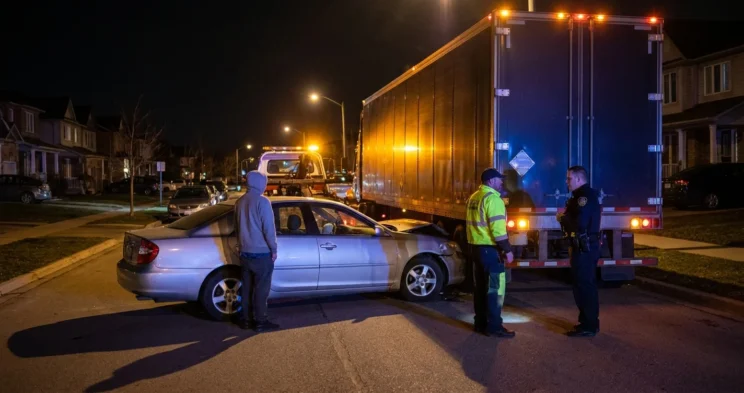
Your headlights caught the back of that trailer far too late. One moment the lane ahead looked empty, and the next you were braking into stopped steel.
Now an adjuster is telling you the crash is your fault because you hit the truck from behind. That conclusion arrives much faster than Texas law actually allows.
Fault here depends on two separate questions: how you were driving, and whether that truck was legally visible to you in the first place.
Who Is at Fault for Hitting a Parked Truck at Night in Texas?
Fault is not automatic against either driver. Texas divides responsibility by percentage, so a nighttime collision with a parked, disabled, or slow-moving truck can be assigned partly to you and partly to the truck driver or the motor carrier.
Under Tex. Civ. Prac. & Rem. Code § 33.001, a claimant recovers no money only if a jury assigns that claimant more than 50 percent of the responsibility for the accident. Below that line, the award is reduced by your own share of fault rather than erased.
Texas courts do apply a rebuttable presumption of negligence against the driver who strikes a vehicle from behind. That presumption grows out of the following-distance duty in Tex. Transp. Code § 545.062, which requires an operator to keep an assured clear distance so the vehicle can stop safely without colliding with the one ahead.
The operative word is rebuttable. The presumption gives way when evidence shows the truck presented a hazard an attentive driver could not reasonably have seen in time.
Dark tail lamps, missing or degraded reflective tape, and warning triangles that were never set out all weigh against the truck side of the ledger. Your speed, attention, and following distance still weigh on yours.
No single fact controls the outcome, as the legal analysis compares fault for both parties.
Federal Lighting and Conspicuity Tape Requirements for Trucks
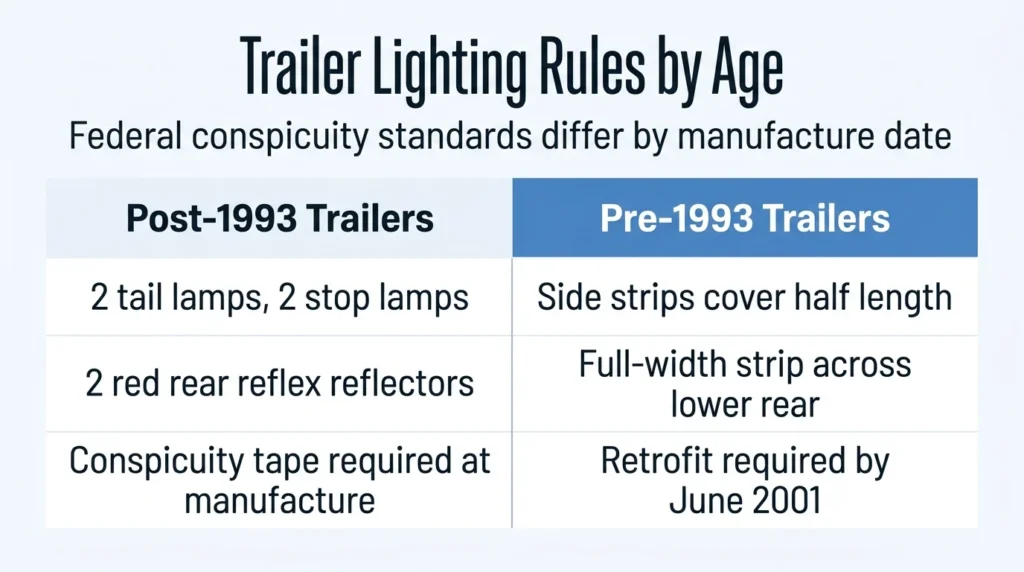
Federal regulation requires trailers to be visible after dark, and the applicable standard splits by the trailer’s manufacture date. Two sections of the Federal Motor Carrier Safety Regulations discuss these requirements:
49 CFR § 393.11 governs lamps and reflective devices, including the conspicuity system required on trailers manufactured on or after December 1, 1993:
- Two red tail lamps and two red stop lamps at the rear of the vehicle.
- Two red rear reflex reflectors mounted as far apart as practicable.
- A conspicuity system of retroreflective sheeting, reflex reflectors, or a combination of both, on every trailer at least 80 inches wide with a GVWR over 10,000 pounds.
49 CFR § 393.13 covers the older equipment still working Texas highways: trailers manufactured before December 1, 1993 that meet the same width and weight thresholds:
- Carriers had until June 1, 2001 to retrofit those trailers with conspicuity treatment, and until December 1, 2001 for container chassis.
- Side strips must run as horizontally as practicable and cover at least half the trailer’s length.
- A full-width strip is required across the lower rear, along with a pair of white strips at each upper rear corner.
- The pattern must generally be red and white under FMVSS 108, and the upper rear treatment must be white.
Those two compliance dates are easy to blur together, and they should not be. An older trailer that may still carry sheeting installed around a 2001 retrofit deadline raises very different questions than a late-model trailer whose tape should still perform close to its original specification.
Equipment questions like these are usually the heart of a Texas truck accident claim, which is why the hardware itself has to be examined before anyone touches it.
The Carrier’s Duty to Warn and Keep the Truck Visible
Compliant equipment on the day of manufacture does not end a carrier’s obligations. A stopped truck triggers a separate duty to warn approaching traffic, and lamps and tape have to stay in working condition for the life of the vehicle.
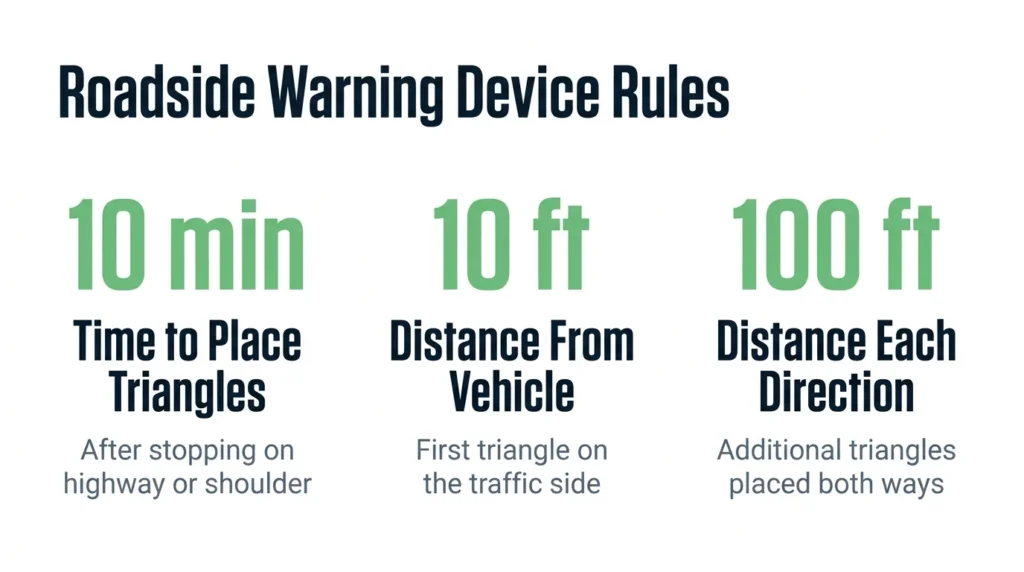
When a commercial motor vehicle stops on the traveled portion or the shoulder of a highway for a reason other than a normal traffic stop, 49 CFR § 392.22 sets a specific sequence for the driver:
- Activate the hazard warning flashers immediately, and keep them on until warning devices are in place.
- Place three bidirectional reflective triangles, or fusees or liquid-burning flares during daylight, as soon as possible and within 10 minutes of stopping.
- Position one device about 10 feet from the vehicle on the traffic side, and one about 100 feet in each direction.
- Move the devices out to between 100 and 500 feet where a hill, a curve, or another obstruction limits how far approaching drivers can see.
Placement is not required inside a business or residential district, with one carve-back that matters directly to a night crash. During darkness, the devices are still required where street or highway lighting does not make the stopped vehicle clearly discernible at 500 feet.
The carrier’s obligations run alongside the driver’s. Under 49 CFR § 396.3, a motor carrier must systematically inspect, repair, and maintain the vehicles under its control, and the parts and accessories covered by Part 393 must be in safe and proper operating condition at all times.
That duty is continuous, since retroreflective sheeting does not stay as bright as it was on the day it was applied. Sunlight, abrasion, road film, and simple age reduce how much light the tape returns to an approaching driver, sometimes without any damage a casual walk-around would catch.
Less reflectivity means a shorter perception distance, and a shorter perception distance means less time to brake or steer. A burned-out lamp or a dulled strip of tape is not just a hardware problem. It is evidence that the carrier’s inspection and maintenance system failed before your crash ever happened.
Building the Case: Evidence and Negligence Per Se
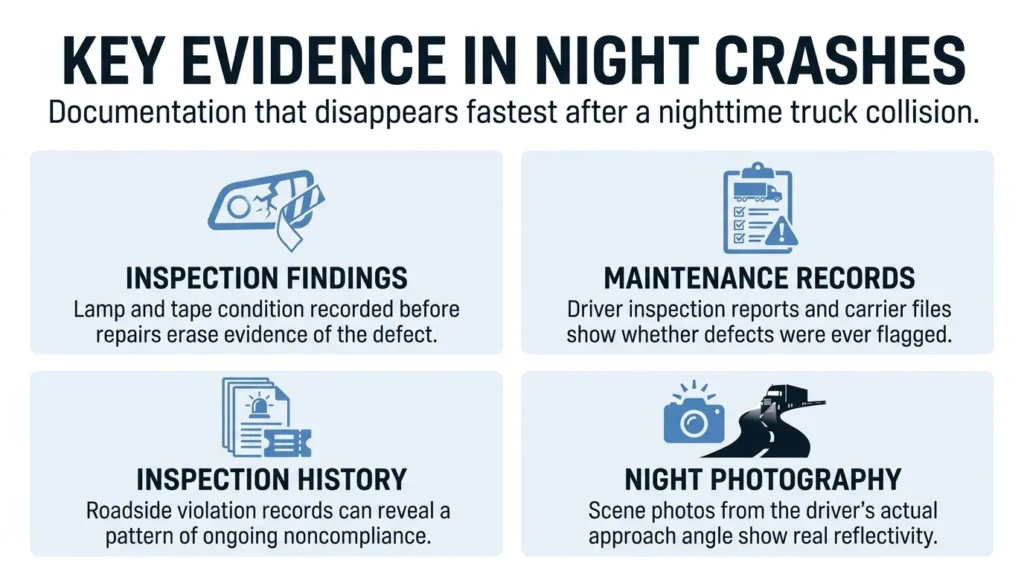
What decides these claims is documentation, most of which starts disappearing within days. The truck gets repaired, the scene is cleared, and the paper trail begins aging out of retention windows.
The evidence that carries the most weight in a nighttime visibility case includes:
- Tape and lighting inspection findings recorded before the tractor or trailer is repaired, since a replaced lamp erases the condition that caused the crash.
- Driver vehicle inspection reports and the carrier’s systematic maintenance file under § 396.3, which show whether defective lamps or sheeting were ever noted, flagged, or fixed.
- Roadside inspection history for lamp and reflector violations, which can reveal a pattern of noncompliance rather than a single bad night.
- Night scene photography taken from the striking driver’s actual approach angle and distance, because reflectivity depends heavily on angle and surface condition.
Regulatory violations also carry legal weight beyond simple carelessness. Texas recognizes that violating a safety statute designed to protect a class of people that includes the injured party can amount to negligence as a matter of law when the violation proximately causes the harm, a doctrine drawn from Impson v. Structural Metals, Inc., 487 S.W.2d 692 (Tex. 1972).
That framework is regularly applied to Part 393 lamp and conspicuity violations and to Part 392 warning-device violations in trucking litigation, and a defendant still has the opportunity to rebut it.
Everything then folds back into the comparative analysis: whether the equipment complied, whether required warning devices went out in time, what the maintenance history shows, and how the approaching driver was actually driving. Chapter 33 assigns the final percentages.
Talk to an Attorney About Your Claim
Nighttime collisions with parked and disabled trucks are won or lost on evidence that has a short shelf life. Trailers get repaired, tape gets replaced, and carrier records move closer to the end of their retention periods while you are still recovering.
Angel Reyes & Associates has spent more than 30 years representing injured Texans, and our team includes investigators and accident reconstruction specialists who know what to request and how quickly to request it.
If an insurer has already decided this crash was your fault, that decision is not the last word. Contact Angel Reyes & Associates for a free consultation, and we will review the crash, the truck’s equipment compliance, and your comparative-fault exposure with you.
Past results do not guarantee future outcomes.
Hitting a Parked Truck FAQs
Does a truck have to use hazard lights and warning triangles if it breaks down on the shoulder, not the travel lane?
Yes. Under 49 CFR § 392.22, the shoulder is treated the same as the traveled portion of the highway. Any time a commercial motor vehicle stops there for a reason other than a normal traffic stop, the driver must immediately activate the hazard flashers and place warning triangles (or fusees/flares in daylight) within 10 minutes, positioned roughly 10 feet from the vehicle and 100 feet in each direction.
What evidence helps prove a trucking company failed to make its truck visible at night?
The strongest evidence is documentation gathered before the truck is repaired: lamp and reflective-tape inspection findings recorded at or near the time of the crash, since a replaced light or new strip of tape erases the condition that caused it. Driver vehicle inspection reports and the carrier’s maintenance file, kept under the carrier’s ongoing duty to maintain Part 393 lighting and reflective equipment under 49 CFR § 396.3, can show whether a defect was already known or flagged.
What if the truck's reflective tape looked fine in daytime photos but wasn't visible at night from the angle I approached?
That mismatch is common and does not mean the tape was compliant or effective. This is why night photography from the striking driver’s real approach angle carries more weight than daytime images of the trailer. If the tape failed to warn you at the angle and distance you actually had, that gap between “present” and “actually visible” is evidence supporting a shift of fault toward the truck or carrier.
About the Authors

Angel Reyes
Writer
Angel L. Reyes, III is the Founder and Managing Partner of Angel Reyes & Associates. A nationally recognized trial attorney and business leader, Angel has helped over 70,000 injury victims recover more than $1 billion since founding the firm in 1993. Named to the Texas Super Lawyers list annually since 2008, Angel brings Wall Street experience, Ivy League education, and a deep commitment to client advocacy. He is a frequent legal commentator and published author with extensive contributions to legal scholarship, trial strategy, and consumer protection.

Kyle Nicolas
Editor
Kyle Nicolas is the Web Content & SEO Manager at Angel Reyes & Associates. He has more than 10 years of experience as a marketing co...

Angel Reyes
Reviewer
Angel L. Reyes, III is the Founder and Managing Partner of Angel Reyes & Associates. A nationally recognized trial attorney and business...