Who Is Liable for an Intermodal Chassis Defect?


Every article on this site is researched by our internal team, reviewed for legal accuracy against current Texas law, and held to State Bar of Texas advertising standards before publication. We do not publish content that overstates outcomes or makes promises about results.
Learn more about our
editorial standards .
Key Takeaways
- Federal law puts chassis safety duties on the equipment provider, not the carrier.
- Texas proportionate responsibility rewards naming every liable party in a crash.
- Texas gives most injury victims two years from the crash date to file suit.
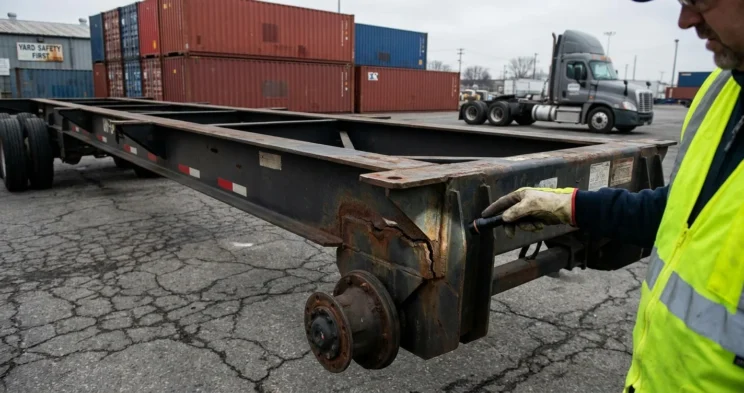
You watched a shipping container break loose from its chassis on I-35, or you were driving beside the rig when a cracked frame let the whole load sway into your lane. Either way, you are left with medical bills, a wrecked vehicle, and a trucking company telling you the crash was not their fault.
That answer is often true, and it points somewhere useful. The chassis under that container may not have belonged to the motor carrier at all.
Federal law puts a separate set of safety duties on the company that owns and leases the chassis, called an intermodal equipment provider, or IEP. When a defect in that chassis causes a crash, the IEP can be liable in its own right, not just the trucking company that happened to be pulling the load that day.
What Federal Law Requires From the Company That Owns the Chassis
The intermodal equipment provider, whether it is a chassis-leasing company, a chassis pool, an ocean carrier, or a railroad, carries its own independent safety duties under federal law. Those duties exist separately from the motor carrier’s own maintenance obligations, and that separation is exactly why a chassis-defect crash can create liability against the equipment owner directly.
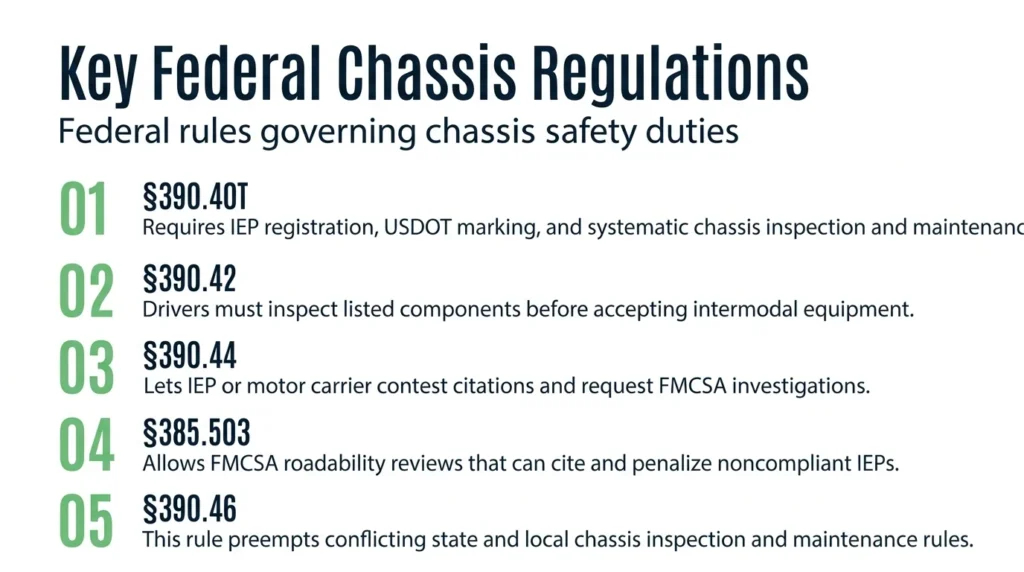
Federal regulation 49 CFR §390.40, now in effect in its updated form as §390.40T since January 17, 2017, requires the IEP to register with the Federal Motor Carrier Safety Administration and mark its equipment with its USDOT number before handing it to a motor carrier.
The same rule requires the IEP to systematically inspect, repair, and maintain every chassis intended for interchange, keep a driver vehicle inspection report system and maintenance records, run periodic inspections, and give drivers proper space to do a pre-trip inspection at the interchange yard. An IEP is never supposed to tender equipment that poses an imminent hazard.
That citation range does not include §390.41 or §390.43. Those section numbers do not exist in the current rule, so an investigation should focus on §390.40T, §390.42, and §390.44.
The driver and motor carrier carry a narrower, parallel duty under 49 CFR §390.42. Before operating intermodal equipment, the driver accepting it must inspect the components listed in §392.7(b) and be satisfied they are in good working order.
When the equipment goes back to the IEP, the driver and motor carrier must report any damage or defects they found.
49 CFR §390.44 gives both sides a way to correct the safety record. An IEP can contest a citation tied to a defect a driver certified as defect-free at pickup, and either the IEP or the motor carrier can ask FMCSA to investigate the other for failing to meet its interchange responsibilities. Those disputes create a paper trail worth pulling during an investigation.
FMCSA can also run a roadability review of an IEP’s operations under 49 CFR §385.503. The review does not produce a numeric safety rating, but FMCSA can still cite violations, issue penalties, and bar a noncompliant IEP from tendering equipment when its practices create an imminent hazard.
49 CFR §390.46 preempts state and local rules that conflict with these federal inspection and maintenance standards for intermodal equipment.
Understanding these separate federal duties is the first step toward identifying every company that should answer for your crash.
How a Chassis, Container, & Twist Locks Fit Together, & Why Chassis Pools Complicate Liability

A chassis accident involves more moving parts than a standard 18-wheeler crash. Knowing what each part is, and who is supposed to maintain it, helps explain why more than one company can end up responsible:
- The chassis is the wheeled undercarriage, the frame, axles, brakes, tires, suspension, and locking hardware, that a truck’s tractor pulls down the highway.
- The container is the steel box that sits on top of the chassis and holds the freight itself.
- The twist locks are the rotating steel connectors at each corner that hold the container to the chassis. A twist lock turns roughly a quarter rotation into the container’s corner casting to lock it down. A twist lock that is cracked, corroded, bent, or never fully engaged is a different failure than a cracked chassis frame or a worn brake, and an investigation has to check both.
- The chassis pool is a shared fleet of chassis that many different motor carriers pull from and return to. Most pools operate under the industry-standard Uniform Intermodal Interchange and Facilities Access Agreement, which sets the rules for interchange, insurance filings, and equipment tracking among ocean carriers, railroads, leasing companies, and motor carriers.
- Because a pooled chassis passes through so many hands, industry sources describe real confusion over which company counts as the “IEP of record” for a specific chassis at a specific time. Sorting that out is exactly the kind of work a chassis-defect investigation requires.
Who You Can Hold Liable–the Equipment Provider, the Motor Carrier, or Both?
The motor carrier and the equipment provider answer for different things, and a chassis defect the driver could not have caught points toward the IEP.
A motor carrier is responsible for qualifying its drivers, tracking hours of service, and maintaining the equipment it owns. Those duties live under a different part of federal law than the chassis-condition duties that fall on the IEP.
When a defect existed before the interchange, or was hidden well enough that a driver’s pre-trip inspection would not have caught it, that points toward the equipment provider rather than the trucking company.
Texas law does not automatically hold every defendant responsible for the full amount of your damages. Under Texas Civil Practice & Remedies Code §33.001, a claimant found more than 50 percent responsible cannot recover anything. Each liable party generally pays only its own share of fault, unless one defendant is found more than 50 percent responsible and becomes liable for the full award.
This is one reason naming every company that controlled or should have inspected the chassis matters. Chassis-leasing companies and pool operators are typically larger, more established businesses with insurance filings tied to their interchange agreements. A small motor carrier, or a single owner-operator, may not carry enough coverage to pay a serious injury claim on its own.
Texas gives most injury victims two years from the date of the crash to file suit under Texas Civil Practice & Remedies Code §16.003. A chassis-defect claim follows that same deadline. Because these claims often require pulling maintenance and interchange records from more than one company, an early investigation counts as much as the filing deadline itself.
The Evidence That Proves an IEP’s Chassis Defect Caused Your Crash

Connecting a specific chassis defect to a specific company takes documentation, not guesswork.
Four types of records typically build that connection:
- Find the IEP identification number. Federal rule requires the equipment provider to mark its chassis with its USDOT number before handing it to a motor carrier. That number is the starting point for identifying which company owned and maintained the equipment and for pulling its FMCSA registration and inspection history.
- Pull the chassis inspection and maintenance file. The same rule requires the IEP to systematically inspect, repair, and maintain its equipment, keep records of that work, and run periodic inspections. That file is the core evidence of whether the company kept up with its own maintenance schedule.
- Request the driver vehicle inspection reports. The IEP’s inspection report system, together with the driver’s pre-trip inspection and post-trip damage report, creates a paper trail showing what was flagged, and what was missed, before and after each interchange.
- Check roadability review findings and DataQs records. FMCSA roadability review citations and DataQs correction requests are separate records that can show a pattern of noncompliance by a specific equipment provider over time.
Talk to an Attorney About Your Chassis-Defect Claim
Figuring out which company actually owned, leased, or maintained the chassis in your crash takes investigation most people cannot do from a hospital bed or a body shop parking lot. Interchange records, inspection files, and DataQs disputes do not stay available forever.
Angel Reyes & Associates has guided injured Texans through situations like this for over 30 years. Our team can identify the equipment provider, the motor carrier, and any other company that should answer for a chassis defect, then pursue the coverage each one carries.
Get a free consultation to review your options.
With a two-year deadline running from the date of the crash, the sooner that investigation starts, the more of that paper trail is still there to find.
Past results do not guarantee future outcomes.
Intermodal Chassis Defect Liability FAQs
What is an intermodal equipment provider, and how is it different from the trucking company?
An intermodal equipment provider (IEP) is the company that owns or leases the chassis, such as a chassis-leasing company, chassis pool, ocean carrier, or railroad, and interchanges it to motor carriers to pull. Under 49 CFR §390.40 (currently codified at §390.40T), the IEP carries its own federal duties to register with FMCSA, mark its equipment with its USDOT number, and systematically inspect, repair, and maintain its chassis before tendering it.
Can I file a claim against both the chassis company and the motor carrier for the same crash?
Yes. Texas’s proportionate responsibility rule allows a claimant to pursue multiple defendants in one case, with each liable party generally answering for its own share of fault unless one defendant is found more than 50 percent responsible. Naming both the intermodal equipment provider and the motor carrier, and any chassis-pool operator involved, can matter because these companies often carry separate insurance coverage.
What is a chassis roadability inspection, and who has to perform it?
A roadability inspection is the systematic inspection, repair, and maintenance work that 49 CFR §390.40T requires an intermodal equipment provider to perform on its chassis before interchange, along with keeping inspection and maintenance records and running periodic inspections. The driver accepting the equipment also has a narrower duty under §390.42 to inspect the components listed in §392.7(b) before operating it.
How long do I have to file a chassis-defect injury claim in Texas?
Texas gives most injury victims two years from the date of the crash to file suit, and that same deadline applies to a chassis-defect claim. Because these claims often require pulling maintenance and interchange records from more than one company, the practical window for gathering that evidence can be tighter than the filing deadline itself.
About the Authors

Angel Reyes
Writer
Angel L. Reyes, III is the Founder and Managing Partner of Angel Reyes & Associates. A nationally recognized trial attorney and business leader, Angel has helped over 70,000 injury victims recover more than $1 billion since founding the firm in 1993. Named to the Texas Super Lawyers list annually since 2008, Angel brings Wall Street experience, Ivy League education, and a deep commitment to client advocacy. He is a frequent legal commentator and published author with extensive contributions to legal scholarship, trial strategy, and consumer protection.

Kyle Nicolas
Editor
Kyle Nicolas is the Web Content & SEO Manager at Angel Reyes & Associates. He has more than 10 years of experience as a marketing co...

Alex Ivanov
Reviewer
Alex Ivanov is a personal injury attorney at Angel Reyes & Associates, focused on car, truck, and motorcycle accident cases. Licensed in...