Who Is Liable for an Oilfield Truck Crash in Texas?


Every article on this site is researched by our internal team, reviewed for legal accuracy against current Texas law, and held to State Bar of Texas advertising standards before publication. We do not publish content that overstates outcomes or makes promises about results.
Learn more about our
editorial standards .
Key Takeaways
- An oilfield truck crash usually has several liable parties, not just the driver.
- On a private lease road, the claim often becomes a premises liability case.
- Lease road evidence is private and perishable, so demand preservation early.
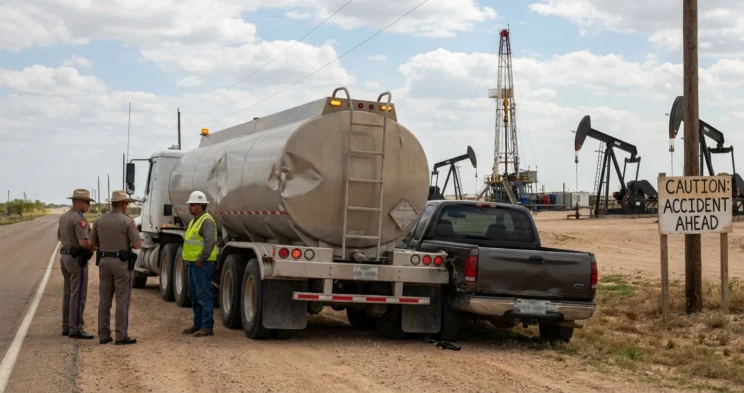
An oilfield truck crash in Texas rarely has one liable party. Responsibility usually reaches the driver, the motor carrier that employed or dispatched the driver, the operator or service company whose work the haul served, the permit holder and vehicle owner on an oversize or overweight move, and whoever controlled and maintained the road.
Which of those parties is liable turns on where the truck was when the crash happened. The last hundred yards decide a great deal.
A crash on a state highway and a crash behind a lease gate are governed by different rules, generate different records, and put different companies on the hook.
Why Oilfield Truck Crashes Are Their Own Category in Texas
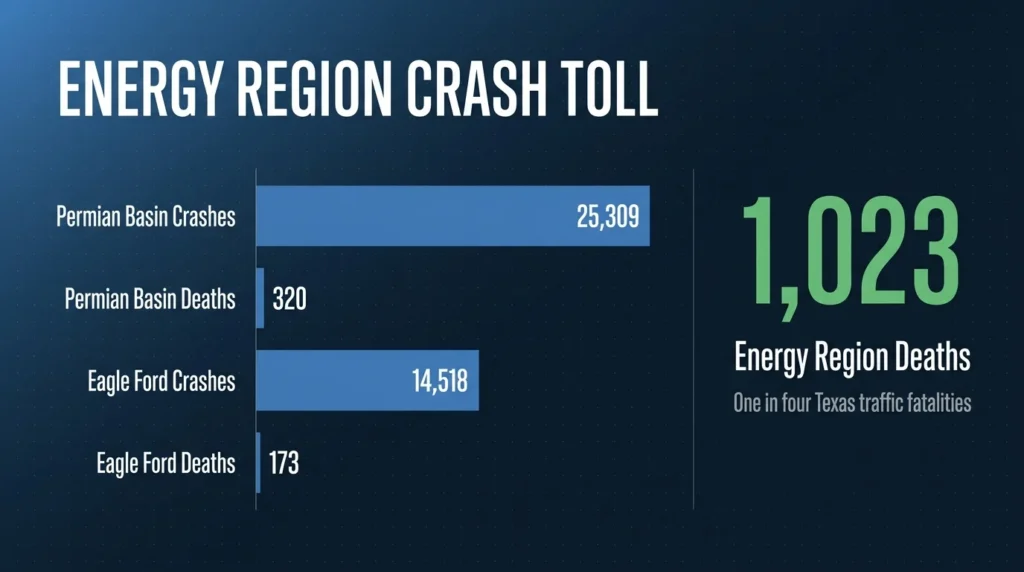
Energy work concentrates heavy commercial traffic on rural Texas roads and gated lease roads at the same time, and the numbers show it. TxDOT reported that in 2024 the Permian Basin saw 25,309 traffic crashes resulting in 320 fatalities and 915 serious injuries, and the Eagle Ford Shale saw 14,518 traffic crashes resulting in 173 fatalities and 598 serious injuries.
Across the five energy regions combined, TxDOT’s Energy Sector Safety Campaign counted nearly 79,000 crashes and 1,023 people killed, one in four of all traffic fatalities in the state.
Read them for what they are. Those are all traffic crashes in those regions, not oilfield truck crashes specifically, so they show the overall traffic toll in the state’s energy regions rather than the crash count for any one truck type.
They still describe the setting these cases come out of. When a commercial truck strikes a car on a highway feeding a field, the injured occupants have a claim against the trucking operation even though the defendant is an industrial company. When the crash kills someone, the case becomes a wrongful death claim brought by the family.
The breakdown comes down to three kinds of trucks:
- Frac sand haulers move proppant to the pad.
- Water trucks run fresh water in and produced water or oilfield waste out.
- Rig-moving equipment hauls the machinery that services, cleans out, and drills the well.
Because each type of vehicle operates differently, each leaves behind a distinct paper trail. The organizing question goes past whether the driver made a mistake. It asks which companies stood behind that driver, and which set of rules applied to the ground under the tires.
Who Can Be Held Liable Beyond the Truck Driver
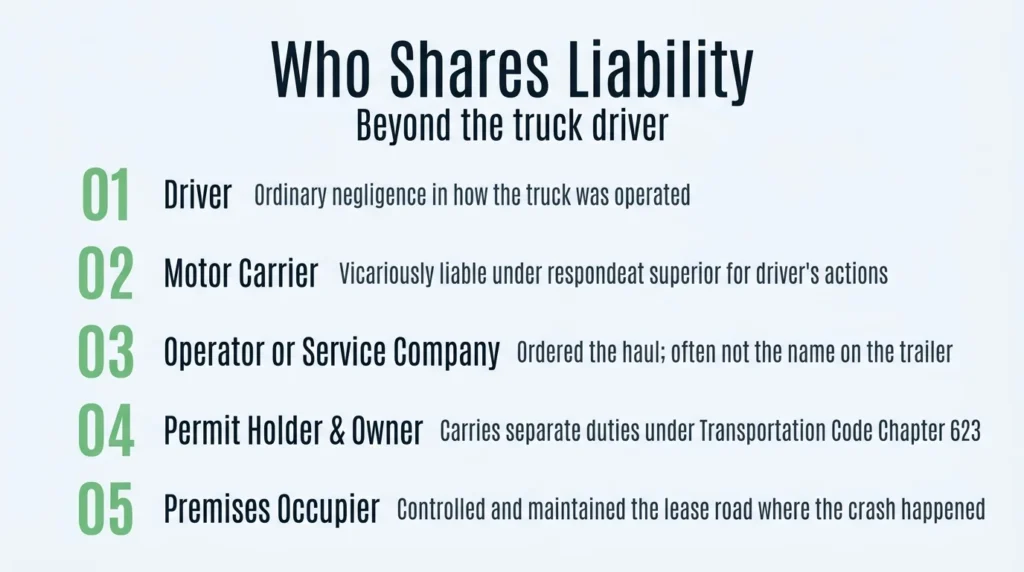
Several parties usually share responsibility for an oilfield truck accident in Texas, and a case built only against the driver can leave real sources of recovery unexamined. Each party below has its own duties, its own records, and often its own insurance.
- The driver, for ordinary negligence in how the truck was operated.
- The motor carrier, vicariously, under respondeat superior for a driver acting in the course and scope of employment. That is the spine of a Texas truck accident claim against the carrier.
- The operator or service company whose work the haul served, meaning the entity that ordered the frac sand, the produced water run, or the rig move. That is frequently not the name painted on the trailer, and identifying it is a records problem covered further below.
- The permit holder and the vehicle owner on an oversize or overweight move, who carry duties under Transportation Code Chapter 623 that are separate from the driver’s.
- The premises occupier of a lease road, meaning whoever controlled and maintained the surface where the crash happened.
Texas law reaches employers further than most people expect. In Painter v. Amerimex Drilling I, Ltd. (Tex. 2018), a driller was carrying three crew members in his personal truck from a remote Longfellow Ranch drilling site back to employer-provided bunkhouses roughly 30 miles away in Fort Stockton, because the operator did not allow bunkhouses at the ranch site.
The crash happened on February 28, 2007. Two crew members were killed, and others were hurt. The employer’s contract required it to pay the driller $50 per day to drive crew out to the well location.
The Texas Supreme Court reversed summary judgment for the employer. Transporting the crew was part of the driller’s assigned duties, fact issues remained on course and scope, and the Court clarified that the right-to-control test is not a required part of the course-and-scope analysis once the employment relationship is established.
The lesson carries well beyond that one crash. An oilfield employer’s exposure is defined by the job duties it paid for, not by where the wheels happened to be turning, and an operator’s site rules can shape the very transportation arrangement that produced the wreck.
Once the defendants are named, Texas divides the fault among them. Under Texas Civil Practice and Remedies Code (CPRC) § 33.001, “In an action to which this chapter applies, a claimant may not recover damages if his percentage of responsibility is greater than 50 percent.”
That is the 51 percent bar, and it explains the behavior you will see from the other side. Every defendant in a multi-party oilfield case has a financial reason to point at another company, and at you.
How Chapter 623 Oversize & Overweight Permits Fit Into a Liability Case
The question worth answering first is whether a permit means the load was safe. It does not, and the statute says so in its own words. Texas Transportation Code § 623.148 provides in subsection (a) that “By issuing a permit under this subchapter, the department does not guarantee that a highway can safely accommodate the movement.”
A permit is a compliance document with conditions attached, not a safety certification. This section stays on public highways because Chapter 623 is a highway permitting scheme.
Start with the baseline: the permit is an exception to Texas Transportation Code § 621.101, which prohibits a single-axle weight heavier than 20,000 pounds and a tandem-axle weight heavier than 34,000 pounds. It provides that overall gross weight on a group of two or more consecutive axles may not be heavier than 80,000 pounds, “including all enforcement tolerances.” Natural gas and electric battery-powered vehicles get up to 2,000 pounds more, capped at 82,000 pounds.
Anything above those limits needs a permit from the Texas Department of Motor Vehicles (TxDMV). The agency’s oversize and overweight permit program states that vehicles or loads exceeding Texas legal size and weight limits must have an oversize/overweight permit, applied for through the Texas Permitting and Routing Optimization System, with routes authorized when applicable.
The permit categories map straight onto the trucks working the field. TxDMV lists fracking trailers, Well Servicing Unit, Unladen Lift Equipment Motor Vehicle and Well Service Unit Mileage, and Water Well Drilling Machinery and Equipment, along with single-trip Superheavy permits for loads exceeding 254,300 pounds.
The mechanics matter because they create checkable facts. § 623.011 allows up to 10 percent above the maximum allowable axle weight and 5 percent above the maximum allowable gross weight, with a further 5 percent gross tolerance under subsection (g) where no individual or tandem axle exceeds permitted limits.
That permit is valid for one year, must be carried in the vehicle it was issued for, and requires a windshield sticker. Failure to display it is a Class C misdemeanor.
Rig moves have their own subchapter. § 623.142 authorizes a permit to move fixed-load mobile machinery used to service, clean out, or drill oil wells that cannot comply with the Chapter 621 Subchapter C width restrictions or the § 621.101 weight restrictions. Subsection (b) bars issuance “unless the vehicle may be moved without material damage to the highway or serious inconvenience to highway traffic.”
Two liability provisions follow the permit around, establishing key responsibilities for vehicle owners and permit holders:
- Strict Liability for Infrastructure: § 623.148(b) makes the owner of the vehicle strictly liable for damage the movement causes to the highway system or its structures even with a valid permit.
- Uncapped County Road Liability: § 623.015(a) provides in subsection (a) that a permit holder’s liability for county road damage is not limited to the bond or letter of credit amount required to issue the permit.
The same statute cuts the other way in subsection (b) by establishing protections around designated paths:
- Route Adequacy Presumption: 623.015(b) is where a county judge, commissioner, road supervisor, or traffic officer designates a route; that route, including bridges and culverts, is presumed adequate to carry the vehicle’s weight, and that presumption works against a claim built on road inadequacy.
Overweight operation also carries criminal exposure.§ 623.019 makes it an offense for a § 623.011 permit holder to operate, or direct the operation of, a permitted vehicle on a public highway while criminally negligent as to exceeding the authorized weight, or to run it over weight in a county not designated in the application. The base fine runs from $100 to $250, with enhancements by degree of overweight and for a third offense within one year, and scales approved by the Department of Public Safety (DPS) are required before a court can impose more than the minimum fine.
Here is the honest use of all of that in a civil case. Departures from permit conditions are concrete, documentable facts that support a negligence theory and identify the permit holder as a defendant distinct from the driver. They are evidence of negligence, and a Chapter 623 violation should not be described as negligence per se.
What Changes When the Crash Happens on a Private Lease Road
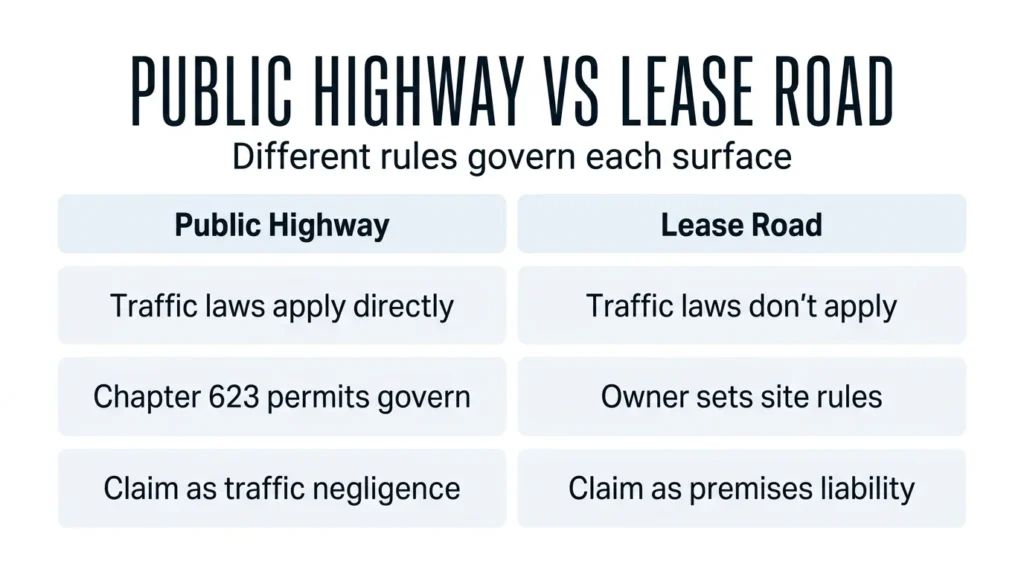
A lease road crash usually becomes a different kind of case. On a gated lease road, the Texas rules of the road do not apply of their own force, so the claim generally converts into a premises liability case against whoever controlled and maintained that surface, layered on top of the ordinary negligence and vicarious liability claims against the driver and the carrier.
Two cautions belong up front.
- Whether a given road is public or private is a fact question about that specific road
- The Chapter 623 permit conditions described above govern conduct on public highways rather than on a private lease road.
Whether the Texas Rules of the Road Apply at All
The Transportation Code answers this directly. Texas Transportation Code § 542.001 states that “A provision of this subtitle relating to the operation of a vehicle applies only to the operation of a vehicle on a highway unless the provision specifically applies to a different place.”
The definitions do the rest of the work. Texas Transportation Code § 541.302 defines “Highway or street” as “the width between the boundary lines of a publicly maintained way any part of which is open to the public for vehicular travel,” and defines “Private road or driveway” as “a privately owned way or place used for vehicular travel and used only by the owner and persons who have the owner’s express or implied permission.”
Put plainly, a gated lease road used only by the operator, its contractors, and permitted invitees is a private road rather than a highway. Consequently, an injured person cannot lean on a statutory traffic violation there the way they could on a state highway or a farm-to-market road.
Something, however, does take its place under state law. Texas Transportation Code § 542.005 lets the owner of a private road regulate or prohibit public vehicular use, allowing them to impose conditions different from or in addition to statutory rules.
Those conditions, such as site speed limits, one-way traffic patterns, escort requirements, and check-in rules, then become the standard-of-care evidence that stands in for the Transportation Code.
The federal rules follow a similar line. 49 CFR 390.5 defines “Highway” as “Any road, street, or way, whether on public or private property, open to public travel,” so a restricted, gated lease road generally is not reached by the federal motor carrier safety regulations for conduct confined to it. That remains a fact question about the particular road, not a blanket rule.
Who Owes a Duty, & Who Maintains the Surface
Duty follows control and maintenance, not title alone. The occupier that graded the road, watered it for dust, set and enforced the speed limit, and heard the complaint about the washout is the party a premises claim points at.
Texas has close authority on facts that look a great deal like a leased road. In TXI Operations, L.P. v. Perry (Tex. 2009), a truck driver employed by a concrete company was injured when his 18-wheeler struck a pothole at a cattle guard on a private dirt road leading to a sand pit.
The premises owner owned the sand pit and maintained the three-mile unpaved road connecting it to the highway, which handled 8,000 to 12,000 truck crossings a year. The driver had crossed it repeatedly that day and knew about both the pothole and the posted 15 mph sign.
The owner did not contest that it owed a duty to warn. It argued that the sign was an adequate warning as a matter of law, and the Court rejected that, because there was evidence the warning was inadequate and that the pothole was dangerous even below the posted speed.
The standard as reported is that an occupier must “take whatever action is reasonably prudent under the circumstances to reduce or to eliminate the unreasonable risk from that condition.” A heavy truck, an unpaved private industrial haul road with high traffic volume, a surface defect, and a posted sign that was not automatically enough describe a lease road in all but name.
On a working lease, several parties can have a hand in the same road. The surface owner, the mineral lessee or operator, a midstream company, and a road-maintenance contractor may each have touched it, and the facts that decide the case are operational rather than recorded on a deed.
Property owners raise a threshold defense here, and this article will not pretend otherwise. Chapter 95 of the Texas CPRC limits a commercial property owner’s liability to a contractor, a subcontractor, or their employee for injury arising from the condition or use of an improvement to real property that the contractor constructs, repairs, renovates, or modifies.
Where the chapter applies, the owner is not liable unless it exercised or retained some control over the manner of the work beyond ordering work to start or stop or inspecting progress, and had actual knowledge of the danger and failed to adequately warn. Most people hurt on a lease road are contractor personnel, so the defense gets raised often.
Whether Chapter 95 reaches a road crash is genuinely litigated, because the statute requires an improvement the contractor was working on. Treat it as an argument the other side will make, not as an answer about your own claim.
One more qualifier keeps this accurate. Some Permian and Eagle Ford lease and pad access roads are in fact county roads or farm-to-market roads, and some private roads have been opened to public travel by long unrestricted use, so the determination is always a fact question about the specific road.
Which Records Exist After a Lease Road Crash, & Which Never Get Created
On a public highway, a serious crash generates an automatic public record. Behind a lease gate, it may not, and the scene can be cleared, graded, and back in service before anyone independent looks at it.
Texas Transportation Code § 550.001 applies Chapter 550 to a road owned and controlled by a water control and improvement district, to a private access way or parking area provided for a client or patron by a business other than private residential property or a garage or fee parking lot, and to a highway or other public place. An operational gated lease road is none of those.
That is a preservation problem rather than a legal impossibility.§ 550.041 lets a peace officer who is notified of a collision investigate and file justifiable charges without regard to whether the collision occurred on property to which the chapter applies, excluding privately owned residential parking areas and fee parking lots.
§ 550.062 then requires an officer who investigates a collision in the regular course of duty to make a written report where the collision resulted in injury to or the death of a person, or damage to the property of any one person to the apparent extent of $1,000 or more, filed electronically with the department not later than the 10th day after the date of the collision. A crash report does get produced if an officer responds and investigates. What changes on a lease road is that nothing compels an officer to be there in the first place.
These are the records that do exist, and who holds them:
- Railroad Commission well records, which establish the operator of record for the well the truck was serving. The Oil and Gas Well Records page lists Applications to Drill (Form W-1) with location plats, Completion Reports (W-2/G-1), Plugging Reports (W-3), Producer’s Transportation Authority (P-4), and miscellaneous filings including correspondence and directional surveys, imaged from 1964 to the present through the Oil and Gas Imaged Records Query, searchable by key fields or full text, with a Public GIS Viewer and a Wellbore Query. The Commission also registers operators doing oil and gas business in Texas.
- Waste hauler permits, which are the water truck’s regulatory record. The Commission’s waste hauler permit page requires a permit for a person who transports non-hazardous oil and gas waste for hire by any method other than by pipeline off a lease, unit, or other oil and gas property where it is generated. Permits are renewed annually; the initial and renewal application fee is $250, applications are filed electronically in LoneSTAR, and the permit cannot be used to transport hazardous oil and gas waste under Statewide Rule 98. Produced water and saltwater haulers therefore come with a named, permitted entity and an annual compliance history that sand haulers do not have.
- TxDMV oversize and overweight permit records, which name the permit holder, the authorized route, the authorized weight, and the designated counties. Because §. 623.011 requires the permit to be carried in the vehicle with a sticker displayed, its absence is itself a fact worth documenting.
- Carrier-side records, meaning the truck’s onboard data and the carrier’s dispatch and maintenance files. These are private, and no one preserves them as a matter of routine practice.
Preservation law rewards moving early. No party owes a duty to preserve evidence until it knows or should know that a claim is likely and that the evidence is relevant.
A jury instruction on spoliation requires intentional destruction with the specific intent to conceal, or, in rare cases, negligent destruction that irreparably harms the other side’s ability to present its case. The trial judge, rather than the jury, decides whether spoliation occurred, and routine overwriting of onboard data and routine grading of a haul road are not sanctionable.
The practical consequence is simple. A written preservation demand that starts the clock protects far more than a complaint months later that the records are gone.
Talk With Angel Reyes & Associates About Your Oilfield Truck Crash
On a lease road, the evidence that decides your case is private, perishable, and held by the companies on the other side. The sooner a preservation demand goes out and the operator of record is identified, the more of that evidence survives.
Angel Reyes & Associates has guided injured Texans through situations like this for more than 30 years, and the firm serves the entire state, including the Permian Basin and the Eagle Ford. Initial consultations are free, someone is available 24 hours a day, and the team can talk with you in English and Spanish.
With 20 or more office locations across Texas and the ability to handle most of a case remotely, distance from the field is not a reason to wait. Contact us for a free consultation and find out what records still exist in your case.
Past results do not guarantee future outcomes.
Texas Oilfield Truck Crash Liability FAQs
What if the crash happened on a county road or farm-to-market road that runs through the lease?
Then the public road rules are back in play, and that changes the shape of the case. Public or private is a fact question about the specific road, not about the lease it crosses. Texas Transportation Code § 541.302 defines “Highway or street” as “the width between the boundary lines of a publicly maintained way any part of which is open to the public for vehicular travel,” and defines a private road as “a privately owned way or place used for vehicular travel and used only by the owner and persons who have the owner’s express or implied permission.” Plenty of access roads in the Permian Basin and the Eagle Ford are in fact county roads or farm-to-market roads. Where that is true, the Transportation Code rules of the road apply, and the Chapter 550 crash reporting scheme applies, so the automatic public record you would otherwise lose behind a gate does get created. Pinning down the road’s actual status is worth doing before anyone assumes the claim is a premises case.
How long do I have to file an oilfield truck accident claim in Texas?
Two years from the date of the injury, under the Texas personal injury limitations period at Texas Civil Practice and Remedies Code § 16.003. Treat that as the outside boundary rather than the working schedule. In an oilfield case, the evidence runs out long before the deadline does. Onboard truck data gets overwritten, dispatch and maintenance files age out, and a haul road gets graded back to a clean surface. A claim filed comfortably inside two years can still be a thin claim if the proof disappeared early.
Does the trucking company's insurance set a limit on what I can recover?
The federal minimums are floors on the coverage an interstate motor carrier is required to carry, not caps on what it can owe you. Under 49 CFR 387.9, those minimums are $750,000 for for-hire carriage of non-hazardous property in vehicles rated 10,001 pounds or more, $1,000,000 for oil listed in 49 CFR 172.101 and for hazardous waste, hazardous materials, or hazardous substances not otherwise categorized, and $5,000,000 for certain hazardous substances in bulk. Two things those numbers do not tell you. They do not say what a particular carrier actually purchased, which is often more than the floor, and they say nothing about the other companies that may share responsibility for the same crash. Each of those parties may carry coverage of its own.
Can the trucking company blame a company that is not part of my lawsuit?
Yes. Texas lets a defendant ask the jury to assign a share of responsibility to a person or company that is not a party to the case, a procedure known as designating a responsible third party. This comes up constantly in multi-party oilfield cases. The carrier points at the operator that ordered the haul, the operator points at the contractor that maintained the road, and every empty chair at trial is a share of fault that might otherwise have landed on a defendant you actually sued. It is one more reason to identify every company connected to the load early, rather than filing against the most visible name and sorting out the rest later.
Do federal trucking safety rules apply to a sand or water hauler that never leaves Texas?
In substance, yes. Texas incorporates the Federal Motor Carrier Safety Regulations by reference for intrastate carriers at 37 Tex. Admin. Code Sec. 4.11, so a hauler that works only Texas leases does not escape the federal safety framework merely by never crossing a state line. Driver qualification, testing, and vehicle inspection and maintenance standards still supply the benchmark for how that carrier should have been running its trucks. Where the truck was at the time is a separate question. The federal rules define “Highway” as “Any road, street, or way, whether on public or private property, open to public travel,” so conduct confined to a restricted, gated lease road generally is not reached by them. Whether a particular road is open to public travel is a fact question about that road.
About the Authors

Angel Reyes
Writer
Angel L. Reyes, III is the Founder and Managing Partner of Angel Reyes & Associates. A nationally recognized trial attorney and business leader, Angel has helped over 70,000 injury victims recover more than $1 billion since founding the firm in 1993. Named to the Texas Super Lawyers list annually since 2008, Angel brings Wall Street experience, Ivy League education, and a deep commitment to client advocacy. He is a frequent legal commentator and published author with extensive contributions to legal scholarship, trial strategy, and consumer protection.

Kyle Nicolas
Editor
Kyle Nicolas is the Web Content & SEO Manager at Angel Reyes & Associates. He has more than 10 years of experience as a marketing co...

Alex Ivanov
Reviewer
Alex Ivanov is a personal injury attorney at Angel Reyes & Associates, focused on car, truck, and motorcycle accident cases. Licensed in...