Why Are Bobtail Trucks Harder to Stop?


Every article on this site is researched by our internal team, reviewed for legal accuracy against current Texas law, and held to State Bar of Texas advertising standards before publication. We do not publish content that overstates outcomes or makes promises about results.
Learn more about our
editorial standards .
Key Takeaways
- A tractor's drive axle brakes are sized for trailer weight that is not there.
- 49 CFR 393.52 sets an in-service floor of 43.5 percent braking force for combinations.
- Dispatch and trip records prove load status, and the rule requires only six months.
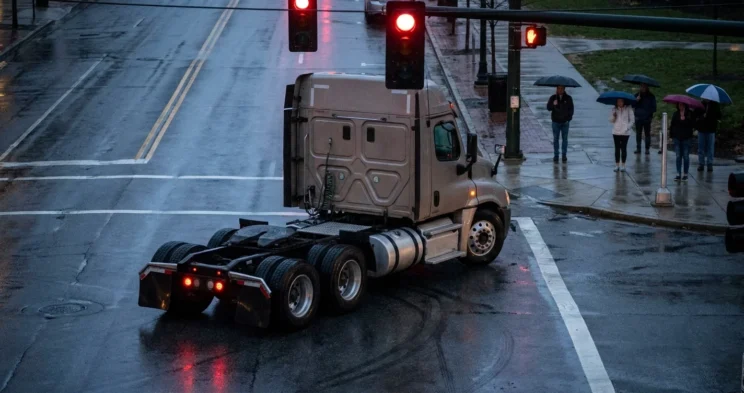
The tractor that hit you had no trailer behind it. On I-35 that looks like the least dangerous truck in the lane.
A tractor’s air brake system is balanced for a loaded combination, not for the tractor alone. Take the trailer away and the same strong drive axle brakes act on a very lightly loaded rear end, which makes the wheels easy to lock and the tractor quick to jackknife.
The honest answer turns on control, not just distance. A bobtail is harder to stop under control, and the margin depends on equipment that has to be present, correctly configured, in adjustment, and maintained. That is where a bobtail truck accident case lives.
Bobtail and Deadhead Are Two Different Kinds of Empty
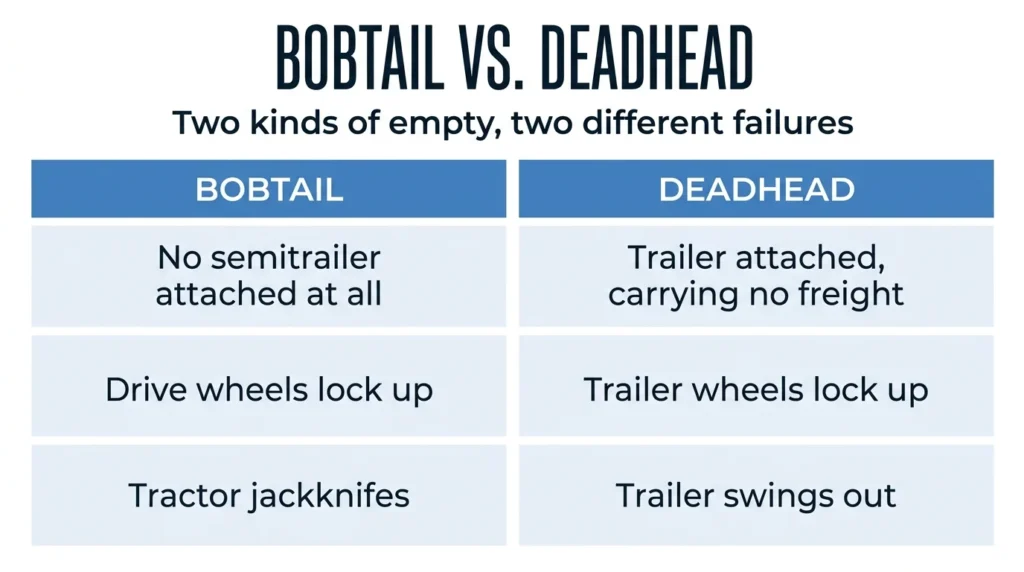
A bobtail is a tractor running with no semitrailer attached at all. The CDL Manual, Section 6, Combination Vehicles uses the term the same way, warning drivers about “bobtail” tractors (tractors without semitrailers).
Deadheading is a different condition. The trailer is still coupled, it simply has no freight in it, which is ordinary work when a carrier repositions equipment toward the next load.
Both leave the rear of the rig far lighter than the brake system was balanced for. That shared problem is why deadhead truck handling and bobtail handling get discussed together, even though the failure signatures are not the same.
The two fail in different ways. A bobtail tractor tends to lock its drive wheels, and the tractor itself jackknifes. A deadhead run tends to lock the empty trailer’s wheels, and the trailer swings.
Running empty is normal freight work. The question after a crash is whether the equipment and the driving accounted for it.
Why Losing the Trailer Changes How the Tractor Stops
The drive axles lost the load their brakes were proportioned for. Traction drops, and brake torque that felt normal under a loaded trailer now locks the wheels.
The driver training material states the consequence without hedging:
“When lightly loaded, the very stiff suspension springs and strong brakes give poor traction and make it very easy to lock up the wheels. Your trailer can swing out and strike other vehicles. Your tractor can jackknife very quickly. You also must be very careful about driving ‘bobtail’ tractors (tractors without semitrailers). Tests have shown that bobtails can be very hard to stop smoothly.”
NHTSA reached the same engineering conclusion from the regulator’s side. In its 2009 final rule on FMVSS No. 121 air brake systems, the agency found that stopping distance gains had to come from the steer axle, because “drive axle brake torque would need to be reduced to prevent wheel lockup (a condition which would prove hazardous).”
The industry answer is engineered compensation. Bobtail proportioning valves react to the loss of pressure in the trailer supply line and shift the balance forward. Bendix service data sheet SD-03-952 documents the split: with a trailer connected, each axle receives 100 percent of the service application pressure, and in bobtail mode the front axle receives 100 percent while the rear axle or axles receive approximately 25 percent.
Antilock brakes are the second layer, and their limits matter. ABS “does not necessarily shorten your stopping distance, but it does help you keep the vehicle under control during hard braking,” and it “only activates when wheels are about to lock up,” according to the CDL Manual, Section 5, Air Brakes.
That same section sets the baseline. Total stopping distance is perception plus reaction plus brake lag plus braking, air brake lag alone adds about 32 feet at 55 mph, and the total runs about 451 feet at 55 mph for an average driver under good traction and brake conditions. Poor traction at a lightly loaded drive axle is the condition that erodes that baseline.
The Federal Brake Rules Behind the Question, 49 CFR 393.40 Through 393.52
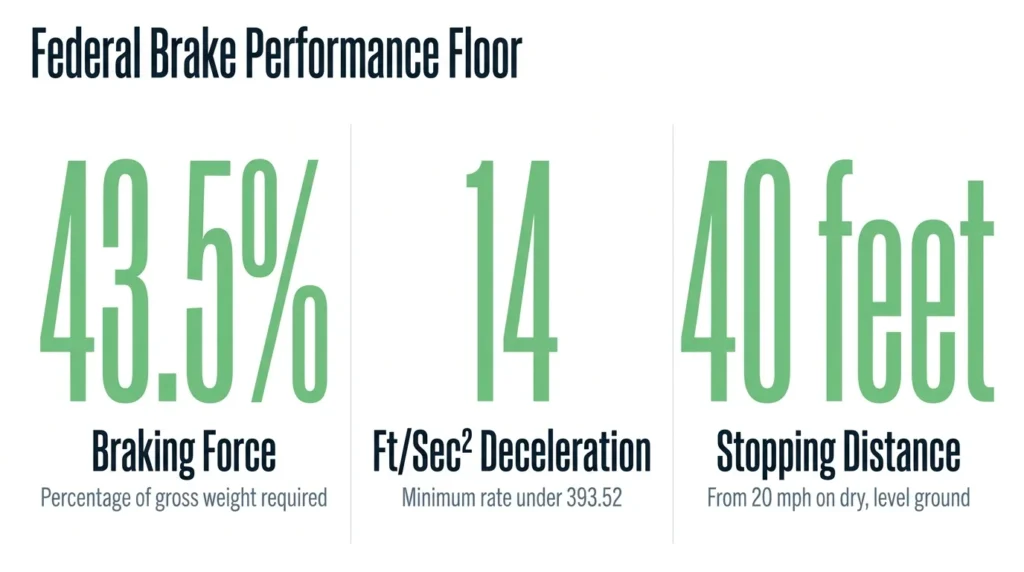
Subpart C of Part 393 is titled Brakes, and it runs from 393.40 through 393.55. It sets the floor a commercial tractor has to meet in service, every day it operates. These are the sections that carry a bobtail case:
- 49 CFR 393.40 requires service, parking, and emergency brake systems, and holds air braked truck tractors manufactured on or after March 1, 1975 to FMVSS No. 121 in effect on the date of manufacture.
- 49 CFR 393.42 requires brakes on all wheels, with narrow exceptions.
- 49 CFR 393.47 governs actuators, slack adjusters, linings and pads, and drums and rotors. Service and spring brake chambers on each end of an axle must be the same size, slack adjusters on the same axle must have the same effective length, pushrod stroke must stay within the published adjustment limits, and linings and pads must meet minimum thickness.
- 49 CFR 393.48 is one sentence long: “All brakes with which a motor vehicle is equipped must at all times be capable of operating.”
- 49 CFR 393.52 sets the in-service performance floor. For combination vehicles that means 43.5 percent braking force as a percentage of gross weight, 14 feet per second per second of deceleration, and a stop within 40 feet from 20 mph, measured on a level, dry, smooth surface with the vehicle staying inside a 12 foot lane.
- 49 CFR 393.55 requires antilock braking on air braked truck tractors manufactured on or after March 1, 1997, and a cab mounted malfunction lamp on towing vehicles built after March 1, 2001.
Each of those is a duty, not an aspiration. The performance floor assumes the equipment is present, correctly configured, in adjustment, and maintained.
A tractor that never leaves Texas answers to the same rules. Under Texas Transportation Code Chapter 644, the Texas Department of Public Safety incorporates the Federal Motor Carrier Safety Regulations by reference at 37 Tex. Admin. Code section 4.11(a), including Parts 390 through 393 and 395 through 397.
Texas DPS restates that framework in A Texas Motor Carrier’s Guide to Highway Safety, which names unsafe vehicles operating under Part 393 as an enforcement focus. A carrier running only between Dallas and Houston is held to the same brake performance floor as one running coast to coast.
How Bobtail and Deadhead Stops Actually Fail
A bobtail truck accident is usually not a story about a driver who forgot to brake. It is a story about a rig whose braking balance was never restored the way it should have been.
Each failure below is a place where that compensation did not do its job, and each one lands on a duty the carrier already owed:
- Rear wheel lockup and tractor jackknife. A lightly loaded rear end locks under hard braking and the tractor comes around, which is the hazard NHTSA described when it explained why drive axle brake torque cannot simply be increased.
- Trailer jackknife on a deadhead run. The CDL manual is explicit: “When the wheels of a trailer lock up, the trailer will tend to swing around. This is more likely to happen when the trailer is empty or lightly loaded.”
- A missing, misapplied, or failed proportioning system. Bendix SD-03-952 cautions that the BP-1 front and rear valves “are similar in appearance but are NOT interchangeable.” Installing the wrong one is a real error with a physical consequence.
- Antilock brakes inoperative, or a warning lamp the carrier ignored. The CDL manual tells drivers that a lamp staying lit means “you may have lost ABS control at one or more wheels,” and the system itself is required by 49 CFR 393.55.
- Brakes out of adjustment or mismatched. Pushrod stroke past the limit, chambers of different sizes on one axle, slack adjusters of unequal effective length, or linings below minimum thickness all fall under 49 CFR 393.47.
- Brakes that cannot operate, or a rig that cannot meet the floor. Brakes not capable of operating violate 49 CFR 393.48, and a combination that cannot hold 43.5 percent braking force or stop within 40 feet from 20 mph fails 49 CFR 393.52.
Proving the Truck Was Bobtail and the Brakes Were Not Right
Two facts have to be established: what the tractor was hauling at the moment of the crash, and what condition its brakes and proportioning system were in. Both answers live in records the trucking company controls, and every one of those records sits on a short retention clock.
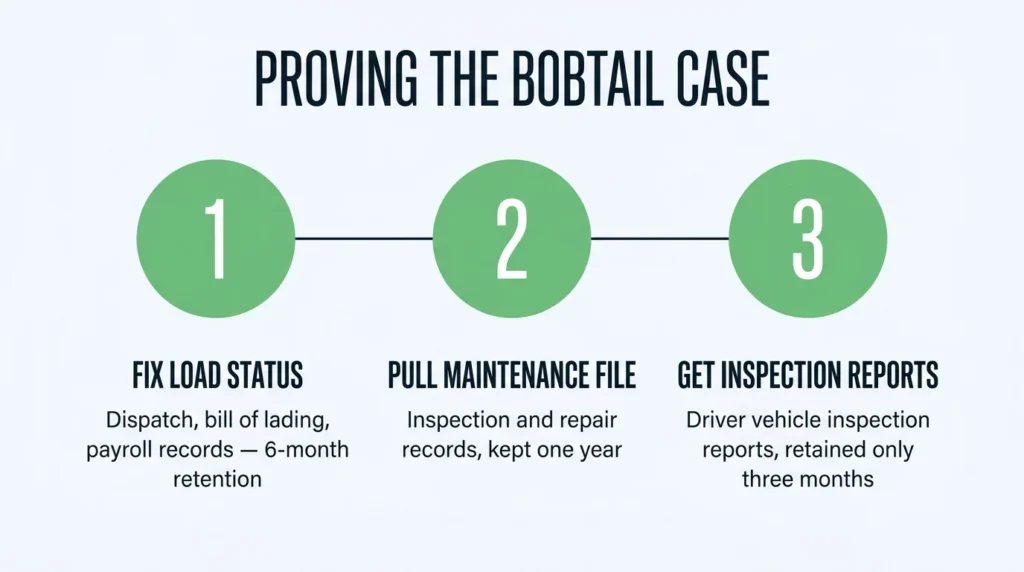
Work them in this order:
First, fix the load status. 49 CFR 395.11 requires carriers to retain supporting documents for each driver’s 24 hour period, and the enumerated categories are exactly what proves whether the tractor was bobtail, deadheading, or loaded:
- “Each bill of lading, itinerary, schedule, or equivalent document that indicates the origin and destination of each trip”
- “Each dispatch record, trip record, or equivalent document”
- “Each electronic mobile communication record, reflecting communications transmitted through a fleet management system”
- “Each payroll record, settlement sheet, or equivalent document that indicates payment to a driver”
Each document must show the driver’s name or identification number, the date, the location by nearest city or town, and the time at that location. Under 49 CFR 395.8(k), a carrier must keep records of duty status and supporting documents for not less than 6 months, and drivers keep only the prior 7 consecutive days in the cab.
Second, pull the maintenance file. 49 CFR 396.3(b) requires maintenance records identifying the vehicle and showing the nature and due date of the various inspection and maintenance operations. Those are retained for one year, and for six months after the vehicle leaves the carrier’s control.
Third, get the driver vehicle inspection reports. 49 CFR 396.11 reports expressly cover “(i) Service brakes including trailer brake connections; (ii) Parking brake.” They are retained for three months, the shortest clock of the three.
With those records in hand, brake proportioning analysis has a documented baseline to measure against, roughly 100 percent front and 25 percent rear in bobtail mode. The physical inspection targets come from 393.47: pushrod stroke, chamber size matching, slack adjuster length, and lining thickness.
The filing deadline and the evidence deadline are not the same. Texas Civil Practice & Remedies Code (CPRC) section 16.003 generally requires suit for personal injury within two years of the day the cause of action accrues, and within two years of the death for an injury resulting in death.
Two years is a long runway. Three months is not. Working early with a lawyer who handles Texas truck accident representation puts a preservation demand in front of the carrier while the dispatch records, trip logs, and inspection reports still exist.
Talk to a Lawyer Before the Records Are Gone
The documents that establish whether the tractor was bobtail or deadheading start aging out in months, not years. The dispatch record that fixes the load status and the inspection report that shows brakes out of adjustment both sit inside windows that close long before the two year filing deadline does.
Angel Reyes & Associates has guided injured Texans for more than 30 years, with offices across Texas, help available 24 hours a day, and service in Spanish. Most of a case can be handled remotely, so getting answers does not require a drive across the state.
Schedule a free consultation with Angel Reyes & Associates to talk through what happened and which records need to be preserved right now.
Past results do not guarantee future outcomes.
Bobtail Truck Accident FAQs
Does antilock braking make a bobtail tractor stop in a shorter distance?
Not by itself. Antilock braking is a control system rather than a distance-shortening one, and it engages only once a wheel is already about to lock, according to the CDL Manual, Section 5, Air Brakes. On a bobtail tractor that control function is the whole point, because the lightly loaded drive axles are exactly where a wheel is most likely to lock.
How is the federal stopping distance standard for a new truck different from the brake rule that applies on the road?
One certifies a new vehicle at the factory, and the other governs the truck every day it operates. In its 2009 final rule on FMVSS No. 121, NHTSA set the stopping requirement from 60 mph at 250 feet for a tractor loaded to gross vehicle weight rating, 310 feet for severe service tractors, and 235 feet in the lightly loaded test condition. Each of those is a new vehicle certification requirement, measured on dry pavement, with compliant and correctly maintained equipment and an unbraked control trailer.
Would a driver feel the difference at the brake pedal when running bobtail?
Usually not, and that is intentional. Bendix service data sheet SD-03-952 describes the design goal that “treadle application force during bobtail operation resembles treadle application force during normal operation with a connected trailer.” The proportioning system shifts the braking balance forward when the trailer supply line loses pressure, sending 100 percent of the service application pressure to the front axle and roughly 25 percent to the rear, without asking the driver to press differently.
What is a performance based brake tester, and what does it measure?
It is a roadside device that measures a truck’s actual braking efficiency instead of relying on a visual look at the components. It reports braking force as a percentage of the vehicle’s weight, which is the same measure 49 CFR 393.52 uses when it sets 43.5 percent as the floor for combination vehicles. Commercial vehicle inspectors use these devices during roadside brake enforcement, and a rig can look acceptable on a visual inspection and still read below the threshold.
About the Authors

Alex Ivanov
Writer
Alex Ivanov is a personal injury attorney at Angel Reyes & Associates, focused on car, truck, and motorcycle accident cases. Licensed in Texas and multiple federal districts, Alex brings international legal experience and a global education to his practice. He earned his LL.M. from Texas A&M University School of Law after graduating from Belarussian State University in 2016. Alex is fluent in Russian, English, Ukrainian, and Belarussian, and is recognized by multiple national trial lawyer associations for his results and leadership under 40.

Kyle Nicolas
Editor
Kyle Nicolas is the Web Content & SEO Manager at Angel Reyes & Associates. He has more than 10 years of experience as a marketing co...

Angel Reyes
Reviewer
Angel L. Reyes, III is the Founder and Managing Partner of Angel Reyes & Associates. A nationally recognized trial attorney and business...