Why Are Your Concussion Symptoms Not Going Away?


Every article on this site is researched by our internal team, reviewed for legal accuracy against current Texas law, and held to State Bar of Texas advertising standards before publication. We do not publish content that overstates outcomes or makes promises about results.
Learn more about our
editorial standards .
Key Takeaways
- Clinical thresholds for persistent post-concussive symptoms range from three weeks to three months
- Serial neuropsychological testing showing a stable deficit rebuts the quick-recovery defense
- Texas future damages need reasonable-probability proof of need, cost, and lost earning capacity

Six weeks after your crash, the headaches are still there. Concussion symptoms that outlast the ordinary recovery window are a recognized medical condition. Doctors call it post-concussion syndrome, or persistent post-concussive symptoms.
Once your symptoms move past the ordinary healing curve into a documented, lasting deficit, your Texas injury claim shifts from past medical bills to future ones. A post concussion syndrome settlement turns on proving those future losses are reasonably probable.
What Counts as “Persistent” Post-Concussion Symptoms?
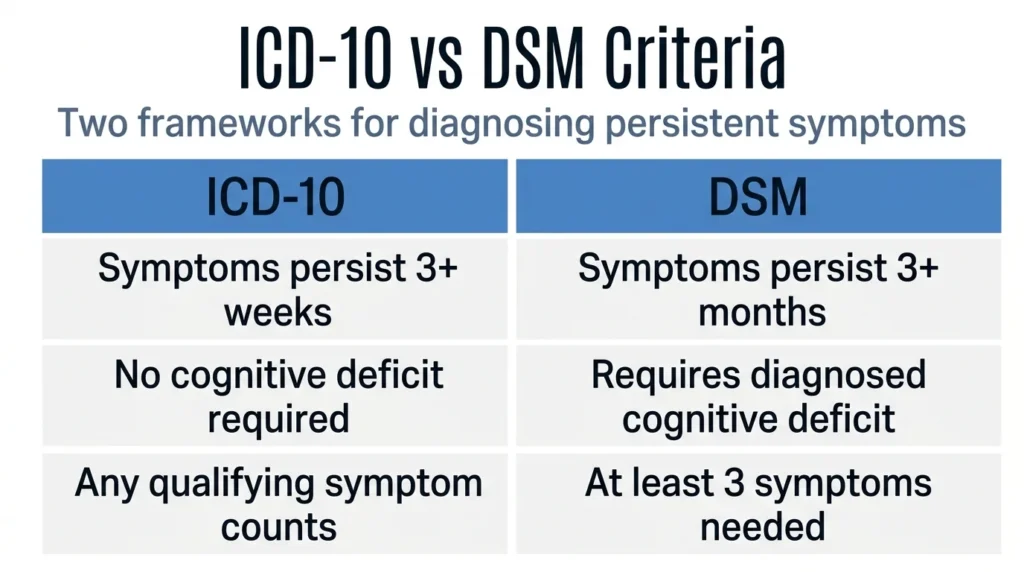
Clinical definitions place the line anywhere from roughly three weeks to three months, depending on which framework your doctor applies.
The CDC’s position is that most people feel better within a couple of weeks, and that symptoms lasting months or longer are the point where a provider may raise post-concussive syndrome as a diagnosis. Its guidance on recovery from a concussion and on what to do after a mild TBI both treat lingering symptoms as a reason to see a specialist.
The NIH medical reference on postconcussive syndrome describes two clinical frameworks. ICD-10 criteria include qualifying symptoms such as headache, dizziness, fatigue, sleep disturbance, and irritability that persist longer than three weeks. DSM-oriented criteria require a cognitive deficit and at least three qualifying symptoms lasting three months or longer.
The number of people diagnosed depends heavily on the framework used. A peer-reviewed study on different classification methods applied several methods to the same patient population and found prevalence ranging from 11.4% to 38.7%. Only 6.3% of patients met every method tested.
Different diagnostic thresholds do not make lingering symptoms less real. Concussions caused by car accidents and motorcycle accidents can continue affecting concentration, sleep, balance, and daily function long after the crash.
The Insurance Company’s Argument & the Testing That Rebuts It
The adjuster may argue that most concussions resolve within weeks, so yours should have resolved too. Medical research supports that general recovery pattern, which makes it important to document why your condition falls outside it.
Serial neuropsychological testing can help. A clinical overview of neuropsychological assessment in mild traumatic brain injury explains how later exams can be compared with an earlier assessment to measure changes in cognitive function.
A deficit that stays stable across repeat testing looks different from one that fades. Fading points toward ordinary recovery. A stable, measured deficit across dated exams is objective evidence that you belong to the documented minority whose symptoms never followed the usual curve.
Testing in personal injury cases sometimes invites suggestions that a claimant is exaggerating. However, the same clinical overview cautions against that conclusion and notes that no single test can prove malingering.
A brain injury attorney can tell you if your records already contain the comparison exams your claim will need.
Why Symptoms That Won’t Go Away Change the Legal Calculation in Texas
Once your condition is documented as persistent rather than healing, Texas law lets a jury award future damages. Texas follows a reasonable probability rule for future personal injury damages, and each category carries its own evidence requirement.
- Future medical expenses. Rosenboom Mach. & Tool, Inc. v. Machala, 995 S.W.2d 817 (Tex. App.—Houston [1st Dist.] 1999, pet. denied), requires evidence that future medical care will probably be needed and proof of its reasonable cost. The court struck the future medical expense award because the plaintiff proved the need for care but did not provide sufficient cost evidence.
- Loss of future earning capacity. Border Apparel-East, Inc. v. Guadian, 868 S.W.2d 894 (Tex. App.—El Paso 1993), explains that this loss need not rest on a specific percentage of physical impairment. A court may consider stamina, efficiency, and the ability to work while in pain. However, the award was reversed because the plaintiff did not introduce evidence of their pre-injury earnings.
Both cases show that a diagnosis alone is not enough. To prove future damages, you need evidence of probability, cost, and the condition’s effect on your ability to work.
Turning Persistent Symptoms Into a Provable Claim
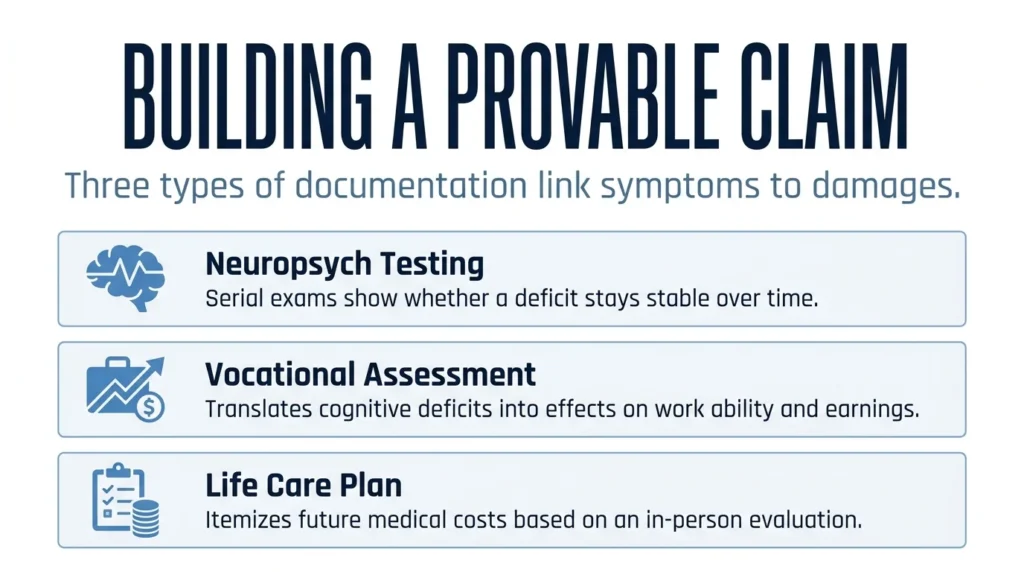
Three types of documentation can connect your ongoing symptoms to the future care, income loss, and other damages you are claiming.
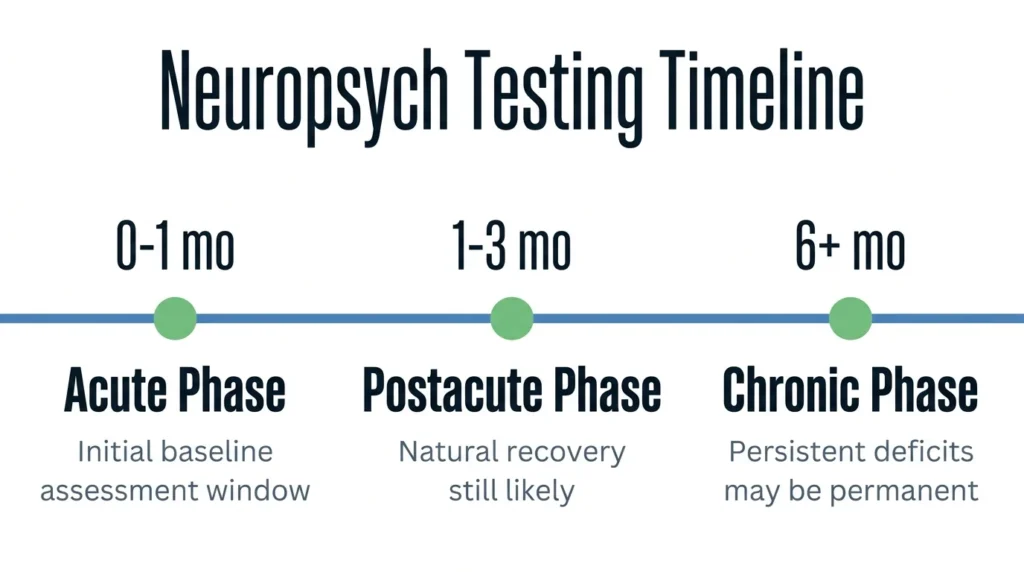
- Serial neuropsychological testing. A comprehensive review of neuropsychological assessment in TBI describes assessment in phases as acute at 0 to 1 month, postacute at 1 to 3 months, and chronic at 6 months and beyond. It recommends monitoring out to 8 to 12 months, because natural recovery can still occur in that window, and it notes that some patients show persistent impairment months to years after injury despite recovering gross motor function.
- Vocational impact documentation. A vocational assessment translates a measured cognitive deficit into its effect on your ability to work and earn income. That is the individualized evidence the earning-capacity standard calls for.
- A life care plan. Where deficits are permanent, treating physicians in neurology, neuropsychology, psychiatry, and cognitive rehabilitation first document what future care you are reasonably certain to need. A Certified Life Care Planner then itemizes that care, working from an in-person, one-to-one evaluation, as described in a trial-lawyer overview of life care planning for traumatic brain injuries.
That itemized cost record is what the future medical expense standard demands. Reasonable probability stays an abstraction until testing, vocational documentation, and a costed plan make it specific.
Talk to a Brain Injury Lawyer About Your Concussion Claim
If your symptoms have outlasted the timeline everyone told you to expect, you need to start documenting them now. Baseline and follow-up testing can only show a stable deficit if someone ordered those exams while the window was still open.
Angel Reyes & Associates has guided injured Texans through the legal process for over 30 years, with board-certified personal injury attorneys, investigators, and accident reconstruction specialists on the team. The firm works on contingency, so there is no upfront cost, and you can reach the office 24/7.
Request a free consultation to review what your medical records already show and what evidence your claim still needs. Every case is different, and past results do not guarantee future outcomes.
Persistent Concussion Symptoms FAQs
Can you have post-concussion syndrome if an MRI or CT scan is normal?
Yes. A normal structural brain scan does not necessarily rule out a concussion or persistent post-concussive symptoms, so doctors may rely on symptoms, clinical examinations, cognitive testing, and other evidence when evaluating the condition.
Can pre-existing migraines or other conditions affect a post-concussion syndrome claim?
Yes. Pre-existing conditions can complicate causation, making medical records from before and after the accident particularly important for distinguishing prior symptoms from new or aggravated problems.
Can a Texas concussion claim include damages for pain, mental anguish, or physical impairment?
Depending on the evidence, a Texas personal injury claim may seek damages for physical pain, mental anguish, and physical impairment in addition to medical expenses and lost earning capacity. These are separate categories of damages and must be supported by evidence showing how the injury affected the claimant.
How long do you have to file a concussion injury lawsuit in Texas?
Texas Civil Practice and Remedies Code Section 16.003 generally gives a person two years after a personal injury claim accrues to file suit, although exceptions can change the deadline. Persistent symptoms do not automatically restart the limitations period.
Should you settle a concussion claim before your symptoms have stabilized?
Settling before the long-term effects and anticipated treatment are reasonably understood can make future damages harder to account for because a settlement generally resolves the covered claim. Medical evidence about prognosis and expected future care can therefore be important when evaluating a settlement involving persistent concussion symptoms.
About the Authors

Spencer Browne
Writer
Spencer Browne is a partner at Angel Reyes & Associates and a Board Certified personal injury trial lawyer with nearly 100 jury trials across Texas. He focuses on car, truck, and wrongful death cases, with notable verdicts including a landmark win in the Choctaw Casino bus crash case. A recognized speaker and legal educator, Spencer is a member of the American Board of Trial Advocates and has been honored as a Texas Super Lawyer and one of D Magazine’s Best Lawyers in Dallas. He brings deep trial experience and relentless advocacy to every client he represents.

Kyle Nicolas
Editor
Kyle Nicolas is the Web Content & SEO Manager at Angel Reyes & Associates. He has more than 10 years of experience as a marketing co...

Angel Reyes
Reviewer
Angel L. Reyes, III is the Founder and Managing Partner of Angel Reyes & Associates. A nationally recognized trial attorney and business...