What Is Res Ipsa Loquitur?


Every article on this site is researched by our internal team, reviewed for legal accuracy against current Texas law, and held to State Bar of Texas advertising standards before publication. We do not publish content that overstates outcomes or makes promises about results.
Learn more about our
editorial standards .
Key Takeaways
- Texas courts formally require two res ipsa elements, not the three often listed.
- Exclusive control fails the moment another person could have accessed the vehicle.
- Res ipsa loquitur rarely wins in Texas without documentation and linked expert proof.

You are behind a pickup on I-35 when its front wheel tears loose, crosses the median, and slams into your car. You know someone was careless. You have no way of knowing who touched those lug nuts, or when.
In some cases, Texas law lets a jury infer negligence from how an accident happened. This rule is called res ipsa loquitur. It applies only in narrow circumstances when direct evidence of the specific negligent act is unavailable.
What Res Ipsa Loquitur Means in Texas Injury Law
Res ipsa loquitur is Latin for “the thing speaks for itself.” In Texas, it is an evidentiary rule used in a negligence case. It’s not a separate cause of action you can file on its own.
You bring a negligence claim and ask the jury to draw an inference of negligence from how the injury happened.
The rule allows a jury to infer negligence from the circumstances of an injury when it cannot identify the specific careless act. In Haddock v. Arnspiger, the Texas Supreme Court explained that the doctrine applies only in limited circumstances.
When direct evidence of what went wrong is available, courts expect you to prove your case the ordinary way.
What a Texas Res Ipsa Claim Must Show
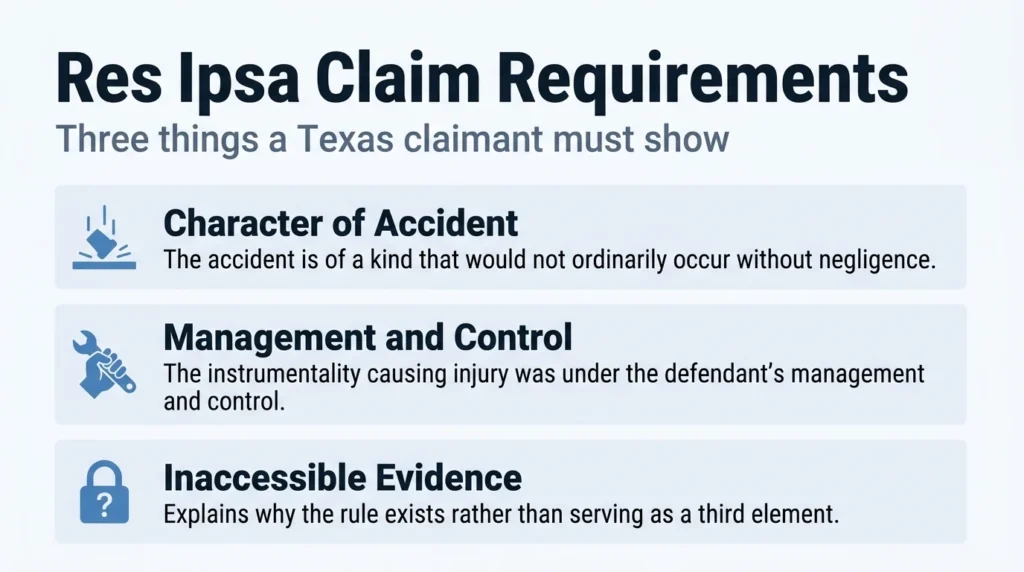
A Texas claimant relying on this doctrine needs to establish three things, though only two of them are formal elements of the court’s own test. The claimant must show that each element is more likely true than not.
- The character of the accident. The Texas Supreme Court requires proof that the accident is of a kind that would not ordinarily occur in the absence of negligence. This is the first of the two elements the court formally requires.
- Management and control. The second required element is that the instrumentality causing the injury was under the defendant’s management and control. Mobil Chemical Co. v. Bell explains that this does not require literal or exclusive control at the moment of the accident. The claimant must rule out other likely causes enough for a jury to reasonably connect the negligence to that defendant.
- Evidence you could not reach. Texas opinions explain the doctrine’s purpose as relieving a plaintiff of proving a specific negligent act when the sequence of events is impossible to reconstruct, or the defendant holds superior knowledge of the cause. It explains why the rule exists, rather than serving as a third, co-equal element of the Supreme Court’s test.
The doctrine also requires the plaintiff to identify a specific defendant. Gaulding v. Celotex Corp. holds that the plaintiff must connect an identifiable defendant to the injury, so res ipsa loquitur cannot be used to determine which of several possible parties was careless.
The doctrine does not change the underlying negligence analysis or how fault is determined in Texas injury cases. It changes the type of evidence a claimant may use to bring the case before a jury.
How Res Ipsa Works When a Wheel Separates From a Vehicle

A wheel coming off a vehicle may seem like a clear res ipsa case. Texas appellate law shows why the doctrine may not apply when more than one person could have accessed or handled the vehicle.
In Discount Tire Co. of Texas, Inc. v. Cabanas, a 2018 San Antonio Court of Appeals case, a tire shop rotated the tires on a customer’s pickup on a Friday afternoon. The customer drove the truck throughout the weekend and parked it in a publicly accessible apartment lot.
Roughly 55 hours after the service, the left front wheel detached while the customer was driving. It crossed into oncoming traffic and injured another driver.
The jury found the tire shop negligent on a res ipsa instruction. The court of appeals reversed the decision and held that the doctrine did not apply.
The reason was the gap in control. Once the customer drove away and left the truck sitting in a public lot for more than two days, the customer, an unknown third party, or the shop could each have been responsible, so a jury could not fairly pin the failure on the shop alone.
Viewed another way, the ruling shows that a stronger claim would likely involve no intervening driver, no public access to the vehicle, no other service provider handling it, and a short period between the defendant’s work and the wheel separation.
No Texas appellate decision has been found awarding a claimant a res ipsa verdict on those exact facts. This scenario illustrates the conditions suggested by the Cabanas reasoning without claiming that Texas courts have approved that precise outcome.
Most car accident and vehicle-defect cases rely on direct evidence of negligence. That may include a direct negligence claim when you sue a mechanic or repair shop in Texas. Res ipsa loquitur applies only when the circumstances satisfy its specific requirements.
How to Prove Control & Rule Out Other Causes
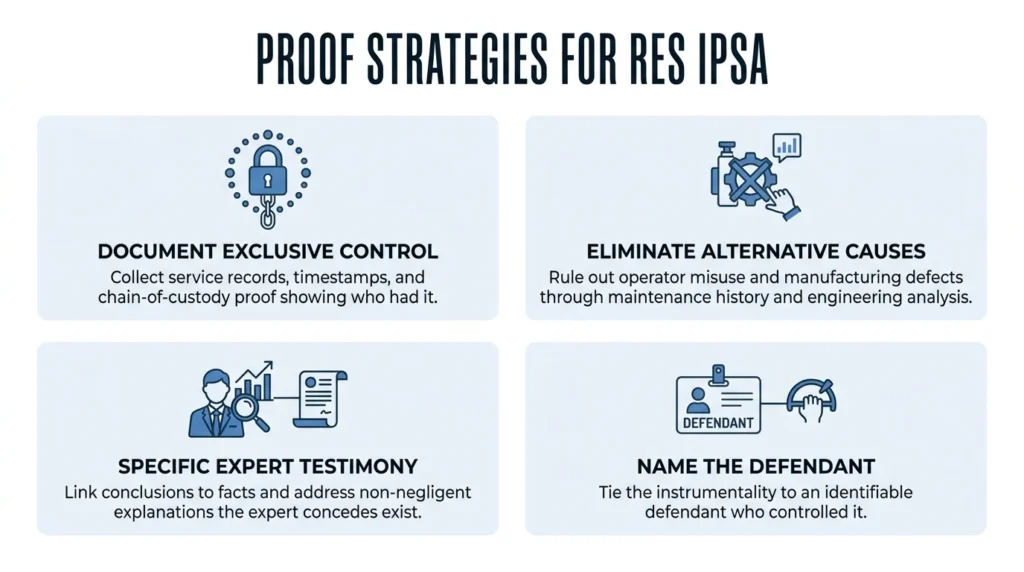
Several types of proof can support a res ipsa argument, and each becomes harder to collect over time.
- Document exclusive control. Collect service records, work orders, timestamps, and chain-of-custody proof showing who had the instrumentality and when. The goal is to show that no other party handled or accessed it, which is exactly what the plaintiff could not show in Cabanas.
- Eliminate the alternative causes. Pull maintenance and inspection history, rule out operator misuse, and rule out a manufacturing defect where one is plausible. Engineering analysis of the failure mechanism belongs here too.
- Make the technical testimony specific. In Schindler Elevator Corp. v. Ceasar, decided in 2023, the Texas Supreme Court reversed a plaintiff’s judgment because the expert testimony on whether the event would ordinarily happen absent negligence was conclusory. An expert has to link conclusions to the facts and address the non-negligent explanations he concedes exist.
- Tie the instrumentality to a named defendant. Marathon Oil Co. v. Sterner ended in a take-nothing judgment because the plaintiff could not identify what caused his exposure or show that the defendant controlled it.
Commercial vehicle cases raise the same questions but often involve more records and more parties. Determining liability in a truck accident may depend on maintenance files the carrier holds and that the claimant can’t access without a formal request.
Talk to an Injury Attorney About Your Case
Res ipsa loquitur applies only in limited circumstances and often depends on records that can disappear quickly. Service logs may be overwritten, and damaged parts may be discarded. Acting quickly can help establish who controlled the item and preserve evidence of what went wrong.
Angel Reyes & Associates has guided injured Texans through situations like this for over 30 years. Our investigators and accident reconstruction specialists can evaluate who had control and help preserve evidence before it is lost. If you were hurt and cannot point to the specific act that caused it, contact Angel Reyes & Associates for a free consultation. Past results do not guarantee future outcomes.
Past outcomes do not guarantee future results. Every case is unique.
Texas Res Ipsa Loquitur FAQs
Does res ipsa loquitur apply to medical malpractice cases in Texas?
Texas Civil Practice and Remedies Code Section 74.201 limits res ipsa loquitur in medical malpractice cases to circumstances recognized by Texas appellate courts before August 29, 1977. Examples include certain cases involving surgical instruments left inside a patient or operations performed on the wrong part of the body.
Can res ipsa loquitur be used in a Texas premises liability case?
Res ipsa loquitur may apply to a premises liability claim when the accident circumstances satisfy the doctrine’s requirements. However, an injury occurring on someone else’s property does not, by itself, establish that the property owner was negligent.
Does res ipsa loquitur shift the burden of proof to the defendant?
No. Under Texas law, the plaintiff retains the burden of proving negligence, even when the circumstances allow a jury to infer negligence.
What is the statute of limitations for a res ipsa loquitur personal injury case in Texas?
Under Texas Civil Practice and Remedies Code Section 16.003, most personal injury lawsuits must be filed within two years after the cause of action accrues, which is generally the date of the injury. Relying on res ipsa loquitur does not extend this deadline, although certain exceptions may apply.
Can you recover damages in Texas if you cannot prove exactly how an accident happened?
Yes, if the available evidence establishes the defendant’s liability and the other requirements of a negligence claim, you may recover compensation without identifying the precise act that caused the accident. Recoverable damages may include medical expenses, lost wages, pain and suffering, and other losses supported by the evidence.
About the Authors

Angel Reyes
Writer
Angel L. Reyes, III is the Founder and Managing Partner of Angel Reyes & Associates. A nationally recognized trial attorney and business leader, Angel has helped over 70,000 injury victims recover more than $1 billion since founding the firm in 1993. Named to the Texas Super Lawyers list annually since 2008, Angel brings Wall Street experience, Ivy League education, and a deep commitment to client advocacy. He is a frequent legal commentator and published author with extensive contributions to legal scholarship, trial strategy, and consumer protection.

Kyle Nicolas
Editor
Kyle Nicolas is the Web Content & SEO Manager at Angel Reyes & Associates. He has more than 10 years of experience as a marketing co...

Angel Reyes
Reviewer
Angel L. Reyes, III is the Founder and Managing Partner of Angel Reyes & Associates. A nationally recognized trial attorney and business...