How Are Truck Accident Claims Different From Car Accident Claims?


Every article on this site is researched by our internal team, reviewed for legal accuracy against current Texas law, and held to State Bar of Texas advertising standards before publication. We do not publish content that overstates outcomes or makes promises about results.
Learn more about our
editorial standards .
Key Takeaways
- Truck crashes can involve several liable parties; car crashes usually involve just one driver.
- Commercial trucks must carry $750,000 or more in coverage, far above Texas auto minimums.
- Truck claims often take 12 to 18 months to resolve, longer than typical car claims.
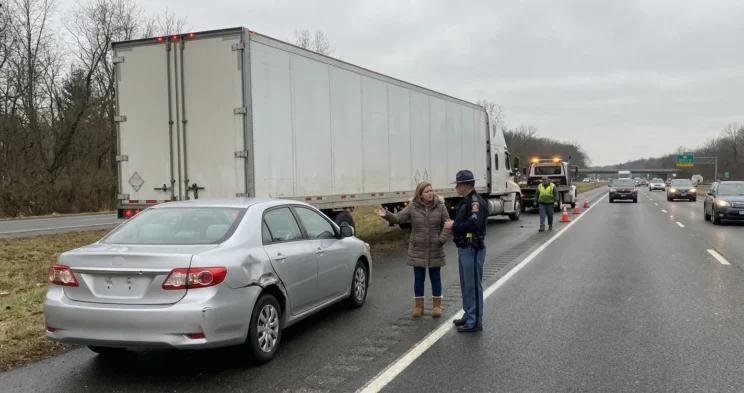
You’ve handled a car accident claim before, so you expected a similar process after a semi-truck rear-ended you on I-45 near Houston. Instead, an insurance adjuster calls within days, before you’ve even seen a doctor. The pace, the players, and the paperwork all feel heavier this time, and that difference is real. It starts with who can be held responsible.
Liability Chains in Truck Accident Claims
A truck accident claim can name several liable parties. A car accident claim usually centers on one driver.
The at-fault driver is only the first name on the list. The trucking company, cargo loaders, maintenance crews, and even the vehicle manufacturer can share the blame, particularly after overloaded or unsecured cargo crashes.
Under 49 CFR Part 395, commercial drivers face strict hours-of-service limits that do not apply to ordinary car drivers. These rules apply only to commercial vehicles above a set gross weight. Along with federal weight limits, that threshold never comes up in a car accident claim.
Texas proportionate responsibility law lets a truck accident defendant point to other responsible parties. Under Texas Civil Practice and Remedies Code Chapter 33, a defendant can designate a third party as partly to blame. That adds a layer of complexity car accident claims rarely see.
Evidence That Disappears After Truck Crashes
Key evidence in a truck crash can vanish within days. Evidence in a car crash usually lasts much longer. After a wreck, the trucking company and its insurer control the data that proves what happened.
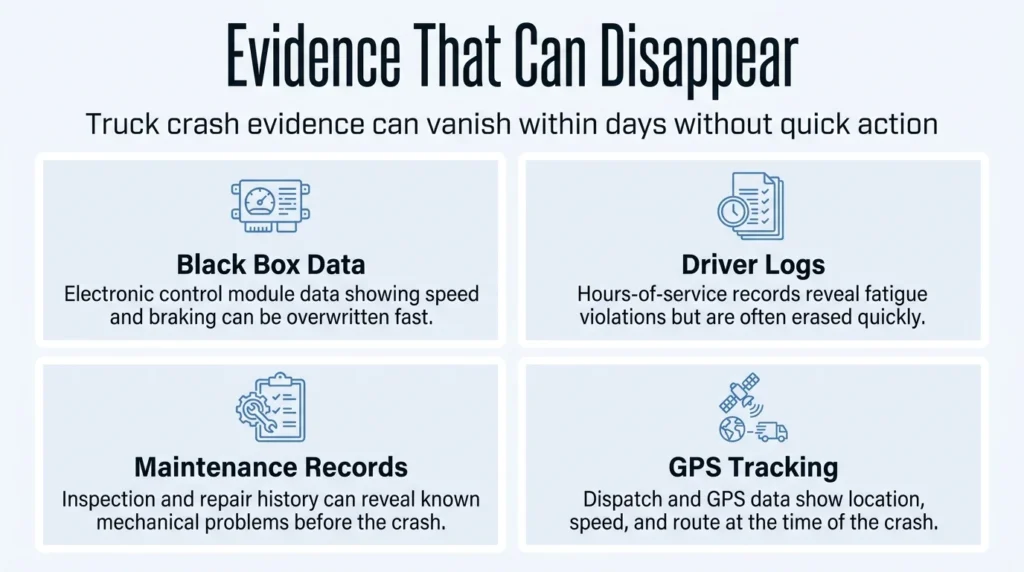
Four types matter most:
- Electronic control module (black box) data showing speed and braking
- Driver logs and hours-of-service records
- Maintenance and inspection records
- GPS and dispatch tracking data
Any of these can be erased or overwritten within days unless a lawyer sends a preservation request fast. Waiting even a week can mean the evidence is gone for good.
Car accident claims lean on a simpler, longer-lasting evidence set: photos, police reports, medical records, and surveillance footage. If you’ve filed a car accident claim before, that evidence holds up over time in a way black box data and driver logs do not. That durability is one reason truck claims demand faster action.
Commercial Insurance Limits vs Car Policies
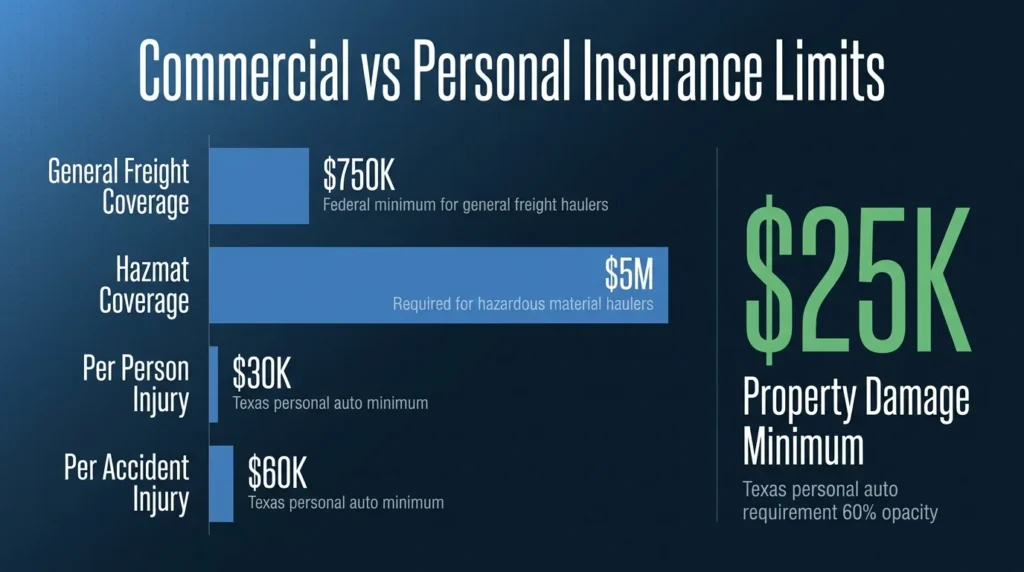
Commercial trucking policies dwarf personal auto minimums. That gap is the clearest reason truck accident claims carry higher stakes.
Commercial Truck Insurance Minimums
Under 49 CFR § 387.9, motor carriers must carry at least $750,000 in liability coverage for general freight. Haulers carrying hazardous materials must carry up to $5,000,000. Even a routine crash can trigger a claim against a policy many times larger than a typical driver’s coverage.
Personal Auto Insurance Minimums
Texas requires far less. Under Texas Transportation Code § 601.072, personal vehicles need only $30,000 per injured person, $60,000 per accident, and $25,000 for property damage.
That is a fraction of the commercial minimums above, and it is the core of why truck and car claims differ so sharply.
Size differences explain why the stakes are so high. An 80,000-pound truck colliding with a 3,000 to 4,000-pound car causes far more severe injuries. It also raises the risk of a multi-vehicle pile-up.
Federal crash data confirms this severity gap, which is why settlement values in truck claims often run higher.
Trucking Company Defense Tactics
Trucking companies respond to crashes fast, often within hours. Car insurers rarely move that quickly.
Many trucking companies deploy rapid-response investigation teams and defense counsel within hours, sometimes before you’ve left the scene. A car accident claim, by contrast, usually starts with a routine adjuster call days later.
Because commercial policy limits run so much higher, trucking insurers fight harder and settle less readily than personal auto insurers. Matching that response early makes a real difference, which is why truck accident attorneys get involved. A fast, well-resourced response from the trucking company’s side is a signal worth taking seriously right away.
Truck Claims Take Longer to Resolve
Truck accident claims almost always take longer to resolve than car accident claims.
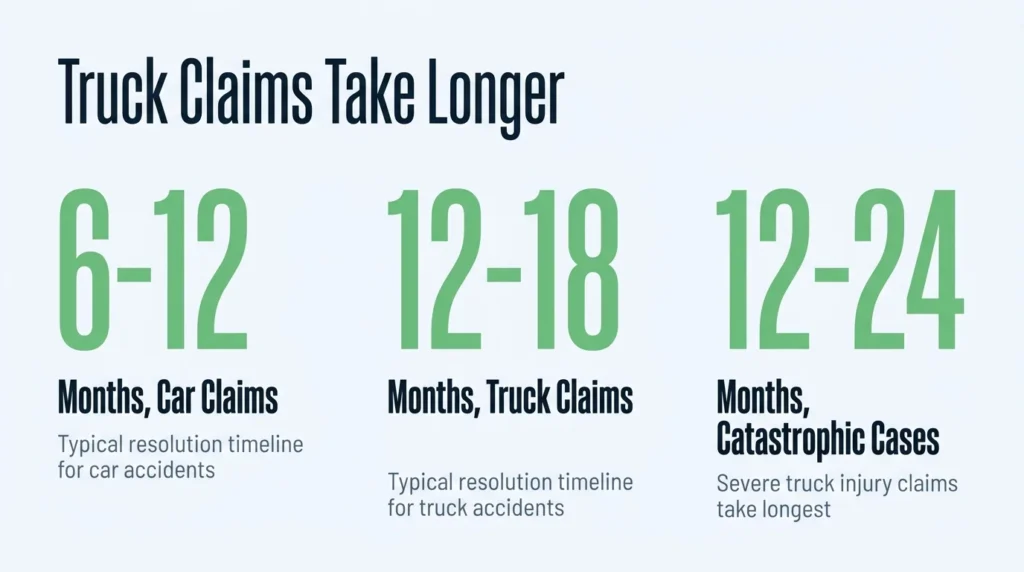
Typical car accident claims resolve in roughly 6 to 12 months. Truck accident claims commonly take 12 to 18 months, and catastrophic injury cases can stretch to 12 to 24 months. Multi-party investigation, federal regulatory complexity, and harder-to-obtain evidence all add time.
A longer investigation does not extend your deadline to file. Under Texas Civil Practice and Remedies Code § 16.003, both truck and car accident claims share the same two-year statute of limitations. Waiting for the investigation to finish before talking to a lawyer can cost you time you don’t have.
Clients who moved quickly after a truck crash often fared better once negotiations began, as reflected in reviews and testimonials. When a claim is likely to take longer than expected, an early case review helps. It can clarify what to expect and protect your rights from the start.
Work with an Experienced Attorney Today
Truck and car accident claims differ in nearly every phase, from who can be held liable to how long the case takes to resolve. Facing that complexity without help puts you at a disadvantage against a trucking company’s defense team.
Angel Reyes & Associates has more than $1 billion recovered for clients. We handle truck and car accident claims across Texas on a contingency basis, so you pay no fee unless we win.
You can also review examples of past truck accident recoveries in our case results.
Contact us today for a free case review: https://www.reyeslaw.com/contact-us/.
Past results do not guarantee future outcomes.
Truck Accident Claim FAQs
What happens if I was partly at fault for a truck accident?
Texas follows a 51 percent bar rule, so you can still recover damages if you were 50 percent or less at fault, but your payout is reduced by your share of the blame. If you are found more than 50 percent responsible, you cannot recover anything.
Can a trucking company be held responsible if the driver was an independent contractor?
Yes, in most cases. Federal leasing rules make a trucking company responsible for a leased driver’s actions for liability purposes, even when that driver is classified as an independent contractor rather than an employee.
Can a truck accident lawsuit end up in federal court instead of state court?
It can, if the trucking company is based in a different state and the claim is worth more than $75,000, since that combination can qualify for federal diversity jurisdiction. Car accident lawsuits usually stay in state court because both drivers are typically Texas residents.
Can a freight broker be held liable for a truck accident?
Yes, in some cases. A 2026 U.S. Supreme Court ruling in Montgomery v. Caribe Transport confirmed that a freight broker can be held liable for negligently selecting an unsafe trucking company, adding another potential party to a claim.
Are truck drivers tested for drugs or alcohol after a crash the way car drivers are?
Federal rules require commercial truck drivers to undergo post crash drug and alcohol testing when a crash involves a death, or a citation combined with a disabling injury or a towed vehicle. Car accident drivers face no equivalent federal testing requirement.
About the Authors

Alex Ivanov
Writer
Alex Ivanov is a personal injury attorney at Angel Reyes & Associates, focused on car, truck, and motorcycle accident cases. Licensed in Texas and multiple federal districts, Alex brings international legal experience and a global education to his practice. He earned his LL.M. from Texas A&M University School of Law after graduating from Belarussian State University in 2016. Alex is fluent in Russian, English, Ukrainian, and Belarussian, and is recognized by multiple national trial lawyer associations for his results and leadership under 40.

Kyle Nicolas
Editor
Kyle Nicolas is the Web Content & SEO Manager at Angel Reyes & Associates. He has more than 10 years of experience as a marketing co...

Angel Reyes
Reviewer
Angel L. Reyes, III is the Founder and Managing Partner of Angel Reyes & Associates. A nationally recognized trial attorney and business...