Should I Accept the Insurance Settlement Offer?


Every article on this site is researched by our internal team, reviewed for legal accuracy against current Texas law, and held to State Bar of Texas advertising standards before publication. We do not publish content that overstates outcomes or makes promises about results.
Learn more about our
editorial standards .
Key Takeaways
- First insurance offers arrive early because a signed release closes your claim for good.
- A fair number counts future medical care and lost earning capacity, not just paid bills.
- Texas gives you two full years to settle or sue, not the deadline an adjuster claims.

Your phone rings two days after your crash on I-635, and the adjuster already has a number ready. It sounds reasonable until you add up what you have spent on the ER visit alone. Before you sign anything, it helps to understand why that number arrived so fast, and so low.
Why First Offers Arrive Early and Low
Insurance adjusters do not study your specific injuries before naming a number. Claims software calculates a minimum figure based on similar past claims, not on what your case is actually worth, a pattern documented across many Texas injury claims.
That figure typically lands well below the true value of a claim. It also tends to arrive early, while you are still in treatment and before anyone knows the full extent of your injury.
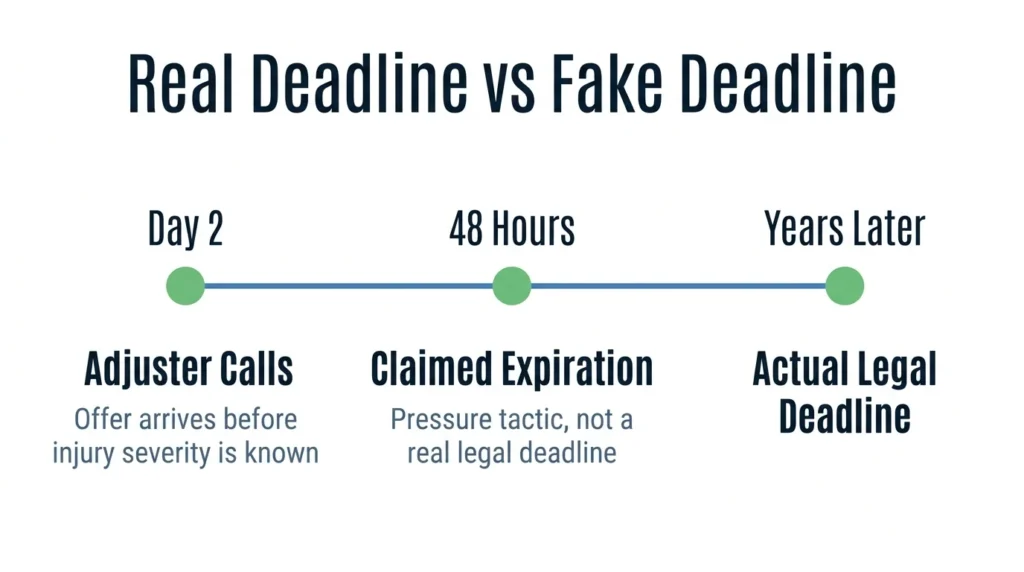
Speed protects the insurer for a specific reason. Under Texas Civil Practice and Remedies Code § 16.003, you have two full years from the date of the crash to settle or file suit, not the day or two an adjuster’s urgency might suggest.
The faster you sign, the less time your injury has to reveal complications the insurer would otherwise owe you for.
Red Flags That Signal a Lowball Offer
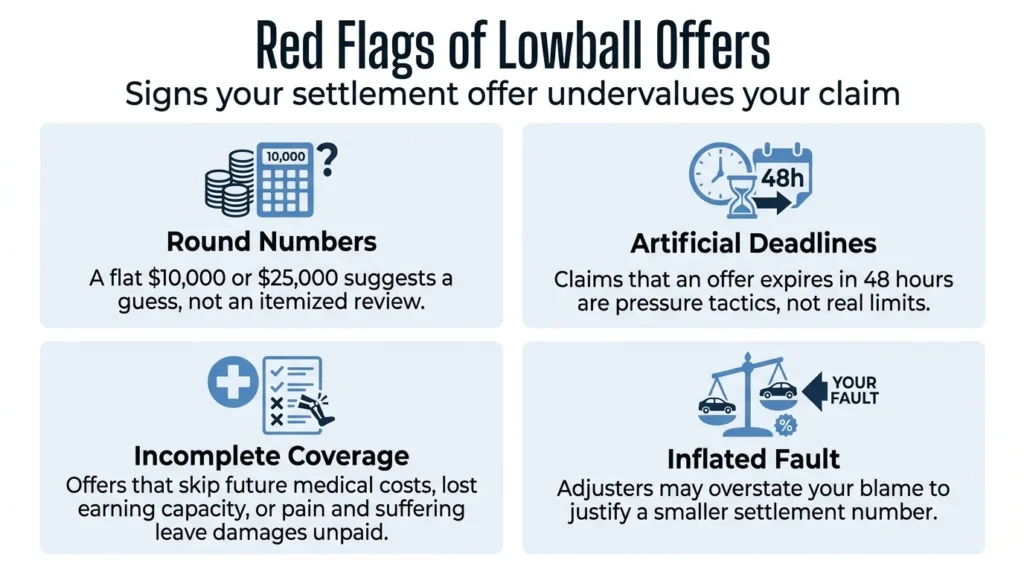
A handful of patterns show up again and again in offers that undervalue a claim:
- Round numbers. A flat $10,000 or $25,000 suggests a guess, not an itemized review of your damages.
- Artificial deadlines. Claims that an offer “expires” in 48 hours or needs a supervisor’s sign-off are pressure tactics, not real limits.
- Incomplete coverage. Offers that skip future medical costs, lost earning capacity, or pain and suffering leave real damages unpaid.
- Inflated fault. Adjusters sometimes overstate your share of blame to justify a smaller number, even though Texas law still lets you recover money as long as you are found 50 percent or less at fault.
Some of these tactics fall under what the Texas Insurance Code § 541.060 unfair settlement practices rule prohibits, including misrepresenting facts about your coverage or failing to settle fairly once liability is clear. If you spot two or more of these signs, it is worth pushing back before responding further.
Why Rejecting a Low Offer Isn’t the End
Turning down a bad offer does not close your claim. Adjusters typically come back with a higher number once they see you are not accepting the first figure.
Time also works in your favor. Injury severity often becomes clearer as treatment continues, and adjusters face internal quotas that add pressure to settle as a review period ends.
What Your Claim Is Genuinely Worth
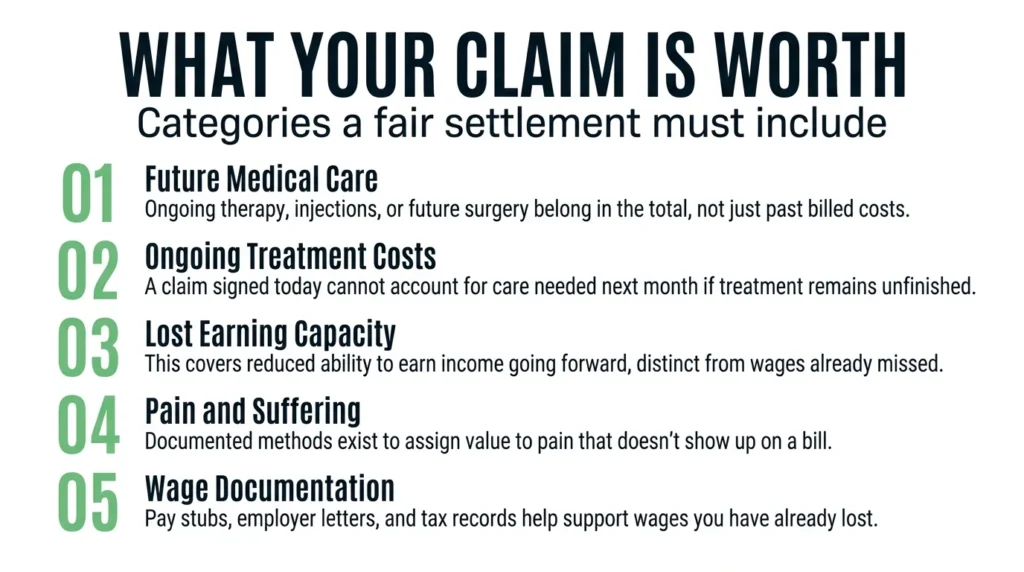
A fair number accounts for more than the bills you have already paid:
- Current and future medical care. Ongoing physical therapy, injections, or a future surgery all belong in the total, not just costs already billed.
- Ongoing treatment costs. If your treatment is not finished, a claim signed today cannot account for care you still need next month.
- Lost earning capacity. This differs from missed paychecks. It covers your reduced ability to earn the same income going forward, a distinct category from lost wages already missed.
- Pain and suffering. Documented methods exist to assign a value to pain that does not show up on a medical bill.
- Wage documentation. Pay stubs, employer letters, and tax records all help support the wages you have already lost.
The Release That Locks In Your Settlement Forever
Every settlement offer comes with release language, and that language is the real risk. Once you sign, Texas law treats the release as final, closing the door on your claim even if you later discover a worse injury.
That is exactly why signing before your treatment concludes is the central danger. You cannot know the true cost of your care while it is still ongoing, and a signed release will not let you reopen the case once you find out.
What We Look at Before Calling an Offer Fair
Before advising anyone that an offer is fair, a real evaluation checks whether it covers every category above: medical care that is finished and still ahead, lost earning capacity, and whether your treatment has actually concluded. Severe injuries, disputed fault, and multi-vehicle crashes all make that check more complicated, not less necessary.
Angel Reyes & Associates has represented injured Texans for more than 30 years, with more than $1 billion recovered for clients. Our case results reflect the same standard we apply before telling any client an offer is ready to sign.
We work on contingency, so you owe nothing unless we win your case. Contact us today for a free review of your offer before you decide.
Past results do not guarantee future outcomes.
Settlement Offer FAQs
Do I have to pay taxes on my personal injury settlement?
Usually not. Under IRS rules for injury settlements, compensation for a physical injury, including medical bills and pain and suffering, is not taxable, though punitive damages and interest are.
Does settling my vehicle's property damage claim also settle my injury claim?
Not automatically. Insurers typically handle property damage and bodily injury as separate claims with separate adjusters, though a broadly worded release can accidentally waive both if you are not careful.
What if settlement talks are still ongoing when my two-year deadline gets close?
You still need to file suit before the deadline passes. Filing an insurance claim does not pause Texas’s statute of limitations, and you can keep negotiating even after the lawsuit is filed.
Does my own PIP or MedPay coverage reduce what the at-fault driver's insurer offers?
It depends on which one paid your bills. Texas law blocks PIP insurers from taking subrogation against an insured at-fault driver, while MedPay carriers generally can reclaim what they paid from your settlement.
About the Authors

Angel Reyes
Writer
Angel L. Reyes, III is the Founder and Managing Partner of Angel Reyes & Associates. A nationally recognized trial attorney and business leader, Angel has helped over 70,000 injury victims recover more than $1 billion since founding the firm in 1993. Named to the Texas Super Lawyers list annually since 2008, Angel brings Wall Street experience, Ivy League education, and a deep commitment to client advocacy. He is a frequent legal commentator and published author with extensive contributions to legal scholarship, trial strategy, and consumer protection.

Kyle Nicolas
Editor
Kyle Nicolas is the Web Content & SEO Manager at Angel Reyes & Associates. He has more than 10 years of experience as a marketing co...

Angel Reyes
Reviewer
Angel L. Reyes, III is the Founder and Managing Partner of Angel Reyes & Associates. A nationally recognized trial attorney and business...