How Do You Sue a Government Entity for a Car Accident in Texas?


Every article on this site is researched by our internal team, reviewed for legal accuracy against current Texas law, and held to State Bar of Texas advertising standards before publication. We do not publish content that overstates outcomes or makes promises about results.
Learn more about our
editorial standards .
Key Takeaways
- Texas cities set their own notice deadlines, from 45 days in Austin to 180 in Dallas.
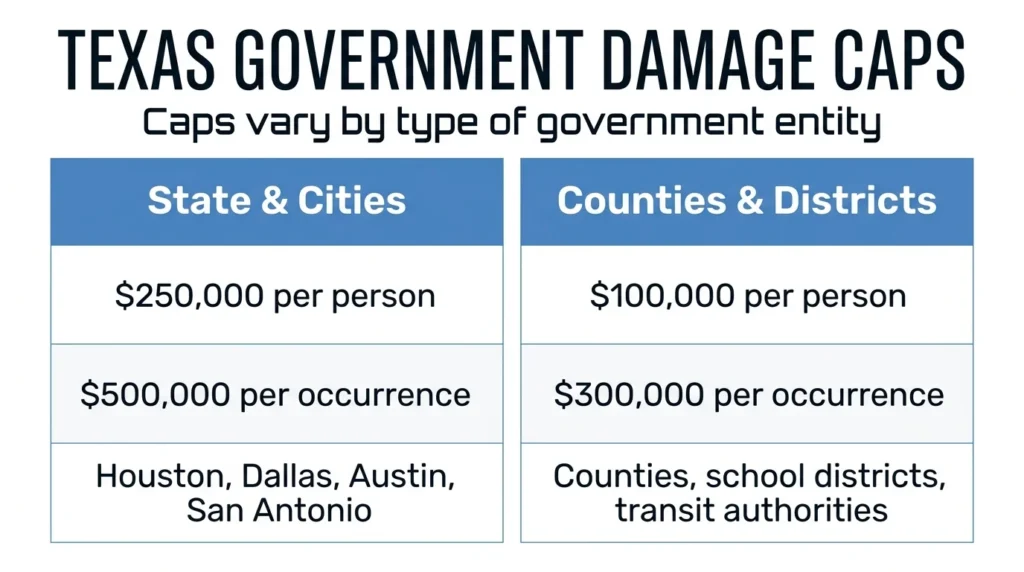
- State agencies and cities cap injury claims at $250,000 per person, $500,000 per event.
- Counties and school districts face a lower $100,000 per person recovery cap.
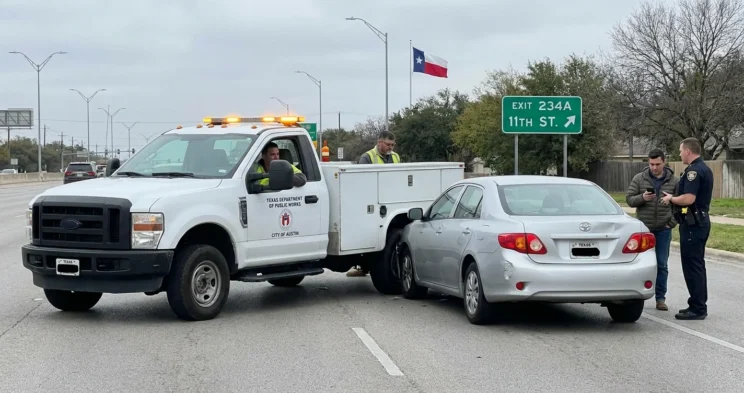
If you have been hit by a government vehicle and medical bills are piling up, you still have options to pursue compensation. However, government claims follow different rules, with some notice deadlines as short as 45 days. Acting quickly is critical to preserving your right to file.
While Texas law generally shields government entities from most lawsuits, the Texas Tort Claims Act (TTCA) creates an exception for crashes caused by an employee’s negligence. Keep in mind that these cases carry statutory damage caps that don’t apply to private drivers. Understanding these unique rules can make all the difference in recovering what you’re owed.
Can You Sue the Government in Texas?
Yes, you can sue government entities in Texas, but only under specific legal exceptions written into state law. Most people assume government agencies can never be sued, and that is not true. The rules differ sharply from cases involving private drivers.
How Sovereign Immunity Protects Government Entities
Sovereign immunity is the legal principle that government entities cannot be sued without their permission. This protection exists so governments can function without facing constant lawsuits over every decision they make.
However, sovereign immunity created a problem when government employees caused serious harm through careless driving. Victims had no way to recover compensation, even when injuries were severe, and fault was clear.
The Texas Tort Claims Act fixed that gap. Under Texas Civil Practice and Remedies Code (CPRC) § 101.021, a government agency is liable for injury, death, or property damage. That liability applies when an employee negligently operates a motor vehicle while acting within the scope of employment.
When Government Immunity Disappears for Car Accidents
The waiver applies whenever a government employee drives negligently while performing job duties. Negligence means failing to use the care a responsible person would use in the same situation.
Running red lights, texting while driving, or failing to check a blind spot all qualify as negligence. However, the employee must have been acting within their official capacity when the crash happened; an off-duty government employee driving a personal vehicle does not create government liability.
Emergency vehicles get special treatment under Texas CPRC § 101.055. A police or fire vehicle responding to an emergency with lights and sirens active keeps its protection from lawsuits. That protection disappears only if the driver shows conscious indifference or reckless disregard for others’ safety.
This is a much harder standard to prove than ordinary negligence. Claiming emergency status is not automatically a shield, as what happens when a police vehicle hits your car during a chase explains in more detail. Because these claims often turn on disputed facts, like whether the lights and sirens were actually on, getting the timeline reviewed early can matter.
The TTCA also covers dangerous road conditions caused by poor government maintenance. However, you must show the agency knew about the hazard and failed to fix it within a reasonable time.
Common Scenarios Where You Can Sue
When city bus drivers fail to check their mirrors, signal lane changes, or yield, the consequces are immediate. A vehicle that size leaves zero room for error, making simple mistakes dangerous for everyone on the road. For a deeper look at how these claims work, check out this breakdown of liability in Texas bus accidents.
Police vehicles outside of emergencies must follow standard traffic rules. A patrol car that causes a crash during routine, non-emergency driving creates the same liability as any private driver.
Garbage trucks and utility vehicles need extra caution because of frequent stops and large blind spots. When operators skip safety procedures, their agencies can be held liable for the resulting crash. That is one of several common causes of car accidents in Texas worth understanding.
What Limits Your Recovery in Texas
Two things limit what you can recover from a government entity. Strict dollar caps limit your damages, and strict notice rules can end a claim before it even starts.
How Damage Caps Limit Government Accident Claims
Under Texas CPRC § 101.023, state agencies face strict damage caps. The precise ceiling depends on the type of entity responsible for the crash:
- State Agencies and Municipalities: Cities like Houston, Dallas, Austin, San Antonio, El Paso, and Fort Worth carry a cap of $250,000 per person and $500,000 per occurrence for injury or death. Property damage claims for these entities are capped at $100,000 per occurrence.
- Counties, School Districts, and Transit Authorities: Non-city government bodies face lower limits of $100,000 per person and $300,000 per occurrence for injury or death.
These statutory limits apply to your total claim, meaning medical bills, lost wages, and pain and suffering all draw from that single cap. Even in catastrophic cases where losses exceed $1 million, financial recovery cannot surpass the legal limit for the entity at fault. For a closer look into specific vehicle claims, explore this guide on how the Texas Tort Claims Act limits bus accident recovery.
What Your Written Notice Must Include
Under Texas CPRC § 101.101, your written notice must reasonably describe:
- The damage or injury you are claiming
- The time and place the accident happened
- What happened in the accident itself
Missing even one of these elements can jeopardize your claim, no matter how serious your injuries are. Precise details help too: the exact intersection or address, the vehicle number, and a badge number or name if you have it. List specific injuries and property damage rather than vague descriptions.
Delivery matters too. The notice must reach the correct department through an accepted method. Many cities also publish their own additional requirements on top of the statutory minimum.
Where to Send Your Notice for Different Agencies
When suing a state agency in Texas, claims go through the Office of the Attorney General regardless of which department’s employee caused the accident.
For municipal claims, local requirements vary by jurisdiction:
- Houston: Formal written notice must be submitted to the mayor and city council via the City Secretary’s office.
- Dallas: Notice must be filed specifically with the City Secretary rather than other city officials.
Because these local notification rules differ across Texas, following the specific filing instructions for the relevant municipality is essential.
Critical Deadlines in Texas Government Claims
Two clocks run against you after a government accident. One is a short notice deadline measured in days or months. The other is a separate two-year deadline to file suit.
Notice Requirements by Texas Jurisdiction
Under § 101.101, governmental units are generally entitled to six months, or 180 days, of notice after an accident. State law also allows individual cities to set a shorter deadline through their own charters. Several major cities do exactly that.
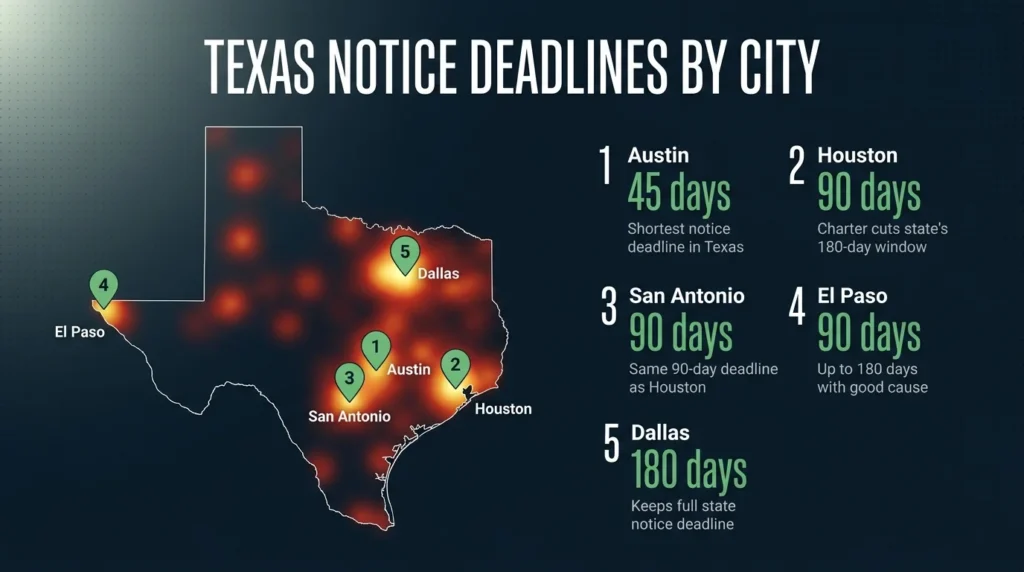
- Houston’s charter cuts the window to 90 days, according to the City of Houston’s own claims process.
- Austin cuts it further still, to just 45 days, as confirmed on the City of Austin’s claim filing page.
- San Antonio and El Paso also require 90 days, though El Paso will allow up to six months when you can show good cause.
- Dallas and Fort Worth keep the full six-month, 180-day window that state agencies use.
Because these deadlines vary so much by city, confirm your specific jurisdiction’s requirement immediately after an accident. Courts have no discretion to extend these deadlines, regardless of your injuries or circumstances.
The Two-Year Statute of Limitations
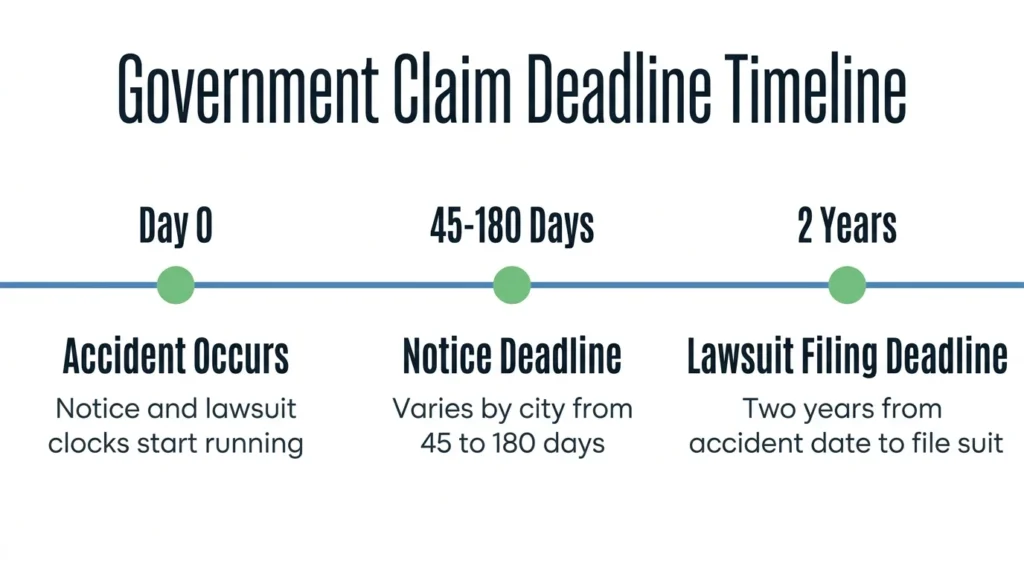
After you provide proper notice, Texas CPRC § 16.003 gives you two years from the accident date to file your lawsuit. This deadline runs from the accident date, not from when you filed your notice.
If you give proper notice but then wait longer than two years to sue, your case gets dismissed regardless of merit. Settlement talks and criminal proceedings do not pause this clock. Many people assume ongoing negotiations or pending charges buy them more time, and they do not.
The two-year deadline becomes meaningless, though, without the earlier notice. You have to satisfy the short notice window before the two-year deadline ever comes into play.
Missing Deadlines Happen More Often Than You’d Think
You are juggling medical appointments, missing work, and figuring out how to cover next month’s bills. Meanwhile, evidence disappears: surveillance footage gets deleted after 30 to 90 days, witnesses move away, and vehicle damage gets repaired.
Government agencies count on this. Their attorneys know overwhelmed accident victims often discover procedural requirements too late. One missing detail, or a notice sent to the wrong department, can end a case before it reaches a courtroom.
Getting your timeline checked against the applicable deadline as soon as possible helps close that gap.
Set Realistic Expectations for Your Claim
Suing a government entity in Texas means navigating sovereign immunity exceptions, meeting tight notice deadlines, and accepting strict damage caps. Evidence disappears and deadlines quickly expire while you are still recovering. That is why immediate action matters more here than in most accident claims.
Angel Reyes & Associates has guided Texans through government injury claims for more than 30 years, recovering more than $1 billion for our clients. Supported by a team of over 600 dedicated professionals across more than 20 Texas offices, we offer services in English and Spanish with 24/7 availability. Our firm’s case results highlight the strong outcomes we achieve, even under these capped, deadline-driven rules.
We work on a contingency fee basis, meaning you get a free consultation and pay no fees unless we win your case. Contact Angel Reyes & Associates today to make sure you meet every deadline before it is too late.
Past results do not guarantee future outcomes.
Suing a Texas Government Agency for a Crash FAQs
How hard is it to sue the government compared to suing a private driver?
Government claims involve more procedural hurdles than private accident cases, including sovereign immunity defenses, strict notice deadlines, and damage caps. These added complications do not mean the cases cannot be won with the right preparation.
Can I sue a federal government vehicle or just Texas state and local entities?
A federal government vehicle accident falls under the Federal Tort Claims Act, not the Texas Tort Claims Act, and requires an administrative claim filed with the responsible federal agency within two years. The Texas Tort Claims Act only reaches Texas state agencies, counties, cities, school districts, and other Texas governmental entities.
What happens if a government contractor's vehicle hits me, not a direct government employee?
Independent contractors working for government agencies typically do not receive sovereign immunity protection. You would pursue the contractor’s company and its commercial insurance instead of the government entity itself.
Do I need to report the accident to anyone besides police for government vehicle claims?
Yes, you must file formal written notice with the specific government agency within that jurisdiction’s deadline, separate from any police report. The police report alone does not satisfy notice requirements under the Texas Tort Claims Act.
What if the government claims their vehicle had the right of way under emergency response laws?
The government must prove its vehicle was actually engaged in emergency response with lights and sirens properly activated, since simply claiming emergency status does not automatically shield it from liability. Dispatch records, dashcam footage, and witness accounts can all challenge that claim.
About the Authors

Angel Reyes
Writer
Angel L. Reyes, III is the Founder and Managing Partner of Angel Reyes & Associates. A nationally recognized trial attorney and business leader, Angel founded the firm in 1993, which has gone on to help over 70,000 injury victims recover more than $1 billion. Named to the Texas Super Lawyers list annually since 2008, Angel brings Wall Street experience, Ivy League education, and a deep commitment to client advocacy. He is a frequent legal commentator and published author with extensive contributions to legal scholarship, trial strategy, and consumer protection.

Kyle Nicolas
Editor
Kyle Nicolas is the Web Content & SEO Manager at Angel Reyes & Associates. He has more than 10 years of experience as a marketing co...

Spencer Browne
Reviewer
Spencer Browne is a partner at Angel Reyes & Associates and a Board Certified personal injury trial lawyer with nearly 100 jury trials a...