Who Is Liable in a Car Accident in Texas?


Every article on this site is researched by our internal team, reviewed for legal accuracy against current Texas law, and held to State Bar of Texas advertising standards before publication. We do not publish content that overstates outcomes or makes promises about results.
Learn more about our
editorial standards .
Key Takeaways
- Texas bars recovery entirely once your fault share passes 50 percent.
- Below 51 percent fault, your payout shrinks by your percentage, not to zero.
- You generally have two years from the crash date to file a Texas lawsuit.
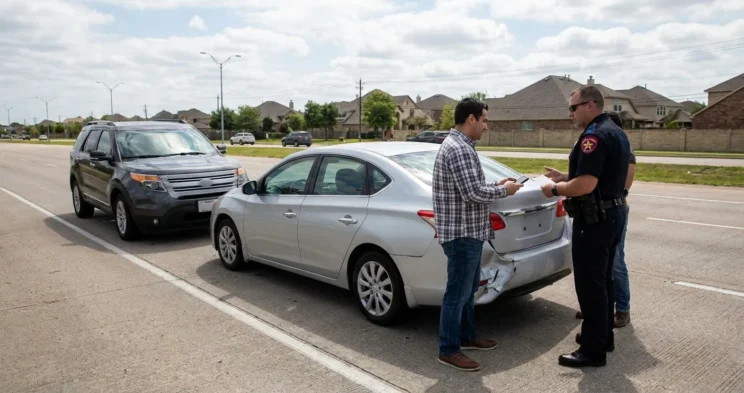
You’re stopped at a red light on the Gulf Freeway when another driver rear-ends your car. Within days, the other driver’s insurance adjuster calls and says you share some of the blame. Before you accept any number, you need to know how Texas law actually decides who is at fault.
The Four Elements of Negligence
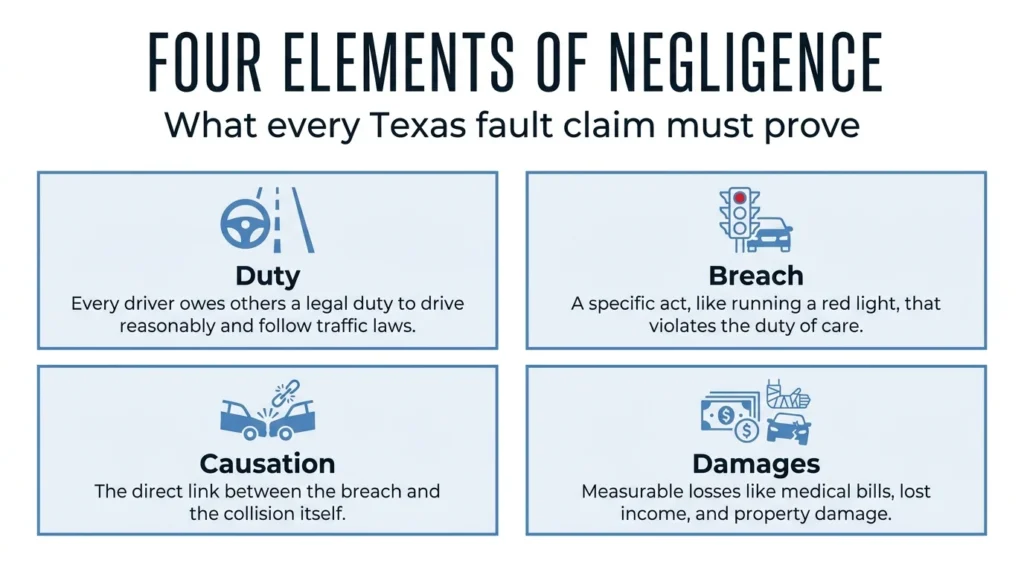
Every fault determination in a Texas car accident case rests on four legal elements: duty, breach, causation, and damages. A driver must satisfy all four before a claim can succeed.
Duty of care is the starting point. Every driver on a Texas road owes other drivers a legal obligation to drive reasonably and follow traffic laws. That duty exists the moment a driver starts the engine.
Breach of duty comes next. A breach is a specific act, such as running a red light or following too closely, that violates this standard. Breach is what most people mean when they call a driver “at fault.”
Causation connects the breach to the crash itself. This is the direct link between what the other driver did and the collision, separate from the injuries that followed. A breach without this link will not support a claim.
Damages are the real losses: medical bills, lost income, and property damage. Without measurable damages, no claim exists even when a breach is obvious.
Legal terms like these can get technical fast. Reviewing common injury law terms and definitions can help you follow your own case as it develops.
These four elements are also why fault disputes often need outside guidance. Learn more about our firm’s experience with Texas car accident claims.
Texas’s 51% Bar Rule Explained
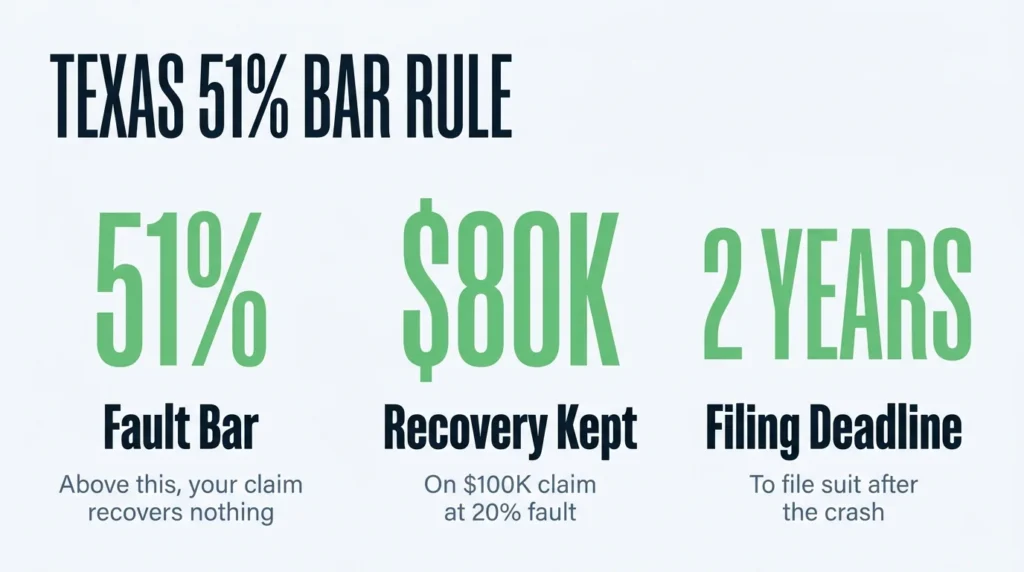
Texas caps recovery at the point where your own share of fault outweighs the other driver’s. Under Texas Civil Practice and Remedies Code § 33.001, a claimant found more than 50 percent responsible recovers nothing.
Below that 51 percent line, Texas uses modified comparative negligence under Texas Civil Practice and Remedies Code § 33.012. Your recovery shrinks by your percentage of fault instead of disappearing. A claimant with $100,000 in damages who is 20 percent responsible still recovers $80,000.
This proportionate responsibility system rewards evidence, not guesswork. If you were told you share the blame for your Texas crash, you are not alone. Read how other drivers handle being partially at fault for a car accident before you accept an adjuster’s number.
You also face a filing deadline. Under Texas Civil Practice and Remedies Code § 16.003, you generally have two years from the crash date to file suit. Narrow exceptions apply to claims against government entities, a claimant’s mental incapacity, and a defendant who leaves Texas.
Evidence That Shapes Fault Decisions
Fault gets proven with evidence tied directly to the four elements above, not with opinions. Each type of evidence tends to support a different element of the claim.
Police crash reports document citations and an officer’s initial fault assessment. These reports primarily support the breach element, since they record what the officer believes went wrong. Texas also tracks crash data through the state’s crash reports and records system.
Vehicle damage patterns and scene photos are physical proof of point of impact. They support causation by showing how the vehicles actually collided. Photograph the scene before vehicles move, since impact points and skid marks fade fast once traffic clears.
Traffic camera footage is treated here as its own distinct evidence source, separate from general video evidence. Witness statements and camera footage can both corroborate or contradict what the other driver claims happened. If your case involves conflicting accounts, our attorneys can walk you through how this kind of evidence gets gathered before it disappears.
Electronic vehicle data, including event data recorders, cell phone records, and GPS logs, can establish speed and timing that no eyewitness could describe.
Common Fault Scenarios in Texas Crashes
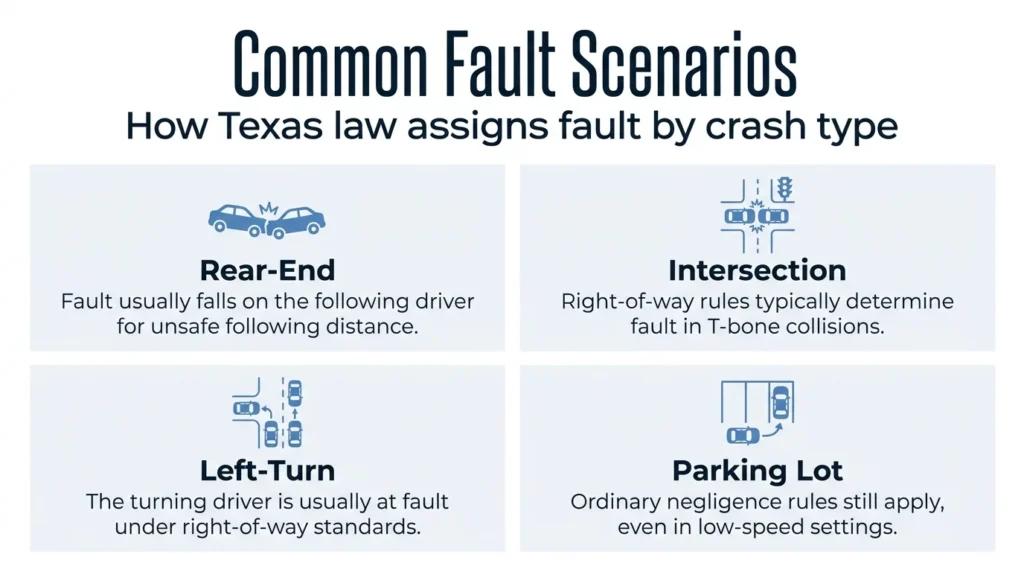
Most Texas crashes fall into a handful of recognizable fault patterns tied to how the collision happened.
Rear-end collisions typically place fault on the following driver. Under Texas Transportation Code § 545.062, drivers must maintain a safe following distance. If you were rear-ended in Texas, this following-distance standard is usually the starting point for your claim.
Intersection and T-bone collisions typically follow the right-of-way rule. Texas Transportation Code § 545.151 sets out who had the legal go-ahead. If your crash matches this pattern, learning how T-bone accident claims typically get built can help you see what comes next.
Left-turn collisions usually place fault on the turning driver. This follows the left-turn right-of-way standard set out in Texas Transportation Code § 545.152.
Parking lot collisions still follow ordinary negligence principles, even in low-speed settings with little signage. The same duty, breach, causation, and damages framework applies, as detailed in these parking lot accident rules in Texas.
How Insurance Companies Manipulate Fault
Adjusters have a financial incentive to shift fault onto you, and they use the 51 percent bar rule to do it. Pushing your share above 50 percent eliminates your claim outright. Inflating it while staying below that line still shrinks your payout.
Unfair settlement practices are addressed under Texas Insurance Code § 541.060. This includes misrepresenting policy terms or failing to investigate a claim promptly. Insurers cannot use these tactics to avoid a fair payout.
Insurers also face statutory deadlines for acknowledging, accepting, rejecting, or paying a claim under Texas Insurance Code Chapter 542. A slow-walked claim is not necessarily a weak claim.
If an adjuster’s fault number does not match your own account of the crash, do not accept it right away. Read what past clients say about disputing a fault assignment first. A disputed fault percentage on any car accident claim is a reason to get informed support, not a reason to walk away.
Work with a Texas Car Accident Attorney
You do not have to accept an adjuster’s fault number on your own. Angel Reyes & Associates has years of experience fighting for injured Texans, with more than $1 billion recovered for clients.
The firm works on a contingency basis, so you pay no fee unless we win your case. Reviewing your fault dispute costs you nothing upfront.
If a fault percentage is threatening the compensation you need for medical bills and lost income, contact us today for a free case review.
Past results do not guarantee future outcomes. Every case is unique.
Frequently Asked Questions
Does getting a traffic ticket mean I was automatically found at fault?
No, a ticket is only one piece of evidence, not final proof, and insurers still weigh police reports and witness statements before assigning fault. Pleading guilty to a ticket can be used against you later, but a no contest plea usually cannot.
What if the other driver has no insurance to cover my damages?
Texas does not require an uninsured driver’s own assets to cover your damages, so your best protection is uninsured motorist coverage on your own policy. Without that coverage, you would need to pursue the driver personally, which can be difficult if they have little money or property.
Can I be held liable if I lend my car to someone who causes a crash?
Yes, if you knew or should have known the driver was reckless, unlicensed, or otherwise unfit to drive. Texas calls this negligent entrustment, and it can make the vehicle’s owner liable even though they were not behind the wheel.
Can more than one driver be found at fault for the same crash?
Yes, a jury can assign a percentage of fault to each driver involved in the crash. Under Texas law, any driver found more than 50 percent responsible can be held liable for the entire judgment, not just their own share.
Does bad weather excuse a driver from being found at fault?
Rarely, since Texas courts expect drivers to slow down and adjust for rain, fog, or slick roads. Weather alone is not usually accepted as a defense to a fault finding.
About the Authors

Spencer Browne
Writer
Spencer Browne is a partner at Angel Reyes & Associates and a Board Certified personal injury trial lawyer with nearly 100 jury trials across Texas. He focuses on car, truck, and wrongful death cases, with notable verdicts including a landmark win in the Choctaw Casino bus crash case. A recognized speaker and legal educator, Spencer is a member of the American Board of Trial Advocates and has been honored as a Texas Super Lawyer and one of D Magazine’s Best Lawyers in Dallas. He brings deep trial experience and relentless advocacy to every client he represents.

Kyle Nicolas
Editor
Kyle Nicolas is the Web Content & SEO Manager at Angel Reyes & Associates. He has more than 10 years of experience as a marketing co...

Angel Reyes
Reviewer
Angel L. Reyes, III is the Founder and Managing Partner of Angel Reyes & Associates. A nationally recognized trial attorney and business...