How Texas Comparative Negligence Works: the 51% Bar Rule


Every article on this site is researched by our internal team, reviewed for legal accuracy against current Texas law, and held to State Bar of Texas advertising standards before publication. We do not publish content that overstates outcomes or makes promises about results.
Learn more about our
editorial standards .
Key Takeaways
- Texas allows you to recover damages if you’re 50% or less at fault, but your compensation is reduced by your fault percentage.
- At 51% or more fault, you’re typically barred from recovering anything from an injury claim.
- Strong evidence collected early protects you from inflated fault claims and strengthens your negotiating position.
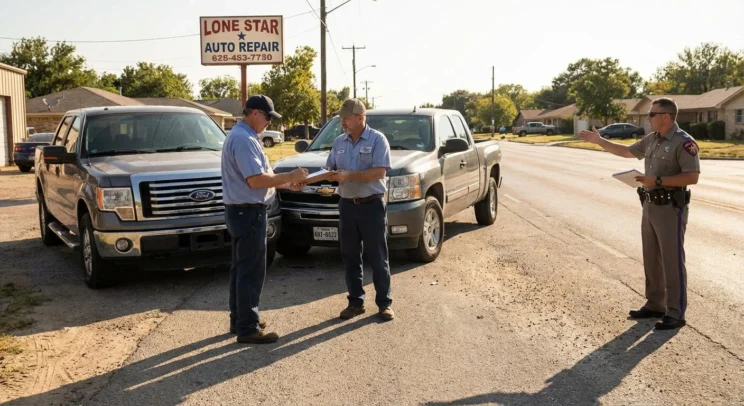
You were rear-ended on I-30 near the Stockyards last week. The other driver clearly didn’t see the traffic light had turned red, but the insurance adjuster is now suggesting you were partially at fault for “suddenly stopping.”
This isn’t unusual or uncommon; the adjuster is using that argument to justify reducing their settlement offer.
Here’s the good news: partial fault doesn’t automatically end your claim in Texas. The state uses a “modified comparative negligence” system, meaning your percentage of fault affects how much you can recover. In some cases, this percentage can impact whether you can recover at all. Understanding how this works gives you leverage when dealing with insurers.
The Four Elements of Negligence
For someone to be at fault for an incident in any way, they must have been negligent. Under Texas law, negligence requires four elements: duty, breach, causation, and damages.
In car accidents, duty means the other driver owed you a responsibility to operate their vehicle safely—every driver on Texas roads has this obligation. Breach occurs when someone violates that duty. Speeding through a red light, following too closely on Loop 820, or making an unsafe lane change on Chisolm Trail Parkway are all examples of breach.
Causation connects the breach to your injuries; the other driver’s actions must have actually caused the crash and your resulting harm. Finally, damages are the losses you suffered because of the crash: medical bills, lost wages, pain, and other impacts.
So long as all four of these elements are demonstrable, an insurance adjuster or jury can assign a percentage of fault accordingly.
Is Texas a Contributory or Comparative Negligence State?
Texas uses a fault system called “modified comparative negligence,” or “proportionate responsibility,” as it is officially referred to in Texas Civil Practice and Remedies Code Chapter 33. Essentially, what this means is that Texas law compares the percentage of negligence (or fault) that each party contributed to an incident to determine liability.
The core rule works like this: if you’re 50% or less at fault for an incident, you can still recover damages, but your recovery is simply reduced by your percentage of responsibility.
However, if you’re 51% or more at fault, you’re typically barred from recovering anything. This is why you’ll hear people refer to the “51% bar” or sometimes the “51% rule.” Both describe the same threshold from different angles.
The 51% Rule: When You Can Recover & When You Can’t
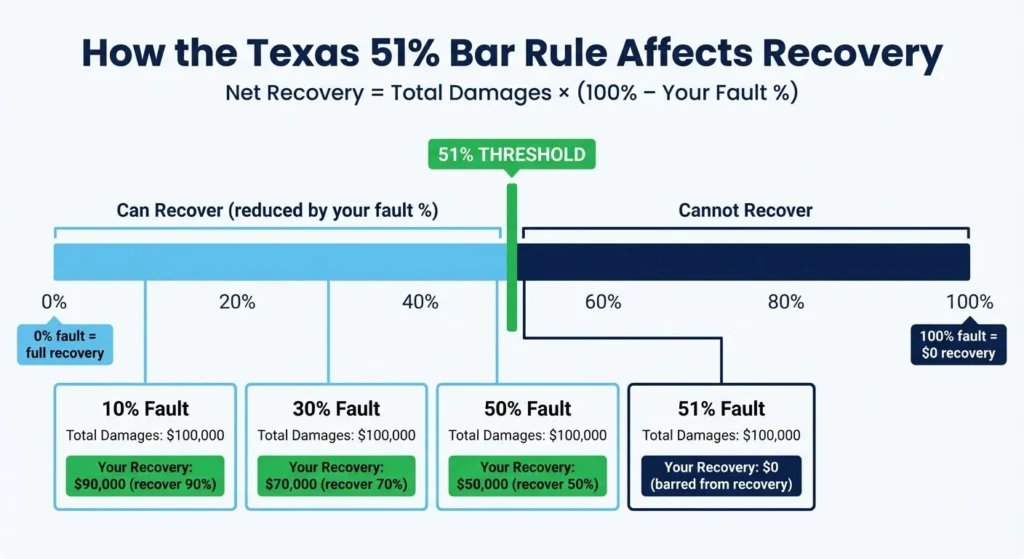
Texas juries must assign fault in whole-number percentages. The percentage assigned to you isn’t just a number on paper; it directly controls whether you receive compensation and how much.
The basic formula is: Net Recovery = Total Damages × (100% − Your Fault Percentage)
Here’s how different fault percentages affect a $100,000 claim:
- 10% fault: $100,000 × 90% = $90,000 recovery
- 30% fault: $100,000 × 70% = $70,000 recovery
- 50% fault: $100,000 × 50% = $50,000 recovery
- 51% fault: $0 recovery
A finding of 50% versus 51% can mean the difference between receiving a reduced settlement and receiving nothing. Insurance companies understand this. Their adjusters often try to push your perceived fault closer to that 51% line to reduce or eliminate what they owe.
For a deeper look at how partial fault affects claims, see our guide on being partially at fault for a car accident in Texas.
How Fault Is Determined After a Texas Crash
Multiple parties influence fault determinations, and they don’t always agree.
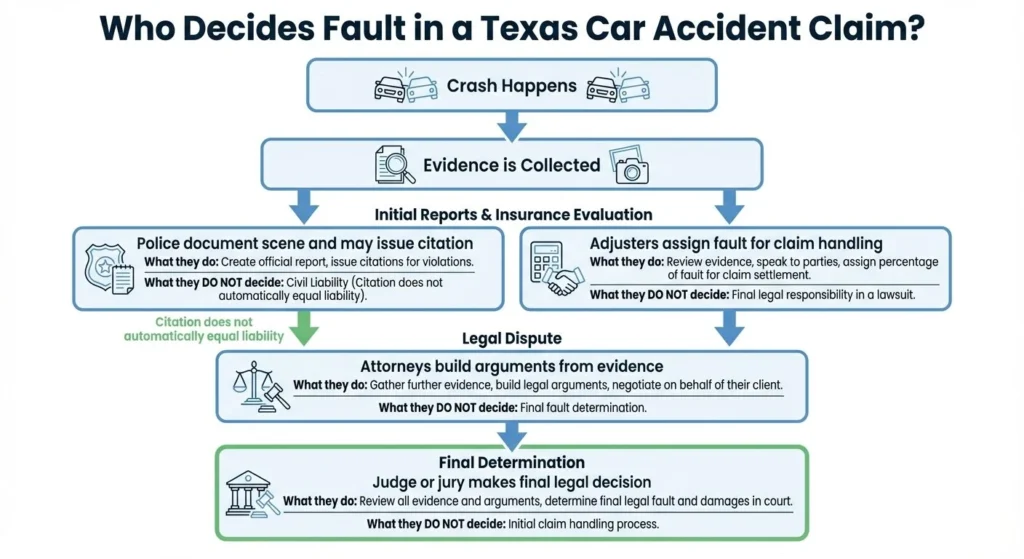
Police officers document the scene and may issue citations, but a crash report isn’t a legal finding of civil liability. Insurance adjusters make fault determinations for claims handling purposes, but their conclusions serve their company’s interests. Attorneys advocate for their clients’ positions using evidence. Judges and juries make the final legal determination if a case goes to trial.
A traffic citation can be evidence of negligence, but it doesn’t automatically equal civil liability. Fault disputes often evolve as more evidence surfaces: dashcam footage, electronic control module data from vehicles, or expert accident reconstruction analysis.
Strong evidence protects you from unfair fault attribution. Key types include:
- Scene evidence: Photos of vehicle positions, skid marks, debris, road conditions, and traffic signals
- Independent sources: Dashcam footage, nearby business surveillance, 911 recordings, eyewitness statements
- Official records: Crash reports, medical records documenting your injuries, phone records when relevant
- Technical analysis: Accident reconstruction reports, vehicle data downloads
Fault for the Crash vs. Fault for Your Injuries
Here’s where disputes often get complicated. An insurer might accept that their driver caused the collision but argue your injuries weren’t caused by it, or your injuries weren’t as severe as you claim.
They may point to pre-existing conditions, delayed treatment, or gaps in your medical care. These arguments attempt to reduce the damages portion of your claim, even when crash-causation seems clear. This is a common tactic, and it’s why thorough medical documentation from the start protects your case.
How Texas Allocates Fault Among Multiple Parties
Fault allocation isn’t always a simple “you versus the other driver” calculation. Texas law allows responsibility to be divided among multiple people and entities.
In a chain-reaction crash on I-35W, for example, the rear driver, middle driver, and lead driver might each share a percentage. In truck accidents, fault could potentially be allocated among the driver, the trucking company, a maintenance contractor, or others, depending on the circumstances.
Texas law also recognizes “responsible third parties.” This means someone not currently named as a defendant can still be assigned a percentage of fault. Additionally, if one party settles early, that settlement can affect how the remaining percentages are argued. These complexities are outlined in CPRC Chapter 33 and can significantly impact your recovery strategy.
How Angel Reyes & Associates Can Help
Navigating fault disputes requires experience, resources, and a clear understanding of Texas law. At Angel Reyes & Associates, we’ve spent over 30 years helping crash victims across Texas protect their rights and fight back against unfair fault attribution.
We offer free consultations and work on contingency, meaning there’s no fee unless we win. Our team has helped clients recover more than $1 billion in compensation for more than 70,000 clients across the state.
If you’re being blamed for a crash, pressured into a recorded statement, or offered a settlement that feels too low, reach out to us today to discuss your situation.
FAQs
Can an injured passenger still recover if both drivers share fault for a Texas crash?
Usually yes. Under Texas Civil Practice and Remedies Code § 33.003, fault can be apportioned among multiple people, so a passenger’s claim is typically reduced only if the passenger also bears some responsibility.
Does not wearing a seat belt automatically bar a car accident claim in Texas?
No. It does not automatically defeat the claim, but insurance companies or defendants can argue that not wearing a seatbelt contributed to injuries, and therefore you hold some responsibility. This could mean a reduced settlement.
What happens if I settle with one driver but still have claims against others after a multi-vehicle wreck?
A settlement with one party does not necessarily end the whole case. Under Texas Civil Practice and Remedies Code § 33.003, a settling person can still be assigned a percentage of responsibility, which can affect what remains recoverable from others.
Can a defendant blame someone who is not actually named in the lawsuit?
Yes. Texas Civil Practice and Remedies Code § 33.004 allows a defendant to seek designation of a responsible third party, which can shift part of the fault analysis to a nonparty.
Does Texas comparative negligence apply only to injury claims, or can it affect vehicle-damage claims too?
It can affect both. Chapter 33 applies to percentages of responsibility for causing personal injury, property damage, death, or other harm, so comparative-fault arguments can reduce recovery for vehicle damage as well as bodily injury losses.
About the Authors

Angel Reyes
Writer
Angel L. Reyes, III is the Founder and Managing Partner of Angel Reyes & Associates. A nationally recognized trial attorney and business leader, Angel has helped over 55,000 injury victims recover more than $1 billion since founding the firm in 1993. Named to the Texas Super Lawyers list annually since 2008, Angel brings Wall Street experience, Ivy League education, and a deep commitment to client advocacy. He is a frequent legal commentator and published author with extensive contributions to legal scholarship, trial strategy, and consumer protection.

Kyle Nicolas
Editor
Kyle Nicolas is the Web Content & SEO Manager at Angel Reyes & Associates. He has more than 10 years of experience as a marketing co...

Angel Reyes
Reviewer
Angel L. Reyes, III is the Founder and Managing Partner of Angel Reyes & Associates. A nationally recognized trial attorney and business...