How Texas’s 51% Fault Rule Works in Self-Driving Car Accidents


Every article on this site is researched by our internal team, reviewed for legal accuracy against current Texas law, and held to State Bar of Texas advertising standards before publication. We do not publish content that overstates outcomes or makes promises about results.
Learn more about our
editorial standards .
Key Takeaways
- In self-driving accidents, Texas reduces your compensation by your fault percentage and bars recovery entirely if you're more than 50% responsible.
- Self-driving crashes often involve multiple defendants, including human operators, fleet companies, manufacturers, and roadway actors. This can reduce your recovery.
- Early evidence preservation and challenging inflated fault percentages are critical to protecting your claim.
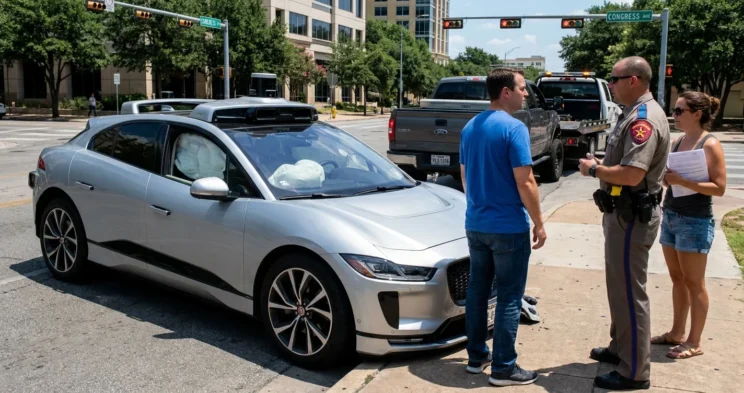
You were driving home on I-35E through Dallas when a vehicle with no one behind the wheel drifted into your lane. The collision happened fast. Now you’re dealing with injuries, vehicle damage, and a confusing question: who exactly is responsible when a self-driving car causes a crash?
In crashes involving autonomous vehicles, fault often gets divided among multiple parties. Understanding how this works can help you protect your claim.
What Proportionate Responsibility Means for Your Recovery
Texas follows a modified comparative fault system under Texas Civil Practice and Remedies Code Chapter 33. According to this code, your compensation gets reduced by your percentage of fault, and you lose the right to recover anything if you’re found more than 50% responsible.
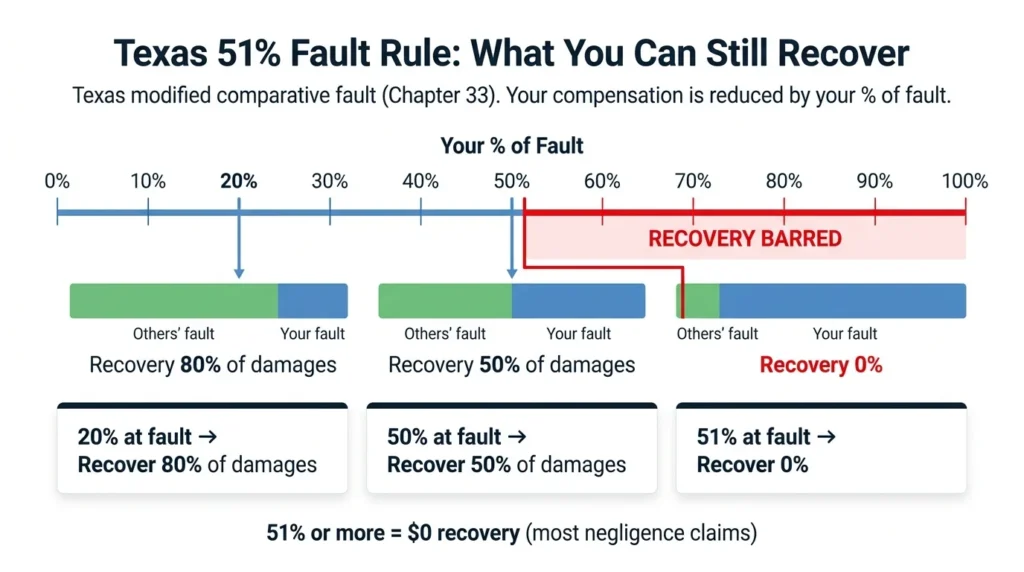
This is often called the “51% bar rule.” If a jury or insurance adjuster assigns you 51% or more of the blame, you walk away with nothing in most negligence claims.
Here’s how the math works in practice:
- You’re 20% at fault & damages total $100,000: You recover $80,000.
- You’re 50% at fault & damages total $100,000: You recover $50,000.
- You’re 51% at fault: You recover $0.
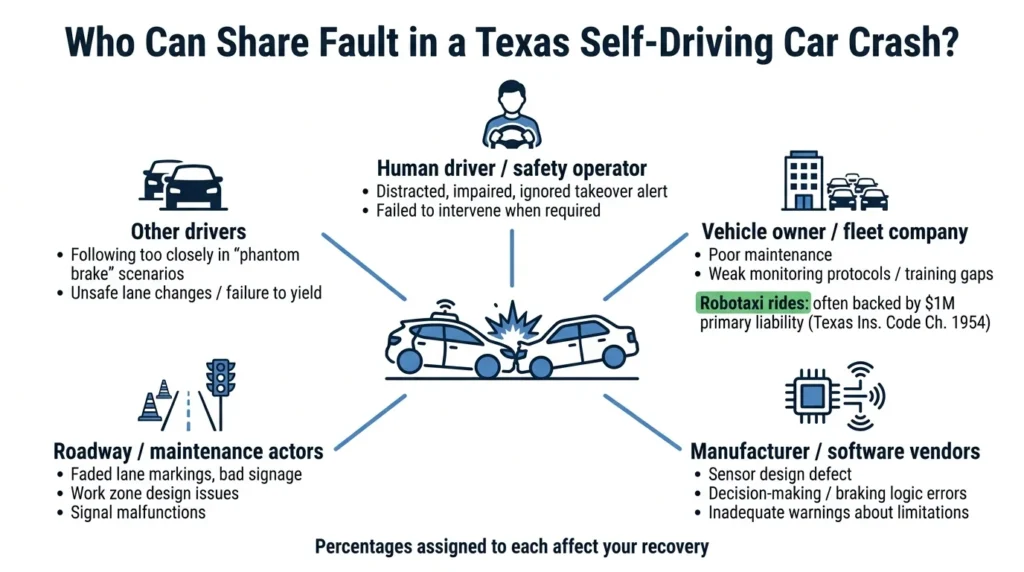
In self-driving car crashes, determining fault percentages can be difficult. Fault might be split among you, a human operator who should have intervened, the company that deployed the vehicle, the manufacturer that built the sensors, or even a city agency responsible for unclear lane markings. Each party’s share affects what you can collect from the others.
Who Texas Law Considers to Be the “Operator” of a Self-Driving Vehicle
Under Texas Transportation Code § 545.453, when the Automated Driving System (ADS) is engaged, the owner of the ADS is considered the operator for the purpose of assessing compliance with traffic laws, regardless of whether they are in the vehicle.
This matters for police reports and citations. It does not automatically answer who pays for your injuries.
A common misconception is that if the self-driving system is the “operator,” the company behind it must be solely liable. That oversimplifies how civil claims work. The U.S. Department of Energy’s overview of Texas Automated Vehicle (AV) law confirms the state has a framework for these vehicles, but civil liability still depends on proving negligence or a product defect.
Parties Who Might Share Fault in an Autonomous Vehicle Crash
Self-driving crashes in the Dallas-Fort Worth area often involve several potential defendants, even when the automated system was technically “operating” the vehicle.
Liability may be assigned to one or more of the following:
- Human driver or operator. Even in highly automated vehicles, a person is often expected to monitor the system and take over when needed. If that person was distracted, impaired, or failed to respond to a takeover alert, they may bear a share of responsibility.
- Vehicle owner or fleet company. Companies operating autonomous vehicles in cities like Frisco or Arlington have duties related to maintenance, driver training, and monitoring protocols. Failures in these areas can contribute to crashes.
Furthermore, because many of these vehicles operate as robotaxis, they fall under Texas Insurance Code Chapter 1954. This requires Transportation Network Companies (TNCs) to maintain at least $1 million in primary liability coverage while a ride is active, ensuring there is a significant recovery source if their technology fails.
- Manufacturer and software vendors. Design defects in sensors, software errors in decision-making algorithms, or inadequate warnings about system limitations can form the basis of product liability claims. These claims focus on whether the vehicle was unreasonably dangerous rather than whether someone drove carelessly.
- Roadway and maintenance actors. Faded lane markings, malfunctioning signals, or poorly designed work zones can confuse automated systems. Government entities or contractors responsible for road conditions may share fault.
- Other drivers. A chain-reaction crash might involve an autonomous vehicle that performs an unexpected “phantom brake” maneuver, causing a human driver behind it to rear-end the vehicle. In this case, fault would be split between the human’s following distance and the software’s braking logic.
Negligence vs. Product Liability Claims
Two main legal pathways apply to self-driving crashes, and they can run side by side in the same case.
Negligence Claims
These claims focus on unreasonable conduct, focusing on what a reasonable person or company would have done. Did the human operator fail to pay attention? Did the fleet company skip required maintenance? Did another driver run a red light in Lower Greenville?
Product Liability Claims
These claims focus on defects, targeting the vehicle or its components rather than driving behavior. Was the sensor system designed in a way that made it unreasonably dangerous? Did the manufacturer fail to warn users about known limitations?
Documenting exactly what the vehicle did, what warnings it gave, and what the manual said about its limitations becomes critical evidence.
How Fault Percentages Are Decided
Fault is determined in stages, and early decisions can shape your entire case. It is important that you do what you can to strengthen your claim and protect your rights.
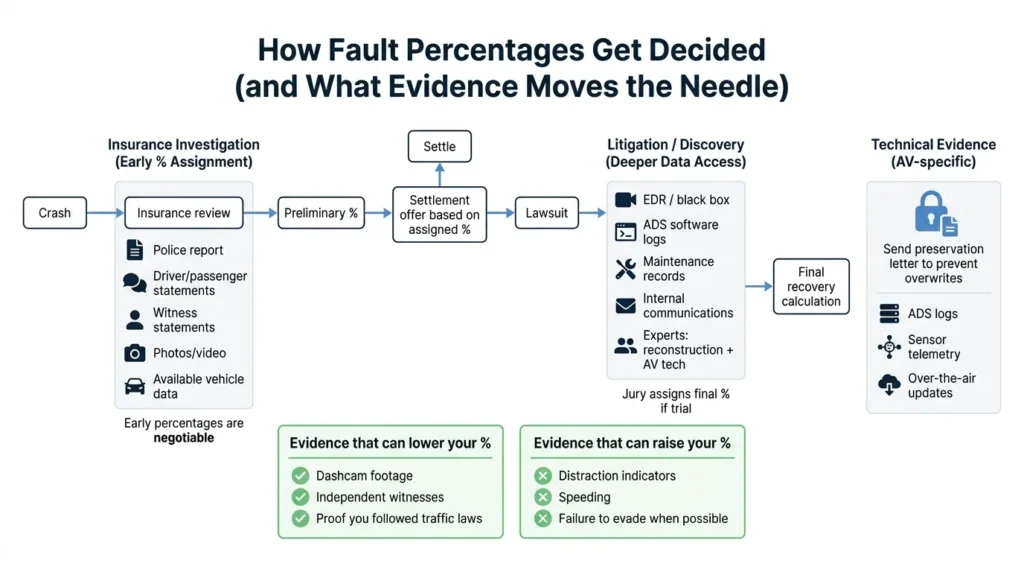
This is how insurance companies determine fault:
- During insurance negotiations, adjusters will review the police report, your statements, witness statements, photos, and any available vehicle data. They assign preliminary fault percentages and make offers based on those numbers. These early percentages are negotiable. Accepting a quick settlement based on an inflated fault assessment can cost you significantly.
- If litigation becomes necessary, formal discovery allows access to Event Data Recorders (EDR), software logs, maintenance records, and internal company communications. Expert witnesses in accident reconstruction and autonomous vehicle technology may testify about what the system should have done. A jury ultimately decides the percentages if the case goes to trial.
To ensure the insurance company has ample evidence, preserve as much information and documentation as possible.
Evidence that can lower your assigned percentage includes dashcam footage, witness statements supporting your account, and documentation showing you followed traffic laws. Evidence that can raise your percentage includes signs of distraction, speeding, or failure to take evasive action when possible.
The Role of Technical Evidence
For autonomous vehicle crashes specifically, data showing whether the automated system was engaged, what alerts it issued, and how quickly any human responded to takeover requests can shift percentages dramatically.
Unlike standard crashes, autonomous vehicle claims rely heavily on digital black box data.
To protect your claim, you want to focus on collecting the following types of technical evidence:
- ADS logs
- Sensor telemetry
- Over-the-air updates
An attorney can send preservation letters to prevent vehicle data from being erased or overwritten.
When You Need an Attorney
Self-driving crash claims often require resources that individual claimants cannot access on their own.
At Angel Reyes & Associates, we have spent over 30 years helping Texas crash victims, including pedestrians and cyclists, navigate complex claims. We offer free consultations and work on a contingency basis, meaning you pay no fee unless we win. Our team has helped clients recover more than $1 billion in compensation. We have 20 offices across Texas and can handle most of your case remotely. If a self-driving vehicle crash in Texas left you injured and uncertain about your options, contact us to discuss your situation.
Self-Driving Comparative Fault FAQs
Can a passenger in a robotaxi or other self-driving vehicle be blamed for the crash?
Not usually, but fault questions can still come up if a passenger interfered with the vehicle, ignored safety instructions, or created a distraction that contributed to the wreck.
Does a police report decide who is legally at fault in a Texas self-driving car accident?
No. A police report can influence insurance negotiations, but it does not control the final civil fault percentages if the evidence later points in a different direction.
What if the self-driving vehicle company says a software update or recall happened after the crash?
A later update or recall does not automatically prove legal liability, but it may become important evidence. The timing, the reason for the fix, and whether it relates to your crash all matter.
Can poor weather affect fault in an autonomous vehicle crash in Texas?
Yes. Rain, fog, glare, or low visibility can matter if a human driver, fleet operator, or vehicle system should have responded differently to those conditions.
Is there a deadline to file a Texas lawsuit after a self-driving car accident?
In many Texas injury cases, the general deadline is two years, but claims involving a government vehicle or road condition can involve much shorter notice rules. Because deadlines can vary by the parties involved, it is risky to assume the standard rule always applies.
About the Authors

Spencer Browne
Writer
Spencer Browne is a partner at Angel Reyes & Associates and a Board Certified personal injury trial lawyer with nearly 100 jury trials across Texas. He focuses on car, truck, and wrongful death cases, with notable verdicts including a landmark win in the Choctaw Casino bus crash case. A recognized speaker and legal educator, Spencer is a member of the American Board of Trial Advocates and has been honored as a Texas Super Lawyer and one of D Magazine’s Best Lawyers in Dallas. He brings deep trial experience and relentless advocacy to every client he represents.

Kyle Nicolas
Editor
Kyle Nicolas is the Web Content & SEO Manager at Angel Reyes & Associates. He has more than 10 years of experience as a marketing co...

Angel Reyes
Reviewer
Angel L. Reyes, III is the Founder and Managing Partner of Angel Reyes & Associates. A nationally recognized trial attorney and business...