How Texas E-Scooter Laws Impact Liability


Every article on this site is researched by our internal team, reviewed for legal accuracy against current Texas law, and held to State Bar of Texas advertising standards before publication. We do not publish content that overstates outcomes or makes promises about results.
Learn more about our
editorial standards .
Key Takeaways
- Texas e-scooter riders have two years under CPRC § 16.003 to file an injury lawsuit.
- A rider found more than 50% at fault under Chapter 33 recovers nothing in Texas.
- Most personal auto and renter's policies exclude e-scooters, creating a major coverage gap.
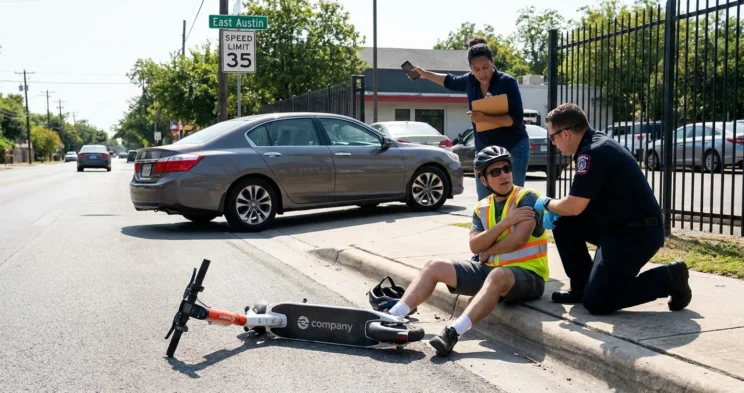
You were riding a rental scooter home from a shift near East Austin when a driver turned right out of a parking lot without looking and clipped your front wheel. You hit the pavement hard, and now you’re facing emergency room bills, missed shifts, and a claims adjuster asking whether you were on the sidewalk.
Every answer you give seems to shift the blame. So, who actually pays when an e-scooter crash happens in Texas?
Texas E-Scooter Laws: What Riders Must Know
Texas regulates motor-assisted scooters under Transportation Code Chapter 551, Subchapter E. These laws set a baseline for where you can ride, how fast, and what equipment is required.
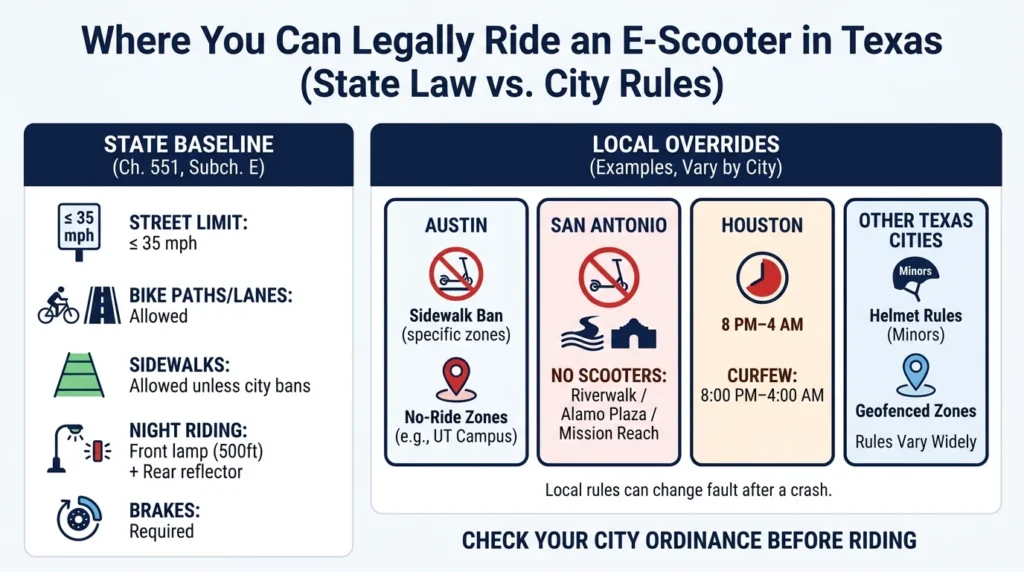
Cities then layer their own rules on top, which is why the same scooter ride can be legal in one neighborhood and illegal in another. This is important because each rule can change who is at fault for an accident.
Under Texas Transportation Code § 551.352, motor-assisted scooters may be operated on streets with posted speed limits of 35 mph or less, on paths set aside for the exclusive use of bicycles, and on sidewalks, though cities may ban sidewalk riding if they determine it is necessary for safety.
A working brake is required at all times. For nighttime riding, state law also requires a front lamp emitting white light visible from at least 500 feet and a rear red reflector or lamp visible from the rear. If those are missing and a crash happens after dark, the missing equipment becomes part of the fault picture.
Ordinances vary widely in different cities. For example, San Antonio bans scooters on the Riverwalk, in Alamo Plaza, and Mission Reach. Houston imposes a curfew on electric scooters between 8:00 PM and 4:00 AM.
Some cities ban sidewalk riding outright. Others require helmets for minors or limit scooters to designated zones. Before riding in a new city, check the local ordinance.
How E-Scooter Law Violations Affect Fault
When a rider or driver breaks a Texas statute or city ordinance, that violation can become direct evidence of negligence. This is called negligence per se. The injured party does not have to prove the violator acted unreasonably. The broken rule does that work for them. In e-scooter cases, this doctrine cuts both ways.
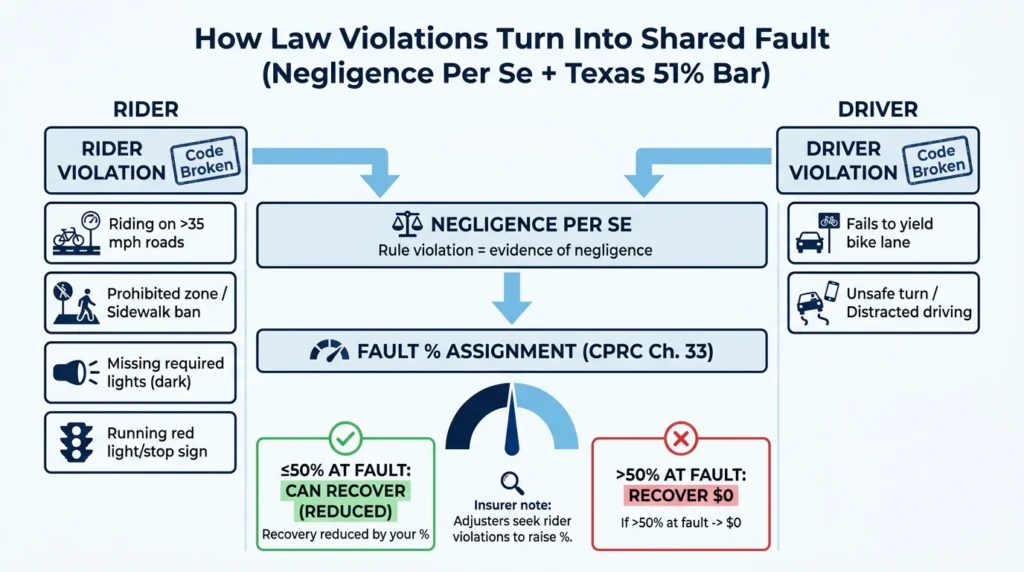
A driver who fails to yield to a scooter in a marked bike lane has likely committed negligence per se. So has a rider who took a scooter onto a 45 mph arterial road where state law forbids it. Each violation gets weighed against the other when fault is assigned.
Texas uses a fault-sharing system under Texas Civil Practice and Remedies Code (CPRC) Chapter 33. Each party is assigned a percentage of fault. If you are found more than 50% responsible for your own injuries, you recover nothing. The details are explained further in our breakdown of the Texas 51% rule for comparative negligence.
That math is the whole game. A rider who was speeding through a prohibited zone may still recover if a distracted driver was mostly at fault. A rider doing everything right may still see their recovery reduced if a small ordinance violation is in the mix. Insurers know this and will look for any rule the rider broke.
How investigators piece this together is covered in our guide on how fault is determined in Texas accident cases. An attorney who handles unprotected-rider cases can review which violations actually matter and how they shift the percentages, similar to the analysis used in motorcycle accident claims.
Insurance Coverage for E-Scooter Injuries in Texas
This is where many injured riders get blindsided. Most personal auto policies exclude e-scooters because Texas does not classify them as motor vehicles. However, policy terms vary, so riders should review their own coverage carefully.
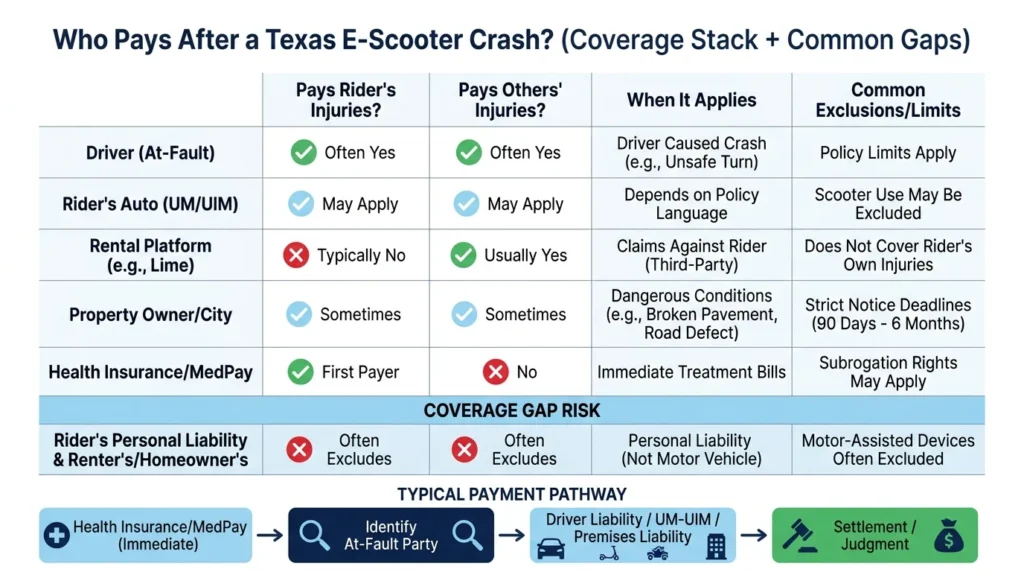
Standard renter’s and homeowner’s policies often exclude motor-assisted devices, too. The result is a coverage gap that surprises riders after a crash.
Rental platforms like Lime carry liability insurance, but those policies are narrow. They generally cover claims brought against the rider by a third party. They typically do not pay for the rider’s own injuries.
If a motor vehicle driver caused the crash, that driver’s auto liability policy is usually the primary source of recovery. If you carry uninsured or underinsured motorist coverage on your own auto policy, that coverage may also apply, even though you were on a scooter at the time.
When the crash involved a dangerous property condition, such as broken pavement on private property or a hazardous walkway, Texas premises liability claims may apply against the property owner. Riders hit while crossing intersections sometimes share legal terrain with Texas pedestrian accident victims, since both are unprotected road users facing motor vehicles.
Until liability is sorted out, your own health insurance and any medical payments coverage are usually the practical first stops for treatment bills.
Filing an E-Scooter Injury Claim in Texas
Identifying every responsible party is the most important early decision in an e-scooter case. The other rider or driver is the obvious starting point. But the rental company may share fault for negligent maintenance. The manufacturer may be on the hook for a defective brake or throttle. A property owner or city may be responsible for a road defect.
You have two years from the date of the crash to file a personal injury lawsuit under Texas Civil Practice and Remedies Code § 16.003. Miss that deadline and the case is over before it starts. Claims against a city or other government entity carry strict notice deadlines under the Texas Tort Claims Act — the standard window is six months, but many cities shorten it to 90 days or less, so acting quickly is critical.
Evidence in these cases moves fast. The strongest items include:
- App telemetry data from the rental platform showing speed, route, and timestamp
- Traffic camera or business surveillance footage from the scene
- The police report and photographs taken immediately after the crash
- Witness names and contact information
Telemetry data is uniquely powerful in scooter cases. It can prove you were in a permitted zone at a lawful speed, which directly counters insurer arguments about rider fault. Reviewing prior Texas injury case results can give a sense of how this evidence translates into recovery. Past results do not guarantee future outcomes.
Your role in the crash also matters under Texas fault rules, as explained in our guide on partial fault in Texas car accidents. An attorney can map out every potential defendant and preserve evidence before the rental platform overwrites telemetry data.
Talk to an E-Scooter Injury Attorney in Texas
E-scooter cases combine unfamiliar laws, narrow insurance coverage, and aggressive fault arguments from insurers. You do not have to figure it out alone. Angel Reyes & Associates has over 30 years of experience handling Texas injury claims and has recovered more than $1 billion recovered for clients.
We offer free consultations and work on contingency, meaning no fee unless we win. You can learn more about our Texas injury attorneys and the team that would handle your case. When you’re ready, contact us today to talk through what happened and what your claim may be worth.
Past results do not guarantee future outcomes.
E-Scooter Injury FAQs
Can a scooter rental company be sued for an accident caused by a mechanical defect?
Yes. If a defective brake, throttle, or other component caused or contributed to the crash, the rental company or manufacturer may be liable under a product liability or negligent maintenance theory. These claims run parallel to any claim against the driver and do not require proving the other party was at fault.
Does Texas require e-scooter riders to follow the same traffic signals and road rules as bicyclists?
Yes. Under Texas Transportation Code § 551.352, motor-assisted scooter riders operating on a road or path are subject to the same traffic laws that apply to bicycle operators. Ignoring a red light or stop sign can factor into fault assignment the same way it would for any other road user.
What happens to a minor's e-scooter injury claim if they were riding without a required helmet?
If a city ordinance required a helmet for the minor’s age group and they were not wearing one, that violation may be used to increase the minor’s assigned fault percentage under Texas proportionate responsibility rules. A parent or guardian typically brings the claim on the minor’s behalf, but the fault analysis still applies.
Can the city be held responsible if a pothole or broken curb caused an e-scooter crash?
A city may be liable under the Texas Tort Claims Act if a road defect caused the crash and the city had notice of the condition. Government entity claims require a formal notice filing within a strict window, often as short as 90 days from the crash date depending on the city.
About the Authors

Angel Reyes
Writer
Angel L. Reyes, III is the Founder and Managing Partner of Angel Reyes & Associates. A nationally recognized trial attorney and business leader, Angel has helped over 70,000 injury victims recover more than $1 billion since founding the firm in 1993. Named to the Texas Super Lawyers list annually since 2008, Angel brings Wall Street experience, Ivy League education, and a deep commitment to client advocacy. He is a frequent legal commentator and published author with extensive contributions to legal scholarship, trial strategy, and consumer protection.

Kyle Nicolas
Editor
Kyle Nicolas is the Web Content & SEO Manager at Angel Reyes & Associates. He has more than 10 years of experience as a marketing co...

Angel Reyes
Reviewer
Angel L. Reyes, III is the Founder and Managing Partner of Angel Reyes & Associates. A nationally recognized trial attorney and business...