Why Insurers Dispute Vehicle Damage Severity


Every article on this site is researched by our internal team, reviewed for legal accuracy against current Texas law, and held to State Bar of Texas advertising standards before publication. We do not publish content that overstates outcomes or makes promises about results.
Learn more about our
editorial standards .
Key Takeaways
- Low vehicle damage does not legally preclude a serious injury claim under Texas crash law.
- Biomechanical experts can opine on crash forces but often cannot rule out medical causation.
- Texas gives crash victims two years under CPRC § 16.003 to file a personal injury lawsuit.
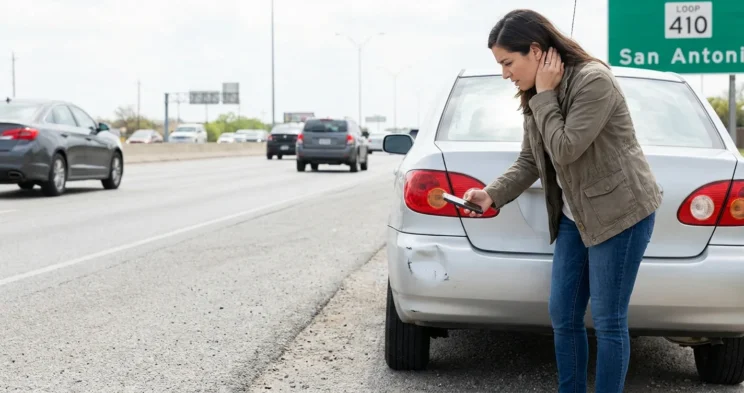
You were stopped at a light off Loop 410 in San Antonio when a driver tapped your rear bumper. The dent looked minor, but two days later your neck and lower back were screaming. Now the adjuster keeps pointing to the photos and saying the crash was “too small” to cause real injuries. That argument is not random, and it is not always honest.
The Link Between Property Damage & Injury Claims
Insurers use visible vehicle damage as a shortcut for crash severity. When repair estimates or photos look minor, adjusters treat the injury claim with more suspicion. The property damage and injury portions of your claim are legally separate in Texas, but adjusters often let a low repair figure anchor the entire evaluation of what you are owed.
Adjusters work from internal damage thresholds. When a repair estimate falls below that number, the file moves into higher scrutiny. Your medical records, your symptoms, and your treatment timeline all get weighed against a photo of a bumper.
Modern vehicles are engineered to absorb low-speed impact with minimal visible deformation. The car can look almost untouched while the occupant absorbs significant force. That engineering reality works against you when an insurer reads photos literally. Learning how adjusters build their files in our breakdown of the Texas insurance claim investigation process is recommended.
Why Low Damage Does Not Mean Low Injury
Low vehicle damage does not mean low injury. Soft-tissue damage, disc injuries, and cervical sprains regularly result from crashes that leave little visible deformation. The human body does not absorb energy the way a steel bumper does, and symptoms often appear days after the crash.
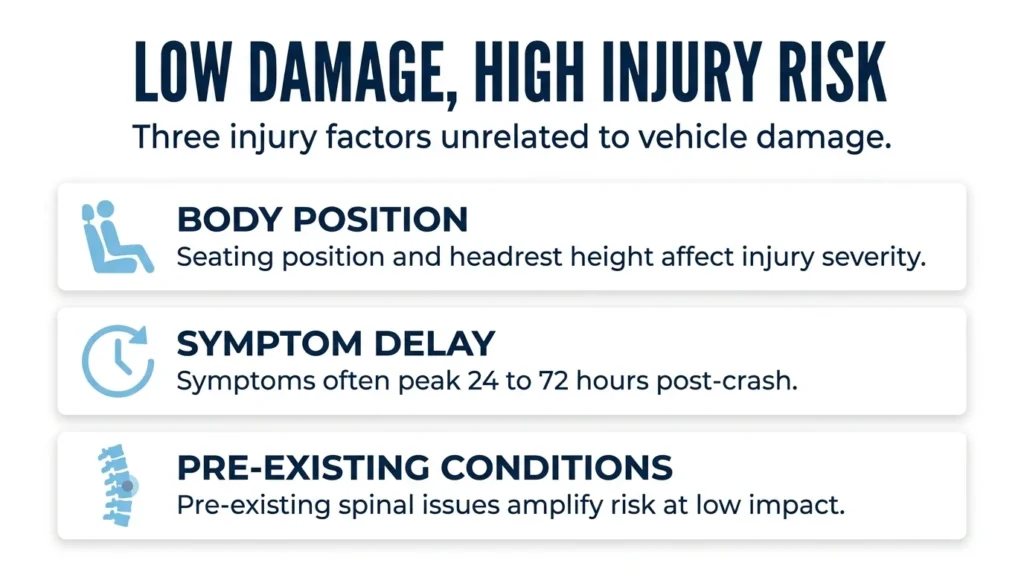
Adjusters know this and still lean on photos to suggest otherwise.
Inflammation and nerve irritation often peak 24 to 72 hours after impact. Early statements and photo submissions capture you before the full injury picture emerges. By the time you feel the worst of it, the adjuster already has a recorded narrative pointing the other direction.
Several factors that raise injury risk have nothing to do with vehicle damage. Seating position, whether you were braced or relaxed, headrest height, and pre-existing spinal conditions all play roles. Clean X-rays do not equal no injury, because soft-tissue damage does not show up on standard radiographs. Some adjusters treat the absence of a fracture as proof nothing happened.
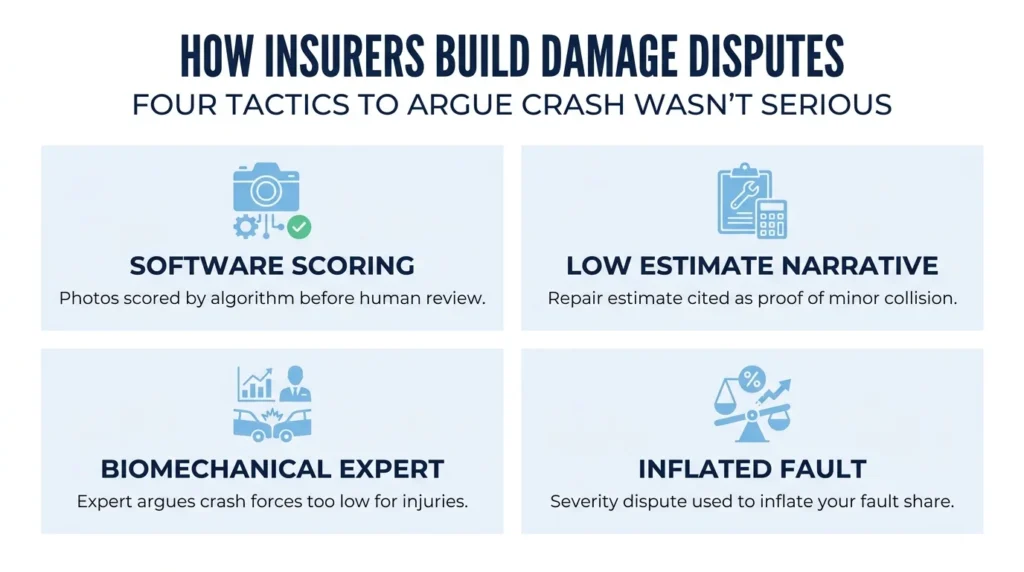
Additionally, when an insurer pushes the damage-severity argument, the next step is often inflating your share of fault. Under Texas Civil Practice and Remedies Code (CPRC) § 33.001, if you are found more than 50% responsible for the crash, you recover nothing. Understanding how Texas treats minor car accident claims can help you protect your position before the adjuster locks one in.
How Insurers Build the Damage-Severity Dispute
Adjusters construct damage severity disputes from two main sources: photographs and repair estimates. They use scene photos, app submissions, and dollar figures to argue the crash lacked the energy needed to cause serious injuries. The dispute often takes shape inside automated software before a human ever looks at your file.
A low repair estimate signals low crash energy. The adjuster may quote that number in claim notes and denial letters as indirect proof the collision was minor. The number becomes the story.
What a Biomechanical Expert Does
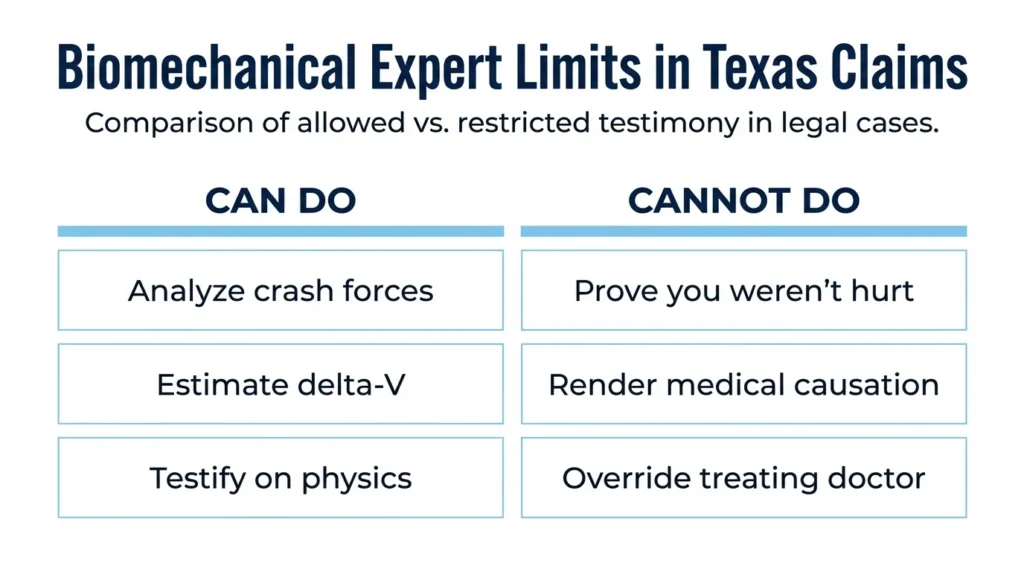
Insurers sometimes retain a biomechanical expert to argue the forces in your crash were too low to cause your injuries. The expert analyzes crash data, vehicle weights, and estimated delta-V to reach a threshold opinion. That testimony is permitted in Texas under Rule of Evidence 702, but it has real limits.
Some Texas courts restrict biomechanical experts to opinions about crash forces involved, not full medical causation. An expert can say the forces were low. That is not the same as a medical opinion that you were not hurt.
Lab-based biomechanical tests also miss real-world variables. Muscle tension, exact seating placement, and occupant awareness at impact rarely match the test conditions. When a biomechanical expert is deployed without genuine scientific basis, the tactic can cross into unfair settlement practices barred by Texas Insurance Code Chapter 541.
How Damage Photos Are Used Against Claimants
Scene photos rarely tell the full story. Bent vehicle subframe components, damaged energy-absorbing foam, and structural damage hidden behind plastic bumper covers only appear during disassembly. The adjuster knows the photo is incomplete and uses it anyway.
Many insurers run damage photos through proprietary claim software that scores them algorithmically before a human reviews the file. Photos you submit through the insurer’s app may also carry metadata showing angles and timing the adjuster can use against you. Slow-walked claims often follow a similar pattern, which we cover in why Texas insurers delay payments.
Texas Protections When an Insurer Disputes Your Claim
Texas law gives you real protections when an insurer uses a damage-severity dispute to stall or shrink your claim. The Insurance Code sets payment deadlines, prohibits unfair settlement practices, and lets you file complaints with state regulators. You also have a hard filing deadline that keeps moving regardless of how long the adjuster wants to argue.
Texas Insurance Code Chapter 542 sets mandatory timelines for claim acknowledgment, investigation, and payment. When an insurer misses those deadlines, you may be entitled to statutory interest and attorney fees on top of the claim value. Chapter 541 covers misrepresentation and bad-faith conduct, and the two work together.
The personal injury filing deadline is two years from the date of the crash under CPRC § 16.003. That clock runs no matter how long your administrative dispute drags on. Waiting for the adjuster to come around is not a strategy.
You can also file a complaint with the Texas Department of Insurance auto claim complaint process. A TDI complaint creates a paper record and sometimes speeds up insurer responses. It is not a substitute for legal action when a claim is being systematically undervalued, and how fault is determined in Texas often shapes whether a TDI complaint or a lawsuit is the better next move.
Talk to an Attorney Today
When an insurer is using bumper photos to shrink a real injury claim, you need someone who has fought that exact argument before. Angel Reyes & Associates has more than 30 years of experience handling car accident claims in Texas, with more than $1 billion recovered for clients.
We work on contingency, meaning no fee unless we win, and consultations are free. Meet our attorneys, then contact us today to discuss what the adjuster is really doing with your file.
Past results do not guarantee future outcomes.
Insurance Vehicle Damage Dispute FAQs
Can an insurer's damage-severity dispute affect how much of the crash is blamed on me?
It can, but disputing damage severity alone does not change who caused the crash. Fault in Texas is based on driving conduct, not on how much a bumper bent.
Does filing a TDI complaint affect my ability to sue the insurer later?
Filing a complaint with the Texas Department of Insurance does not waive your right to sue, and it does not pause your two-year filing deadline. The two tracks can run at the same time.
What documentation helps prove a serious injury when vehicle damage looks minor?
Medical records showing symptom onset within days of the crash, imaging that reveals soft-tissue or disc changes, and a supplemental repair estimate documenting hidden structural damage all strengthen the injury claim. Photos from the scene taken before cleanup or towing can also show angles the adjuster’s app submission missed.
Can the other driver's insurer access photos I submitted through my own insurer's app?
In litigation, both sides can request claim files and digital records through discovery, which may include metadata from app-submitted photos. Anything you submit to any insurer early in the process can potentially surface in a dispute over your injury.
Does Texas require an insurer to hire a biomechanical expert before denying an injury claim?
No Texas statute requires an insurer to retain a biomechanical expert before disputing or denying an injury claim. Retaining one is a strategic choice the insurer makes, and it does not automatically make the denial legally sound.
About the Authors

Angel Reyes
Writer
Angel L. Reyes, III is the Founder and Managing Partner of Angel Reyes & Associates. A nationally recognized trial attorney and business leader, Angel has helped over 70,000 injury victims recover more than $1 billion since founding the firm in 1993. Named to the Texas Super Lawyers list annually since 2008, Angel brings Wall Street experience, Ivy League education, and a deep commitment to client advocacy. He is a frequent legal commentator and published author with extensive contributions to legal scholarship, trial strategy, and consumer protection.

Kyle Nicolas
Editor
Kyle Nicolas is the Web Content & SEO Manager at Angel Reyes & Associates. He has more than 10 years of experience as a marketing co...

Angel Reyes
Reviewer
Angel L. Reyes, III is the Founder and Managing Partner of Angel Reyes & Associates. A nationally recognized trial attorney and business...