How Commercial Insurers Calculate Settlement Offers in Texas


Every article on this site is researched by our internal team, reviewed for legal accuracy against current Texas law, and held to State Bar of Texas advertising standards before publication. We do not publish content that overstates outcomes or makes promises about results.
Learn more about our
editorial standards .
Key Takeaways
- Commercial insurers build offers by totaling specials, estimating non-economic damages, then applying reductions for fault, coverage limits, future-damage uncertainty, and liens.
- Under Texas proportionate responsibility rules, being more than 50% at fault bars recovery, and any assigned fault percentage directly reduces your settlement.
- Texas has a 2-year statute of limitations for personal injury claims, and waiting too long eliminates leverage and can end your case entirely.

You were rear-ended by a delivery truck on I-635 near Garland last month. The adjuster has called twice, and neither conversation felt constructive. Now there’s an offer on the table that feels disconnected from your medical bills, missed work, and the pain you wake up with every morning.
That offer didn’t come from a coin flip. Commercial insurers follow a fairly predictable formula to build settlement numbers, then apply reductions that can shrink their starting figure fast. Once you understand how that math works, you can spot whether an offer is reasonable or premature.
The Settlement Math Behind a Commercial Insurance Offer
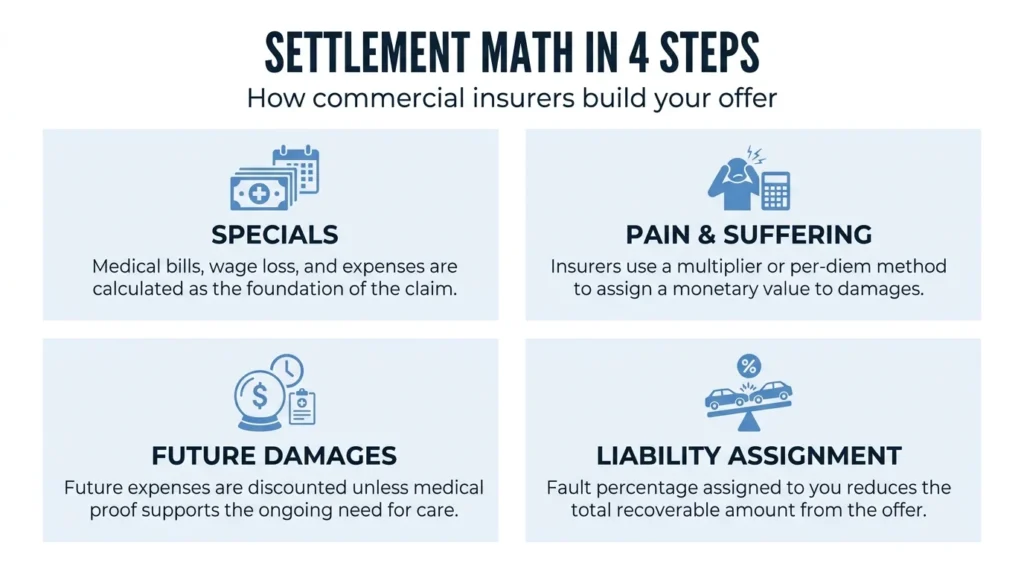
Most commercial insurers start with a valuation range, not a single “true value.” They calculate your “specials,” estimate non-economic damages, then apply reductions for fault, policy limits, future-damage uncertainty, and liens.
Commercial claims differ from personal auto claims. There are more documentation demands, layered authority levels, higher reserves, and a more aggressive defense posture. A claim involving a commercial truck often involves multiple adjusters and supervisors before a number is approved.
First offers are typically anchored low compared to the insurer’s internal range. Insurers will typically push for a quick settlement in these cases because there is usually considerable room for the final value to grow as more evidence is uncovered. Movement depends on the strength of your proof and how prepared you appear.
Step 1: Building the Base With Specials
“Specials” are measurable, documented economic losses. They form the foundation of the valuation because they’re the easiest items to verify.
Specials typically include:
- Medical charges (ER, hospital, specialists, imaging)
- Pharmacy and medical equipment
- Physical therapy and rehabilitation
- Mileage to and from appointments
- Wage loss and missed work
- Other out-of-pocket costs
Adjusters often distinguish between billed charges, paid amounts, and write-offs. They argue about what’s “reasonable and necessary,” especially when bills look inflated relative to the treatment.
What moves the number? Clean records, diagnostic findings, a clear treatment plan, disability notes, wage verification, and employer letters. A well-organized demand package makes it easier for a supervisor to approve a higher number.
Wage Loss: What Commercial Insurers Want to See
Commercial carriers treat wage loss as “prove it line-by-line.” That’s especially true for variable income or self-employment.
W-2 employees should collect and provide all of the following:
- Pay stubs
- HR verification documentation
- Missed-time logs
- Return-to-work restriction documentation
Self-employed or 1099 workers need bank statements, invoices, tax returns, and proof of canceled bookings. Lost earning capacity claims (longer-term reductions in what you can earn) require stronger medical support than short-term wage loss.
Step 2: Pain and Suffering Calculations
Because there is no way to document non-economic damages like pain and suffering, these damages are typically negotiated. Insurers use structured heuristics to justify a range.
The two common starting frameworks are:
- Multiplier method: specials are multiplied by a factor (often between 1.5 and 5) based on severity
- Per-diem method: a daily dollar value is assigned for the recovery period
Factors that push the multiplier higher include duration of treatment, objective findings on imaging, invasiveness of care, missed work, daily limitations, and scarring. Credibility drivers matter just as much. Consistent treatment helps you. Gaps in care, prior injuries, recorded statements, and social media posts can all be used to discount your number.
Many commercial carriers run claims through evaluation software with structured fields for injury codes, treatment duration, and diagnostics. The cleaner your file, the better the output. For more on offer dynamics, see our guide on accepting an insurance settlement offer.
Step 3: Future Damages & Uncertainty Discounts
Commercial insurers discount future damages unless the need is clearly supported. They often label projected costs “speculative” without strong medical proof.
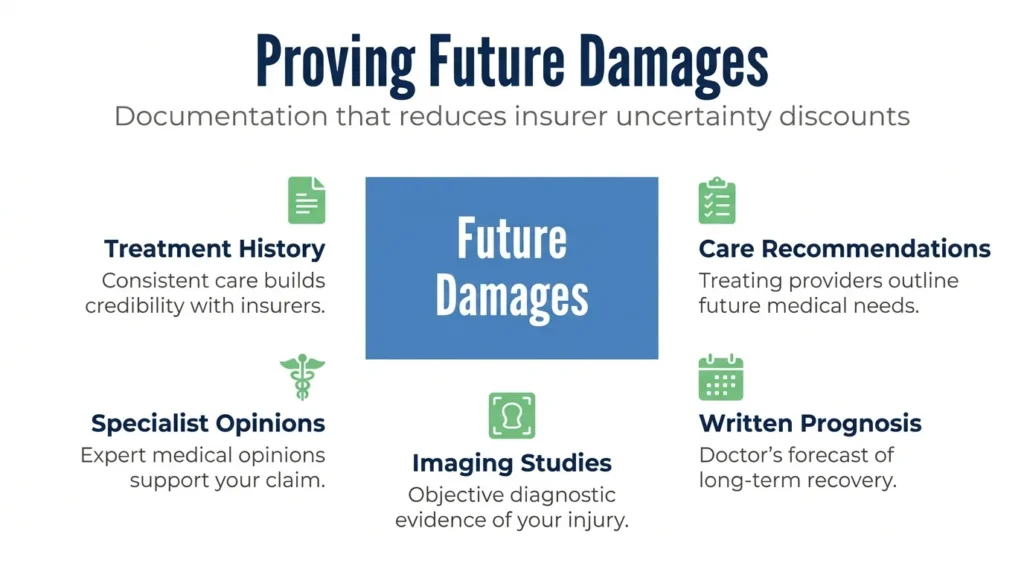
Documentation that reduces uncertainty includes consistent treatment history, specialist opinions, imaging studies, written prognosis, and future-care recommendations from treating providers. Independent medical exams and surveillance are tools insurers use to challenge future-damage claims. Keeping records consistent and accurate is the best response.
Step 4: Liability Assignment
After a potential value is estimated, commercial insurers discount the range based on liability risk. Any argument that you share fault becomes a reduction.
Common liability arguments from commercial insurers include speed, improper lane changes, following distance, and delayed treatment. Evidence that counters these arguments includes photos, EDR or telematics data, witness statements, and a careful reading of the police report.
Under Texas Civil Practice and Remedies Code § 33.001, your percentage of responsibility reduces what you can recover. If you are found more than 50% at fault, you are barred from recovering damages. This is often called “The 51% Bar Rule.“
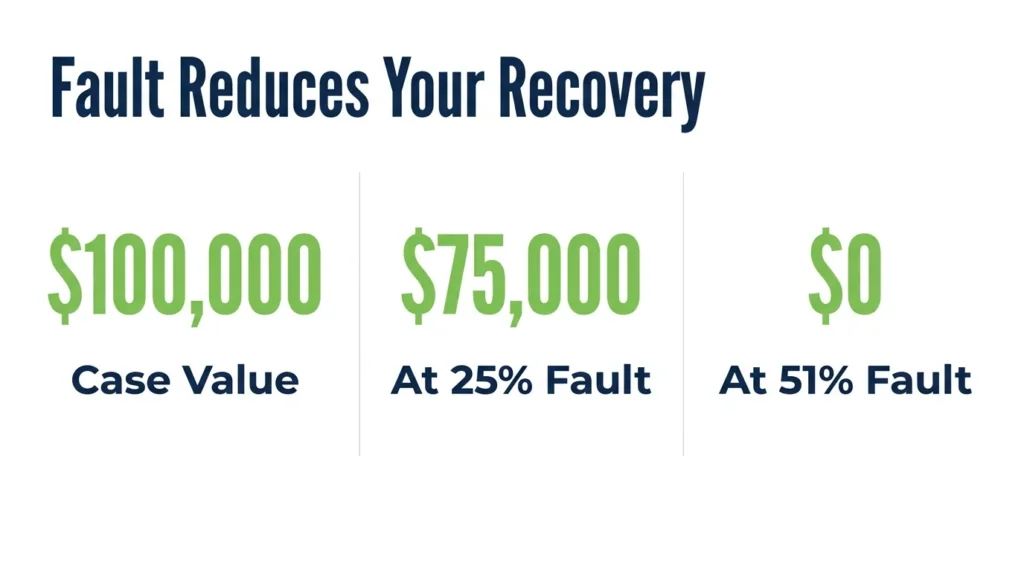
Here’s the math in practice: if your case is valued at $100,000 and the insurer assigns you 25% fault, your recoverable damages drop to $75,000. If they argue you are 51 percent at fault, you recover nothing.
An Adjuster’s Assessment Is Not the Last Word
Remember: the other insurer is not motivated to provide an honest, unbiased assessment. Their job is to reduce their employer’s liability as much as possible. They will try to argue claims are worth less than they really are.
However, assigned fault percentages are negotiation positions tied to risk, venue, and proof. They are not final legal findings. Strong evidence can shift the allocation.
In multi-vehicle or commercial driver scenarios, fault may be spread across several parties. Employer responsibility concepts can come into play when the at-fault driver was working at the time of the crash. A car accident attorney can analyze how liability arguments stack up against the evidence.
Coverage Caps & Policy Limits
A well-supported valuation can still be capped by available coverage. Adjusters will sometimes anchor negotiations to policy limits or their “authority” rather than the full value of your case.
Commercial cases often involve multiple insureds, additional insured issues, and layered coverage towers. Each layer can slow authority decisions and increase documentation demands. A $500,000 case against a delivery company might involve a primary policy, an excess policy, and a corporate self-insured retention.
Practical steps include requesting policy information early, identifying all potentially responsible parties, and avoiding releases that close off claims against other insurers.
Liens, Subrogation, and Offsets
A settlement can look generous on paper and shrink dramatically after repayment claims. These reductions affect what actually lands in your bank account.
Common sources of repayment claims include:
- Health insurance carriers
- Medicare or Medicaid
- Workers’ compensation insurers
- Medical providers with billed liens
Lien resolution can meaningfully change your net recovery. Evaluate offers using a net estimate, not gross dollars.
Texas Deadlines as Negotiation Leverage
Timing changes leverage, risk, and the insurer’s incentives. Two deadlines matter most.
First, Texas has a 2-year statute of limitations for personal injury claims under Texas Civil Practice and Remedies Code § 16.003. If you do not file a lawsuit for your claim within two years of the crash, your claim is generally barred.
Second, Texas Insurance Code Chapter 542 sets prompt claims-handling deadlines for insurers. The Texas Department of Insurance publishes a plain-English overview of these timelines. Documented delays can become leverage in appropriate cases.
A clear demand letter with reasonable deadlines, organized exhibits, and a tracked follow-up schedule signals that you’re prepared. Review our overview of the Texas insurance settlement timeline for more detail.
Evaluating the Offer Against Your Likely Net
A smart evaluation compares the offer to a realistic valuation range, risk-adjusted fault, collectibility, and lien repayment.
Along with an attorney, walk through this checklist before responding:
- Confirm your specials total is correct
- Sanity-check the pain and suffering range
- Apply a realistic fault percentage
- Compare to available policy limits
- Estimate liens and expenses
- Calculate your likely net
Red flags include missing records, disputed liability with no evidence, pressure to settle quickly, and offers that ignore future care needs. Ask the adjuster in writing for the basis of the liability split, the line items in the damages calculation, and any documents they say are missing.
Talk to a Texas Injury Lawyer Before You Sign
Commercial insurers negotiate differently when they believe a case is prepared for litigation and backed by solid evidence. Serious injuries, contested liability, low policy-limit offers, future medical needs, or multiple lienholders are all signals to get help.
At Angel Reyes & Associates, we bring over 30 years of experience to Texas injury claims, and we’ve recovered more than $1 billion for clients. We work on contingency, so there’s no fee unless we win, and initial consultations are free. We serve the entire state of Texas with more than 20 office locations and can even assist clients in Spanish.
Schedule a free consultation to have your offer reviewed before deadlines start working against you. Past results do not guarantee future outcomes.
Settlement Offer FAQs
Do I have to give the commercial insurer a recorded statement after a Texas crash?
In many cases, the other driver’s insurer is not entitled to a recorded statement from you, and giving one too early can create inconsistencies they later use against your claim. It is usually safer to stick to basic facts until you understand your injuries and the issues in dispute.
Can I still recover if the truck driver got a ticket but the insurer says I was partly at fault?
Yes. A traffic ticket may help, but it does not automatically decide civil fault, and the insurer can still argue for a percentage of blame based on the full evidence.
What if I was hurt in a company vehicle while working?
Your claim may involve both a third-party injury claim and a workers’ compensation issue, depending on who caused the crash and whether your employer carries workers’ comp. That can affect reimbursement claims against any settlement and make the paperwork more complex.
Will future surgery or ongoing treatment increase a settlement offer?
It can, but insurers usually want clear medical support showing the treatment is reasonably related to the crash and likely to happen. A vague possibility of future care often carries less weight than a written recommendation from a treating specialist.
Are settlement proceeds for personal injuries taxable in Texas?
Compensation for physical injuries is often not taxable under federal law, but portions tied to interest or some non-physical claims may be treated differently. Because tax treatment depends on how the settlement is structured, many people review the final breakdown carefully before signing.
About the Authors

Angel Reyes
Writer
Angel L. Reyes, III is the Founder and Managing Partner of Angel Reyes & Associates. A nationally recognized trial attorney and business leader, Angel has helped over 70,000 injury victims recover more than $1 billion since founding the firm in 1993. Named to the Texas Super Lawyers list annually since 2008, Angel brings Wall Street experience, Ivy League education, and a deep commitment to client advocacy. He is a frequent legal commentator and published author with extensive contributions to legal scholarship, trial strategy, and consumer protection.

Kyle Nicolas
Editor
Kyle Nicolas is the Web Content & SEO Manager at Angel Reyes & Associates. He has more than 10 years of experience as a marketing co...

Angel Reyes
Reviewer
Angel L. Reyes, III is the Founder and Managing Partner of Angel Reyes & Associates. A nationally recognized trial attorney and business...