How Tire Blowouts Cause Motorcycle Accidents


Every article on this site is researched by our internal team, reviewed for legal accuracy against current Texas law, and held to State Bar of Texas advertising standards before publication. We do not publish content that overstates outcomes or makes promises about results.
Learn more about our
editorial standards .
Key Takeaways
- Front-tire blowouts on motorcycles can cause immediate loss of steering and severe rider injuries.
- Tire makers, installers, and road authorities can all be liable, depending on what caused the blowout.
- Texas gives most injury victims two years to file a lawsuit and bars recovery of damages by victims found to be over 50% at fault.
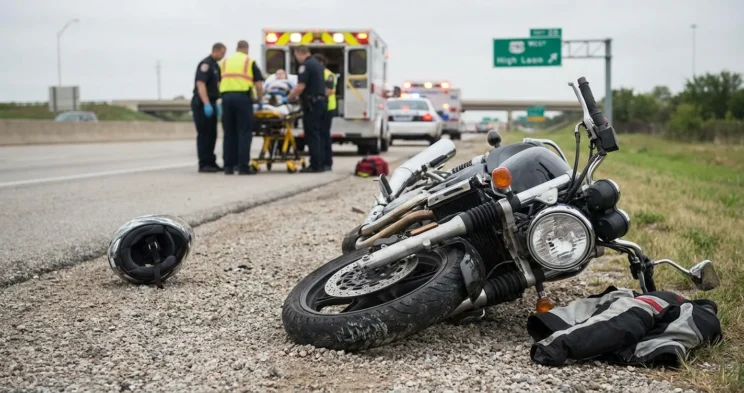
You were heading west on US-290 outside Cypress when your front tire let go without warning. The bike pitched hard, the bars shook, and you were on the pavement before you could process what happened.
Now you’re trying to figure out what caused the accident, who might be responsible, and whether the medical bills from your injuries are costs you have to absorb alone.
Why Tire Blowouts Hit Motorcycles Harder
A tire blowout on a motorcycle is more dangerous than on a car because a four-wheeled vehicle distributes a sudden tire failure across its remaining tires and frame, whereas a bike has no such backup. A front-tire blowout can instantly take away steering and lock the wheel, leaving the rider with no way to control the bike.
Losing a tire can throw a rider into a tank slapper (the front wheel and handlebars start shaking rapidly), a highside ejection (the rear wheel loses traction, then quickly regains it, often causing the rider to be thrown off the machine), or a lowside slide (the bike slides out from under the rider and falls onto its side). Each of these scenarios can launch the rider into traffic, a barrier, or onto the road at full speed.
Because bikers have no protective cabin around them or airbag, their injuries from a blowout crash are far more severe than they would be from a comparable car crash. Traumatic brain injuries, spinal fractures, and deep road rash needing surgical care are common. Our overview of common motorcycle accident injuries tells you what to expect during treatment for these conditions.
Common Causes of Motorcycle Tire Blowouts
Most motorcycle tire blowouts can be traced to one of the following sources: the tire itself, how it was installed, how it was maintained, the road surface, or the load on the bike. Identifying the cause matters because it points to who may be legally responsible.
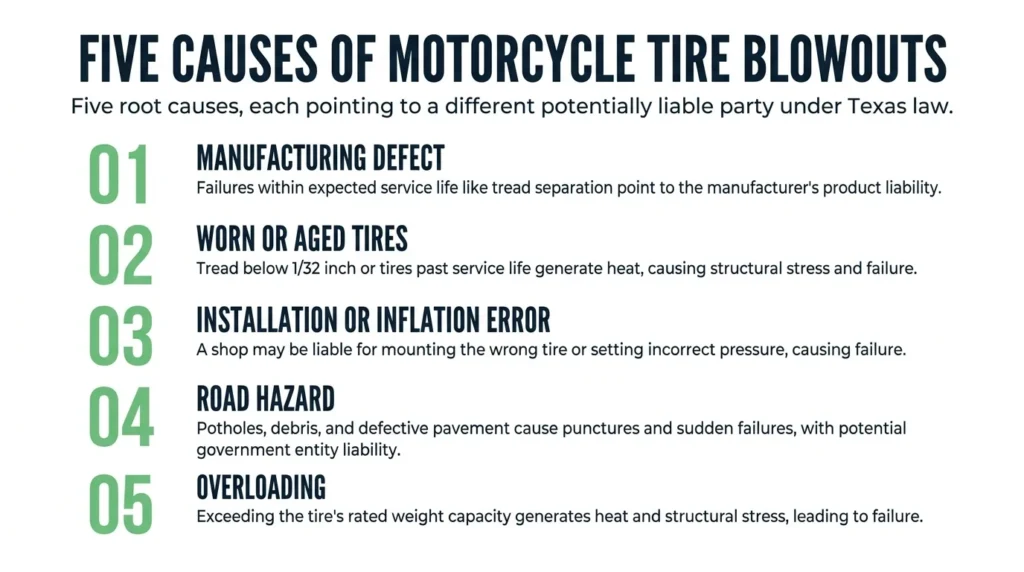
Manufacturing defects are a leading cause of motorcycle wrecks. Tread separation, sidewall failure, and belt delamination (the rubber on the tire separates from the casing and belts of the tire) can make a tire fail during a normal ride. To protect riders, the federal government requires tire manufacturers to meet minimum safety standards, found under 49 CFR § 571.119.
Worn or old tires are another major culprit in crashes. Tread below safe depth (1/32 inch or less), UV cracking on the sidewall, and tires rated for the wrong vehicle class can all rupture under the bike’s load.
Installation and inflation errors by a shop also play a role. Overinflated tires can lead to less traction and control over the bike. Underinflated tires accelerate sidewall fatigue and generate a lot of heat, which can cause a blowout.
Road hazards can destabilize even well-maintained tires. Potholes, exposed rebar, construction debris, and pavement defects across roads cause punctures and sudden failures every year. The National Highway Traffic Safety Administration’s tire safety guidance highlights the maintenance checks that motorcyclists can do regularly to reduce their risk of accidents.
Overloading the bike beyond the tire’s rated capacity is yet another common cause of crashes. Excess weight generates heat and structural stress that the tire was never built to handle.
If any of the above factors were involved in your accident, check our Texas motorcycle accident practice page to learn how we can help you evaluate your damages claim.
Texas Law & Who May Be Liable
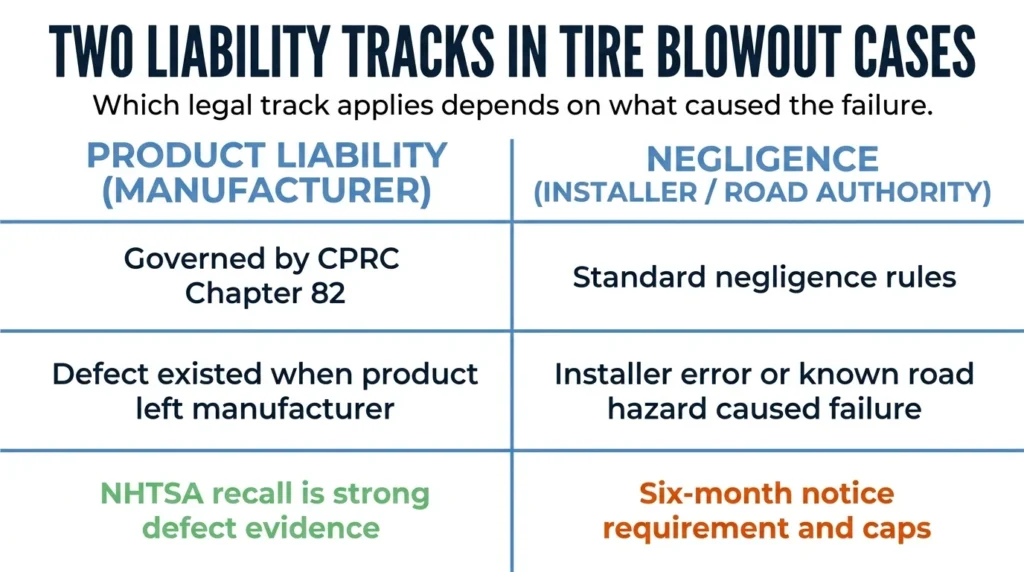
Texas law treats motorcycle blowout claims in two ways:
- Product liability against the tire manufacturer
- Negligence against the tire installer or road authority
The category that your claim fits in depends on what caused your bike tire to fail.
Product Liability Against Tire Manufacturers
When a tire fails because of a manufacturing or design defect, the claim is governed by Texas Civil Practice and Remedies Code (CPRC) Chapter 82. This regulation provides the basis for holding manufacturers, distributors, and sellers responsible for defective products.
To win your case, you must prove that the tire was defective in design, manufacturing, or marketing and that the defect caused your crash and injuries. A tire that fails to meet federal standards is strong evidence of a defect.
Tread separation and sidewall blowouts on tires within their expected service life are among the strongest fact patterns for these claims. Proper maintenance records help rule out competing causes.
Negligence Claims Against Installers & Road Authorities
When the blowout traces to a tire shop’s error or a road hazard, the claim is for negligence. A mechanic who mounts the wrong tire, installs it improperly, or sets the wrong pressure can be held responsible when that error contributes to a failure.
Road authorities such as city public works departments can also be liable for hazards they failed to fix. Claims against government entities have stricter rules, including short notice deadlines under the Texas Tort Claims Act and caps on damages that do not apply to private defendants.
Texas Transportation Code § 547.004 makes it a misdemeanor to operate a vehicle equipped in a manner that is unsafe or that does not comply with the state’s vehicle equipment standards. Whether a tire’s condition violated that general standard is relevant to whether mounting it on a motorcycle was reasonable in the first place.
How Texas Proportionate Responsibility Affects Your Claim
Texas allocates fault among all parties responsible for a crash, and that includes the injured biker. Under Texas Civil Practice and Remedies Code Chapter 33, if you are found more than 50 percent responsible for your accident, you cannot recover damages. Below that threshold, your compensation is reduced by your percentage of fault.
Defense lawyers in blowout cases often try to push fault onto the rider. They will argue that the motorcyclist failed to inspect the tires before the trip, or that they knowingly rode on worn or damaged tires, or that they were speeding at the time of the blowout.
Fault allocation gets complicated in multiparty lawsuits. A jury may have to apportion percentages for the tire manufacturer, the installer, the road authority, and the rider.
You can push back against arguments that you were at fault by having strong evidence, including records of regular maintenance and pre-ride inspections. Photos of the tire before the ride, receipts for recent service, and a clean inspection history all bolster your case.
If you’re worried about how Texas fault rules will affect your case, you may want to review the basics of how lane-splitting rules apply to Texas riders, since similar blame-shifting tactics are used in many motorcycle claims.
Steps to Take After a Motorcycle Blowout Crash
What you do in the days after your wreck will likely determine whether your claim will be successful. The busted tire is your single most important piece of evidence.
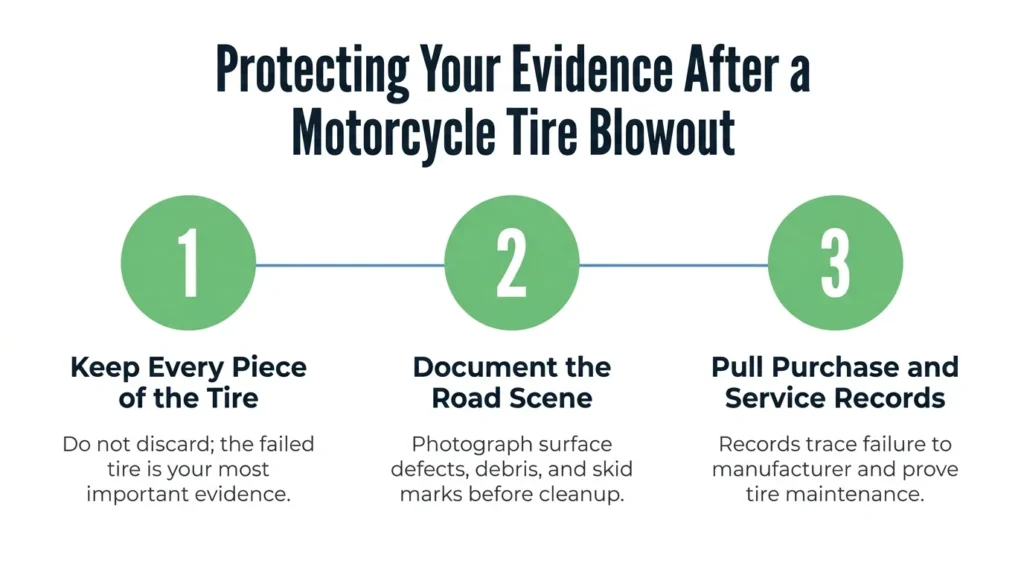
Keep every piece of it that is left. Do not let the tow yard, the body shop, or anyone else throw out the tire.
Document the scene as soon as you can. Photograph the road surface, debris, potholes, and any skid or scrub marks before TxDOT or a city crew cleans up the area.
Pull together your purchase, installation, and service records for the tire, as these can be used to trace the failure back to the manufacturer or installer.
Get medical attention right away even if you feel OK, since adrenaline can mask pain for hours. Equally important, if you have a gap in treatment, the defendant’s attorney or insurer can argue that your injuries were not serious.
Texas gives most injury victims two years from the date of their crash to file suit. This applies for defective product or poor workmanship claims, which many tire blowout related injuries are.
Talk to an Attorney About Your Claim
Angel Reyes & Associates handles motorcycle blowout cases involving defective tires, negligent installers, and unsafe roadways across Texas. With more than 30 years of experience and more than $1 billion recovered for clients, our team knows how to investigate tire failures and identify every responsible party.
We offer free consultations and work on contingency, meaning we receive no fee unless we win your case. Contact us today to discuss your accident and what your claim may be worth.
Past results do not guarantee future outcomes.
Motorcycle Tire Blowout FAQs
Does Texas require motorcycle tires to meet any state-specific inspection standards?
Texas requires motorcycles to pass a state safety inspection that includes checks such as visible tread depth and absence of visible damage. A tire that fails the inspection but was still mounted and ridden on can affect how fault is assigned after a blowout crash.
Can a tire blowout claim involve both a products liability track and a negligence track at the same time?
Yes. If the tire had a manufacturing defect and a shop also set incorrect inflation pressure, both claims can be pursued in the same lawsuit. Texas allows a jury to divide fault among multiple defendants, including a manufacturer and an installer.
What happens to a tire blowout claim if the tire brand has already been recalled by NHTSA?
An active NHTSA recall tied to the tire model strengthens a product liability claim considerably, because it shows that the manufacturer had notice of the defect. If the tire was recalled and the rider or installer had no reasonable way to know, that fact can also work against a fault argument directed at the rider.
Does Texas allow a passenger injured in a motorcycle blowout crash to file a separate claim?
Yes. A passenger injured in a blowout crash can file their own personal injury claim against any liable party, including the tire manufacturer, the installer, or a road authority. The passenger’s claim is evaluated independently, and the rider’s share of fault does not automatically reduce what the passenger can recover.
About the Authors

Spencer Browne
Writer
Spencer Browne is a partner at Angel Reyes & Associates and a Board Certified personal injury trial lawyer with nearly 100 jury trials across Texas. He focuses on car, truck, and wrongful death cases, with notable verdicts including a landmark win in the Choctaw Casino bus crash case. A recognized speaker and legal educator, Spencer is a member of the American Board of Trial Advocates and has been honored as a Texas Super Lawyer and one of D Magazine’s Best Lawyers in Dallas. He brings deep trial experience and relentless advocacy to every client he represents.

Kyle Nicolas
Editor
Kyle Nicolas is the Web Content & SEO Manager at Angel Reyes & Associates. He has more than 10 years of experience as a marketing co...

Angel Reyes
Reviewer
Angel L. Reyes, III is the Founder and Managing Partner of Angel Reyes & Associates. A nationally recognized trial attorney and business...