Internal Injuries from a Motorcycle Accident


Every article on this site is researched by our internal team, reviewed for legal accuracy against current Texas law, and held to State Bar of Texas advertising standards before publication. We do not publish content that overstates outcomes or makes promises about results.
Learn more about our
editorial standards .
Key Takeaways
- Internal injuries like splenic rupture can show no symptoms for hours after a motorcycle crash.
- CT imaging is the reliable standard for ruling out internal injury after a crash; FAST misses many.
- A confirmed internal injury diagnosis provides objective evidence that strengthens your claim value.
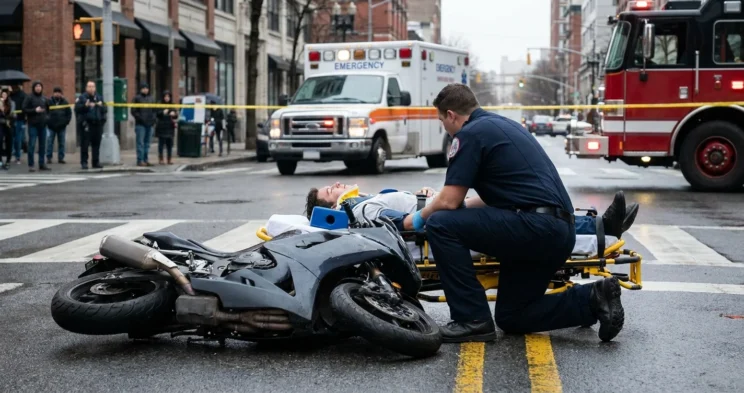
You hit the pavement on I-35 near Round Rock. The other driver stopped. Someone called 911. When paramedics arrived, you felt shaken, but okay, so you declined the ambulance and went home.
Several hours later, your abdomen feels tight, your left shoulder aches, or you feel dizzy when you stand up. You may have an internal injury, even if you felt fine at the scene.
Why Internal Injuries Are Invisible at First
Internal injuries are often difficult to detect immediately after a motorcycle accident because the damage happens inside the body. Unlike a broken bone, deep cut, or road rash injury, there may be no obvious signs at the crash scene.
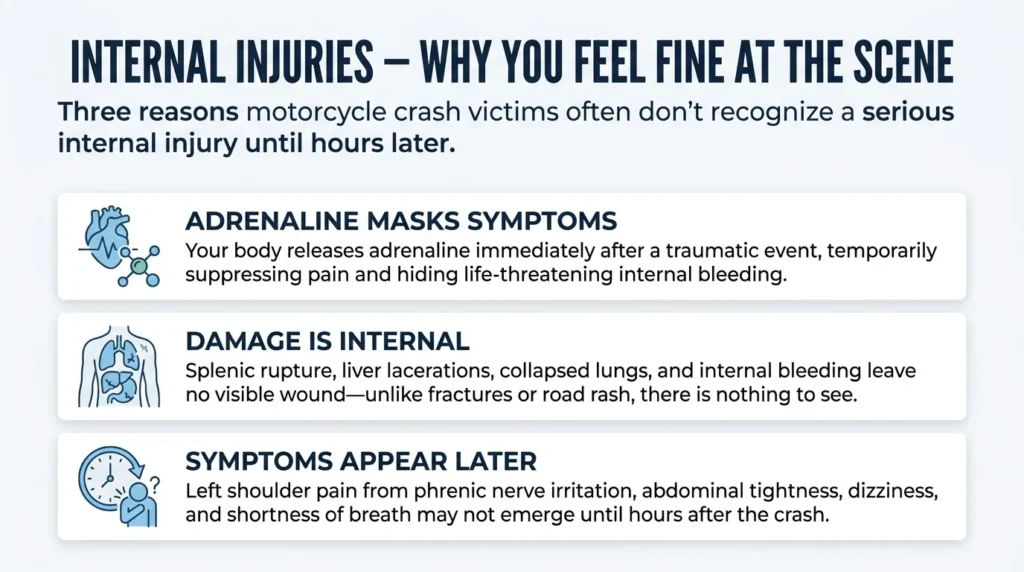
Adrenaline makes the problem worse. Your body releases it immediately after a traumatic event, and it can temporarily mask pain and other symptoms. Riders have walked away from crashes that caused life-threatening internal organ damage and felt nothing for hours. By the time the adrenaline clears, internal bleeding may already be progressing.
That delay can be dangerous. Internal bleeding, splenic rupture, liver injuries, and collapsed lungs may continue to worsen even when a rider feels relatively normal. By the time symptoms become obvious, the injury may already require emergency treatment. If you are experiencing abdominal pain, dizziness, weakness, or shortness of breath, seek emergency medical care immediately.
Internal injuries are just one category of harm riders can suffer. Many of the same crash forces that cause internal bleeding can also lead to common injuries in motorcycle accidents, including fractures, head injuries, and road rash.
Why Refusing Emergency Transport Is Dangerous
Many riders decline an ambulance at the scene, but it’s one of the most dangerous decisions a motorcycle accident victim can make.
Paramedics do more than drive you to the hospital. They assess patients for signs of serious injuries that may not be obvious at the scene. Paramedics also identify situations where additional testing or emergency imaging may be needed.
There can also be consequences for your injury claim. Insurance companies often look closely at gaps in treatment and may argue that the crash did not cause your injuries or that they were not serious enough to require immediate medical care. Early medical records help document both the existence of an injury and the timeline of your symptoms.
Imaging Required to Rule Out Internal Injury
A physical exam alone cannot rule out an internal injury after a motorcycle accident. If you suffered blunt force trauma to your chest or abdomen, doctors may need imaging to determine whether internal bleeding or organ damage is present.
Emergency rooms routinely use the FAST exam, a focused ultrasound scan that detects free fluid in the abdomen. It can be performed quickly in the emergency room and helps doctors identify certain injuries. However, a negative FAST exam does not always rule out internal damage.
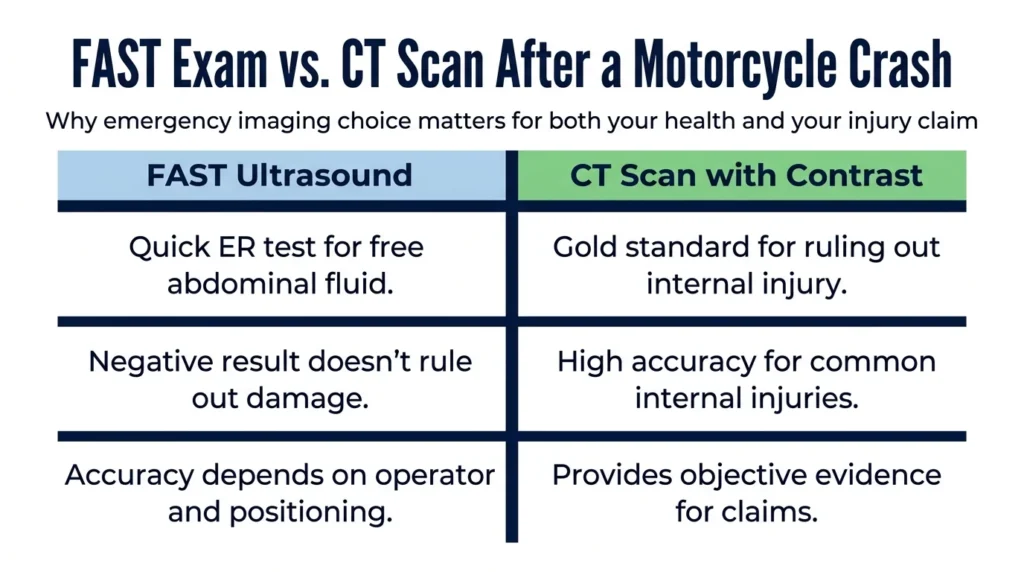
The standard for ruling out internal injury after significant blunt trauma is a CT scan with contrast, which achieves approximately 95% accuracy for detecting splenic laceration, liver injury, internal bleeding, and pneumothorax.
Imaging can also play an important role in your motorcycle accident case. A CT scan or other diagnostic test provides objective medical evidence of an injury. Medical imaging often carries far more weight than a patient’s description of symptoms alone.
How a Confirmed Diagnosis Increases Claim Value
A confirmed diagnosis can make a big difference in a motorcycle accident settlement. Why? Insurance companies often distinguish between reported symptoms and documented medical findings.
A medical report documenting internal bleeding, a splenic injury, a liver injury, or a collapsed lung is objective evidence. The insurer cannot dismiss it as subjective or pre-existing without directly contradicting the imaging record. That documentation anchors your economic damages to specific findings that require specific treatment.
Treatment can also affect the value of your claim. Hospitalization, surgery, follow-up imaging, physical therapy, and ongoing medical care help document the severity of an injury and its impact on your life. Injuries that require extensive treatment and recovery tend to result in higher damages.
Steps to Take After Discovering a Delayed Internal Injury
If you are reading this because your symptoms appeared after the crash, the first step is the same regardless of how much time has passed. Get emergency care.
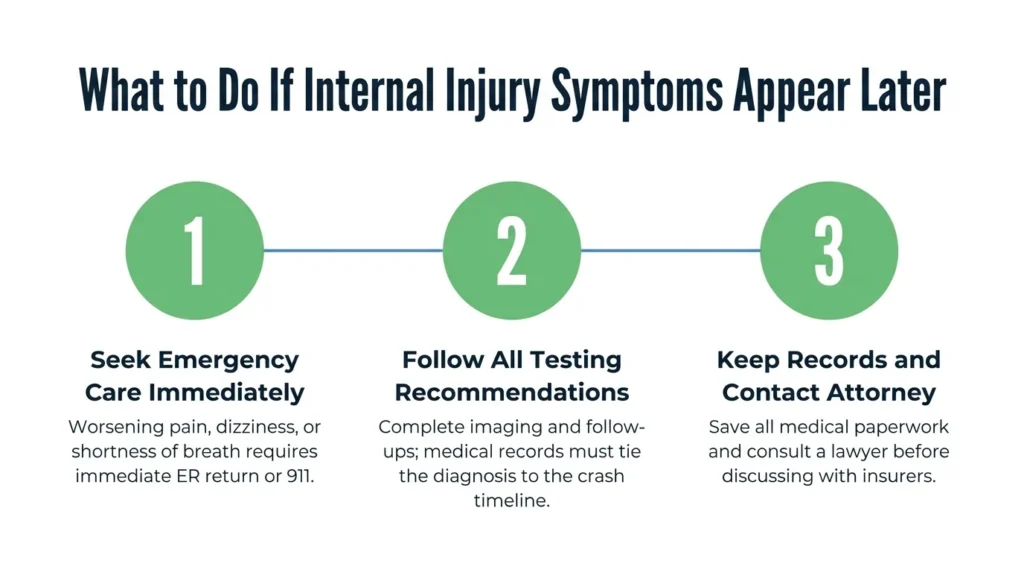
If you are experiencing worsening abdominal pain, a rigid or swollen abdomen, unexplained dizziness, shortness of breath, or pain that radiates into your shoulder, return to the emergency room or call 911. These symptoms may indicate internal bleeding or another serious injury that requires immediate evaluation.
Follow all recommended testing and treatment. If your symptoms persist or worsen, ask your doctor whether additional imaging is needed. A delayed diagnosis does not make an injury less serious.
Keep copies of your medical records, imaging reports, discharge paperwork, and follow-up treatment records. These documents help establish when symptoms appeared, what injuries were diagnosed, and what treatment was required.
Finally, don’t speak to an insurance adjuster about your updated diagnosis before talking to an attorney. There are specific legal strategies for protecting your claim after a motorcycle crash.
Get Legal Help for Your Internal Injury Claim
If you discovered an internal injury hours or days after a motorcycle accident, you may be wondering how that delay affects your health, your recovery, and your injury claim. While delayed symptoms are common with internal injuries, insurance companies often use treatment gaps to question what happened and why.
Angel Reyes & Associates has spent over 30 years helping injured Texans recover compensation for serious injuries, including internal injuries that insurers challenge on causation and severity. We work on a contingency basis, meaning you pay no fee unless we win. We offer free consultations and can handle most, if not all, of your case remotely from anywhere in Texas.
Contact us through our free consultation request to review your situation. Every case is different, and the right next step depends on the specifics of your crash, your diagnosis, and your timeline.
Past results do not guarantee future outcomes.
Motorcycle Accident Internal Injury FAQs
What does referred left shoulder pain after a motorcycle crash mean?
Left shoulder pain that appears after a crash, without a direct shoulder injury, can be a sign of splenic bleeding. Blood pooling under the diaphragm irritates the phrenic nerve, which shares nerve roots with the shoulder, causing pain in a location that seems unrelated to the impact.
Can internal bleeding kill you even if you feel okay after a crash?
Yes. Internal bleeding can be present for hours before symptoms become severe, and without treatment, blood loss can lead to hemorrhagic shock. The absence of immediate pain does not rule out life-threatening bleeding from a ruptured spleen, liver laceration, or torn blood vessel.
How does an insurer try to minimize an internal injury claim?
Insurers often challenge the connection between the crash and the injury, arguing that delayed symptoms show the injury was pre-existing or unrelated. They may also dispute the necessity of surgical treatment or follow-up imaging. A complete medical record starting at the earliest possible point after the crash is the strongest tool against these arguments.
Can internal injuries appear days after a motorcycle accident?
Yes. Some internal injuries do not cause immediate symptoms. While some riders notice symptoms within hours of a crash, others may not experience abdominal pain, dizziness, weakness, or shortness of breath until days later.
How long do I have to file a motorcycle accident lawsuit in Texas?
In most cases, Texas Civil Practice and Remedies Code (CPRC) § 16.003 gives injured riders two years from the date of the accident to file a personal injury lawsuit. Because exceptions may apply in certain situations, it is best to speak with an attorney as soon as possible.
About the Authors

Angel Reyes
Writer
Angel L. Reyes, III is the Founder and Managing Partner of Angel Reyes & Associates. A nationally recognized trial attorney and business leader, Angel has helped over 55,000 injury victims recover more than $1 billion since founding the firm in 1993. Named to the Texas Super Lawyers list annually since 2008, Angel brings Wall Street experience, Ivy League education, and a deep commitment to client advocacy. He is a frequent legal commentator and published author with extensive contributions to legal scholarship, trial strategy, and consumer protection.

Kyle Nicolas
Editor
Kyle Nicolas is the Web Content & SEO Manager at Angel Reyes & Associates. He has more than 10 years of experience as a marketing co...

Angel Reyes
Reviewer
Angel L. Reyes, III is the Founder and Managing Partner of Angel Reyes & Associates. A nationally recognized trial attorney and business...