What Is a Letter of Protection After a Motorcycle Accident?


Every article on this site is researched by our internal team, reviewed for legal accuracy against current Texas law, and held to State Bar of Texas advertising standards before publication. We do not publish content that overstates outcomes or makes promises about results.
Learn more about our
editorial standards .
Key Takeaways
- A letter of protection defers medical bills but does not erase them; you still owe if there is no recovery.
- Texas hospital liens are capped at 50% of your total recovery under state property law.
- Reducing your medical lien at settlement produces the same net benefit as raising your gross payout.

You crashed on the I-35 corridor outside San Antonio, and the ER patched you up. Now your orthopedic surgeon wants $4,000 upfront before scheduling the surgery your back needs. You don’t have health insurance, and the at-fault driver’s insurer isn’t making any payments yet. You have a valid personal injury claim, but treatment is sitting behind a paywall.
A Letter of Protection is how injured riders in your situation get care now and pay later.
What a Letter of Protection Does for Injured Riders
A Letter of Protection (LOP) is a legally binding contract sent by your personal injury attorney to your medical providers. It allows you to get the healthcare you need right away, even if you do not have health insurance or cash to pay out of pocket.
How an LOP Works
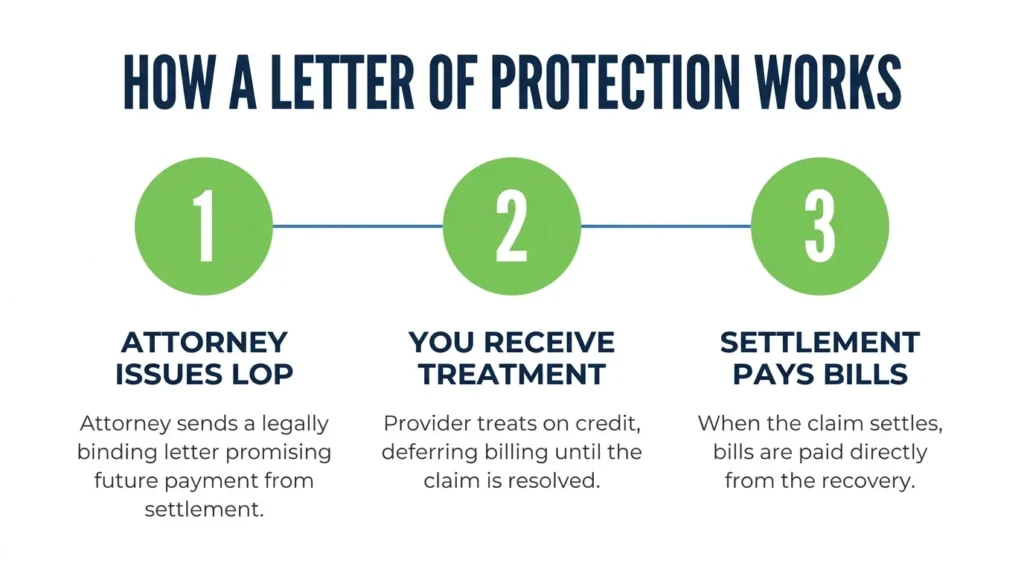
Instead of demanding payment up front, the doctor or hospital agrees to treat you on credit. In exchange, your attorney promises to pay the medical bills directly out of your eventual insurance settlement or court judgment before any money is distributed to you.
How Attorneys Determine If an LOP Is a Good Option
Because an LOP is a promise of future payment, your attorney will carefully evaluate your case before issuing one. If the fault for the motorcycle accident is unclear, or if the available insurance policy limits are too small to cover your medical costs, an attorney may decline to offer an LOP.
Crucial Safeguards & Risks
While an LOP is an excellent tool for securing medical care, riders must understand two critical rules before signing.
These include:
- Active Case Protection: While your injury claim is ongoing, the LOP acts as a financial shield. The medical provider cannot send your bills to collections, call you for money, or damage your credit score.
- The Ultimate Liability: An LOP does not erase your debt; it only delays it. If your case is unsuccessful and you recover zero money from the insurance company, you remain personally responsible for paying the medical provider the full billed amount.
Evaluating whether your motorcycle accident claim supports an LOP arrangement is a top priority. A personal injury attorney can review the available insurance policies during your initial consultation to ensure you do not commit to treatments you cannot afford.
How Medical Liens Attach to Your Settlement
While an LOP is a contract, Texas law gives hospitals an automatic, separate right to take their cut directly from your settlement using a legal tool called a medical lien. Under Texas Property Code § 55.002, the lien attaches directly to your personal injury claim. This means the hospital is legally entitled to take its payment straight out of any money you recover from the at-fault driver.
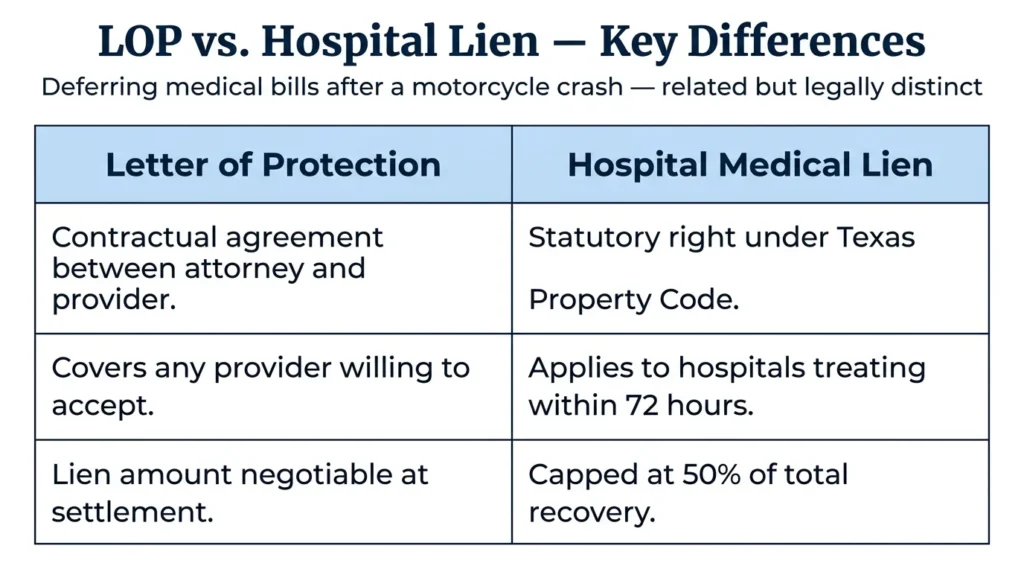
For the statutory lien to be valid, the provider must have admitted and treated the patient within 72 hours of the accident. The provider must also file a written notice of the lien with the county clerk before funds are distributed. The lien does not attach to the rider’s real property, wages, or personal accounts. It attaches to the third-party recovery only.
Two statutory limits protect riders from losing their entire settlement to the medical provider. First, a hospital’s lien cannot exceed 50% of the rider’s total recovery from the claim. Second, the lien applies only to charges incurred during the first 100 days of hospitalization.
How Lien Amounts Affect Net Recovery
Net recovery equals the gross settlement minus attorney fees and any lien balances owed to medical providers.
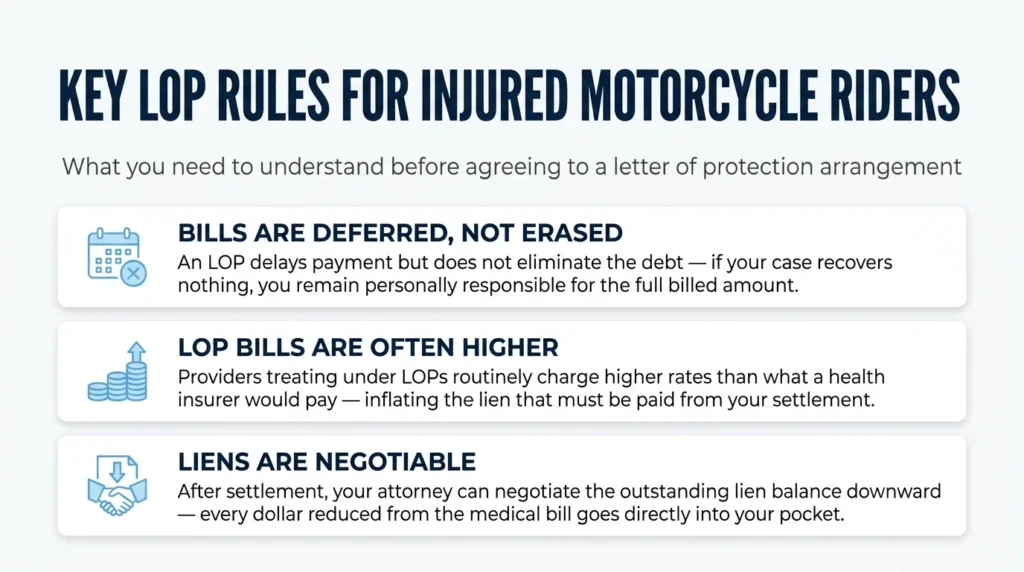
Providers who treat under LOPs routinely charge higher rates than the amounts a health insurer would have paid for the same services. This is legal, and it is common. The result is that your LOP medical bill may be significantly larger than what a typical insurance reimbursement would have been. That inflated balance sits as a lien against your settlement.
Before accepting any settlement offer, ask your attorney for a projected lien payoff statement. The gross number means little if liens consume most of what remains after fees.
Negotiating Medical Liens at Settlement
Medical liens are not fixed. After your settlement is reached, your attorney can negotiate directly with providers to reduce the outstanding lien balance before any funds are distributed.
Providers frequently accept less than the full billed amount. From the provider’s perspective, receiving a confirmed reduced payment is more reliable than pursuing a collection action against a rider with limited assets.
Additionally, Texas law requires medical providers to share the burden of your legal expenses. Because your attorney spent time and money to secure the settlement, the hospital or doctor must deduct a fair share of those attorney fees and court costs from their medical bills.
Every dollar your attorney negotiates off your hospital bill is a dollar that goes straight into your pocket. Because of this, maximizing your payout requires a two-front battle: negotiating the highest possible settlement from the at-fault driver’s insurance, and aggressively fighting down the medical bills on the back end.
Speak with a Texas Injury Attorney Today
If you were recently injured in a motorcycle accident and do not have the health insurance to get the care you need, Angel Reyes & Associates is available 24/7/365 to discuss your case. Our attorneys have helped injured Texans work through motorcycle accidents, wrongful death cases, car accidents, and other personal injury cases for over 30 years.
We work on a contingency fee basis, which means you pay nothing unless we win. Contact us today to talk through your case, explore your treatment options, and learn what a letter of protection could mean for your specific situation.
Letter of Protection FAQs
What happens if my motorcycle accident case settles for less than my LOP medical bills?
If the settlement does not cover your full lien balance, your attorney will typically negotiate with the provider to accept the available amount in full satisfaction of the debt. Providers usually prefer a reduced payment over no payment, so a negotiated reduction is often possible even when the total recovery is tight.
Can I use my health insurance instead of a letter of protection after a motorcycle crash?
Yes, health insurance can cover accident-related treatment in Texas, and using it often results in lower billed rates than LOP providers charge. Your health insurer may seek reimbursement from your settlement later, but those subrogation claims are also negotiable and are typically lower than raw LOP lien balances.
Is a letter of protection the same thing as a medical lien?
They are related but not identical. An LOP is the contractual agreement your attorney makes with the provider to defer payment until settlement. A medical lien is the legal claim the provider has against your recovery, which can arise from the LOP contract, from Texas Property Code Chapter 55, or both simultaneously.
Does a hospital have to treat me in an emergency even if I have no insurance?
Under the federal Emergency Medical Treatment and Labor Act (EMTALA), hospitals that participate in Medicare must screen and stabilize patients with emergency medical conditions regardless of insurance status or ability to pay. EMTALA covers emergency stabilization only; any follow-ups and specialist care outside the emergency department are not required under that law.
How long does lien resolution take after a motorcycle accident settlement?
Private provider liens, including most LOP lien balances, can often be resolved in a few weeks once a settlement amount is confirmed. Government liens, such as Medicare or Medicaid, involve a separate federal process and can take several months to fully resolve.
About the Authors

Angel Reyes
Writer
Angel L. Reyes, III is the Founder and Managing Partner of Angel Reyes & Associates. A nationally recognized trial attorney and business leader, Angel has helped over 70,000 injury victims recover more than $1 billion since founding the firm in 1993. Named to the Texas Super Lawyers list annually since 2008, Angel brings Wall Street experience, Ivy League education, and a deep commitment to client advocacy. He is a frequent legal commentator and published author with extensive contributions to legal scholarship, trial strategy, and consumer protection.

Kyle Nicolas
Editor
Kyle Nicolas is the Web Content & SEO Manager at Angel Reyes & Associates. He has more than 10 years of experience as a marketing co...

Angel Reyes
Reviewer
Angel L. Reyes, III is the Founder and Managing Partner of Angel Reyes & Associates. A nationally recognized trial attorney and business...